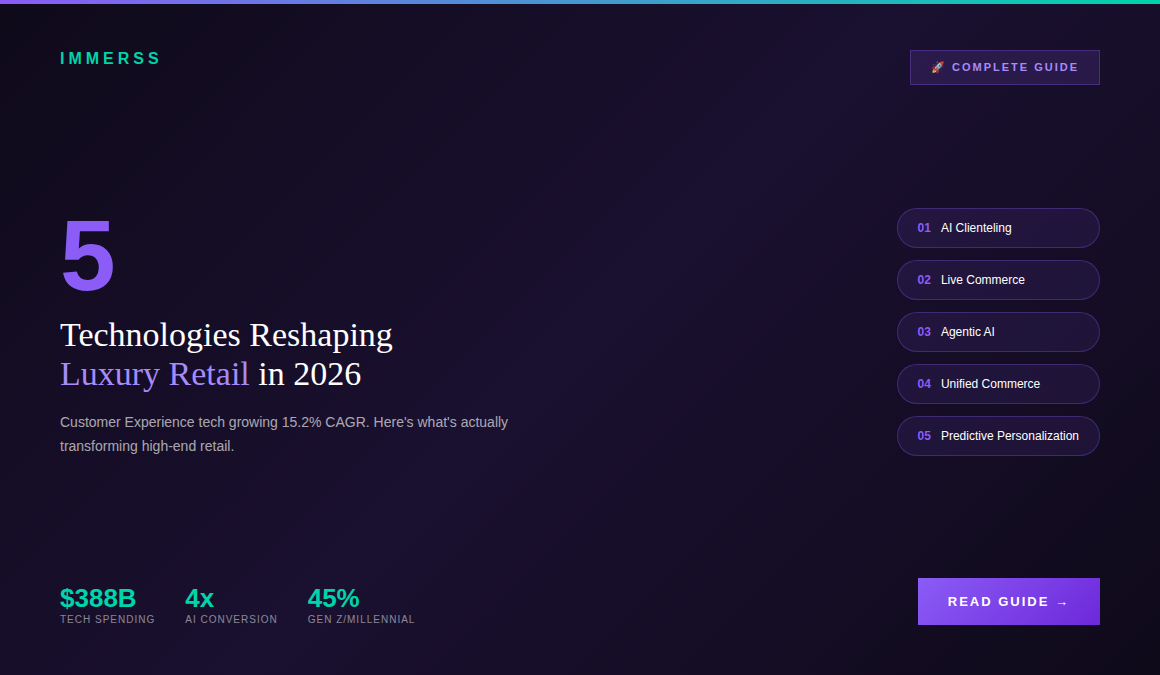

5 Technologies Reshaping Luxury Retail in 2026: The Complete Guide
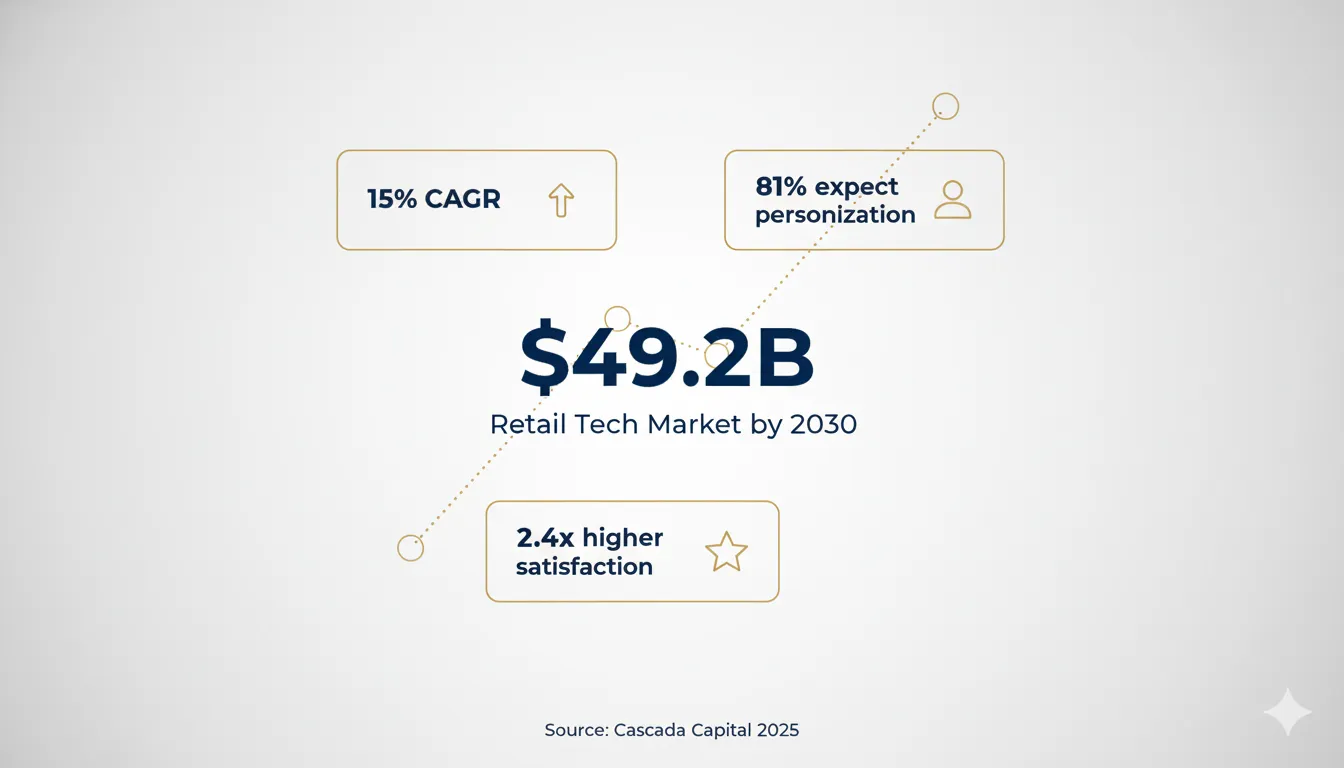
Customer Experience tech growing 15.2% CAGR. From AI-powered clienteling to live commerce that puts a person back in front of the customer — here’s what’s actually transforming high-end retail.
Executive Summary
The luxury retail landscape is undergoing its most significant transformation in decades. With global retail technology spending expected to reach $388 billion by 2026 and AI investments growing at 25% annually, luxury brands can no longer afford to resist digital transformation. This guide examines the five technologies that are genuinely reshaping how luxury brands serve discerning customers — without sacrificing the exclusivity and personal service that defines high-end retail.
Key insight: Technology alone isn’t enough. The winning formula is AI for efficiency, human expertise for conversion.
The Transformation Imperative
For years, luxury brands prioritized exclusivity over technological innovation. That resistance has ended.
The Market Reality in 2026:
Spending shift: Millennials and Gen Z are projected to account for roughly 45% of the luxury retail market. These digital natives demand different experiences.
Channel evolution: Nearly 3 in 4 shoppers routinely move across online and offline channels during their purchase journey.
Social commerce maturity: The number of U.S. social shoppers reached over 104 million in 2025. TikTok alone projects ~40 million U.S. buyers in 2026.
Technology investment: According to Gartner, worldwide retail technology spending reaches $388 billion by 2026, with AI-related investments growing at nearly 25% annually.
CX priority: The Customer Experience Enhancement sector is growing at 15.2% CAGR, outpacing nearly every other segment of retail tech.
The message is clear: luxury consumers expect personalization, convenience, and seamless experiences — without sacrificing the premium service that defines high-end shopping.
Technology 1: AI-Powered Clienteling Platforms
The Challenge
Luxury brands built their reputation on personalized, one-on-one service. A knowledgeable associate who remembers your preferences, anticipates your needs, and guides you to the perfect purchase.
But scaling that experience across locations, channels, and customer touchpoints has always been difficult. Siloed systems mean associates in one store can’t see what happened in another. Online purchases don’t inform in-store conversations. VIP clients get inconsistent service depending on who they encounter.
The 2026 Solution
AI-powered clienteling platforms give sales associates instant access to comprehensive customer profiles, purchase history, preferences, and predictive recommendations — all in real-time.
How it works:
In 2026, sales associates are armed with data like never before. Many retailers equip staff with clienteling apps or AI “copilots” on tablets or smart glasses, which can pull up a shopper’s past purchases, preferences, and even suggest items to upsell.
When a VIP client walks into a store:
- The associate receives an alert on their device
- They see the customer’s entire purchase history across all channels
- AI suggests products based on past preferences and current inventory
- They can check stock across all locations instantly
- They can reserve items, arrange alterations, or schedule follow-ups — all without leaving the floor
Real-world implementation:
Diane von Furstenberg made the switch after realizing the gap in their customer data. As their assistant store manager noted: “We weren’t able to deliver a personalized clienteling experience or access customer insights as easily as we wanted to. We couldn’t see our clients’ online and store purchase history in the same place.”
Why It Matters for Luxury
Just over 0.1% of the total luxury customer base accounts for 23% of all purchases.
Missing one VIP interaction because your systems are siloed is catastrophically expensive. When your top 0.1% drives nearly a quarter of revenue, every associate needs to deliver exceptional service to every high-value customer, regardless of prior relationship.
Clienteling platforms don’t replace human relationships — they amplify them. The best sales associates were always great at remembering preferences and anticipating needs. Now, every associate can provide that level of service.
Implementation Approach
Phase 1: Unify customer data across channels (online, in-store, CRM) Phase 2: Deploy clienteling tools to associates with training Phase 3: Enable AI recommendations and proactive alerts Phase 4: Iterate based on associate feedback and customer response
Technology 2: Live Commerce
The Challenge
High-end products require touch, feel, and expert guidance. Standard ecommerce has always felt inadequate for luxury goods — static images can’t convey craftsmanship, and checkout pages lack the romance of an in-store experience.
The data tells the story:
Luxury e-commerce conversion rates: 0.9-1% — the lowest of any category In-store luxury conversion: 20-40% — the highest when expert guidance is present
The gap isn’t the product. It’s the experience.
The 2026 Solution
Live shopping events combine video content, real-time interaction, and seamless checkout into a single, immersive experience.
The numbers:
Live commerce is accelerating globally, with livestream sales growing at over 30% CAGR. What makes it work for luxury is not the format but what the format restores: a shopper who can ask about the clasp, the weight, the way the piece sits on a wrist, and get the answer from someone holding it.
Social platforms have become primary shopping destinations:
- U.S. social shoppers increased from 96 million (2023) to 104+ million (2025)
- TikTok projects ~40 million U.S. buyers in 2026
- 43% of Gen Z consumers begin product searches on TikTok or social platforms rather than Google or Amazon
Why Live Commerce Works for Luxury
Unlike mass-market live shopping (think QVC), luxury live commerce emphasizes:
Storytelling — Highlighting craftsmanship, heritage, and design philosophy Exclusivity — Limited-time access, VIP-only events, invitation-based streams Curation — Fewer products, more depth and context Expertise — Designers, artisans, or brand ambassadors presenting with authority
Implementation Approach
Live commerce works when it feels like an event, not a transaction. Winning brands treat live shopping like a product launch, fashion show, or trunk show — not a sales pitch.
Key elements:
- Expert hosts who can answer complex questions
- Behind-the-scenes access that creates exclusivity
- Limited-time offers that drive urgency
- Seamless checkout that doesn’t break the experience
- Replay capability for extended engagement
Technology 3: Agentic AI (Beyond Chatbots)
The Challenge
Traditional chatbots answered questions. They couldn’t sell. They couldn’t guide complex purchase decisions. They couldn’t build relationships.
For luxury, where purchase decisions involve education, consideration, and emotional investment, basic chatbots were worse than nothing — they damaged the brand experience.
The 2026 Solution
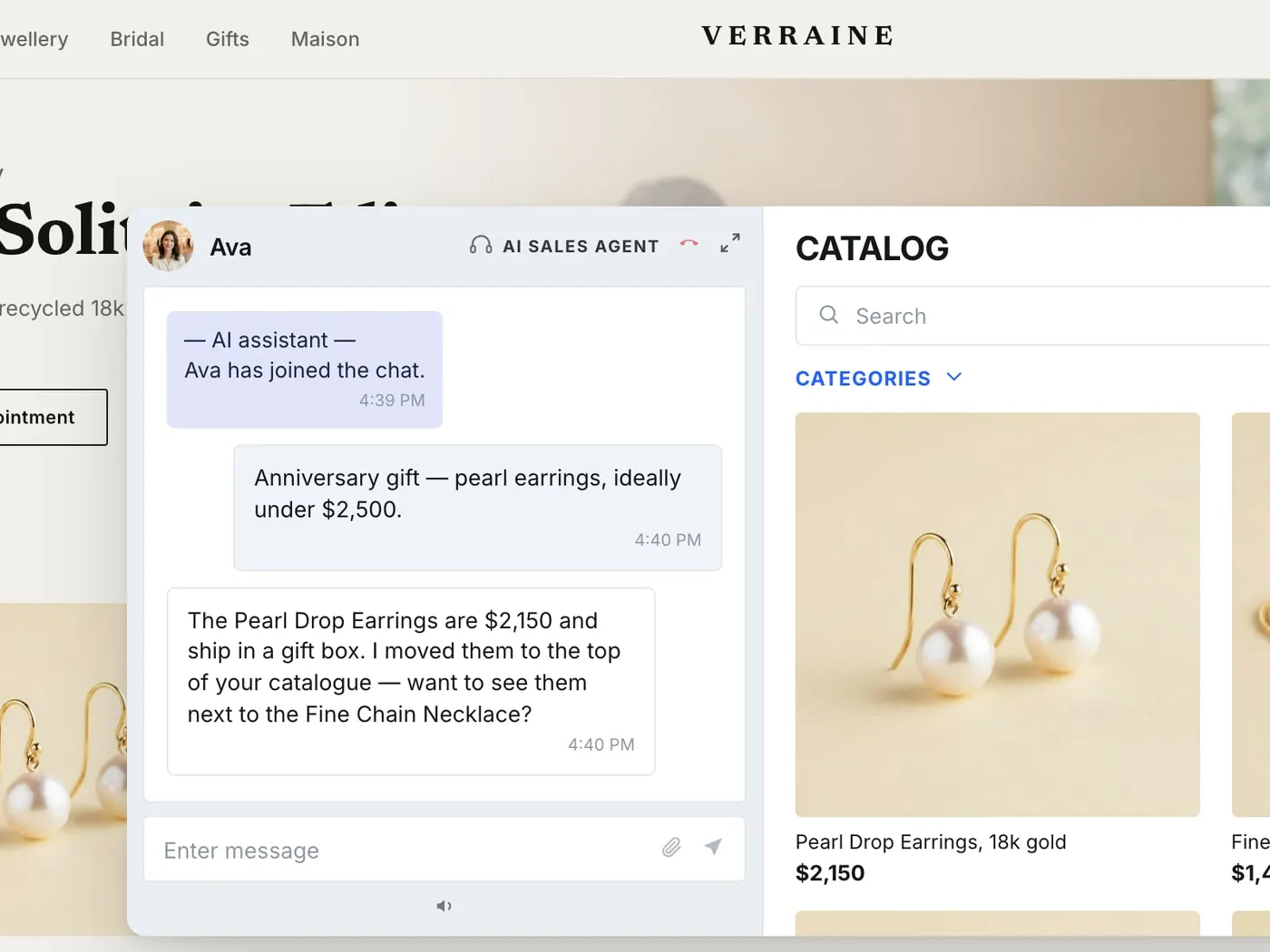
2026 marks the rise of “agentic commerce” — autonomous, learning-based AI agents that guide users, answer product questions, and deliver highly personalized recommendations across all stages of the customer journey.
What’s different:
Instead of just reacting to user prompts, these new AI-powered assistants are the new digital front-line workers. They can:
- Predict intent — Anticipate what a customer needs based on behavioral signals, not just explicit requests
- Personalize deeply — Pull from CDP data, purchase history, and real-time context
- Guide through complexity — Handle high-consideration purchases that require education
- Build confidence — Address objections and concerns in real-time
- Operate 24/7 — Capture off-hours traffic that represents 30-40% of visitor volume
NRF 2026 highlighted agentic commerce as one of the three defining AI trends: AI systems making real-time decisions across retail operations — from sourcing and pricing to customer service.
The Results
AI-engaged visitors show dramatically higher conversion than standard ecommerce.
For luxury’s 0.9% baseline, this means AI-engaged visitors can convert at a dramatically higher rate — transformational impact from the same traffic.
Additional benefits:
- Meaningfully larger orders with effective AI deployment
- Recovery of a meaningful share of abandoned carts with proactive AI intervention
- 24/7 coverage without staffing costs
The Distinction: Sales Agents vs. Support Bots
The critical distinction is intent:
Support bots: Built to deflect tickets and reduce costs AI Sales Agents: Built to guide decisions and close sales
Support bots end conversations with links to FAQ pages. AI Sales Agents guide customers through the decision process, address objections, and build confidence toward purchase.
For luxury, this distinction is everything. Your AI should feel like a knowledgeable associate, not a support ticket system.
Technology 4: Unified Commerce
The Challenge
Luxury customers expect products to be available when and where they want them. But managing inventory, customer data, and experiences across channels has traditionally been siloed.
The ecommerce systems work. The POS systems work. The CRM works. But collectively, siloed solutions create drag on the entire operation. Gaps cause delays in data transfer, leading to missed opportunities.
The 2026 Standard
Technology trends now favor unified commerce over omnichannel strategies.
The difference is crucial:
Omnichannel: Multiple channels that work together Unified Commerce: A single platform where all channels share real-time data
By combining channels into a single platform, unified commerce enables real-time synchronization with data from every customer interaction.
What this enables:
- Customer buys online → Associate sees it before next store visit
- Customer browses in-store → Online recommendations reflect that visit
- VIP status triggers consistent treatment across all touchpoints
- Inventory visibility across all locations in real-time
- Seamless BOPIS, ship-from-store, and returns
Why It Matters for Luxury
88% of shoppers expect consistent experiences across online, mobile, and in-store.
For luxury, inconsistency is brand damage. When a customer spends $15,000 online and the in-store associate doesn’t know, that’s not just a missed upsell opportunity — it’s a service failure that damages the relationship.
Brands whose systems share one view of the customer keep that customer longer — nobody has to be told twice who they are, what they own, or what they already asked for.
The Architecture
Modern unified commerce relies on:
MACH architecture: Microservices, API-first software, cloud-native, and headless commerce Composable commerce: Best-in-class specialized vendors rather than monolithic systems Centralized data: Single source of truth for inventory, pricing, and customer data Real-time sync: Changes propagate across all touchpoints instantly
Technology 5: Predictive Personalization
The Challenge
Traditional marketing relies on segmentation — grouping customers into categories (age, income, location) and treating everyone in that segment the same way.
But luxury shoppers don’t want to be treated like a segment. They want to be treated like individuals.
“Women 25-45 with high income” is not personalization. It’s demographic targeting.
The 2026 Solution
AI-driven personalization engines analyze individual behavior, preferences, and context to deliver unique experiences to every customer — in real-time.
The evolution:
Reactive personalization is being replaced by predictive intent engines. Instead of waiting for a customer to browse, AI anticipates the customer’s next wants based on contextual data like weather, life events, and even local cultural moments.
How it works across touchpoints:
- Product recommendations — Based on individual style, not just “what’s popular”
- Content personalization — Editorial content tailored to demonstrated interests
- Communication timing — Messages sent at optimal moments for each individual
- Dynamic offers — VIP-exclusive pricing or early access for loyal customers
- Experience customization — In-store displays, email content, and app interfaces all tailored
The Results
81% of consumers prefer companies that provide personalized experiences.
Retailers using AI-driven personalization see 10-15% increases in revenue.
Nearly half of luxury shoppers aged 18-34 use social platforms to research high-end purchases, making personalized engagement across channels critical.
The Balance
Personalization at scale requires both technology and taste.
The best luxury brands use AI to power recommendations, but maintain human curation to ensure every suggestion aligns with brand aesthetic. The AI surfaces options; the brand voice and visual identity remain distinctly human.
Bringing It All Together
These five technologies aren’t isolated tools — they’re interconnected pieces of a larger transformation.
The integration pattern:
- Unified commerce provides the data foundation
- AI clienteling empowers associates with that data
- Agentic AI extends consultation to digital channels 24/7
- Predictive personalization tailors every interaction
- Live commerce creates engagement moments that convert
The NRF 2026 Formula
The industry’s largest retail event highlighted a clear pattern:
AI for efficiency, human expertise for conversion.
Physical stores offer sensory experiences, human expertise, and trust-building interactions that AI alone cannot replicate. NRF 2026 emphasized the resurgence of physical stores as trust-building hubs alongside AI advancement.
The retailers who win aren’t the ones with the flashiest tech. They’re the ones using it thoughtfully — balancing automation with humanity.
Implementation Priorities for 2026
For brands just starting:
- Audit your data silos — Where is customer information fragmented?
- Pilot AI clienteling — Start with your highest-performing location
- Test live commerce — One exclusive event to learn the format
- Measure and iterate — Conversion, AOV, and customer satisfaction
For brands already investing:
- Move from omnichannel to unified — Eliminate the gaps between systems
- Upgrade from chatbots to AI Sales Agents — Intent to sell, not deflect
- Scale live commerce — From experiment to regular programming
- Deepen personalization — From segments to individuals
The Timeline Reality
97% of retailers plan to increase AI spending. The window for competitive advantage is narrowing.
Brands that implement thoughtfully in 2026 will build the foundation for the next decade. Those that wait will find themselves catching up to customer expectations that have already moved on.
The Immerss Approach
At Immerss, we specialize in helping luxury brands create live shopping experiences that maintain exclusivity, elevate storytelling, and drive meaningful engagement.
Our AI Sales Agents combine the technologies discussed here:
- Deep product knowledge trained on your full catalog
- Brand voice customization that sounds like your best associate
- 24/7 availability for high-intent off-hours traffic
- Seamless handoff to human experts when needed
- Integration with your existing commerce infrastructure
The goal is simple: bring the consultation experience online — the same guidance, expertise, and personal attention that drives in-store conversion.