
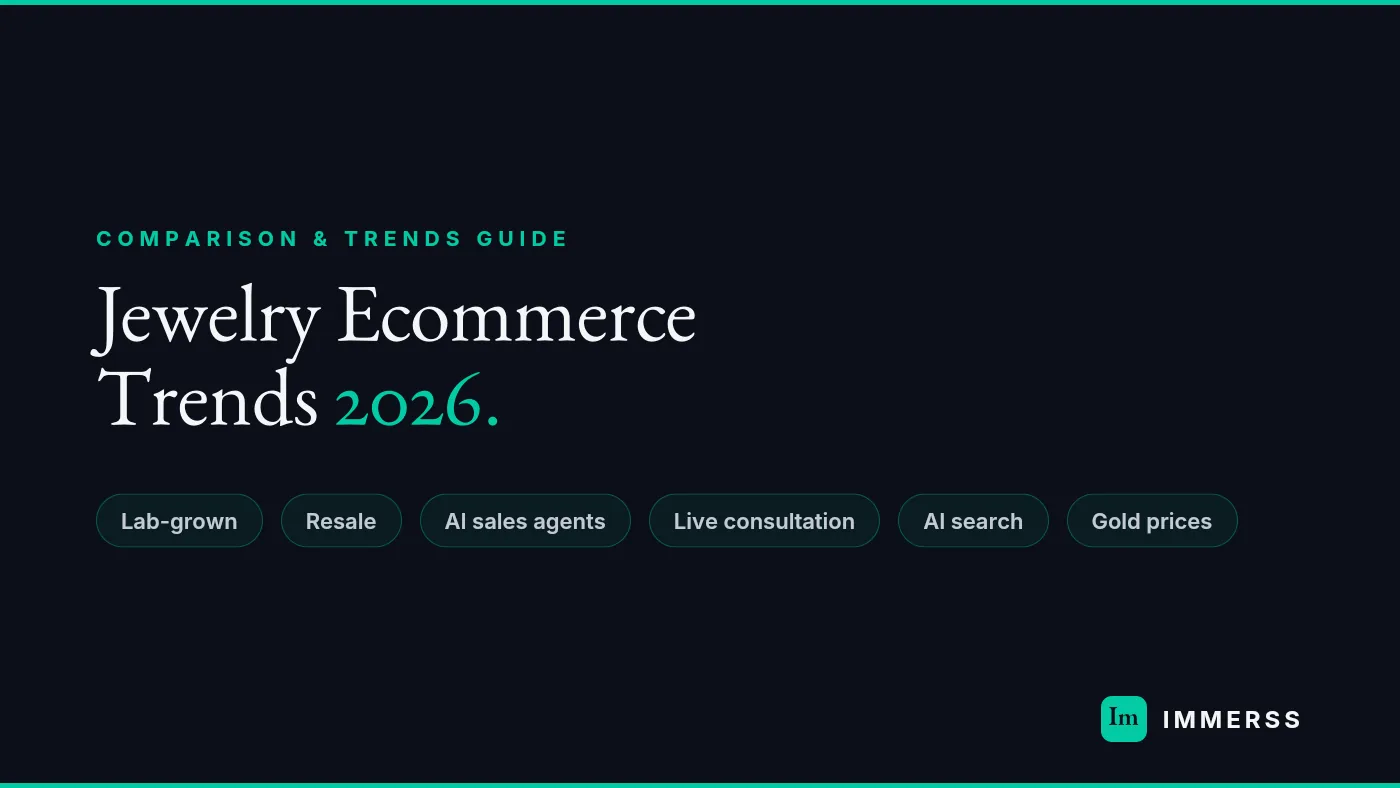
Jewelry ecommerce in 2026 is being reshaped by lab-grown diamonds, mainstream resale, climbing gold prices, AI sales agents, live video consultation, and a discovery shift toward short-form video and AI search. Every roundup you’ll read lists these as ten separate disruptions. They aren’t. Underneath the list, every one of them is doing the same thing from a different angle: eroding the old ways jewelers competed — the stone, the inventory, the materials, the foot traffic — and concentrating value in the guided, trusted relationship.
That’s why this guide ends with one response rather than ten action items. Below is each trend, what it means for an independent or family jeweler, and the practical move it calls for — so you can read the year as one decision instead of a dozen fire drills.
What are the biggest jewelry ecommerce trends in 2026?
The biggest jewelry ecommerce trends in 2026 are lab-grown diamonds maturing into the mainstream, pre-owned and rental going mass-market, AI sales agents and live video consultation reshaping how high-AOV pieces sell online, discovery moving to short-form video and AI search, gold-price volatility forcing pricing and design changes, and provenance and sourcing becoming table stakes rather than differentiators. They look like separate disruptions, but they share a direction — away from competing on product and toward competing on experience and trust. The trends below are ordered by how directly they affect how you sell, not just what you sell.
How are lab-grown diamonds changing jewelry ecommerce?
Lab-grown diamonds are commoditizing the stone, which pushes a jeweler’s value toward guidance and service. As lab-grown quality became visually indistinguishable and prices fell, the diamond stopped being a scarce differentiator — and selling on the stone alone became a race to the bottom.
For independents, the opportunity isn’t to win a price war on lab-grown; it’s to be the trusted expert who guides a confused buyer through the natural-versus-lab-grown decision honestly. That means carrying both, explaining the real differences without the false dichotomy, and pricing transparently. It’s exactly what a live one-to-one consultation delivers and exactly what a price-only listing can’t.
Is pre-owned, resale and rental jewelry worth selling online?
Pre-owned jewelry is worth selling online and is becoming mainstream — but it rewards trust, not just inventory. A growing secondary market means a customer can usually find a comparable piece somewhere else, which erodes “we have the inventory” as an advantage and shifts value toward “we’re the people you trust to guide you.”
Resale is therefore both a product line and a trust test. Authentication, transparent grading, and expert guidance turn it from a margin race into a relationship builder. The same logic runs through the circular services around it — trade-in and buy-back programmes, repair and restoration, upcycling an inherited piece into something wearable. Each one is a reason for a customer to come back to a specific person rather than to a marketplace.
Rental and subscription belong in the same family, with a caveat worth stating plainly: for fine jewelry they are a discovery mechanism, not a business model. Access-based offers lower the commitment threshold and put a piece on a real person for a real occasion; the money is still made when that person comes back to buy. Treat rental as top-of-funnel with an unusually high intent signal attached, and make sure someone follows up.
Why is live video consultation becoming the norm for high-AOV jewelry?
Live, one-to-one video consultation is becoming the norm for high-AOV jewelry because it restores the in-store experience online — currently the only reliable way to sell a five-figure piece at full price. Self-service checkouts process decisions; they don’t help customers make them.
The mechanism is specific: an AI sales agent engages and qualifies high-intent shoppers around the clock, and a human advisor takes the conversation that actually builds trust — showing the piece under real light, answering the questions a spec sheet can’t, reading hesitation. Expect appointment-based video selling to move from novelty to standard for fine jewelry through 2026.
How is AI changing how customers shop for jewelry?
AI is changing jewelry shopping on two fronts: how customers are guided, and how they discover.
On guidance, AI sales agents engage shoppers, answer factual questions, and route serious buyers to a human advisor — scaling the best-salesperson experience rather than replacing it. The misframe to avoid is treating AI as a way to become cheaper and more automated. Automation makes a commodity business more efficient; on a high-consideration purchase it removes the exact thing the customer came for. The winning use is the opposite: high-touch guidance delivered at a scale one advisor couldn’t cover alone.
On discovery, AI answer engines increasingly sit in front of the search results page, so being visible and citable inside AI answers — clear, factual content, structured data, real reviews, a legible product story — is becoming its own discipline for jewelers.
Where do jewelry customers discover brands in 2026?
In 2026, jewelry customers increasingly discover brands through short-form video and AI search answers, then convert through a guided experience. Short-form video is now a top-of-funnel engine — excellent for reach and storytelling, useless for closing a five-figure sale on its own.
The same split explains the shift from celebrity endorsements to smaller, niche creators: a long-running relationship with a creator whose audience actually collects, styles or inherits jewelry produces better-qualified traffic than a one-off post with a large following. But the qualification still has to land somewhere. Discovery and conversion are two different jobs on two different surfaces, and the practical takeaway is to use social video and AI-search visibility to fill the funnel, then convert high-intent shoppers with guidance rather than discounts.
How are gold prices affecting jewelry pricing and design?
Climbing, volatile gold prices are squeezing margins and pushing jewelers toward lighter designs, alternative metals, and — most importantly — prices held through trust rather than through spot-price competition. When materials cost more and move unpredictably, competing on raw price gets punishing fast.
The durable response is to build enough relationship that customers aren’t shopping you against the daily gold price. That is the difference between a buyer who asks “what’s your price on this” and one who asks “what would you recommend” — and it is built by a person, not a promotion. (The mechanics of holding price on high-ticket goods: increasing AOV without discounting.)
What do jewelry shoppers want for trust and transparency in 2026?
Jewelry shoppers in 2026 expect provenance, certification and sourcing transparency — and reward the jewelers who provide them clearly. As lab-grown, resale and online buying all raise the stakes on “can I trust this,” visible certificates, honest grading, documented ownership history and an advisor who stands behind the piece become real differentiators.
This is where the industry’s digital-certification work matters more than its NFT-era framing suggested. What survived the hype is unglamorous and useful: tamper-evident records of origin and ownership, certification that travels with the piece from creation through resale, and documentation a customer can hand to an insurer. That chain is what makes both authentication and resale value credible — see our guide to certification and documentation for jewelry buyers. Transparency isn’t a compliance chore; it’s a conversion tool on a purchase where the entire decision runs on trust.
Is sustainability still a differentiator in jewelry retail?
Sustainability has largely stopped being a differentiator and become a baseline expectation — which is a bigger change than it sounds, because baselines are punished when missing and rarely rewarded when met. Recycled precious metals, traceable stone origins, certified suppliers, plastic-free packaging and honest supply-chain documentation are increasingly assumed by the buyers most likely to spend at the top of your range.
The practical consequence for an independent: stop marketing sustainability as a campaign and start treating it as inventory data your advisors can speak to. A customer asking where a stone came from is not running an audit — they’re asking whether you know. Someone who can answer specifically, in a conversation, converts the question into confidence. Someone who points at a values page does not.
Will virtual try-on and AR help sell jewelry online in 2026?
Virtual try-on and AR help jewelry sales mainly by reducing uncertainty early in the journey, not by closing high-value sales. For rings, watches and earrings, AR lets a shopper see scale and style on themselves, which lowers hesitation, reduces avoidable returns and moves more buyers toward a serious decision.
On a five-figure piece, though, the technology is a confidence aid, not a closer — the customer still needs a person to answer the real questions about the stone, the setting and the occasion. Treat AR as a funnel tool that hands a more confident, better-qualified buyer to a live consultation, where the sale actually happens.
How important is omnichannel and appointment booking for jewelers in 2026?
Omnichannel and online appointment booking are increasingly essential, because jewelry buying now crosses online discovery, virtual consultation and the showroom within a single journey. A customer might find you on Reels, book a video consultation and finish in store — or the reverse.
The jewelers who win make that path seamless: easy appointment booking, a video consultation that feels like the showroom, and customer history that follows the buyer across every touchpoint. This is where clienteling lives — the advisor and the customer record that persist across channels and visits, turning scattered interactions into one continuous relationship instead of a series of introductions to strangers.
The trend underneath the trends: from product to relationship
Every trend above is doing the same thing from a different angle — dissolving the old bases of jewelry competition and concentrating value in the one place that can’t be commoditized: the guided, trusted relationship.
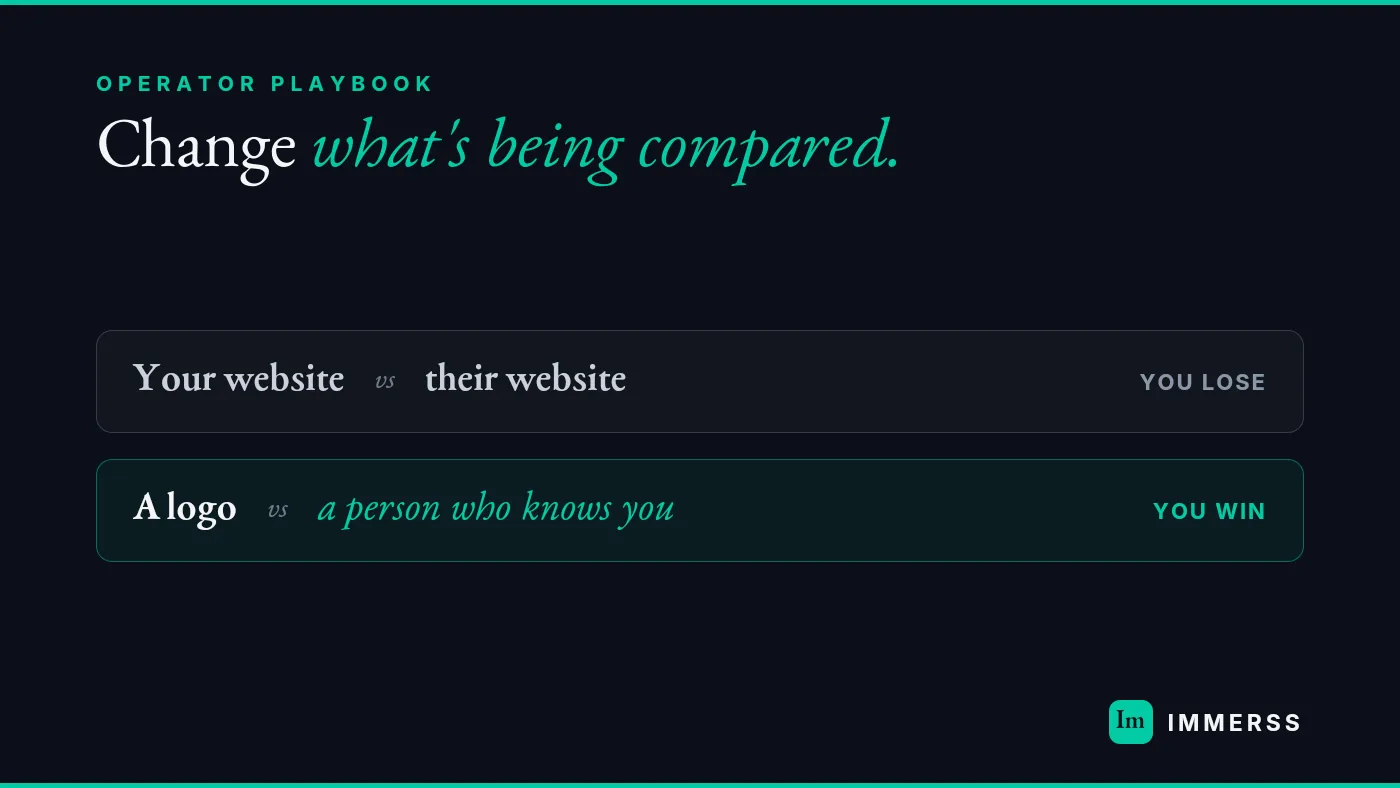
This is the real 2026 story, and it forces a fork. One path is to commoditize — compete on price, automate the human out, chase volume, treat sales as transactions. It’s the path of least resistance and a losing one for an independent, because there is always someone with cheaper stones and more ad budget. The other is to specialize on the relationship: take every trend above and invert it into a reason for a person to talk to your people.
It’s also the path that plays to what an independent already has and a marketplace never will — the maker’s story, the named designer, the regional workshop, the advisor who remembers what a customer bought for their anniversary three years ago. Only this path is defensible, because a trusted advisor relationship is the one asset competitors can’t copy or outspend.
Is your jewelry store positioned for these trends?
Run this quick filter:
- Shopify Plus, 50K+ monthly visits, AOV $500+ — decisive at $5,000+. The higher the AOV, the more these trends reward relationship over price.
- You’re feeling margin pressure from lab-grown, resale or gold prices.
- Strong in-store conversion, weak online conversion — the guided experience hasn’t made it online yet.
- You discover customers on social but struggle to convert them at high AOV.
If two or more are true, the 2026 trends are pushing you toward the fork — and the relationship path is the one you’re built for. (For where your numbers sit against the category: jewelry ecommerce benchmarks 2026.)
What jewelers should measure in 2026
The trends reward the relationship, so measure the relationship — not just the transaction. Commodity metrics such as sessions, whole-catalogue conversion rate and cost per click will tell you how you’re doing on the path you don’t want to be on. These tell you whether the relational path is working:
- Repeat-purchase rate and customer lifetime value — the relational path’s core proof.
- Advisor-attributed revenue and share of high-AOV sales closed via consultation — how much of the business runs through guidance.
- Full-price conversion versus discount dependency — whether you’re holding price through trust.
- Discovery-to-consultation rate — how well social and AI-search traffic converts into guided conversations.
- Referral rate — the clearest sign that relationships, not promotions, are driving growth.
Each of these is deliberately measurable. A relationship-led strategy that can’t be counted is indistinguishable from a hunch, and the case for it collapses the first time someone compares it to a paid-traffic spreadsheet.
Where to start
The fastest way to act on the 2026 trends is to put a guided, consultation-led experience in front of your high-AOV shoppers and measure it against your current baseline — one trend bent toward the relationship, proving the model before you touch the other nine.
That’s what the 60-day pilot, on us is for: an AI sales agent engaging and qualifying high-intent jewelry shoppers, one-to-one video consultation as the selling mechanism, and clienteling holding the customer record between visits. You change no platform to see what the relationship path does on your own inventory. Pricing for the three modules is banded by monthly traffic and each has a free tier — the details are on our pricing page, but the entry point is a conversation.
Book a demo and we’ll walk through it on your own catalogue.
See the pilot for merchants: landing.immerss.live Agency partner program: partners.immerss.live
Immerss is a luxury live commerce platform — AI sales agents, clienteling and one-to-one video consultation for fine jewelry, watches and high-AOV retail, built on Shopify Plus.