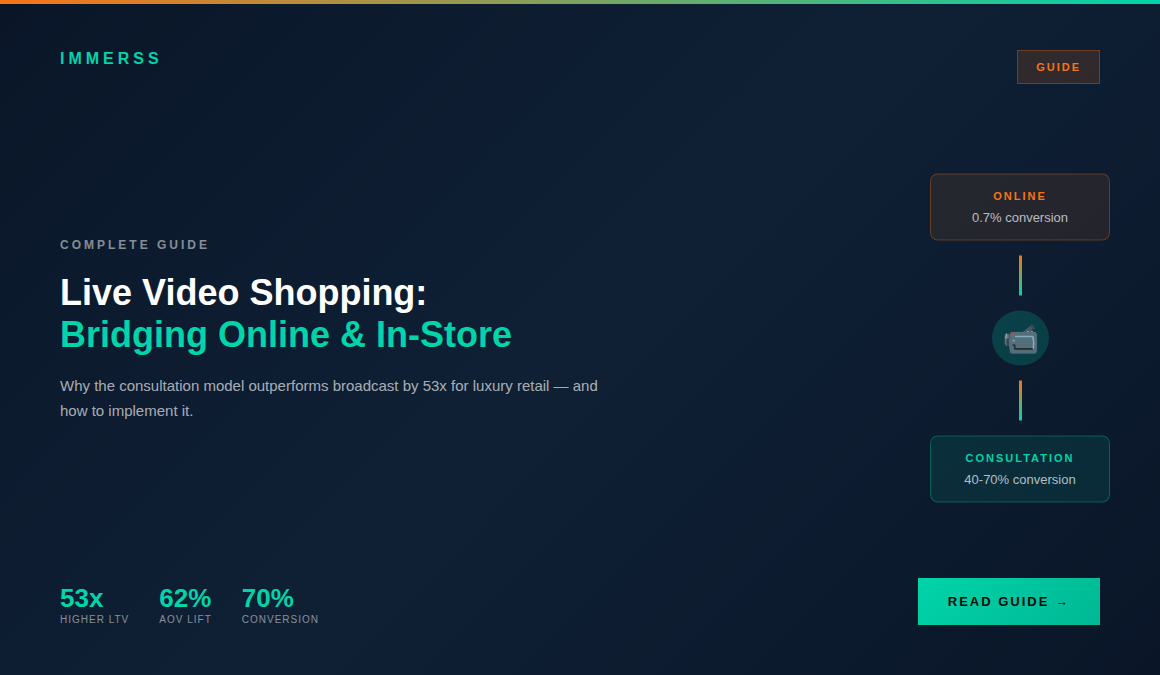

Live Video Shopping: When a Text Answer Isn't Enough
Most writing about live video shopping is about scheduled livestream events with a host, a run of show and a production crew. This guide is about the other version — one-to-one, on demand, triggered by a moment of hesitation rather than by a calendar — including how to tell which of your products actually need it, how to staff it without building a channel, and how to judge a platform.
What is live video shopping?
Live video shopping is a real-time video conversation between a shopper and someone from the store, in which the shopper can see the product being handled and ask for specific angles, comparisons or demonstrations.
Two distinct things share the name, and conflating them causes most of the confusion in this category.
One-to-many (livestream shopping) is a broadcast: a scheduled event, one host, many viewers, products presented in sequence with a buy link. It is a merchandising and audience channel, and it needs an audience to work at all.
One-to-one (live video shopping, sometimes “virtual shopping appointment” or live co-shopping) is a private conversation with a single shopper who already has a specific question. It needs no audience, no schedule and no production, and it fires from hesitation rather than from a calendar slot.
This guide is about the second. For brands selling considered, higher-consideration products it is almost always the relevant one, because it requires no audience-building and it scales down to a handful of interactions a week without looking broken. We have written separately about how the livestream and one-to-one models differ as products you buy.
What’s the difference between live video shopping and shoppable video?
Shoppable video is recorded content answering questions you anticipated; live video shopping is an unscripted interaction answering the question one shopper actually has.
The practical difference is direction. A recorded clip is a broadcast answer — you decide in advance what to show, and it plays the same way for everyone. That is genuinely effective for predictable doubts, and the shot list should come from your returns log rather than from your marketing calendar.
Live is different because the shopper directs it. Turn it over. Hold it next to a mug so I can see the scale. Walk toward the window. You cannot pre-record that, because you do not know what she will ask and neither does she until she sees the first angle.
The two are not alternatives. Recorded video absorbs the predictable questions at scale — that is the case for shoppable video on the product page — and live handles the unpredictable residue.
Which questions actually need video instead of text?
Questions about perceptions need video; questions about facts do not — and the reliable signal that you have crossed from one to the other is a shopper rephrasing a question she has already had answered.
Text transfers facts perfectly: dimensions, compatibility, materials, stock, timing, policy. A good answering layer handles these faster and more consistently than a person on the phone, and at any hour.
Text cannot transfer a perception. Drape, heft, the exact quality of a colour under a kitchen light, whether a hinge feels solid or cheap, how a coat moves when you turn.
The diagnostic worth naming is the double-ask:
- Is it heavy? — 2.4 kg. — No, I mean is it heavy to carry around all day?
- What colour is the green? — sage. — Is it more grey-green or yellow-green though?
- Will it fit a tall three-year-old? — it’s a 4T. — Is 4T generous or slim?
The rephrasing means the shopper has discovered that accuracy was not the axis she needed. It is usually her last message — almost nobody asks a third time.
That last detail is the whole argument. The double-ask is not a complaint; it is the sound of someone standing closer to the buy button than anyone else in your funnel, about to leave because the answer she got was correct and useless.
How do you find which of your products need this?
Cross-reference double-asks in your pre-purchase conversations against perception-related returns; the overlap is your shortlist.
Two passes, both doable in an afternoon:
- Count double-asks. Review the last two hundred pre-purchase conversations. Mark every case where a shopper asked, got an answer, and rephrased the same question. Exclude follow-ups that move to a new topic — those are progress, not friction.
- Filter the returns log for reasons shaped like “not as expected”, “looked different”, “smaller than I thought”, “colour was off”. These are the same failure arriving three weeks later, with shipping paid twice and the margin gone.
Products appearing on both lists are where the gap costs you at both ends of the same transaction. For most catalogues that is five or six SKUs, not the whole range.
One caveat about the first number: it undercounts, and not slightly. Only unusually patient shoppers ask twice. The ones who receive a description-shaped answer to a perception question and close the tab are the same population, and a much larger one. Treat the double-ask count as a floor.
How do you staff live video shopping without hiring a team?
You staff it by not building a channel: live video works for a normal-sized team when it is an escalation out of an AI answering layer rather than a service with opening hours.
The failure mode people imagine — an associate sitting available on camera all day, waiting — is real, and it is what happens if you implement this as a channel. Nobody should try to staff that.
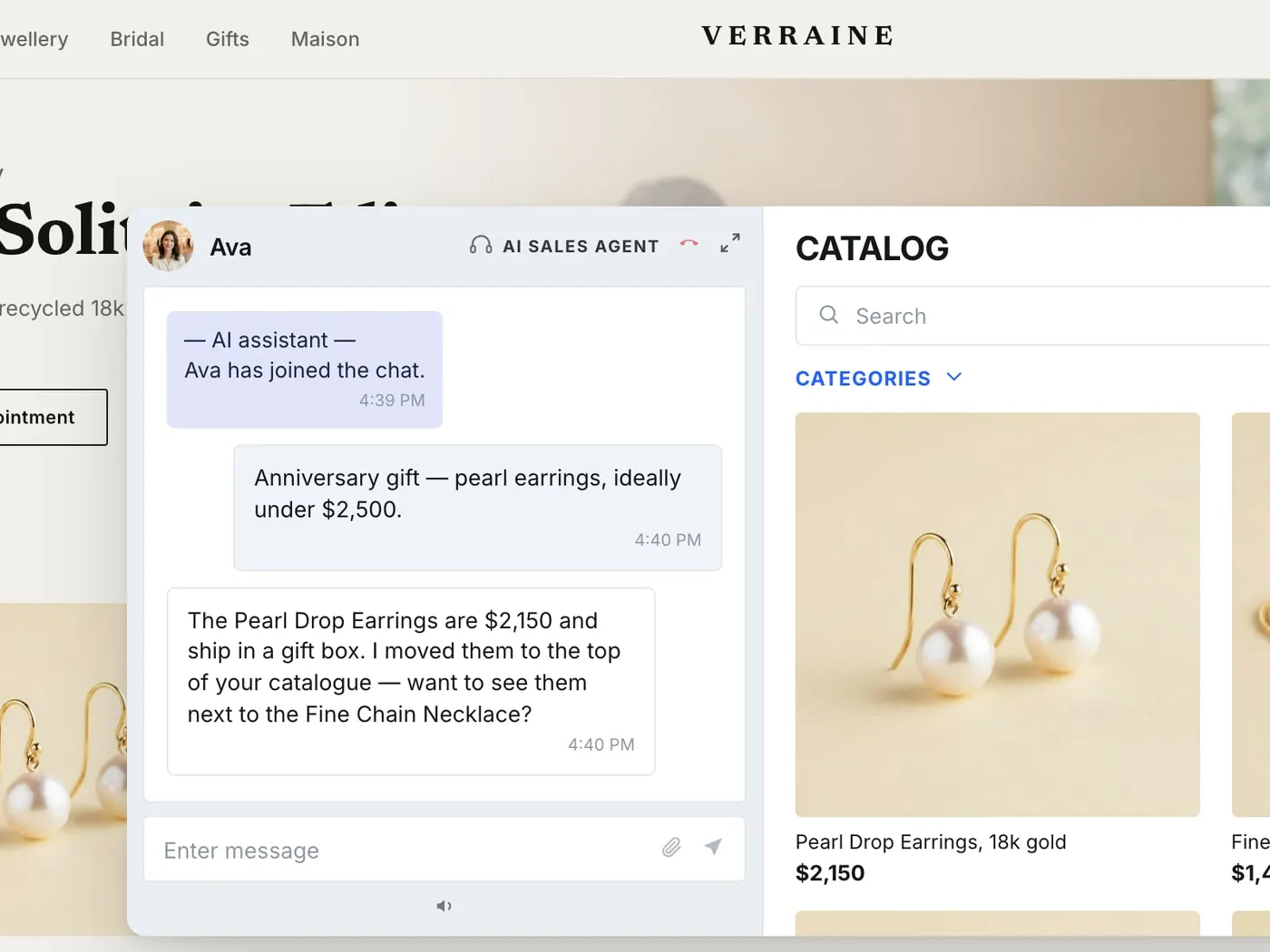
The workable shape is an exit valve. The AI Sales Agent resolves the overwhelming majority of questions instantly and around the clock: sizes, compatibility, stock, shipping, care, policy. What remains is the small residue where answers keep missing — and that residue is both low in volume and disproportionately valuable, because it consists of shoppers who have asked twice and are still trying to buy.
The two halves depend on each other, which is the part most implementations miss. Without the answering layer, live video is unstaffable, because every trivial question reaches a human. Without the escalation, the answering layer hits a wall on perception questions and stops, having done everything correctly. If you are weighing those two layers as alternatives rather than as a sequence, the comparison of AI sales agents, chatbots and live commerce is the argument in full.
Rules that keep this affordable for a real team:
- Trigger on circumstance, not on every page. Offer it on considered products, mid-conversation, after a double-ask — not as a permanent button on every SKU.
- No booking on the instant path. One tap, no download, shopper’s camera off by default. A calendar invite three days out is a different, much smaller product.
- Offer a fallback, not a dead end. If nobody is available, offer to show her later or send a short personal clip. That is still better than a description she has already rejected.
- Keep sessions short. Most run two to five minutes. This is showing someone one thing, not a consultation.
- Let the advisor add to cart. If she says yes on the call, buying should not require her to go and find the product again.
That escalation, run deliberately and at scale, is what Clienteling is: one-to-one live co-shopping plus the outbound follow-up that turns a single session into a relationship an associate can return to.
What does this look like in practice?
The clearest way to see it is against the in-store journey it reproduces, step for step.
In a boutique: the customer arrives, an associate greets her personally, they talk about what she needs, the associate curates a few relevant pieces, she examines them and asks questions, the associate answers from expertise, she decides with confidence, and a relationship exists for next time.
On live video: the customer is already on the product page, an associate joins her, they talk about what she needs, the associate shows a few relevant pieces on camera, she looks and asks questions, the associate answers from expertise, she decides with confidence, and a relationship exists for next time.
The format changes — video instead of physical presence. The mechanism does not. That is the reason this bridges the online-offline gap where a better product page does not: it restores the human on the other side of the question, not just more information about the product.
Among brands we work with, Lucchese uses it for exactly the ambiguity western boots carry — last shape, leather, fit through the instep, customisation options — questions a size chart answers correctly and unhelpfully. Hammitt uses live video for the leather-and-hardware questions that photographs flatten. Neither case is about entertainment or reach. Both are about a specific shopper who asked twice.
Which platform is best for live video shopping?
The right platform depends on whether you need one-to-many broadcast or one-to-one escalation, and the two are judged on different criteria — most brands with considered products need the second and evaluate the first by habit.
For one-to-one escalation, these are the questions that decide it:
| Criterion | What to check |
|---|---|
| Trigger model | Can a session start from inside a conversation, or only from a booking page? |
| Shopper friction | Any app download or account required? Is her camera optional? |
| Answering layer | Does an AI sales agent handle routine volume, or does every question reach a person? |
| Add-to-cart in session | Can the advisor put the item in her basket during the call? |
| Install | One-click on your platform, or a development project? |
| Pricing shape | Per-session, per-seat, per-view with overage, or banded — and what happens on a quiet month? |
| Mobile | Most shoppers are on a phone. Does it work without an app? |
| Measurement | Can you see conversion and returns for escalated sessions specifically? |
The criterion most often missed is the answering layer. A live video tool with nothing in front of it routes every routine question to a human, which is precisely the arrangement that makes the format unsustainable — and it is why “live chat with a video button” is a different thing wearing the same name.
On pricing, compare the model rather than this quarter’s number, because the number rotates and the model does not. View-based platforms bill you by how much video is watched, with overage when a stream goes well; per-seat models bill you by how many associates are licensed whether or not they are consulted. Immerss bands by monthly traffic, so inside a band the bill is fixed and a good month moves you up deliberately rather than arriving as an overage invoice — the current bands are on our pricing page, and every vendor’s real figure belongs on theirs.
Do customers actually want a video call?
Most will not accept a scheduled call for a low-stakes purchase — but acceptance is materially different when it is offered mid-conversation as a quick showing rather than as a meeting.
The objection is half right and worth respecting. Nobody wants to book a slot three days out to discuss something inexpensive, and any implementation that requires it deserves to fail.
What changes acceptance is circumstance: she is already in a conversation, she has already asked twice, the offer is one tap with no booking and no download, her camera stays off unless she chooses otherwise, and the framing is let me show you rather than let’s have a call.
Where the instinct is genuinely correct: cheap, low-stakes, low-ambiguity products. If your catalogue is entirely inexpensive items with no fit or scale dimension, this is not your lever, and no amount of implementation quality will make it one.
How do you measure live video shopping?
Measure conversion and return rate on escalated sessions against comparable shoppers who were not offered one — not session volume, and not call duration.
Four numbers are worth keeping:
- Conversion of shoppers offered an escalation versus comparable shoppers who were not. This is the only comparison that answers the question you are asking.
- Return rate on escalated orders versus store average. It should fall. If it rises, your advisors are selling rather than advising, and that is a coaching problem with a number attached.
- Average order value on escalated orders, which tends to run higher because the interaction resolves doubt on exactly the items where doubt is expensive.
- Double-ask rate over time. It should decline, as the honest one-sentence answers your advisors give on camera get promoted into product copy.
Deliberately not a target: number of calls. Volume is not the goal — this mechanism is supposed to fire rarely, on the moments that justify a person. A rising call count usually means the trigger is too broad, not that the programme is working. For context on where your other funnel numbers should sit, the 2026 e-commerce benchmarks are the wider picture.
Where to start
Your answering layer, however good it becomes, has a class of question it will always answer with a description. The shopper asking that question is the most valuable person in your funnel and the easiest to lose.
Start by counting double-asks for a week. If they cluster on a handful of considered products, you have found where this pays — and you will have written down the honest one-sentence answers you needed for your product pages anyway.
That is the whole argument for one-to-one live video, and it is deliberately a narrow one. It is human where the alternative is a better paragraph, personal because it answers the question this shopper actually asked, and measurable on conversion and returns for the sessions it fires on. If you want to see it against your own catalogue and your own returns log, that is a conversation rather than a signup — we run a 60-day pilot, on us. Book a demo and bring the five SKUs your shoppers ask about twice.
Frequently asked questions
There is no single best one, because two different products share the name. If you need one-to-many broadcast — scheduled events, a host, an audience — you are shopping for a livestream platform and judging it on production tooling, audience reach and moderation. If you need one-to-one escalation, where a single shopper who has already asked twice gets shown the product on camera, you are shopping for a clienteling platform and the criteria are different: can it trigger from a conversation rather than a booking page, does an AI answering layer sit in front of it, can the advisor add to cart inside the session, and does it work on a phone without an app. Most high-consideration brands need the second and buy the first by mistake.
Broadcast live selling has three structural costs: it needs an audience you must build and rebuild for every event, it needs production time and a host, and it converts on impulse, which is the wrong mechanism for a considered purchase. One-to-one live video avoids all three but has its own failure mode — if you implement it as a staffed channel with opening hours, a small team cannot sustain it. It only works as an exit valve from an answering layer that handles the routine volume, so a human is reached rarely and always at a high-intent moment.
Amazon Live is Amazon's broadcast format: creators and brands stream on Amazon's own storefront to Amazon's audience, with products attached to the stream. It is a marketplace media channel, not software you run on your site. The audience, the customer relationship and the data stay with Amazon, and you are one of many sellers in the same feed. That is a reasonable place to buy reach, and a poor substitute for a conversation on your own store where you keep the relationship.
Start by finding out whether you need it at all. Review your last few hundred pre-purchase conversations and mark every double-ask — where a shopper asked something, got a correct answer, and rephrased the same question. Then filter your returns log for perception-shaped reasons: 'not as expected', 'looked different', 'smaller than I thought'. Products on both lists are where a description is failing at both ends of the same transaction. For most catalogues that is five or six SKUs. Turn escalation on for those only, put an answering layer in front of it, and decide in advance what happens when nobody is available.
Shoppable video is recorded content answering questions you anticipated; live video shopping is an unscripted interaction answering the question one shopper actually has. The practical difference is direction — a recorded clip plays the same way for everyone and should be built from your returns log, while a live session is directed by the shopper: turn it over, hold it next to a mug for scale, walk toward the window. They are not alternatives. Recorded video absorbs the predictable questions at scale; live handles the unpredictable residue.
No, but its value scales with ambiguity, not with the price tag alone. The test is whether the product carries questions a description cannot settle. An item with real fit ambiguity may justify it while a more expensive item with exact published specifications may not. The categories where it consistently earns its place are apparel with fit ambiguity, furniture and homeware where scale matters, jewellery and watches, instruments, and anything with compatibility complexity.
No. A phone, reasonable daylight and the actual product are sufficient, and over-produced setups work against you. The reason the format resolves doubt is that the shopper is watching a real person handle the real item in real conditions. A commercial-grade set signals the opposite — that she is being shown a version of the product rather than the product.