

Video Commerce Strategy: From Product Pages to Live Consultations
A comprehensive framework for implementing video across the e-commerce customer journey.
Executive Summary
Video has become the dominant content format for product discovery, with 91% of consumers watching video to learn about products and 82% reporting video convinced them to purchase. The technology barriers that historically limited video adoption — load times and production costs — have been eliminated by 5G infrastructure and generative AI tools.
For e-commerce leaders, video implementation is no longer optional. This analysis provides a strategic framework for video deployment across the customer journey, from pre-recorded product content through live video consultation for high-consideration purchases.
The Business Case for Video
Consumer Preference Data
Research from Wyzowl’s 2024 Video Marketing Statistics Report establishes clear consumer preference patterns:
Discovery preference: 44% of consumers prefer short video for product discovery, significantly exceeding all other formats including manuals, infographics, and text articles.
Learning behavior: 91% of consumers watched video to learn about a product or service in 2023.
Purchase influence: 82% of consumers report being convinced to purchase after watching a video.
Performance Impact Metrics
Marketing performance data demonstrates measurable video ROI:
Traffic improvement: 86% of marketers report video has improved traffic to products.
Sales increase: 87% of marketers have seen sales increases from video implementation.
Engagement extension: Amazon internal data shows 44% increase in visit duration when Brand Stores include video content.
Conversion multiplication: Product pages featuring video reviews demonstrate 3.5x higher conversion rates.
Case Study: Petit Bateau
The French apparel brand tested user-generated video integration:
Implementation: Invited customers to create videos featuring flagship products, posted on corresponding product pages.
Result: 10% sales increase on pages with consumer videos.
Key insight: Authentic user content drove significant conversion improvement without professional production investment.
Technology Enablers
Infrastructure: 5G Adoption
Historical barrier: Video files increase page load times. Slow loading reduces conversion by up to 15%.
Resolution: 5G networks transmit data up to 100x faster than 4G, enabling near-instant video loading without user experience degradation.
Implication: The performance penalty for video integration is approaching zero for growing user segments.
Production: Generative AI
Historical barrier: Professional video production required significant time and budget investment.
Resolution: 75% of marketing professionals now use generative AI to create or edit video content, dramatically reducing production timelines and costs.
Implication: Video content can be produced at scale without proportional budget increases.
Platform Support
Major platforms now actively support and encourage video:
Amazon: A+ Enhanced Content includes video integration. Brand Stores support video content. Vine program encourages video testimonials.
Shopify: Native video support on product pages. App ecosystem for video commerce.
Other platforms: WooCommerce, Salesforce Commerce Cloud, and other major platforms offer robust video integration capabilities.
Video Format Framework
Tier 1: Product Demonstration Video
Purpose: Reduce purchase uncertainty by showing products in motion, from multiple angles, and in use context.
Optimal specifications:
- Duration: 30-90 seconds
- Content: Multiple angles, zoom details, usage demonstration
- Format: Mobile-optimized, silent-capable with captions
- Placement: Primary product page, above fold when possible
Expected impact: Meaningful conversion lift, reduced return rates, increased customer confidence.
Production approach: Can be produced in-house with modern smartphone equipment, or scaled with AI-assisted tools.
Tier 2: User-Generated Content (UGC)
Purpose: Build trust through authentic peer validation. Address the 92% of consumers who trust peer content over brand content.
Content types:
- Video testimonials (post-purchase satisfaction)
- Unboxing videos (anticipation and first impressions)
- Usage videos (real-world application)
- Review videos (detailed product assessment)
Collection mechanisms:
- Post-purchase email campaigns
- Incentive programs (discounts, loyalty points)
- Community features and contests
- Review platform integration
Expected impact: 3.5x conversion rate improvement on pages with video reviews.
Tier 3: Brand and Category Content
Purpose: Build engagement, educate customers, and establish brand positioning across the shopping journey.
Content types:
- Brand story and values
- Category education and comparison
- How-to and tutorial content
- Behind-the-scenes and craftsmanship
Expected impact: 44% increase in visit duration (Amazon Brand Store data), improved brand perception, enhanced SEO performance.
Tier 4: Live Video Commerce
Purpose: Provide real-time, personalized guidance for customers who need interactive support to purchase with confidence.
Formats:
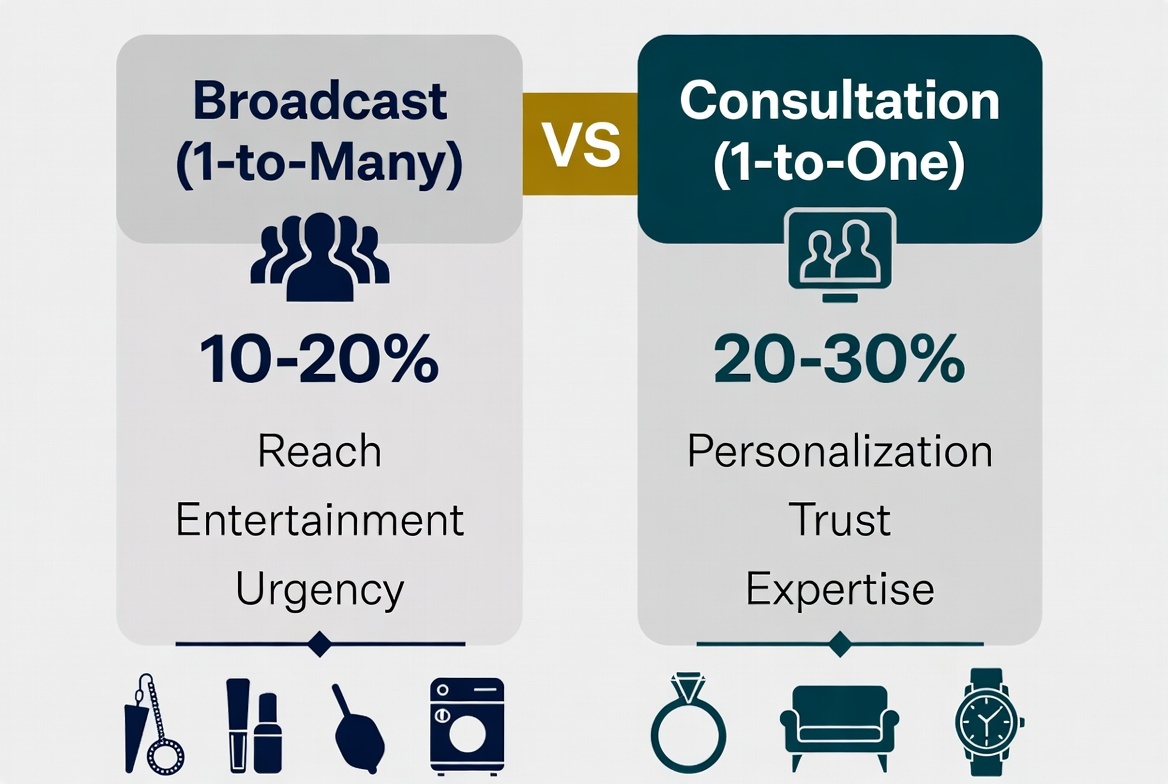
One-to-Many Broadcast:
- Single host, multiple viewers
- Entertainment-driven format
- Time-limited offers and urgency
- Best for: Lower-price, impulse-friendly products
- Typical conversion: 10-20%
One-to-One Consultation:
- Single expert, single customer
- Personalized demonstration and Q&A
- Specific question answering
- Best for: High-consideration, complex products
- Typical conversion: 20-30%
Expected impact: Conversion rates approaching in-store levels for high-consideration products.
Implementation Roadmap
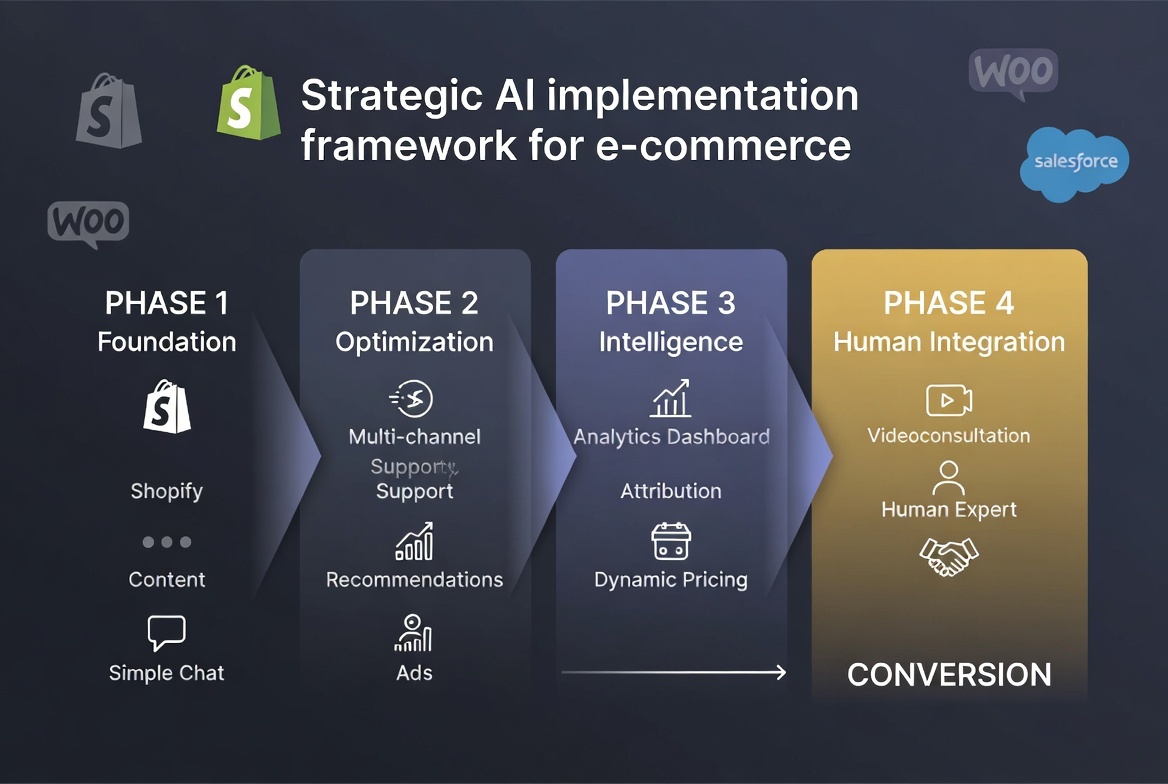
Phase 1: Foundation
Objective: Establish video presence on highest-impact product pages.
Actions:
- Audit top 20% of products by revenue/traffic
- Produce demonstration videos for priority products
- Implement video on product pages
- Establish measurement framework
Resource requirements:
- Video production capability (internal or external)
- Platform integration (typically straightforward)
- Analytics configuration
Success metrics:
- Video play rate
- Conversion rate change (A/B test)
- Time on page change
Phase 2: User Content
Objective: Build authentic user-generated video library.
Actions:
- Implement post-purchase video request program
- Create incentive structure for video submissions
- Deploy UGC collection and moderation platform
- Integrate UGC on product pages
Resource requirements:
- UGC platform (Skeepers, Bazaarvoice, or similar)
- Moderation workflow
- Customer communication templates
Success metrics:
- Video submission rate
- UGC quality scores
- Conversion impact of UGC pages vs. non-UGC
Phase 3: Experience Enhancement
Objective: Extend video across the full shopping experience.
Actions:
- Develop brand story video content
- Create category education videos
- Build how-to and tutorial library
- Integrate video into email and social channels
Resource requirements:
- Content strategy and production
- Multi-channel distribution
- Expanded analytics
Success metrics:
- Overall site engagement metrics
- Return visitor rates
- Brand awareness indicators
Phase 4: Live Commerce
Objective: Add live video capability for high-consideration products.
Actions:
- Identify product categories suited for live consultation
- Select and implement live commerce platform
- Train product experts on video consultation
- Launch and optimize based on performance data
Platform consideration: Immerss provides one-to-one video consultation infrastructure with e-commerce platform integration (Shopify, WooCommerce, Salesforce Commerce Cloud).
Resource requirements:
- Live commerce platform
- Trained product experts
- Scheduling and availability management
- Consultation-to-checkout workflow
Success metrics:
- Consultation request rate
- Consultation-to-purchase conversion
- Average order value from consultations
- Customer satisfaction scores
High-Consideration Product Strategy
For product categories with traditionally low online conversion rates — jewelry, furniture, electronics, luxury goods — live video consultation addresses the fundamental barriers.
The Conversion Gap
Baseline performance:
- Online jewelry conversion: <1%
- Online furniture conversion: 0.5-1.5%
- In-store with expert guidance: 20-30%
Gap analysis: The difference is not product quality or pricing. It is confidence. Customers lack the trust and certainty needed to purchase significant items online.
How Live Consultation Bridges the Gap
Pre-recorded video limitations:
- Answers generic questions
- Cannot address individual situations
- No personalization capability
- One-way information transfer
Live consultation capabilities:
- Answers specific customer questions
- Demonstrates to individual needs
- Provides personalized recommendations
- Creates dialogue and trust
Immerss Implementation
Immerss provides the infrastructure for one-to-one video consultation optimized for high-consideration retail:
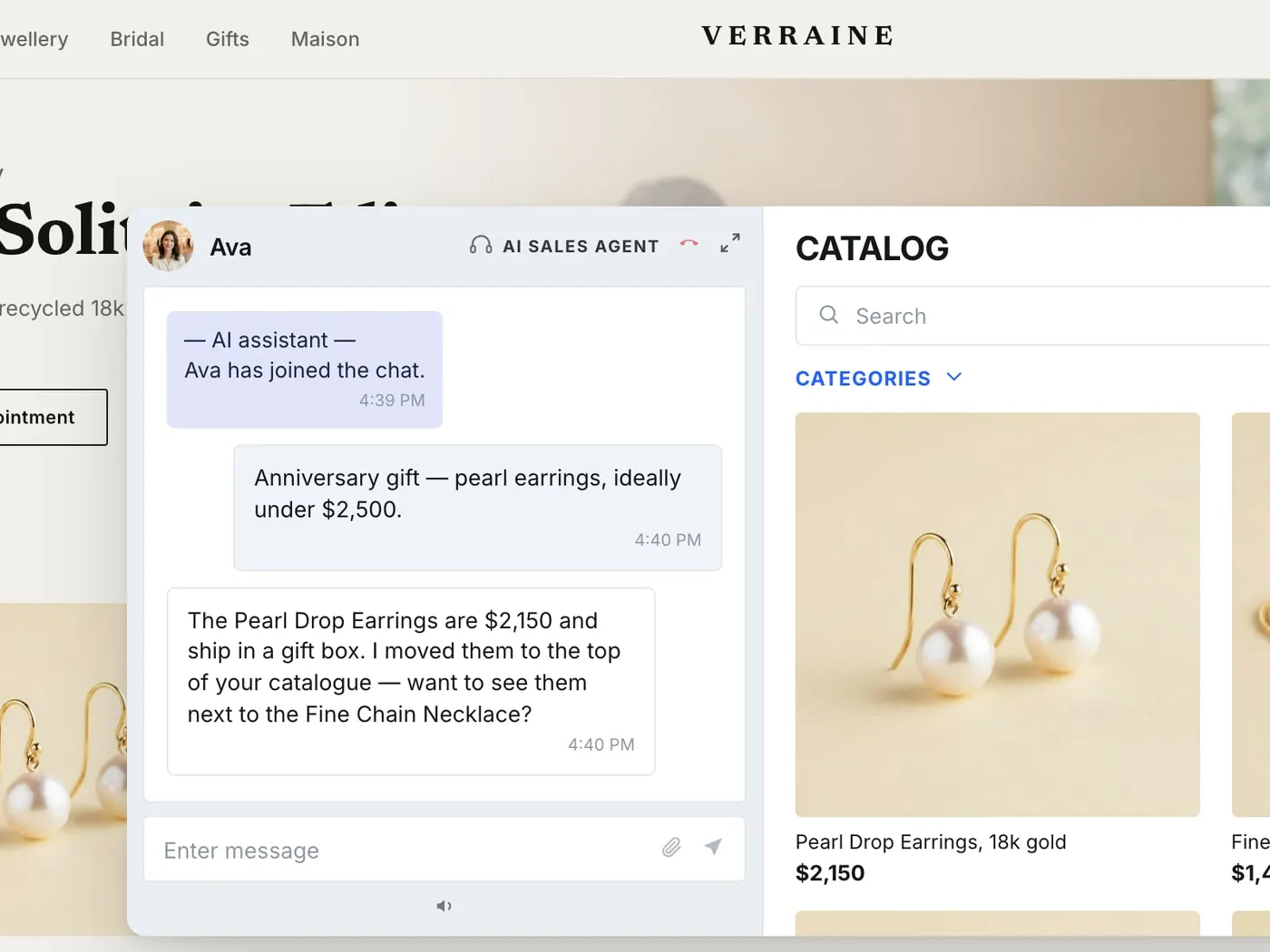
Customer experience:
- Browse products on e-commerce site
- Request video consultation with product expert
- Connect via high-quality video call
- See products demonstrated in real light
- Ask specific questions, receive expert answers
- Complete purchase within consultation
Technical integration:
- Native Shopify app
- WooCommerce plugin
- Salesforce Commerce Cloud integration
- Existing inventory and checkout systems
Operational support:
- Expert scheduling and availability
- Consultation analytics
- Performance optimization guidance
Expected outcomes:
- Conversion rates: 20-30%
- Average order value: +30-50% vs. unassisted
- Return rates: Lower (confident purchases)
- Customer satisfaction: High
Measurement Framework
Video Content Metrics
Engagement:
- Play rate (% of page visitors who start video)
- Completion rate (% who watch to end)
- Average watch duration
- Replay rate
Conversion:
- Conversion rate: video viewers vs. non-viewers
- Add-to-cart rate with video exposure
- Revenue attributed to video-influenced purchases
- Return rate for video-influenced purchases
Live Consultation Metrics
Volume:
- Consultation requests per period
- Consultation completion rate
- Average consultation duration
Performance:
- Consultation-to-purchase conversion rate
- Average order value from consultations
- Revenue per consultation hour
- Customer satisfaction score
Quality:
- Return rate from consultation purchases
- Repeat consultation requests
- Expert performance comparison
ROI Calculation
Revenue attribution:
- Incremental conversion from video (A/B tested)
- AOV lift from consultation
- Return rate reduction value
- Customer lifetime value impact
Cost components:
- Video production (internal and external)
- Platform and technology costs
- Personnel (experts, moderation)
- Training and optimization
Target ROI: 300%+ within first year of full implementation
Conclusion
Video has transitioned from competitive advantage to baseline expectation. Consumer preference (91% watch video for product learning), performance impact (3.5x conversion on video review pages), and eliminated barriers (5G, AI production) make video implementation a clear strategic priority.
The video commerce maturity path progresses from product demonstration through user-generated content to live video consultation. Each tier builds on the previous, creating a comprehensive video experience across the customer journey.
For high-consideration products, where a self-service page converts a fraction of a percent of the people who look at it, live video consultation is the highest-impact move available — not because it is video, but because it puts someone in front of the buyer at the moment the buyer has a question the page cannot answer.
The question is not whether to implement video commerce, but how quickly and comprehensively to do so.