
AI Sales Agents vs. Support Chatbots: Why Your E-Commerce Site Needs Both
Understanding the critical difference between tools that reduce costs and tools that drive revenue.
Executive Summary
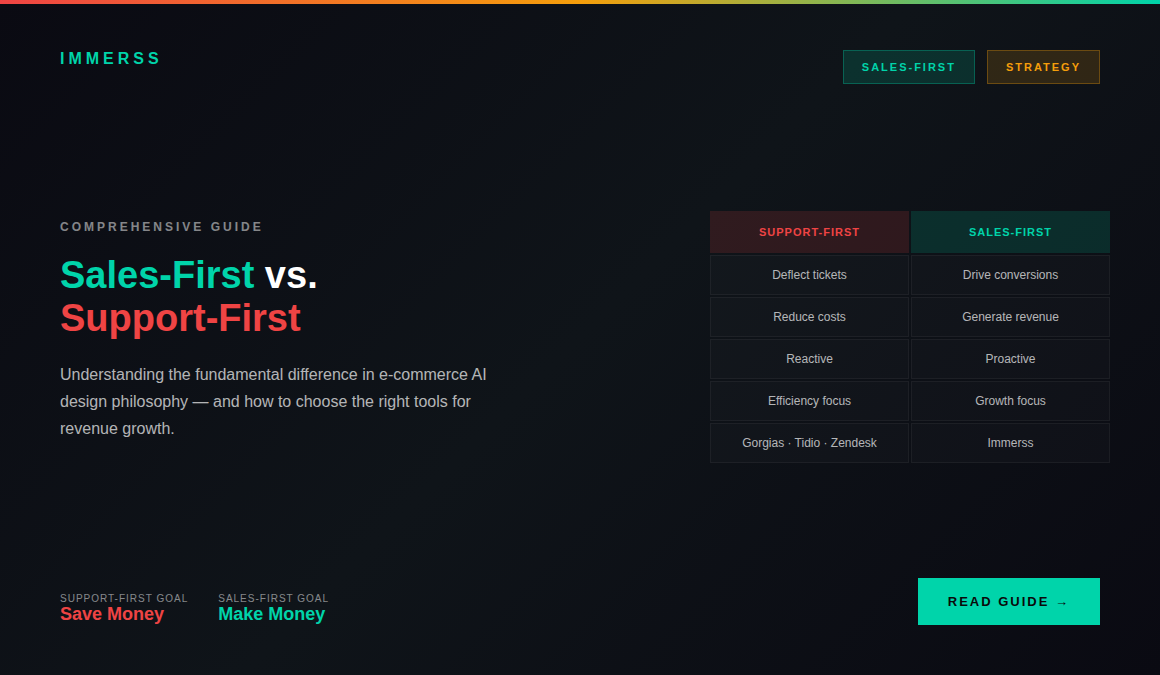
E-commerce brands increasingly deploy chatbots, but most use support-focused tools (Gorgias, Tidio, Zendesk) that optimize for ticket deflection rather than revenue generation. This guide explains the fundamental difference between support chatbots and AI Sales Agents, provides data on their respective impacts, and offers a framework for deploying both effectively.
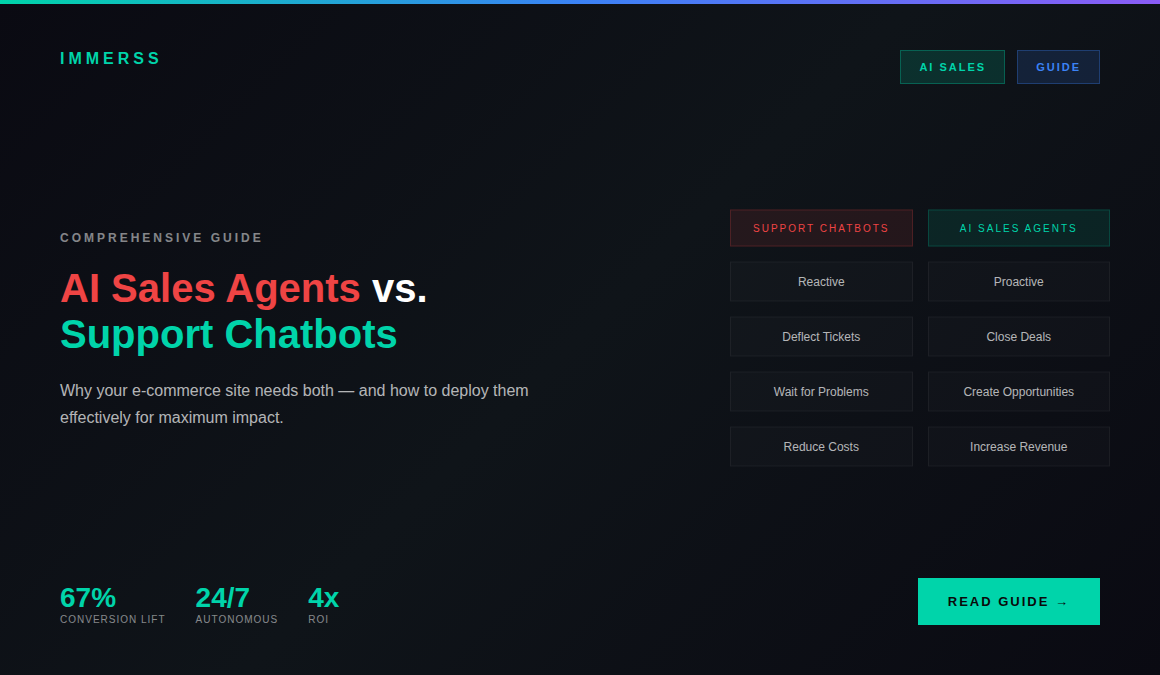
Key insight: Support chatbots reduce costs. AI Sales Agents increase revenue. Both are valuable, but they solve different problems.
The State of Conversational AI in E-Commerce
The conversational commerce market has reached $8.8 billion in 2025, with projections of $32.6 billion by 2035. Key statistics:
- 54% of organizations now use chatbots for customer-facing roles (Gartner)
- 97% of retailers plan to increase AI spending this year (NVIDIA)
- 80% of retail customer interactions projected to be AI-handled by 2025
- 47% faster purchase completion when customers are assisted by AI
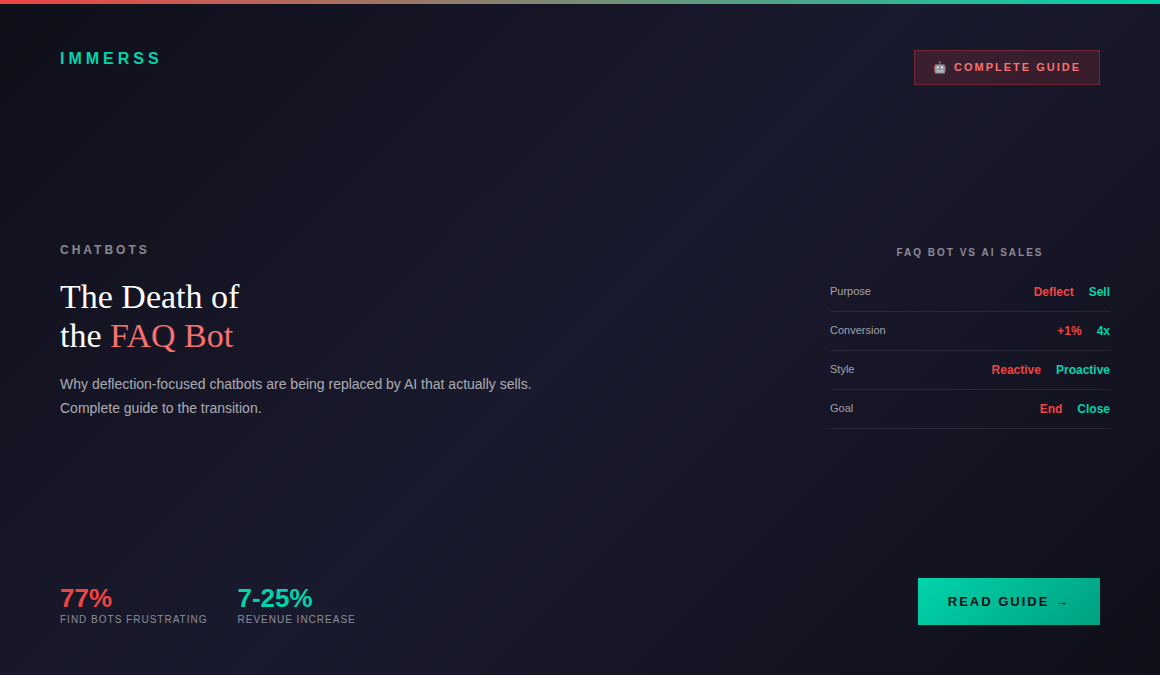
Despite this massive adoption, many e-commerce brands report that conversion rates remain unchanged after chatbot implementation. The reason: most are using support tools and expecting sales results.
Understanding the Fundamental Difference
Support Chatbots: Built for Cost Reduction
Tools like Gorgias, Zendesk, Tidio, and Intercom originated as helpdesk solutions. Their core purpose is reducing support costs through automation.
Design Philosophy:
- React to customer-initiated inquiries
- Deflect tickets from human agents
- Resolve issues efficiently
- Reduce cost per interaction
Primary Metrics:
- Ticket deflection rate
- First response time
- Resolution rate
- Support cost savings
Best Use Cases:
- Order tracking (“Where’s my package?”)
- Return processing
- FAQ responses
- Policy explanations
- Basic troubleshooting
Limitations for Sales:
- Reactive, not proactive
- No product expertise
- Not optimized for conversion
- Measures deflection, not revenue
AI Sales Agents: Built for Revenue Generation
AI Sales Agents are designed with a fundamentally different purpose: converting visitors into customers.
Design Philosophy:
- Proactively engage high-intent visitors
- Guide purchase decisions
- Recommend products based on behavior
- Close sales autonomously
Primary Metrics:
- Conversion rate
- Revenue per visitor
- Average order value
- Sales closed
Best Use Cases:
- Product recommendations
- Purchase guidance
- Objection handling
- Comparison assistance
- Checkout completion
Advantages Over Support Chatbots:
- Proactive engagement capability
- Product catalog expertise
- Sales conversation training
- Revenue-focused optimization
The Data: Support vs. Sales Performance
Research consistently shows different outcomes based on chatbot purpose:
Support Chatbot Performance
| Metric | Performance |
|---|---|
| FAQ deflection | 60-80% |
| Order tracking success | 70-85% |
| Return processing | 58% (Gartner) |
| Billing dispute resolution | 17% (Gartner) |
| Conversion impact | Minimal |
AI Sales Agent Performance
| Metric | Performance |
|---|---|
| Conversion rate lift | 23-67% |
| First-time shopper engagement | 64% of AI sales (Rep AI) |
| Cart abandonment recovery | Up to 35% |
| Purchase speed improvement | 47% faster |
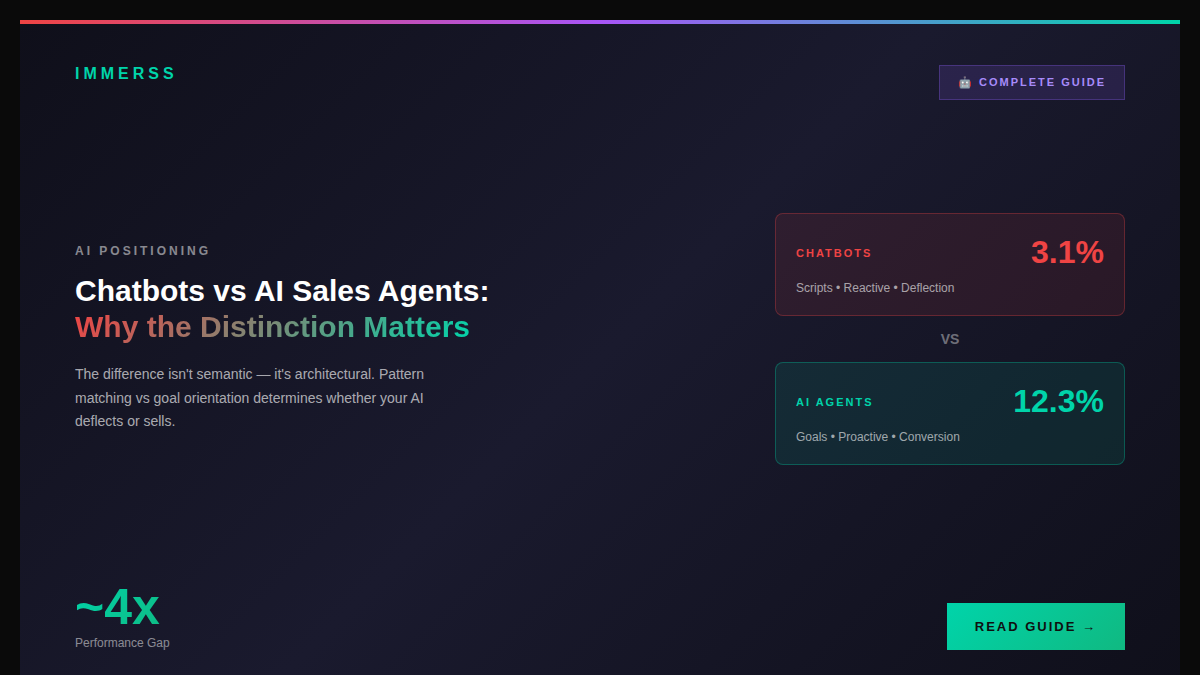
| Assisted conversion rate | 12.3% vs 3.1% unassisted |
The gap is significant: support chatbots excel at reducing costs but have minimal impact on conversion. AI Sales Agents directly drive revenue growth.
How AI Sales Agents Work
1. Behavioral Trigger System
Unlike support chatbots that wait for customer initiation, AI Sales Agents monitor visitor behavior and engage at high-intent moments:
Trigger Examples:
- Extended time on product page (>30 seconds)
- Multiple product comparisons
- Return visits to same product
- Cart inactivity
- Exit intent detection
2. Product Knowledge Engine
AI Sales Agents integrate deeply with product catalogs to provide expert-level recommendations:
Capabilities:
- Feature comparisons across products
- Personalized recommendations based on browsing history
- Complementary product suggestions
- Size/fit guidance
- Use case matching
3. Sales Conversation Framework
Trained specifically for sales interactions:
Conversation Elements:
- Need identification questions
- Benefit-focused responses
- Objection handling
- Social proof integration
- Urgency creation
- Clear calls to action
4. Autonomous Closing
AI Sales Agents can complete sales without human intervention:
- Guide through checkout process
- Apply relevant promotions
- Address last-minute concerns
- Confirm purchase decisions
- Process transactions 24/7
Implementation Framework: Using Both Tools Effectively
The Dual-System Approach
Most e-commerce sites benefit from both support and sales capabilities:
Support Layer (Gorgias, Zendesk, etc.):
- Order tracking and status
- Return/refund processing
- Policy questions
- Account issues
- Post-purchase support
Sales Layer (AI Sales Agents):
- Product discovery assistance
- Purchase decision guidance
- Cart recovery
- Upselling/cross-selling
- Checkout completion
Integration Architecture
Visitor Journey Map:

[Browsing] → AI Sales Agent engages
     ↓
[Considering] → Product recommendations
     ↓
[Deciding] → Objection handling, comparisons
     ↓
[Purchasing] → Checkout assistance
     ↓
[Post-Purchase] → Support chatbot for service needs
Handoff Protocols
Sales → Support: When an AI Sales Agent conversation reveals a support need (tracking, returns, complaints), seamlessly transfer to support system with full context.
Support → Sales: When a support interaction reveals purchase intent (“I’m also thinking about buying X”), flag for sales engagement or transfer to AI Sales Agent.
ROI Analysis: Support vs. Sales Investment
Support Chatbot ROI
Investment: Platform costs + setup + maintenance Returns:
- Reduced support headcount
- Lower cost per interaction
- Faster resolution times
- Improved support availability
Typical ROI: 10-30% reduction in support costs
AI Sales Agent ROI
Investment: Platform costs + integration + optimization Returns:
- Increased conversion rate
- Higher average order value
- 24/7 sales capability
- Better visitor engagement
Typical ROI Calculation:
| Metric | Before | After (20% lift) | Impact |
|---|---|---|---|
| Monthly visitors | 100,000 | 100,000 | — |
| Conversion rate | 3.0% | 3.6% | +20% |
| Orders | 3,000 | 3,600 | +600 |
| AOV | $100 | $110* | +10% |
| Revenue | $300,000 | $396,000 | +$96,000 |
*AI Sales Agents often increase AOV through recommendations
Typical ROI: 3-10x return on investment within first quarter
Evaluation Criteria for AI Sales Agents
When selecting an AI Sales Agent platform, evaluate:
1. Proactive Engagement Capability
- Can it initiate conversations based on behavior?
- What triggers are configurable?
- How natural is the engagement approach?
2. Product Catalog Integration
- How deeply does it understand your products?
- Can it make intelligent recommendations?
- Does it handle complex product relationships?
3. Sales Conversation Quality
- Is it trained for sales interactions?
- How does it handle objections?
- Can it create appropriate urgency?
4. Metrics and Analytics
- Does it track revenue metrics (not just support metrics)?
- Can you measure conversion impact directly?
- What optimization tools are available?
5. Autonomy Level
- Can it close sales without human intervention?
- What hours is it effective?
- How does it handle edge cases?
6. Integration Ecosystem
- Does it work with your e-commerce platform?
- How does it integrate with existing support tools?
- What data does it share across systems?
Immerss: Purpose-Built for Sales
Immerss was designed from the ground up as an AI Sales Agent platform, not a support tool with sales features added.
Core Capabilities
Proactive Engagement Engine
- Behavioral trigger system
- Exit intent detection
- Cart abandonment recovery
- Return visitor recognition
Product Intelligence
- Deep catalog integration
- Feature-based recommendations
- Complementary product suggestions
- Inventory-aware responses
Sales Conversation AI
- Trained on successful sales interactions
- Objection handling frameworks
- Social proof integration
- Urgency creation techniques
Revenue Analytics
- Conversion attribution
- Revenue per interaction
- AOV impact tracking
- A/B testing for engagement strategies
Integration Architecture
Immerss complements existing support tools rather than replacing them:
- Shopify — Native product catalog sync
- BigCommerce — Full feature integration
- Gorgias — Seamless support handoffs
- Klaviyo — Customer data enrichment
- Custom platforms — API integration available
Getting Started
Phase 1: Assessment (Week 1)
-
Audit current tools: What chatbots/AI do you currently use? What are they optimized for?
-
Identify gaps: Where are visitors dropping off? What sales opportunities are being missed?
-
Define success metrics: What would meaningful improvement look like? (Conversion rate? AOV? Revenue?)
Phase 2: Implementation (Weeks 2-3)
-
Deploy AI Sales Agent: Install on high-traffic pages, configure triggers
-
Integrate with catalog: Connect product data for intelligent recommendations
-
Set up analytics: Ensure revenue tracking is properly configured
Phase 3: Optimization (Ongoing)
-
Monitor performance: Track conversion impact, identify patterns
-
Refine engagement: Adjust triggers, messaging, and timing based on data
-
Expand coverage: Roll out to additional pages and use cases
Conclusion
The distinction between support chatbots and AI Sales Agents is fundamental:
Support chatbots excel at reducing costs through ticket deflection and automated responses. They’re essential for efficient customer service.
AI Sales Agents excel at increasing revenue through proactive engagement, product recommendations, and autonomous selling. They’re essential for conversion optimization.
Most e-commerce sites need both — but using only support tools and expecting sales results leads to disappointment.
For a side-by-side look at the named tools, see our sales-first alternative to Gorgias and Tidio.
Your website has support. The question is: does it have sales?