
Sales-First vs. Support-First: Understanding the Fundamental Difference in E-Commerce AI
A comprehensive guide to why design philosophy matters — and how to choose the right tools for revenue growth.
Executive Summary
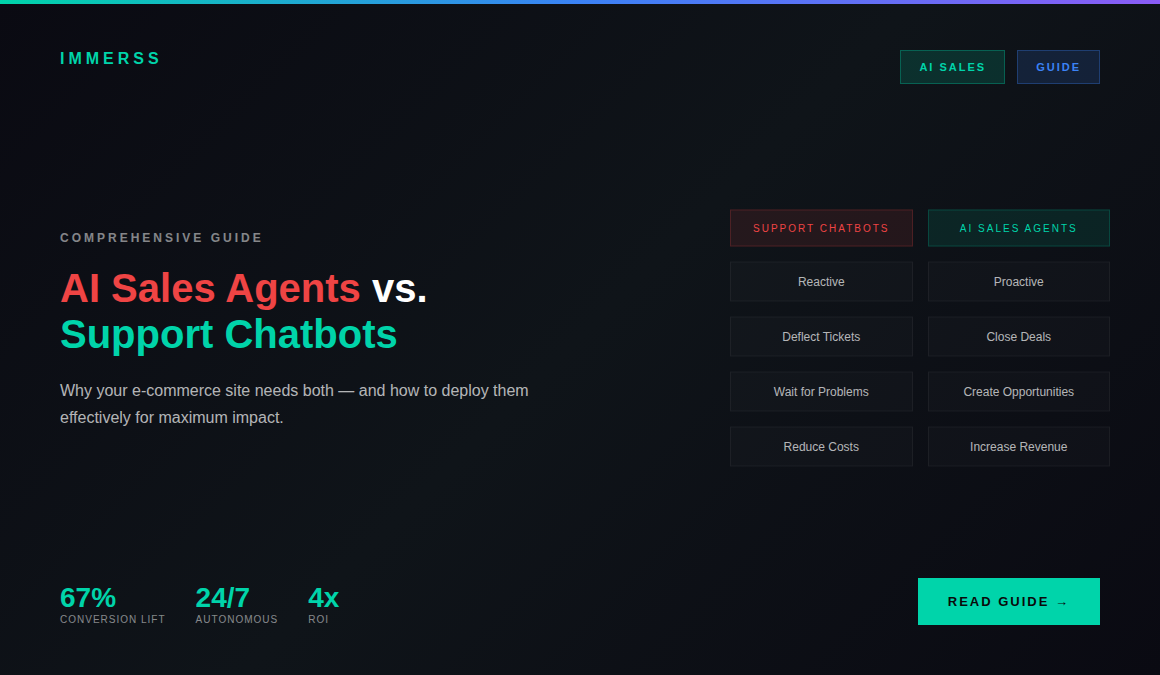
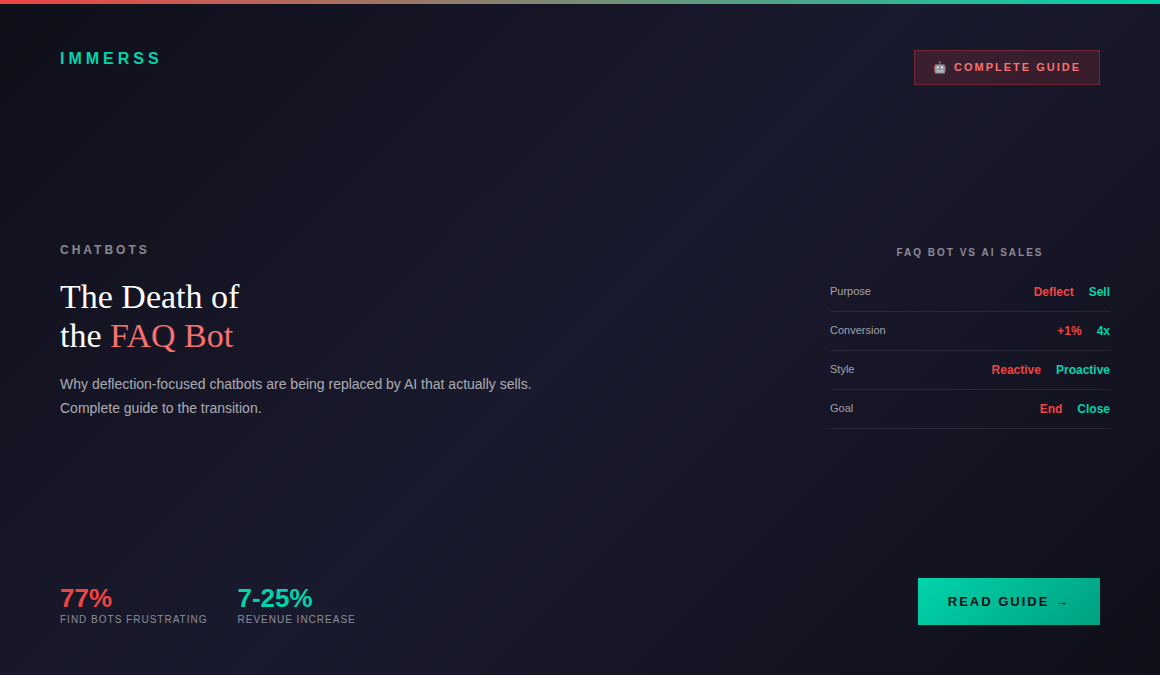
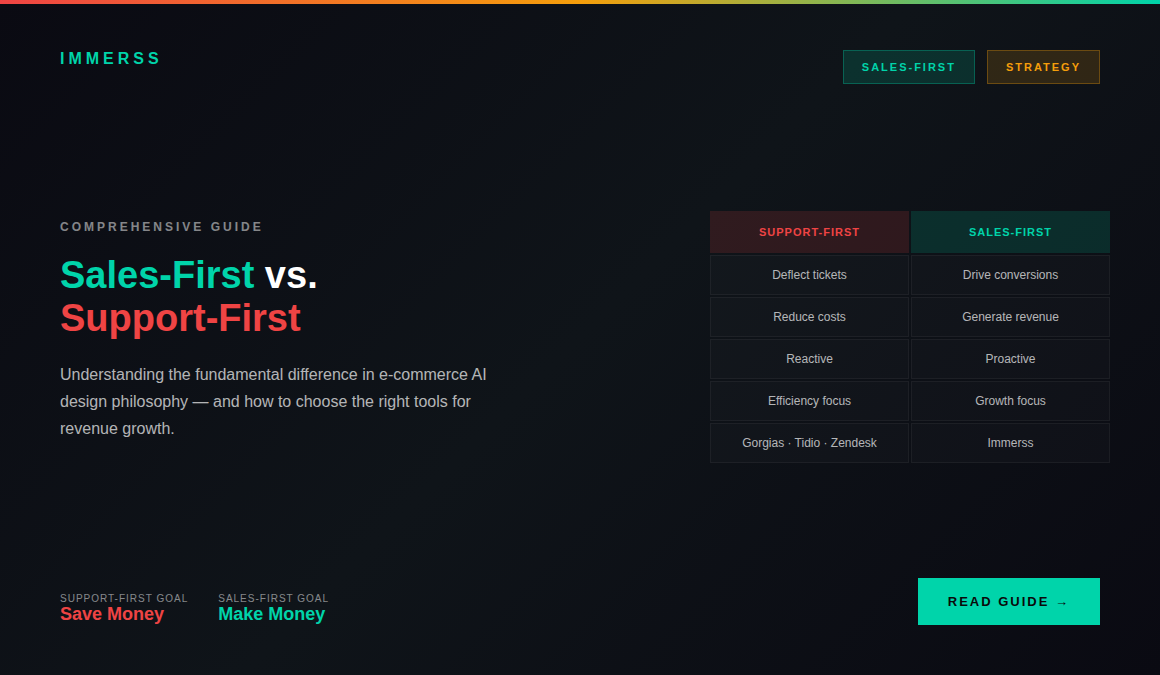
E-commerce chat and AI solutions fall into two distinct categories: support-first tools designed to deflect tickets and reduce costs (Gorgias, Tidio, Intercom, Zendesk), and sales-first tools designed to engage visitors and drive revenue (Immerss). This fundamental difference in design philosophy shapes everything from AI behavior to optimization metrics. This guide explains the distinction, provides data on performance differences, and offers a framework for implementing the right approach. See also our AI sales agent vs chatbot vs live commerce comparison.
Key insight: Support-first tools optimize for efficiency (doing less). Sales-first tools optimize for growth (doing more). Both are valuable, but they solve different problems.
The Two Philosophies
Support-First Design Philosophy
Support-first tools originate from the helpdesk and customer service industry. Their foundational purpose is reducing the cost of customer support through automation.
Core Assumptions:
- Customer contact is a cost to be minimized
- Success = fewer issues reaching human agents
- Chat is a support channel
- Efficiency is the primary goal
Design Priorities:
- Ticket deflection
- Fast resolution
- Cost reduction
- Workload reduction
Origin of Major Players:
| Tool | Origin | Core Purpose |
|---|---|---|
| Gorgias | Helpdesk platform | Support ticket management |
| Zendesk | Ticket management system | Customer service automation |
| Intercom | Customer messaging | Communication & support |
| Tidio | Live chat solution | FAQ automation |
Sales-First Design Philosophy
Sales-first tools are built specifically for revenue generation. Their foundational purpose is converting visitors into customers through proactive engagement.
Core Assumptions:
- Visitor engagement is an opportunity to be maximized
- Success = more conversions and higher revenue
- Chat is a sales channel
- Growth is the primary goal
Design Priorities:
- Conversion optimization
- Proactive engagement
- Revenue attribution
- Average order value increase
How Philosophy Shapes Behavior
The design philosophy fundamentally changes how AI behaves in practice:
Support-First Behavioral Patterns
| Behavior | Description |
|---|---|
| Reactive engagement | Waits for visitor to initiate contact |
| Question-answering focus | Responds to what’s asked, nothing more |
| Conversation minimization | Aims to resolve and close quickly |
| Problem orientation | Activates when issues arise |
| Efficiency optimization | Seeks shortest path to resolution |
Typical Support-First Interaction:
Visitor: What's your return policy?
Bot: We offer 30-day returns on all items. Would you like more details?
Visitor: No, that's fine.
Bot: Great! Is there anything else I can help with?
Visitor: No thanks.
[Conversation ends]
Outcome: Question answered efficiently. No sales impact.
Sales-First Behavioral Patterns
| Behavior | Description |
|---|---|
| Proactive engagement | Identifies opportunities and initiates contact |
| Recommendation focus | Actively suggests products based on behavior |
| Conversation expansion | Looks for ways to add value and increase order |
| Opportunity orientation | Activates when purchase potential is detected |
| Growth optimization | Seeks highest-value outcome |
Typical Sales-First Interaction:
[Visitor has viewed product page for 60 seconds]
Bot: I noticed you're looking at the Milano leather jacket —
     it's one of our bestsellers. Are you looking for
     something for a specific occasion?
Visitor: Yeah, for a wedding next month.
Bot: Great choice! This style works perfectly for weddings.
     Many customers pair it with our silk pocket square
     collection. Would you like to see the matching options?
Visitor: Sure, show me.
[Bot presents complementary products]
[Visitor adds jacket + pocket square to cart]
Outcome: Proactive engagement → Product recommendation → Upsell → Conversion
Metrics Comparison
The philosophical difference is most visible in what each approach measures and optimizes:
Support-First Metrics
| Metric | Definition | Why It Matters (Support) |
|---|---|---|
| Ticket Deflection Rate | % of issues resolved without humans | Reduces support costs |
| First Response Time | Speed of initial bot response | Improves satisfaction |
| Resolution Rate | % of issues fully resolved | Efficiency measure |
| Cost Per Interaction | Total cost / conversations | Budget optimization |
| CSAT (Support) | Satisfaction with support experience | Quality measure |
Sales-First Metrics
| Metric | Definition | Why It Matters (Sales) |
|---|---|---|
| Conversion Rate | % of engaged visitors who purchase | Direct revenue indicator |
| Revenue Per Visitor | Revenue generated / visitors engaged | Growth efficiency |
| Assisted Revenue | Sales involving AI interaction | Contribution to top line |
| AOV Lift | Order value increase with AI assistance | Revenue maximization |
| Cart Recovery Rate | % of abandoned carts recovered | Revenue recapture |
The Performance Gap
Research data shows substantial differences in business impact:
| Outcome | Support-First | Sales-First |
|---|---|---|
| Conversion rate impact | +0.2-0.5% | +3-10% |
| AOV impact | Neutral | +15-30% |
| Cart recovery | Limited | Up to 35% |
| Revenue attribution | Indirect | Direct |
| ROI calculation | Cost savings | Revenue growth |
Use Case Analysis
Where Support-First Excels
Support-first tools are the right choice for:
Post-Purchase Support
- Order tracking and status updates
- Return/refund processing
- Shipping inquiries
- Policy questions
Issue Resolution
- Product problems
- Billing disputes
- Account issues
- Technical support
Volume Management
- FAQ automation
- Ticket routing
- Agent workload reduction
Where Sales-First Excels
Sales-first tools are the right choice for:
Pre-Purchase Engagement
- Product discovery assistance
- Comparison guidance
- Size/fit recommendations
- Feature explanations
Conversion Optimization
- High-intent visitor engagement
- Cart abandonment recovery
- Checkout assistance
- Objection handling
Revenue Maximization
- Cross-selling and upselling
- Bundle recommendations
- Promotional offers
- Urgency creation
The Integration Framework
Most e-commerce operations benefit from both approaches working together:
Dual-Layer Architecture
┌─────────────────────────────────────────────────────┐
│                  VISITOR JOURNEY                     │
├─────────────────────────────────────────────────────┤
│                                                      │
│  BROWSING → CONSIDERING → DECIDING → PURCHASING     │
│      │           │            │           │         │
│      └───────────┴────────────┴───────────┘         │
│                      ↓                               │
│            ┌─────────────────┐                       │
│            │  SALES-FIRST    │                       │
│            │    (Immerss)    │                       │
│            └─────────────────┘                       │
│                                                      │
├─────────────────────────────────────────────────────┤
│                                                      │
│  POST-PURCHASE: TRACKING → ISSUES → RETURNS         │
│                      ↓                               │
│            ┌─────────────────┐                       │
│            │  SUPPORT-FIRST  │                       │
│            │   (Gorgias)     │                       │
│            └─────────────────┘                       │
│                                                      │
└─────────────────────────────────────────────────────┘
Handoff Protocols
Sales → Support: When a sales conversation reveals a support need (order status, return request), seamlessly transfer to support system with full context.
Support → Sales: When a support conversation reveals purchase intent (“I’m also interested in…”), flag for sales engagement or transfer to sales-first system.
Data Sharing
Both layers should share:
- Customer identification
- Conversation history
- Purchase history
- Behavioral data
This enables contextual continuity across the entire customer journey.
ROI Analysis
Support-First ROI Model
Investment: Platform subscription + implementation + maintenance
Returns:
- Reduced support headcount (or avoided hiring)
- Lower cost per ticket
- Faster resolution times
- Improved support availability
Typical ROI Calculation:
Support cost savings = (Tickets deflected × Cost per human ticket)
                      - Platform cost

Example:
- 5,000 tickets/month deflected
- $8 cost per human ticket
- $500/month platform cost

ROI = (5,000 × $8) - $500 = $39,500/month in savings
Sales-First ROI Model
Investment: Platform subscription + implementation + optimization
Returns:
- Increased conversion rate
- Higher average order value
- Recovered cart abandonment
- Attributed revenue growth
Typical ROI Calculation:
Revenue impact = (Additional conversions × AOV)
               + (Recovered carts × Recovery AOV)
               + (AOV lift × Total orders)

Example:
- 100,000 visitors/month
- 20% engagement rate = 20,000 engaged
- 25% conversion on engaged = 5,000 conversions
- Baseline without AI: 3,000 (at 3% overall CVR)
- Net additional: 2,000 orders
- $150 AOV

ROI = 2,000 × $150 = $300,000/month in revenue
Comparative Analysis
| Factor | Support-First | Sales-First |
|---|---|---|
| Investment type | Cost center | Revenue center |
| ROI ceiling | Limited by support volume | Scales with traffic |
| Measurement | Savings | Growth |
| Strategic value | Operational efficiency | Competitive advantage |
Implementation Guide
For Brands Currently Support-First Only
Phase 1: Assessment (Week 1)
- Audit current chat tool capabilities
- Identify pre-purchase engagement opportunities
- Map high-intent visitor behaviors
- Calculate potential conversion impact
Phase 2: Sales-First Addition (Weeks 2-3)
- Deploy Immerss on high-traffic product pages
- Configure proactive engagement triggers
- Set up product recommendation engine
- Establish revenue tracking
Phase 3: Integration (Week 4)
- Connect sales and support systems
- Define handoff protocols
- Establish shared data pipelines
- Train team on dual-system operation
Phase 4: Optimization (Ongoing)
- A/B test engagement approaches
- Refine triggers based on conversion data
- Expand to additional pages/categories
- Continuous improvement based on metrics
Key Success Factors
Clear ownership: Assign sales-first to revenue/growth team, support-first to CX team.
Distinct metrics: Don’t blend measurements. Track each layer separately.
Appropriate expectations: Don’t expect support tools to drive sales or sales tools to handle support volume.
Integration quality: Seamless handoffs prevent customer friction.
Choosing the Right Approach
Decision Framework
| If Your Priority Is… | Choose… |
|---|---|
| Reducing support costs | Support-first (Gorgias, Zendesk) |
| Increasing conversion rate | Sales-first (Immerss) |
| Managing ticket volume | Support-first |
| Engaging high-intent visitors | Sales-first |
| Post-purchase experience | Support-first |
| Pre-purchase guidance | Sales-first |
| Both growth AND efficiency | Dual-layer approach |
Evaluation Criteria for Sales-First Tools
When selecting a sales-first solution, evaluate:
-
Proactive engagement capability
- Behavioral trigger system
- Intent detection accuracy
- Engagement timing optimization
-
Product intelligence
- Catalog integration depth
- Recommendation quality
- Cross-sell/upsell logic
-
Conversion optimization
- Cart recovery features
- Checkout assistance
- Objection handling
-
Revenue attribution
- Conversion tracking
- AOV impact measurement
- Full-funnel analytics
-
Integration ecosystem
- E-commerce platform compatibility
- Support tool integration
- Data sharing capabilities
Immerss: Built Sales-First
Immerss was designed from the ground up with a sales-first philosophy. Every feature, metric, and optimization prioritizes revenue generation.
Core Differentiators
Proactive Engagement Engine
- Behavioral trigger system identifies high-intent moments
- Intent detection initiates conversations at optimal timing
- Engagement approach adapts to visitor behavior patterns
Product Intelligence
- Deep catalog integration for accurate recommendations
- Cross-sell and upsell logic based on purchase patterns
- Real-time inventory awareness
Revenue Optimization
- Cart abandonment recovery sequences
- Checkout assistance for completion
- AOV maximization through strategic recommendations
Full Attribution
- Direct conversion tracking
- Revenue impact measurement
- ROI calculation and reporting
Integration with Support Tools
Immerss complements existing support infrastructure:
- Gorgias integration: Seamless handoff for support needs
- Zendesk compatibility: Shared customer context
- Data synchronization: Unified customer view
Conclusion
The distinction between sales-first and support-first isn’t a minor feature difference — it’s a fundamental divergence in purpose that shapes every aspect of how these tools work.
Support-first tools (Gorgias, Tidio, Intercom, Zendesk):
- Built to deflect tickets and reduce costs
- Optimize for efficiency and savings
- Reactive by design
- Measure success by cost reduction
Sales-first tools (Immerss):
- Built to engage visitors and generate revenue
- Optimize for conversion and growth
- Proactive by design
- Measure success by revenue impact
Most e-commerce operations benefit from both — but using the right tool for the right job.
Don’t expect support-first tools to drive sales. Don’t expect sales-first tools to manage ticket volume.
If you’re weighing a specific switch, our sales-first alternative to Gorgias and Tidio compares the named tools side by side.
The tools you choose shape the outcomes you get.