
The Death of the Product Grid
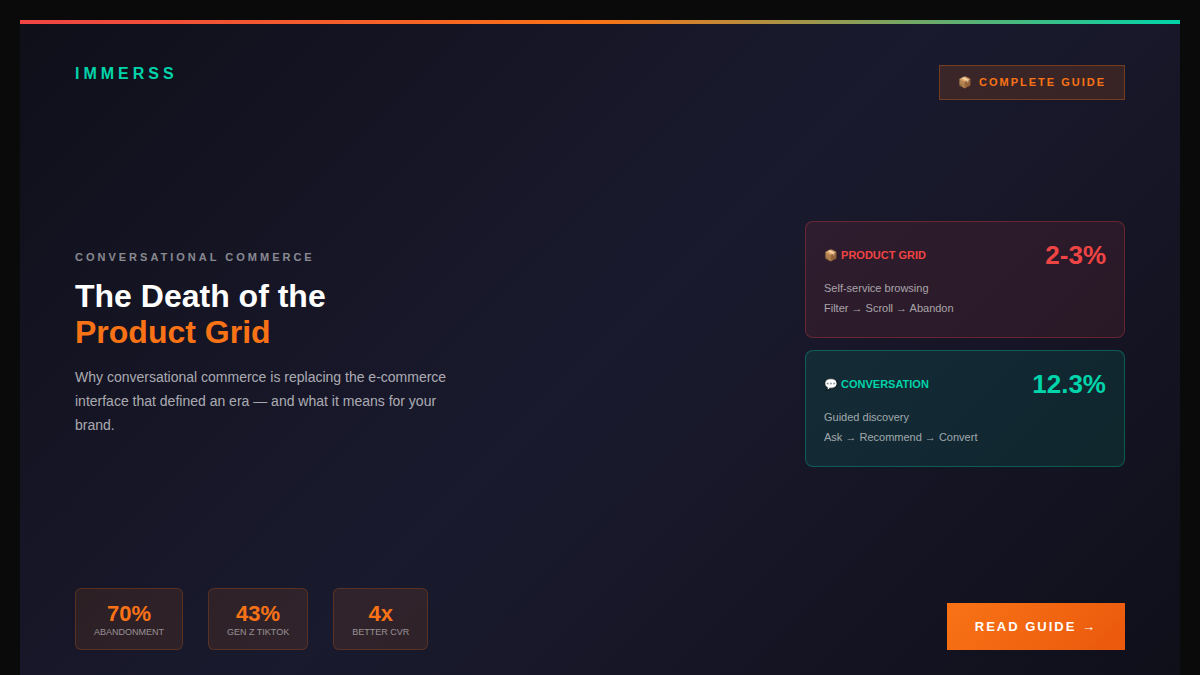
Why conversational commerce is replacing the e-commerce interface that defined an era — and what it means for your brand.
Executive Summary
For twenty-five years, the product grid — rows and columns of product images with filters and sort options — has been the dominant interface for online shopping. It seemed natural because it mimicked physical retail: the organized shelf, the catalog page.
But the product grid made a fundamental assumption that’s increasingly wrong: that customers know what they want and just need help finding it.
The data reveals the problem. Average e-commerce conversion rates sit between 2% and 3%. Cart abandonment runs at 70%. Most visitors browse, scroll, and leave without buying. The grid puts the cognitive burden on customers — and they abandon under that burden.
A new paradigm is emerging. Conversational commerce, powered by AI, replaces the grid’s self-service model with guided discovery. Instead of presenting everything and asking customers to filter, it understands what they need and presents curated options. Instead of static product pages, it offers dialogue.
The results speak clearly. AI-engaged shoppers convert at a dramatically higher rate than self-service browsers. Conversational search outperforms keyword search. The product grid isn’t broken exactly — it’s just losing to something better.
This guide examines why the grid is dying, what’s replacing it, and how brands should respond.
Part 1: The Product Grid’s Design Assumptions
How the Grid Works
The product grid interface follows a predictable pattern. Customers land on a category page showing dozens or hundreds of products in thumbnail format. Filter options on the left or top let them narrow by price, size, color, brand, and various attributes. Sort options arrange results by relevance, price, popularity, or recency.
Customers browse the grid, click products that interest them, view product detail pages, and decide whether to add items to cart. The process repeats until they’re ready to checkout — or abandon.
This interface works well for a specific type of shopping: when customers know what they want and just need to find it. A customer searching for “iPhone 15 case” has clear intent. The grid helps them browse options, compare, and choose.
Where the Grid Fails
But much shopping isn’t like this. Customers often explore without clear intent. They know they want a gift but not which one. They know they need something for an occasion but not what style. They recognize a problem but don’t know which product solves it.
For this type of shopping — which represents the majority of e-commerce visits — the grid fails. It presents everything without guidance. It requires customers to understand category structures, filter taxonomies, and product attributes well enough to narrow options effectively. It demands decision-making under uncertainty.
Consider what the grid asks customers to do. First, understand the category well enough to use filters. What’s the difference between “moisture-wicking” and “quick-dry” fabrics? Is 18K or 14K gold better for everyday wear? Does “true to size” mean the same thing across brands?
Second, compare products based on specifications, images, and reviews. Scroll through dozens of options. Open multiple tabs. Remember which product had which feature.
Third, make a decision with incomplete information. Will this actually look good on me? Will this fit in my space? Will this solve my problem?
Fourth, trust that the decision is right despite uncertainty. Hope that the reviews are accurate. Assume that the product matches the photos.
At each step, customers can abandon. The data shows they do — at staggering rates.
The Conversion Crisis
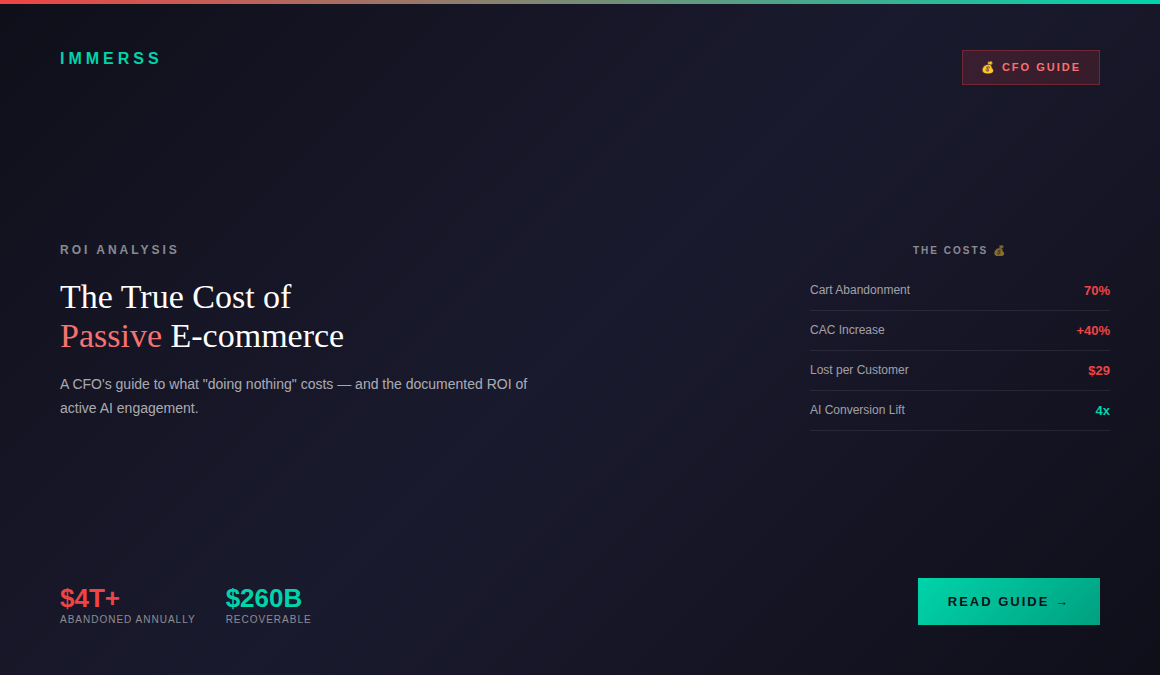
Average e-commerce conversion rates globally hover between 1.9% and 3%. This means 97-98% of visitors leave without buying. Cart abandonment averages 70.19% according to Baymard Institute, with mobile abandonment approaching 79%.
For luxury and high-consideration purchases, the numbers are worse. Jewelry and luxury fashion see cart abandonment exceeding 80%. The higher the stakes, the more customers hesitate — and the grid offers no help with that hesitation.
The product grid puts the cognitive burden entirely on the customer. They do the work. They bear the uncertainty. They take the risk. And mostly, they leave.
Part 2: How People Actually Shop
The Physical Retail Comparison
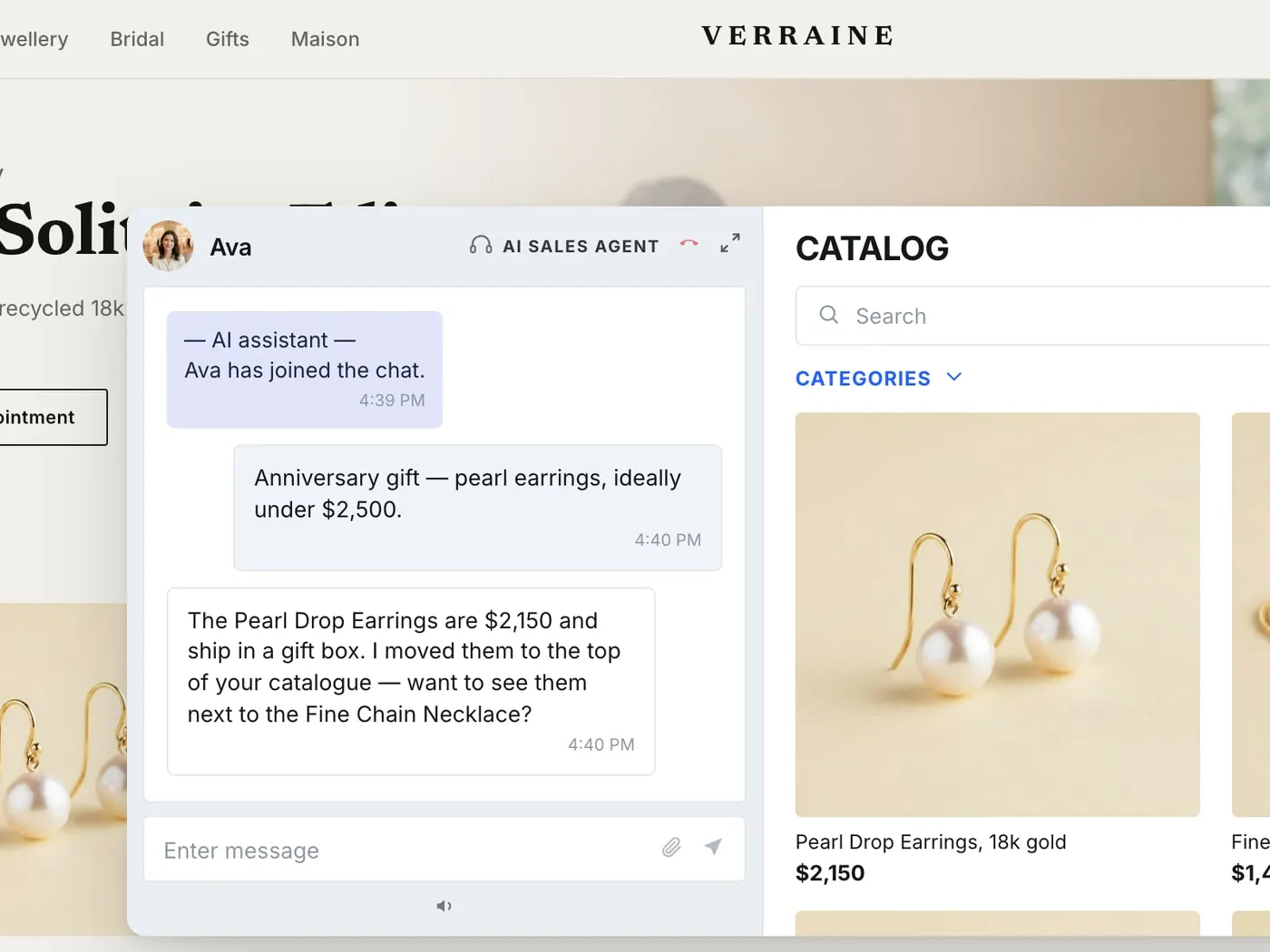
In physical retail, shopping works differently. A customer walks into a jewelry store looking for an anniversary gift. A salesperson approaches, asks questions: What’s your budget? What does she typically wear? Does she prefer bold or subtle pieces? Gold or silver?
Based on the answers, the salesperson presents three or four options — not three hundred. They explain why each piece might work for this specific situation. They address concerns. They help the customer feel confident about the decision.
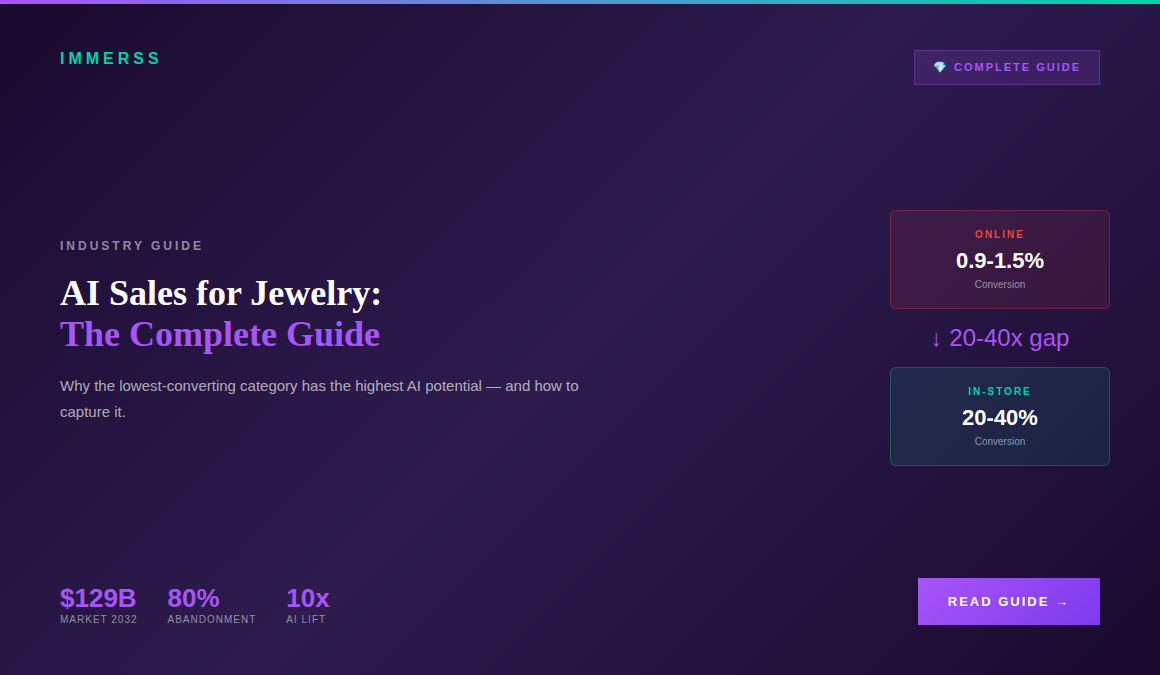
The conversion rate for this type of interaction is dramatically higher. In-store retail converts at 20-40%, compared to 2-3% for e-commerce product grids.
Why Guided Discovery Works
The difference isn’t the products. It’s the experience. Guided discovery outperforms self-service browsing for several interconnected reasons.
It reduces cognitive load. Instead of evaluating hundreds of options, customers consider a curated few. The salesperson’s expertise filters options before presentation.
It builds confidence. When an expert recommends something, customers feel better about the decision. The recommendation carries implicit validation that browsing lacks.
It addresses uncertainty. Customers can ask questions and get answers. Concerns surface and get resolved rather than festering into abandonment.
It creates emotional connection. The conversation itself changes the shopping experience from transactional to relational. Customers feel helped rather than left to figure things out alone.
The product grid offers none of this. It’s a self-service interface that assumes customers want to do the work themselves. Some do. Most don’t.
Part 3: The Conversational Commerce Revolution
Discovery Moving from Search to Conversation
The way people discover products online is fundamentally changing.
Research shows 43% of Gen Z consumers now start their product searches on TikTok rather than Google or Amazon. They’re not looking for search results — they’re looking for recommendations, demonstrations, and context. They want to be shown what’s good, not presented with everything and asked to figure it out.
This behavioral shift reflects a deeper truth: shoppers don’t think in keywords. Traditional e-commerce search requires customers to translate their needs into the right search terms, then parse results that may or may not match what they actually meant. Conversational interfaces remove this translation layer.
When shoppers can describe what they need in natural language — “comfortable running shoes for wide feet under $120” or “a gift for my mother who likes gardening but already has all the basic tools” — and receive curated recommendations, they convert at higher rates than those browsing product grids.
The Data on Conversational Commerce
The numbers reflect the shift’s magnitude.
Site search users convert 2-3x higher than non-searchers — and conversational search outperforms keyword search. AI-powered personalization increases revenue by 10-25%. Personalized calls-to-action convert 42% more visitors than generic ones.
Amazon’s Rufus AI assistant already influences 40% of purchase decisions on the platform. This represents the largest e-commerce platform in the world shifting toward conversational discovery.
AI chatbots drove 28% more shopper referrals during Black Friday 2025 than the previous year. The trend is accelerating.
Research from multiple sources shows 49% of Americans say AI recommendations already influence what they buy, and 64% are willing to purchase items recommended by generative AI.
What Conversational Commerce Looks Like
The emerging model for product discovery looks fundamentally different from the product grid.
Instead of presenting everything and asking customers to filter, it starts by understanding what they need. Natural language processing lets customers describe their situation in plain terms and receive targeted recommendations.
Instead of static product pages, it offers guided exploration. Customers can ask follow-up questions, compare options, and get advice tailored to their specific situation.
Instead of one-size-fits-all presentation, it adapts to individual preferences. Returning customers see recommendations informed by their purchase history. New customers are guided based on their expressed needs.
The shift is described as moving from search to conversation. Search is transactional. Conversation is consultative. Search assumes you know what you want. Conversation helps you figure it out.
Part 4: Why the Grid Persists — and Why That’s Changing
Infrastructure and Habit
If conversational commerce converts better, why do product grids remain dominant?
Partly, infrastructure. E-commerce platforms were built around the grid paradigm. Category pages, filter systems, and product listing templates are deeply embedded in how platforms work. Changing to conversational interfaces requires significant technical investment.
Partly, measurement. Organizations optimize what they measure. If metrics focus on traffic, page views, and time on site, the grid looks acceptable. Only when measurement shifts to conversion and revenue does the grid’s weakness become apparent.
Partly, habit. Both retailers and customers are accustomed to the grid. It’s familiar, predictable, and understood. Change requires effort that organizations may resist, and customer education that takes time.
Competitive Pressure Forces Change
But competitive pressure is forcing reassessment. When AI-driven interfaces convert at a dramatically higher rate than traditional grids, the economics become impossible to ignore.
The conversion gap creates a strategic disadvantage that compounds over time. Brands with higher conversion rates can afford higher customer acquisition costs, invest more in product quality, and reinvest margins into growth. Brands stuck at 2-3% conversion lose ground.
The shift is already visible among leading retailers. Amazon’s Rufus represents conversational commerce at massive scale. Beauty retailers like Sephora deploy AI assistants for guided discovery. Luxury brands embrace one-to-one video shopping. What all of these have in common is that the shopper can ask something, and the answer arrives before they leave.
The pattern is clear: the brands adapting to conversational commerce are outperforming those clinging to product grids.
Part 5: Strategic Implications
Product Data as Competitive Advantage
Conversational commerce requires rich, structured product data. Traditional catalogs organized by category and specification aren’t sufficient. Products need attribute data that AI systems can use to match customer needs with appropriate options.
This means going beyond basic specifications to capture use cases, occasions, customer segments, and contextual information. When a customer asks “what’s a good gift for someone who has everything,” the system needs data that connects products to gift-giving contexts.
Brands with complete, well-structured product information gain advantage in conversational discovery. Brands with sparse or inconsistent data become invisible to AI systems that guide recommendations.
Engagement Models Must Evolve
The passive “build it and they will come” approach of product grids gives way to proactive engagement. AI sales agents that reach out to browsing customers, ask questions, and guide discovery convert far better than hoping customers figure things out themselves.
This represents a philosophical shift. The grid assumes customer self-sufficiency. Conversational commerce assumes customers benefit from assistance. The data supports the latter assumption.
Success Metrics Change
Traffic and page views mattered for advertising-supported or grid-based models. For conversational commerce, what matters is engagement quality, conversion rate, and customer lifetime value.
The shift requires new analytics capabilities. Understanding which conversation patterns lead to conversion, how AI recommendations perform, and where dialogue breaks down becomes essential.
Experience Becomes Differentiator
When everyone has product grids, the experience is commodity. Customers can’t distinguish between grid interfaces — they all look essentially the same.
When some brands offer guided discovery while others don’t, experience becomes competitive advantage. The brand that helps customers find what they need earns loyalty that grid-based competitors cannot match.
Part 6: The Human Element
AI Makes Shopping More Human
There’s an irony in AI-driven conversational commerce: it makes online shopping feel more human.
Product grids are mechanical. Browse, filter, click, scroll. There’s no relationship, no guidance, no adaptation to individual needs. The interface treats every customer identically regardless of their situation or preferences.
Conversational interfaces, whether AI-powered or human, restore the consultative element that physical retail always had. They acknowledge that buying is often uncertain, that customers benefit from guidance, and that the best shopping experiences involve dialogue rather than catalog browsing.
The Spectrum of Assistance
This doesn’t mean eliminating self-service. Customers have different needs at different moments.
Some know exactly what they want and prefer to find it quickly. A repeat purchase of a known product doesn’t need conversation. The grid serves this situation fine.
Others explore without clear intent. They benefit from guidance, questions, and recommendations. Conversation serves them better.
Still others make high-consideration purchases where confidence matters. They need the human touch — whether from AI that feels human or actual humans through video shopping.
The best commerce experiences adapt to where customers are on this spectrum rather than forcing everyone through the same interface.
Part 7: The Immerss Approach
Combining AI Sales with Live Video
Immerss addresses the product grid’s limitations through a combination of AI sales agents and live video shopping.
AI sales agents provide 24/7 conversational commerce at scale. They engage browsing customers, understand needs through dialogue, recommend products, handle objections, and guide toward purchase. They convert at rates that make traditional grids look antiquated.
Live video shopping adds human connection for high-consideration purchases. When customers want to see products demonstrated, ask questions in real time, and feel confident about significant purchases, human interaction delivers what AI alone cannot.
The combination covers the full spectrum — from quick automated assistance to deep consultative selling.
From Grid to Guided Discovery
The Immerss approach transforms product discovery from self-service browsing to guided experience.
Instead of presenting grids and hoping customers figure things out, AI sales agents proactively engage visitors. They ask questions to understand needs. They present curated recommendations with explanation. They address concerns before they become abandonment.
The result is conversion rates that reflect guided discovery’s advantage over self-service grids. Customers find what they need faster. They buy with more confidence. They return more often.
Conclusion: The Grid’s Twilight
The product grid won’t disappear overnight. It will remain for quick repurchases, commodity items, and customers who prefer self-service.
But for discovery, exploration, and high-value purchases, the grid is already losing to conversation. The 2-3% conversion that grids deliver can’t compete with what conversational commerce achieves.
The brands adapting to this shift are building competitive advantages that will compound over time. Higher conversion rates fund better products, better marketing, and better customer experiences. Lower conversion rates create a spiral of underinvestment and competitive decline.
The question isn’t whether conversational commerce will replace the product grid for most shopping occasions. The data makes that trajectory clear.
The question is whether your brand will lead the transition or be forced to follow after competitors have already captured the advantage.