
How To Make The Generational Handoff Work In Fine Jewelry
For family-owned fine jewelry businesses approaching a generational transition, the conventional succession-planning literature has been giving advice that does not match the operational reality of the current category pressures. The literature treats the question as primarily emotional or financial — does the successor want it, can the transition be funded — and misses the structural question that actually determines whether the handoff produces a viable business or a slow decline.
This piece is for both generations: the incumbent owner planning the eventual transition and the next-generation successor evaluating whether to accept it. It covers what the structural question actually is, what the digital-era reality has been doing to the business model for the last fifteen years, what has changed in the last twelve months, and what a successful generational handoff looks like operationally now.
The Structural Question
The question that actually determines whether a generational handoff produces a viable business is not whether the successor wants the business. It is whether the business model itself has a viable next chapter that the successor can credibly run forward.
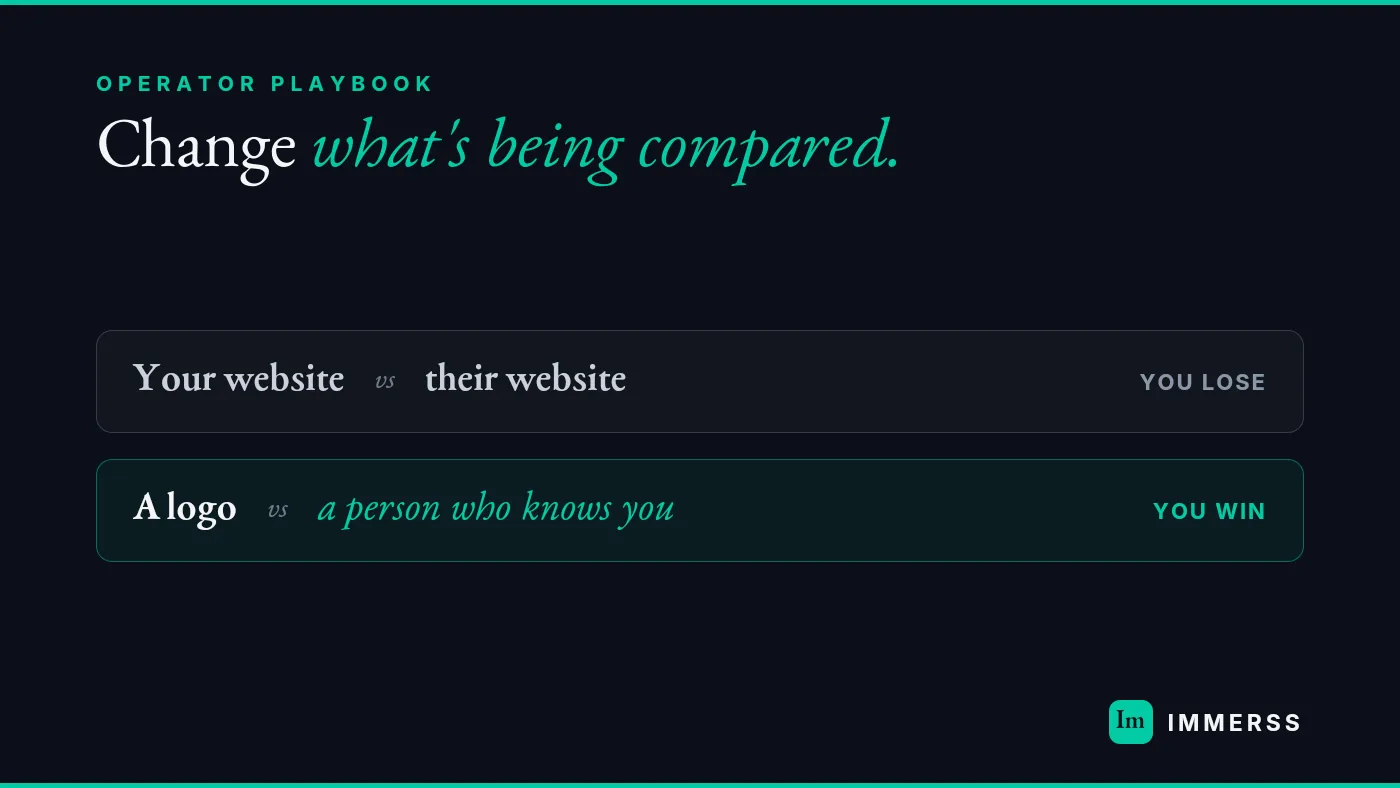
For most of the last fifteen years, the honest answer to this question has been uncertain in ways that the older generation has not always wanted to acknowledge. The conventional digital playbook has been failing for multi-generational fine jewelry businesses. The website looks generic. The SEO is a losing battle. The social media is indistinguishable from competitors. The relational asset that defines the business value is not visible on the digital surface at all.
For the older generation, this erosion has been mostly invisible because their customer base — their generation, their personal network — still walks in. For the next generation, the erosion is clearly visible because their generation does not walk in, will not walk in, and will not be the walk-in customer base when they are running the business in fifteen years.
This is what makes the succession decision structurally different from the way the literature treats it. The next-generation successor is not deciding whether to inherit the current business. They are deciding whether they want to be the steward of a structural decline that the conventional playbook does not resolve.
When the conventional answer is no — when the model is unviable for the channel the next generation will need to serve — the rational decision for the successor is to decline. This is what has been happening, quietly, across the country for fifteen years.
The Three Failure Modes Of Conventional Succession
When the strategic question goes unanswered and the handoff is executed anyway, three failure modes consistently emerge:
The successor inherits and replicates. The next generation comes in committed to honoring what was built and runs the business essentially the way the older generation ran it. The strategic decline continues. The successor spends ten or fifteen years presiding over the same erosion the older generation was experiencing, eventually closing the business or selling at a substantial discount.
The successor inherits and rebuilds. The next generation comes in with the analytical clarity of a professional career and decides to modernize. The brand gets redesigned. The inventory gets updated. The aesthetic gets refreshed. The relational asset — which was the actual value — gets eroded in the process, because it was tied to the specific identity the older generation built. Customers who chose the business specifically for that identity drift away. The business becomes another generic mid-tier jeweler competing on price.
The successor declines. The next generation, looking at the structural reality honestly, declines to take over. The business closes or sells. The community loses the jeweler. The asset built across three generations is extracted at a discount.
All three failure modes share a common root cause: the strategic question of whether the business model has a viable next chapter has not been resolved before the succession decision was made. Without that resolution, the successor is being asked to take on a problem that cannot be solved by either replication or reinvention.
What Has Operationally Changed
In the last twelve months, the strategic question has acquired a meaningfully different answer than it had for the previous fifteen years.
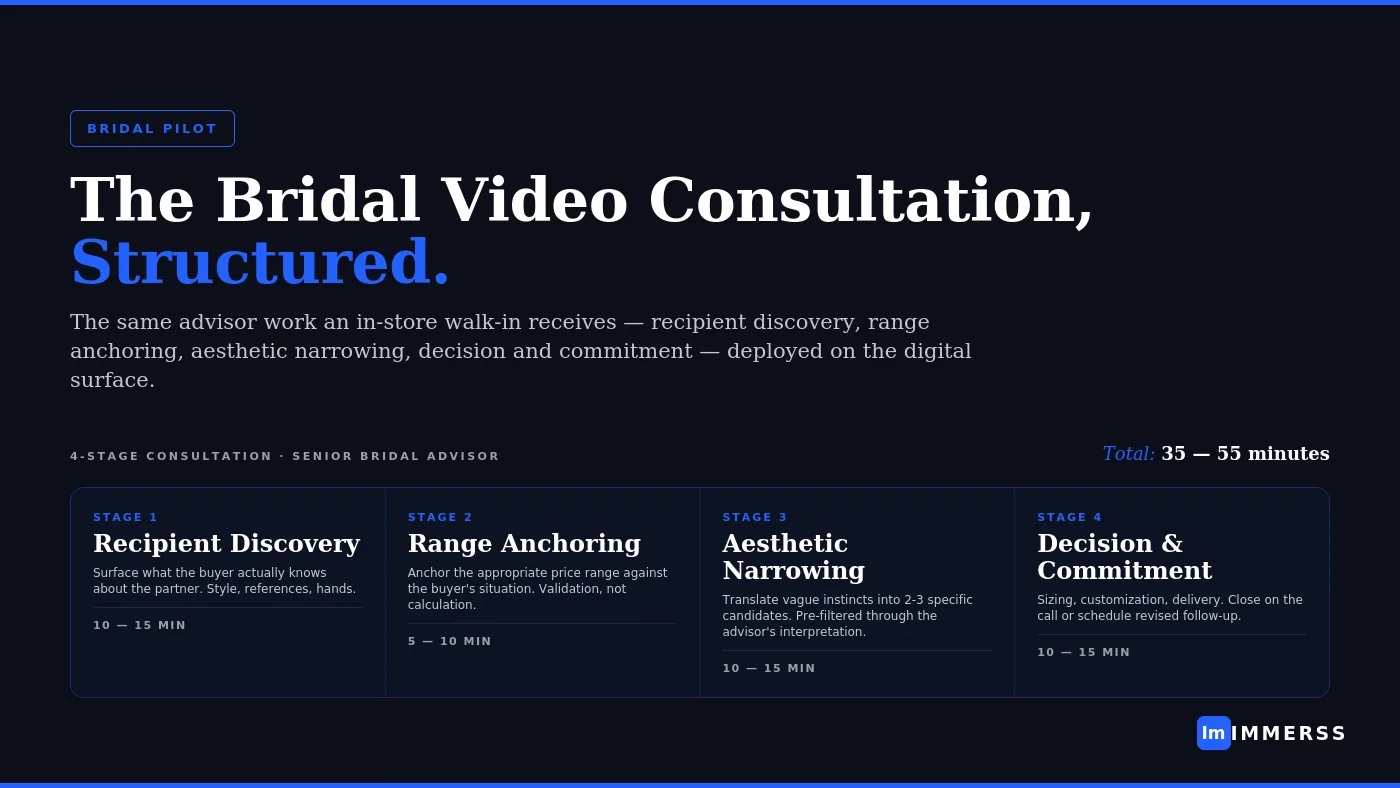
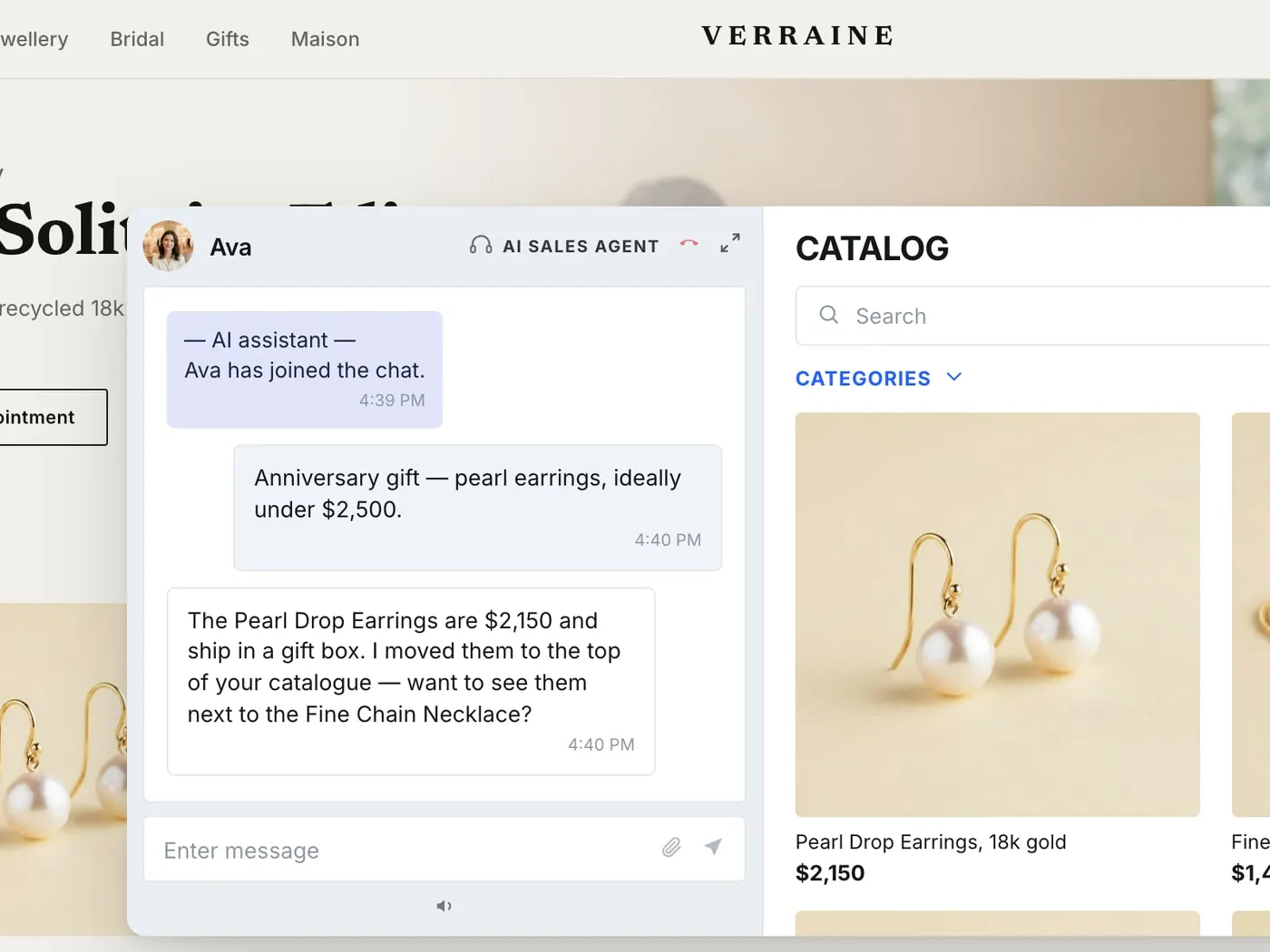
The shift is operational: the relational asset the older generation built can now be deployed on the digital channel where the next generation’s customer base actually lives. The mechanics are clean. An AI sales agent on the storefront — the one we assemble for jewelry and watch brands — recognizes high-intent customers in session signals — extended dwell on relational categories, returning visits, milestone-window timing — and routes them to scheduled video consultations with the owner or senior advisor. The consultation runs the way an in-person conversation would run. The relational authority deploys across the digital channel rather than getting compressed into a logo.
For multi-generational handoffs specifically, this changes what is structurally possible:
The asset transfers cleanly across the generational transition. The incumbent owner’s institutional memory, taste authority, and community standing can be deployed on consultations while the next generation builds their own equivalent assets through their own consultations. The handoff becomes a gradual transition rather than a sudden discontinuity.
The next generation’s natural fluencies become amplifiers rather than substitutes. Comfort with video, understanding of digital reputation, fluency in the platforms where the next generation of luxury consumers researches — all of these enhance the deployment of the relational asset rather than replacing it.
The customer base expands across the transition rather than contracting. The incumbent’s customer base continues being served through video consultations even as they age out of regular in-person visits. The next generation’s customer base — geographically dispersed, digitally native, professionally networked — can be served at the same quality of relationship.
The retirement of the older generation becomes structurally possible without asset evaporation. The institutional memory the older generation carries gets deployed on consultations during the transition years, with the next generation absorbing and extending it. By the time the older generation is fully retired, the institutional memory has been transferred to the channel where it continues compounding.
What The Successful Handoff Looks Like
For fine jewelry businesses planning a generational transition, the operational sequence that produces a successful handoff has consistent characteristics:
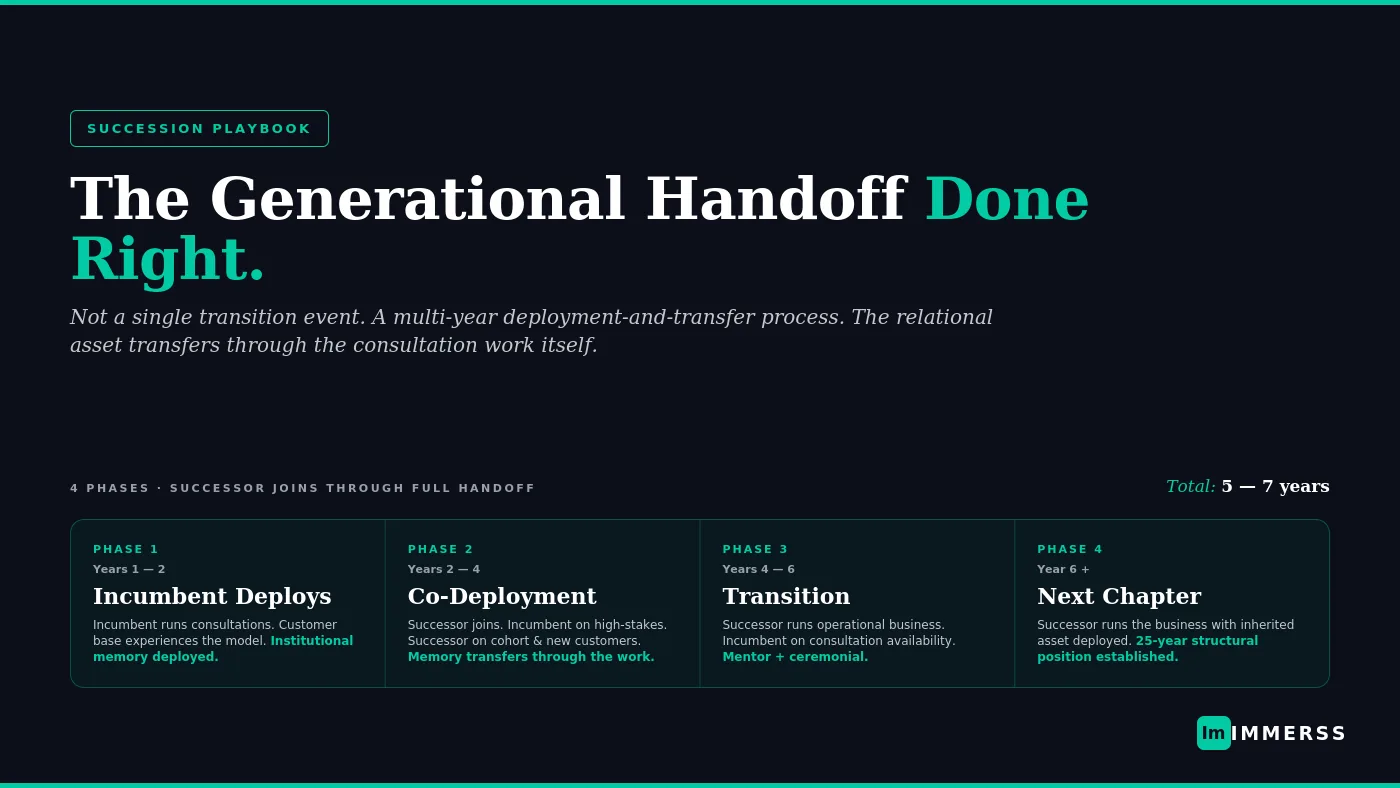
Phase 1: Deployment before transition (Years 1-2). The incumbent owner deploys the video consultation model while they are still actively running the business. They are the consultation lead. The institutional memory is deployed on the digital channel. The customer base experiences the model. The operational rhythm gets established.
Phase 2: Co-deployment (Years 2-4). The next generation joins the business and begins taking consultations alongside the incumbent. The incumbent handles the highest-stakes consultations and the long-standing customer relationships. The next generation handles consultations with newer customers, customers from their generational cohort, and references that the incumbent is mentoring them on. The institutional memory begins transferring through the consultation work itself.
Phase 3: Transition (Years 4-6). The incumbent steps back to consultation availability rather than daily presence. The next generation runs the operational business. The incumbent remains available for the highest-stakes consultations and serves as ongoing mentor. The relational asset has effectively transferred while the incumbent is still alive and contributing.
Phase 4: The next chapter (Year 6+). The next generation runs the business with the inherited relational asset deployed across the digital channel. The incumbent’s contribution shifts to ceremonial and high-stakes occasional involvement. The business is structurally positioned for the next twenty-five years.
This sequence is meaningfully different from the conventional succession playbook, which typically treats the handoff as a single transition event rather than a multi-year deployment-and-transfer process. The deployment of the model before the transition is the operational discipline that makes the handoff actually work.
What This Asks Of Both Generations
For the handoff to produce the result, both generations have specific requirements:
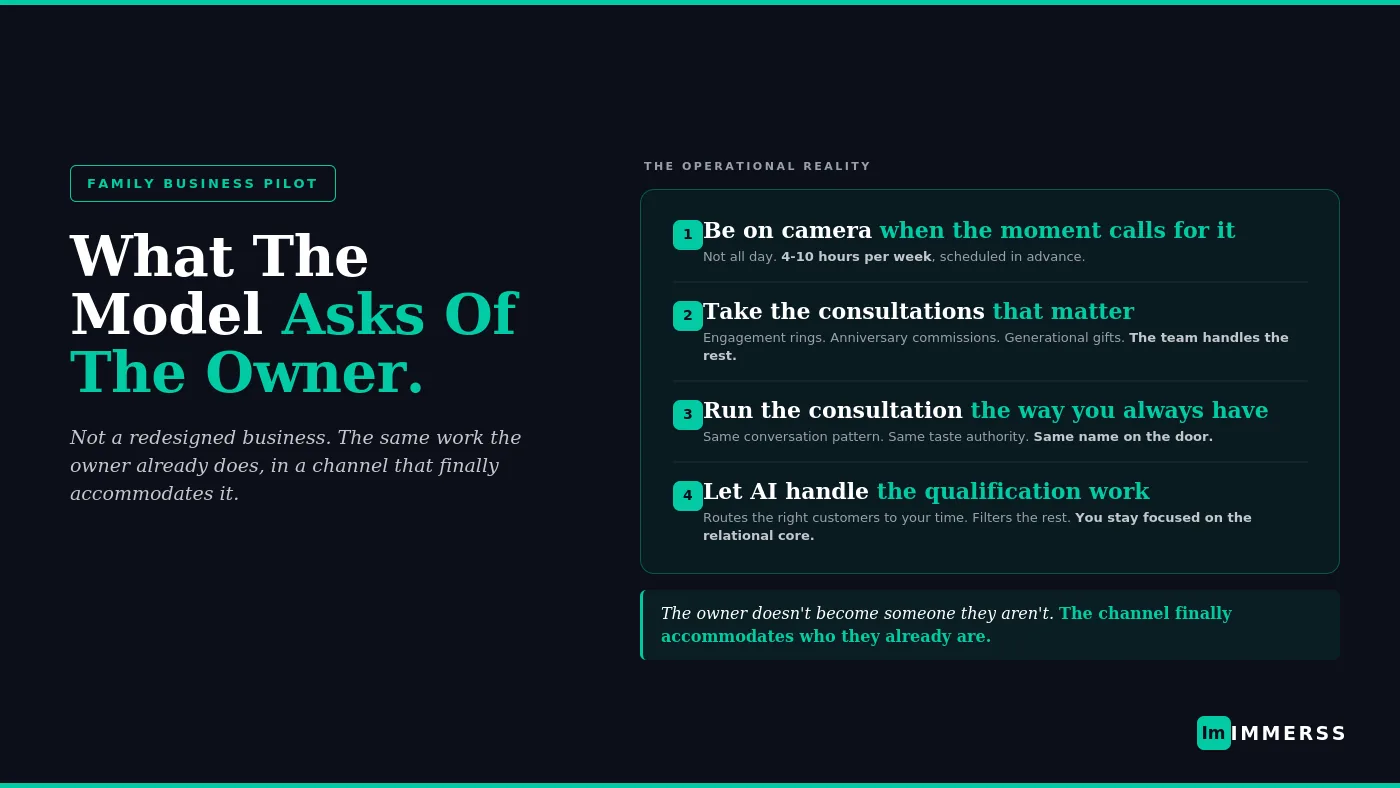
The incumbent owner must commit to the model while still running the business. Deploying it after the transition does not work — the asset transfers through the consultation work itself, which requires the incumbent to be doing the consultations during the transition years. Waiting until retirement to begin the deployment forfeits the asset transfer entirely.
The next generation must respect what was built rather than rebuilding. The asset is the relational equity the older generation accumulated. The model deploys it. The successor who comes in wanting to modernize the brand, refresh the inventory, or update the aesthetic erases the asset they are supposed to inherit. The successor who comes in wanting to extend what was built compounds it.
Both generations must commit to the consultation work as the actual operational reality. The model is not technology that runs by itself. It is a deployment channel for human authority. Both generations have to be willing to do the consultations, build the institutional memory, engage with customers across the channel. The deployment is technological; the value is human.
The transition timeline must be realistic. Five to seven years from initial deployment to full handoff is typical. Compressed timelines — trying to execute the handoff in twelve months — do not produce the asset transfer the slower transition produces. The succession is a gradual process by nature.
The 60-Day Pilot In The Succession Context
For businesses planning a generational transition over the next five years, the structured 60-day pilot is the operationally cleanest way to test the model at the beginning of Phase 1 before committing to the broader deployment.
The pilot tests, in the specific succession context:
- Whether the incumbent owner is comfortable being on camera and conducting video consultations
- Whether the institutional memory can be effectively deployed on consultations the incumbent runs
- Whether the close rate and AOV outcomes match the in-person baseline the business has historically produced
- Whether the operational rhythm of scheduling, conducting, and following up on consultations fits the existing business rhythm
- Whether the AI qualification correctly identifies the customer types the business actually serves
The pilot is fully managed. The incumbent owner provides the consultation time and the brand context. Setup, integration, and optimization are handled by the Immerss team. There is no upfront cost. The pilot runs for 60 days. At the end, the business has data to make a confident decision about whether to begin the broader generational deployment.
What The Stakes Actually Are
The slow consolidation pressure on multi-generational fine jewelry businesses has been building for fifteen years. The conventional digital playbook has not stopped it. Many family businesses that have been waiting for the right strategic answer have eventually closed or sold under that pressure.
The shift in the last twelve months changes the strategic calculus in a way that matters for the businesses that are still operating. For the family businesses that have a viable next generation, the operational path forward exists in a way it did not before. The handoff can produce a real next chapter rather than a managed decline.
The window for early-mover advantage is real. The businesses that deploy the model now, before the broader category catches up, compound the advantage across the next two generational cycles. The businesses that wait another five or ten years are entering a category that has already recalibrated.
For families in the generational transition conversation right now, the timing is meaningful. The decision to begin the deployment in the next twelve months produces meaningfully different outcomes than the same decision made five years from now.
Immerss is a luxury live commerce platform combining AI sales agents with one-to-one video consultations. Built for multi-generational fine jewelry businesses whose value is the relational asset accumulated across decades, and for the families navigating the generational transition that determines whether that asset has a next chapter.
Apply for the 60-day AI Sales Agent pilot: landing.immerss.live For Shopify Plus agencies supporting family business clients through generational transitions: partners.immerss.live