
How Fine Watch Dealers Deploy Substantive Expertise Online
For fine watch dealers — independent specialists with genuine category authority in specific brands, references, or eras — the conventional digital playbook has been quietly costing them the highest-value transactions for fifteen years. The standard ecommerce surface treats the serious collector as a generic shopper. The collector, in response, does extensive research on the dealer’s site and then transacts through phone, email, or in-person channels because the digital surface is not built to support what the transaction actually requires — the same trust-and-sight gap behind how to sell luxury watches online in 2026.
This piece is the practical playbook for capturing the serious collector vertical online: who this customer actually is, what they need from a dealer that the standard surface cannot provide, and how a structured deployment finally aligns the digital channel with what fine watch retail has always required.
Who The Serious Collector Is
The serious watch collector is not a shopper in any meaningful ecommerce sense. They are operating in a curatorial mode that the standard analytics frameworks systematically misclassify.
Patterns that consistently identify this customer:
| Signal | What It Indicates |
|---|---|
| Extended dwell on specific references across multiple visits | Tracking specific examples for the right opportunity |
| Returning visits over weeks or months without conversion | Maintaining working knowledge of the market |
| Deep engagement with provenance, condition, movement details | Sophistication that exceeds generalist customer service |
| Technical query patterns (reference numbers, calibre, period specifics) | Established collector vocabulary |
| Browsing categories beyond immediate purchase intent | Curatorial market research, not funnel behavior |
When two or more of these signals combine, the visitor is a serious collector in curatorial mode, and the standard ecommerce intervention — better photos, more aggressive remarketing, generic recommendations — produces nothing because the underlying need is not what the intervention addresses.
What The Collector Actually Needs
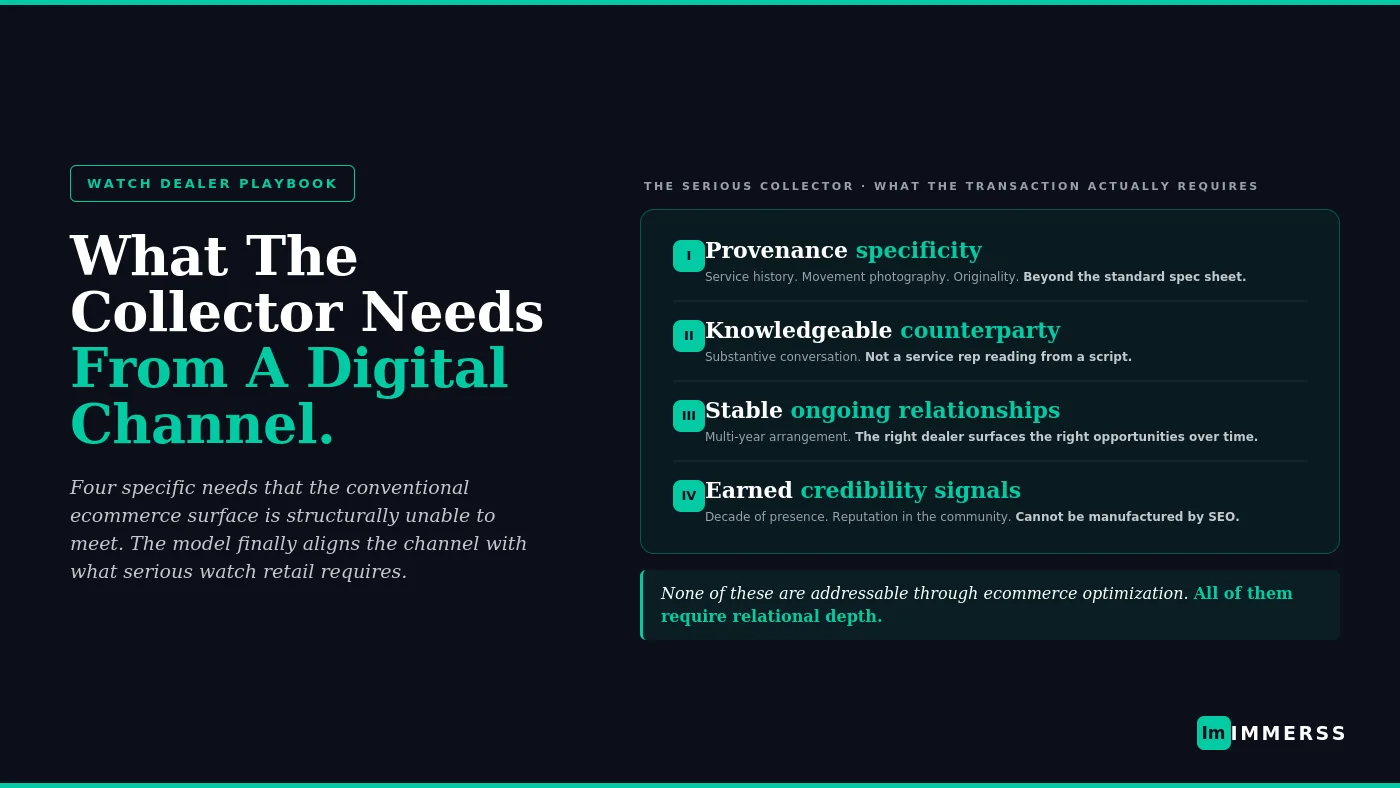
Four needs consistently differentiate the serious collector experience from what the standard digital surface provides:
Provenance and condition specificity beyond the standard spec sheet. Service history. Box and papers status. Movement photography from multiple angles. Bracelet stretch measurements. Hands and dial originality. Crystal type and replacement history. The information that determines whether this specific example is worth acquiring is in the dealer’s head and in the physical handling of the piece — not on the standard product page.
A knowledgeable counterparty for substantive conversation. Not customer service reading from a script. Someone who can speak to whether this is a good representative of the reference, what the market has been doing recently, whether the price is right relative to comparable sales, what the dealer would want for the piece in their own collection.
Stable, ongoing relationships that surface opportunities over time. The collector is not optimizing for the best single transaction. They are optimizing for being in the right dealer’s notification list when the right piece comes through. This is a multi-year relational arrangement that compounds.
Credibility signals that the standard ecommerce surface cannot generate. Long presence in the category. Demonstrable expertise in specific references or brands. Transparency about provenance. Reputation in the collector community earned across decades of transactions.
None of these needs are addressed by conventional ecommerce optimization. All of them require the substantive relational depth that defines serious watch dealing.
The Operational Deployment
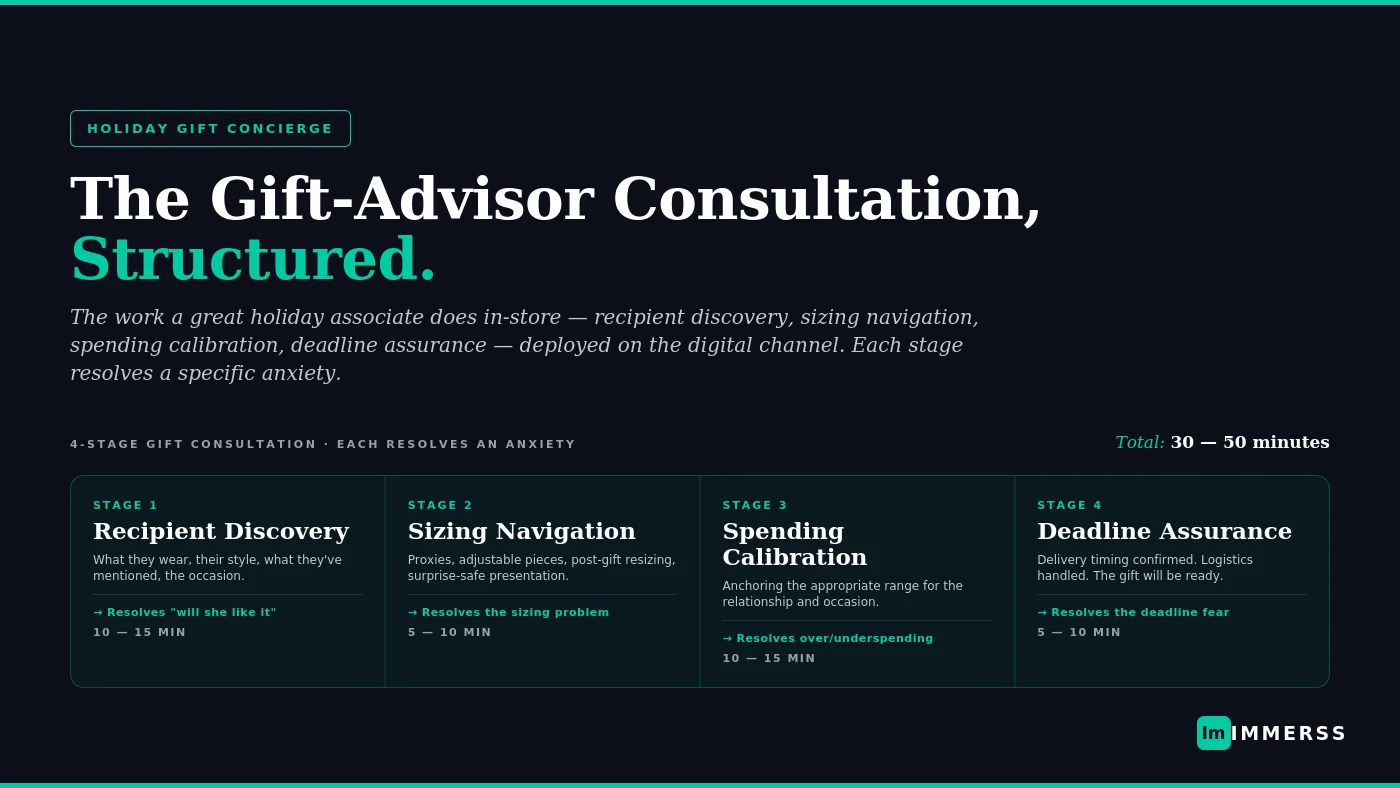
The structured deployment for the serious collector vertical has four operational layers:
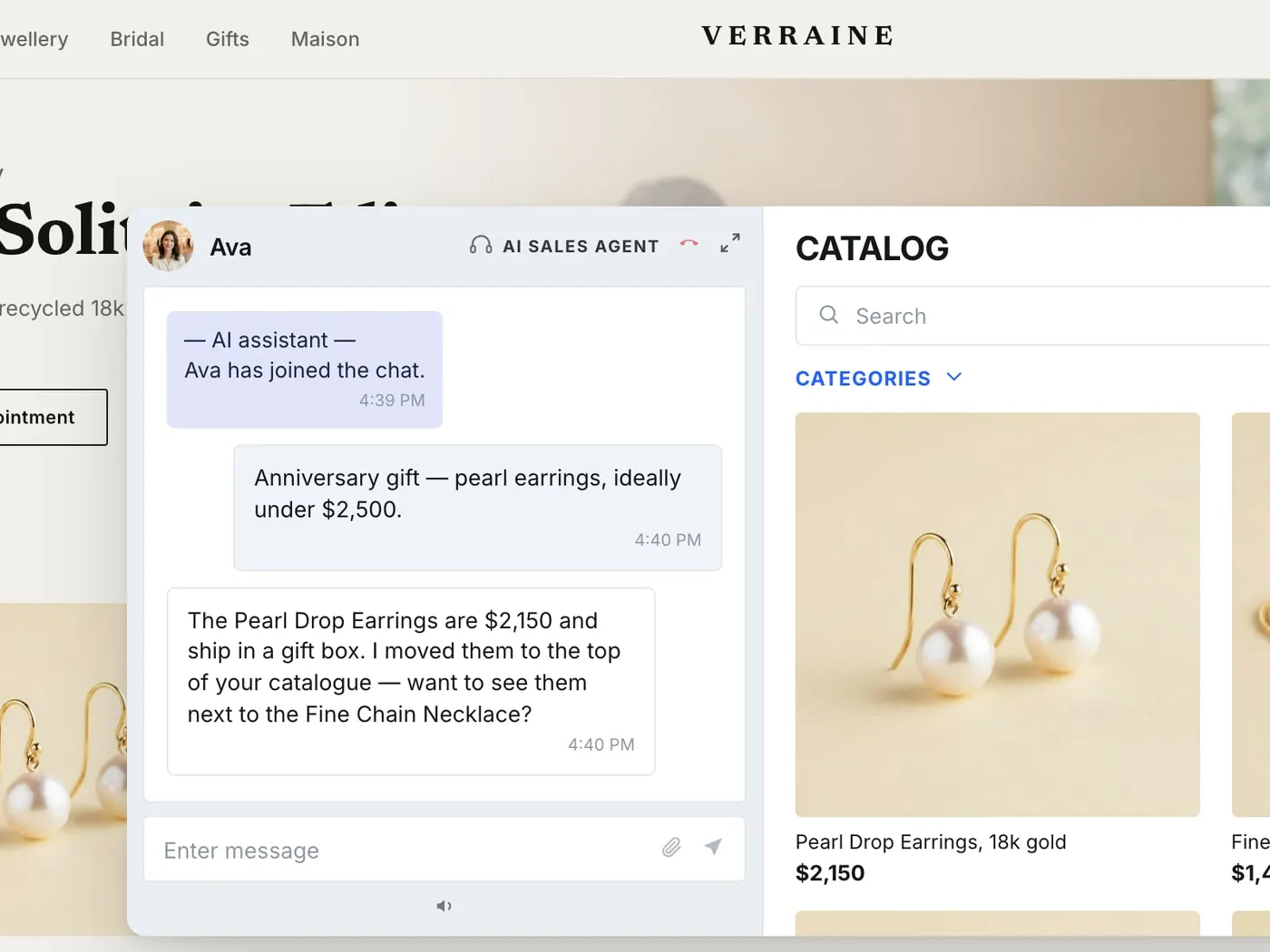
Layer 1: AI qualification calibrated to collector signals. The agent on the storefront recognizes the curatorial pattern — extended dwell on specific references, returning visits across months, sophistication signals in technical engagement — and routes the visitor toward a scheduled consultation rather than treating them as a transactional shopper. The qualification logic recognizes curatorial mode rather than treating it as failed funnel behavior.
Layer 2: Senior dealer scheduling, not generic booking. The collector is routed specifically to the dealer or to the senior associate with genuine category authority in the references the collector has been tracking. Not the general booking pool. Not whoever is available. The specific person whose expertise matches the specific collector’s interest area.
Layer 3: Pre-consultation context with specific reference history. Before the consultation, the dealer receives the collector’s session history — which references they have engaged with, what provenance and condition details they have read, what category direction their pattern indicates. The dealer walks into the call already knowing what the collector is in research mode about.
Layer 4: Consultation structure that matches dealer conversation. The video consultation runs the way the in-person dealer conversation runs. Substantive engagement on specific pieces. Provenance discussion. Comparable-sales context. Recommendation grounded in the dealer’s actual expertise. Decision and commitment when the moment is right. The consultation closes today or it banks future opportunity, depending on whether the right example has surfaced.
For dealers with genuine substantive expertise, the technology is now operationally clean. The deployment work concentrates in the institutional inventory knowledge layer — making sure the specific provenance, condition, and history details for specific examples are captured and accessible — and in the scheduling layer — making the dealer’s expertise time deployable on collectors’ schedules.
The Unit Economics
The unit economics on the serious collector vertical are dramatically favorable for dealers with genuine category authority:
Acquisition cost: essentially zero for known collectors, very low for collectors arriving via category authority signals. The serious collector finds dealers through reputation in the collector community, not through paid acquisition. The model captures conversions on traffic the dealer is not paying for.
Close rate on consultations on tracked references: dramatically above baseline. The collector who books a consultation on a specific reference they have been tracking is at high purchase intent by the act of booking. Close rates well above any general ecommerce baseline are typical.
AOV: concentrated in the high tiers. Serious collectors do not transact on entry-level pieces. The AOV on completed collector consultations runs meaningfully above the dealer’s general transactional baseline.
Repeat rate: structurally high. The collector relationship is by nature multi-year and multi-acquisition. A converted collector consultation is the beginning of an ongoing relationship, not a one-off transaction.
LTV impact: compounds across the collector’s career. Stewarding a collector relationship over a five- or ten-year span produces a transaction stream that no first-time customer acquisition math can replicate.
The 60-Day Watch Dealer Pilot
For fine watch dealers considering whether to deploy this attentively, the structured 60-day pilot validates the model on the dealer’s specific collector base.
What the pilot tests:
- Whether the AI qualification correctly identifies curatorial-mode collector traffic on the dealer’s actual site
- Whether the dealer’s or senior associate’s time can be scheduled for consultations without disrupting the existing operational rhythm
- Whether the close rate, AOV, and ongoing relationship outcomes match the in-person dealer baseline
- Whether the deployment surfaces collector relationships that have been transacting through other channels
The pilot is fully managed. The dealer provides the inventory knowledge, brand context, and the consultation time commitment from the principal or senior associate. Setup, AI qualification configuration, consultation infrastructure, and ongoing optimization are handled by Immerss. There is no upfront cost. The pilot runs for 60 days. At the end, the dealer has data to make a confident decision about scaling.
Who This Pilot Fits
The watch dealers for whom this deployment fits most cleanly share specific characteristics:
- Genuine category authority. The dealer has substantive expertise in specific brands, references, or eras. Generalist watch retail without specific depth does not produce the consultation quality the model requires.
- Established collector relationships. The dealer has a meaningful book of returning collectors with multi-year purchase histories. The model amplifies existing relational equity.
- High-AOV inventory mix. Serious collector transactions concentrate in higher tiers. The unit economics work most decisively at the $10K+ AOV level and become decisive at $25K+.
- Willingness to engage in substantive conversation. The model rewards depth over volume. Dealers optimizing for transaction velocity are not the right fit.
If your business fits this profile, the structured pilot is a low-risk way to capture the serious collector revenue that has been research-only on your site for years.
The Strategic Position
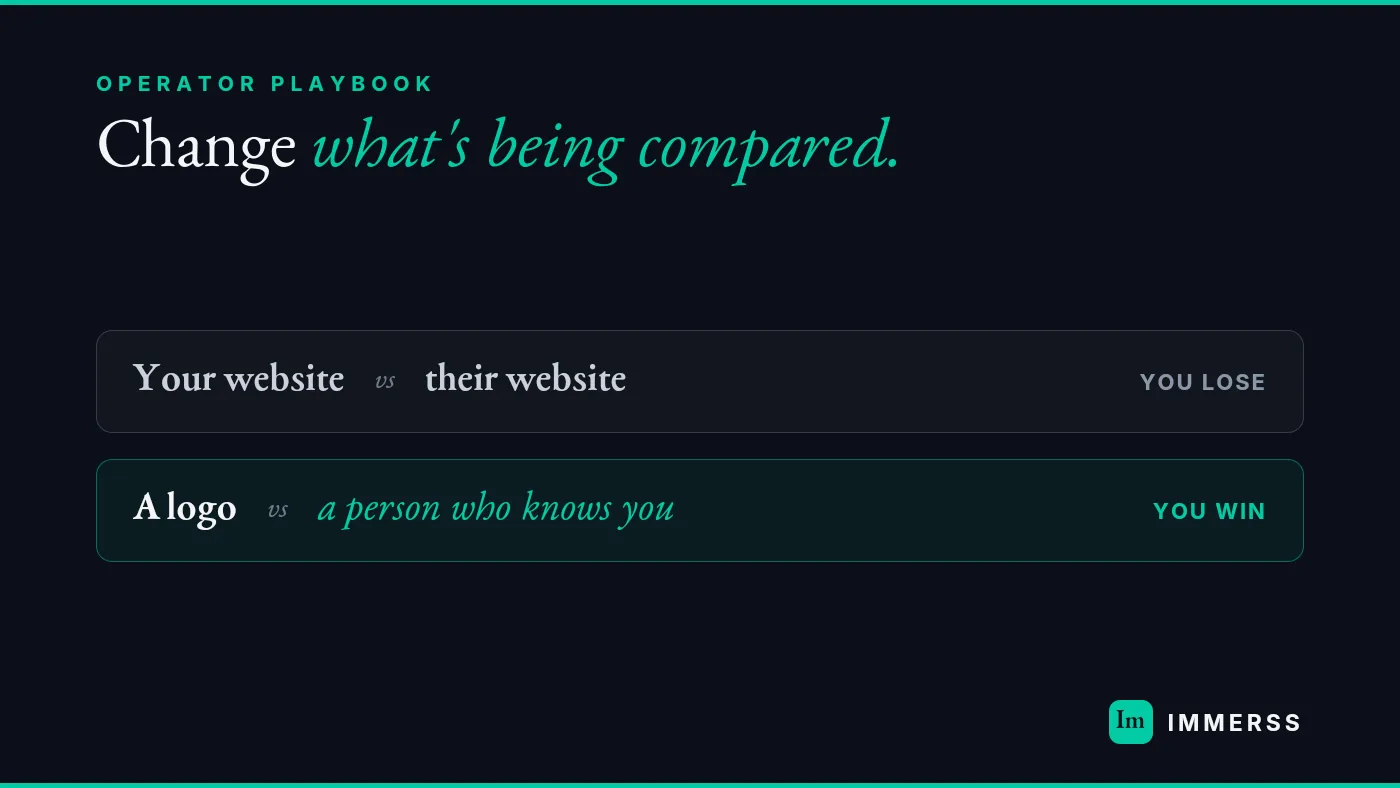
The serious watch dealer business has been under structural pressure for fifteen years from two directions. Corporate online retailers competing on price and convenience for entry-level acquisitions. Auction houses and gray market competing on selection for high-tier acquisitions. The independent specialist dealer, whose actual value has always been substantive expertise plus relational depth plus trusted provenance, has been squeezed in the middle.
The model that deploys substantive expertise on the digital channel reverses this pressure. The collector who values expertise over price gets access to that expertise regardless of geography. The dealer who has been losing the price-and-convenience competition suddenly has a way to deploy the dimension where they have always had structural advantage.
For dealers serious about the category, this is the lever that changes the next five years of competitive positioning. The window for early-mover advantage is wider than in most categories because the collector community is small and the substantive-expertise deployment takes time for competitors to replicate.
The operators who deploy this now compound the advantage through the rest of the decade.
Immerss is a luxury live commerce platform combining AI sales agents with one-to-one video consultations. Built specifically for fine retail operators whose competitive advantage is substantive expertise and relational depth, not price or scale.
Apply for the 60-day AI Sales Agent pilot: landing.immerss.live For Shopify Plus agencies introducing this to fine watch clients: partners.immerss.live