
A Sales-First Alternative to Gorgias & Tidio: AI That Sells, Not Just Supports (2026)
If you’ve outgrown support-first chatbots and want AI that actually drives revenue, here’s how the options really differ.
The short answer
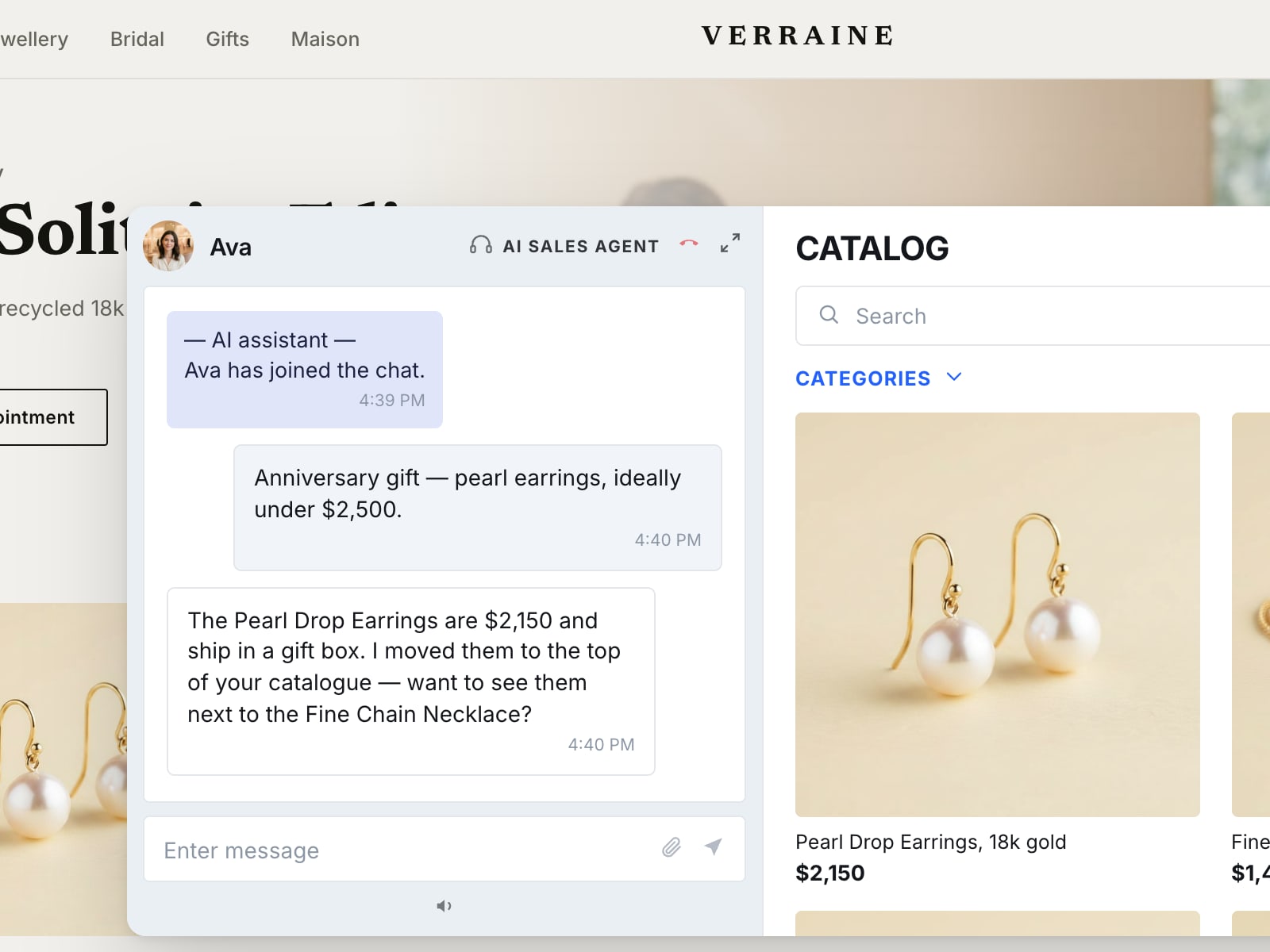
If you need an AI chatbot focused on sales, not just support tickets, the honest split is this: Gorgias, Tidio, and Intercom (Fin) are excellent support-first tools — they resolve and deflect customer-service questions. If your goal is lowering support cost, pick one of them. If your goal is revenue, you need a sales-first system. Immerss is built for that — a proactive AI Sales Agent that engages every visitor and hands off to live one-to-one video, keeping selling Human, Personal, and Measurable.
Support-first vs sales-first: the distinction that decides everything
Most “AI chatbot” comparisons miss the only question that matters: what is the tool optimized to do?
- Support-first tools are reactive. They wait for a customer to ask something, then answer it well — deflecting tickets, automating FAQs, and reducing the load on your support team. Success is measured in resolution rate and support cost saved. Gorgias, Tidio’s Lyro, and Intercom’s Fin are all strong here.
- Sales-first tools are proactive. They engage a visitor before a question is even asked, qualify intent, recommend products, and move the shopper toward checkout — escalating high-value buyers to a human when it counts. Success is measured in conversion and revenue.
A support-first bot pointed at a sales problem will still behave like a support bot: it answers, then waits. That’s the gap a sales-first AI exists to close. We unpack the mechanics in chatbot vs AI sales agent.
There’s a cost dimension worth understanding too. Support-first AI is usually billed per ticket or per resolution — Gorgias charges for AI resolutions on top of helpdesk tickets, Tidio’s Lyro is a per-conversation add-on, and Intercom’s Fin is priced per outcome. That means your bill scales with how many questions you receive, and can climb during high-volume periods like Black Friday. A sales-first platform is oriented the other way: it’s tied to the revenue it helps create, not to the volume of support you absorb. Neither model is “wrong” — but they reward very different outcomes, and you should buy the one aligned with the result you actually want.
The honest landscape
The tools most people compare here fall into clear lanes:
- Ecommerce helpdesk — Gorgias centralizes support across channels and automates ticket resolution, with deep Shopify integration. Built for stores handling high support volume.
- SMB live chat + chatbot — Tidio combines live chat, flows, and the Lyro AI bot to answer common questions affordably, aimed at small and mid-sized teams.
- Customer-service platform — Intercom is a mature support suite whose Fin AI agent resolves questions on a pay-per-outcome basis, popular with mid-market and enterprise support teams.
- Sales-first live commerce — Immerss engages visitors proactively, sells from your catalog, and hands off to live one-to-one video, built to grow revenue rather than deflect tickets.
All four can sit on a storefront. Only one is designed so that its primary metric is a sale.
Comparison at a glance
| Capability | Immerss | Gorgias | Tidio | Intercom (Fin) |
|---|---|---|---|---|
| Primary purpose | Sales-first: convert visitors into buyers | Ecommerce helpdesk: resolve support tickets | SMB live chat + AI chatbot (Lyro) | Customer-service platform + Fin AI |
| AI behavior | Proactive — engages and guides to checkout | Reactive — answers and deflects tickets | Reactive — answers FAQs | Reactive — resolves support questions |
| Optimized for | Conversion / revenue | Ticket deflection / support cost | Support cost / affordable chat | Resolution rate / support efficiency |
| Handoff to live 1-to-1 video selling | ✅ Live Co-Shopping | ➖ | ➖ | ➖ |
| Live shopping events + shoppable video | ✅ Video Commerce | ➖ | ➖ | ➖ |
| Shopify / Shopify Plus | ✅ Native | ✅ Shopify-native helpdesk | ✅ App | ✅ App / integrations |
| Pricing model | Custom (consultative) | Plans + per-AI-resolution | Plans + Lyro AI add-on | Per-resolution outcome + seats |
| Best for | Brands optimizing for sales & AOV | High-volume support teams | SMBs wanting affordable chat | Mid-market / enterprise support |
Pricing and feature sets change; verify current details with each vendor. This table reflects each tool’s core design focus, not a claim that others can’t do any selling or support.
Where each tool wins
- Choose Gorgias if you’re a high-volume Shopify store and your real problem is support load — you want tickets centralized, automated, and deflected, with tight Shopify-native workflows.
- Choose Tidio if you’re a small or mid-sized team that wants affordable live chat plus a capable FAQ-answering bot, without per-seat enterprise pricing.
- Choose Intercom (Fin) if you’re mid-market or enterprise and need a mature customer-service platform with pay-per-resolution AI across many support channels.
- Choose Immerss if your bottleneck is conversion, not ticket volume — you want AI that proactively sells 24/7, recommends from your catalog, and hands the high-AOV shopper to a real person on live video to close.
What about Ada, Drift, Intercom Fin, and the rest?
The category is crowded, and not every “AI chatbot” sits in the same lane. Ada and Intercom’s Fin are support-first automation, in the same family as Gorgias and Tidio — built to resolve service questions at scale. Drift leans toward B2B conversational marketing and lead qualification rather than ecommerce checkout. Rep AI and Octane AI tilt toward ecommerce sales assistance, closer to what a sales-first tool does on-site.
The test cuts through the noise: is the tool optimized to resolve a question or to drive a purchase? If your goal is lower support cost, the support-first lane is right. If your goal is revenue, you want the sales-first lane — and, for high-consideration carts, the ability to escalate a ready buyer to a real person on live video, which is the line most chat-only tools don’t cross.
How to choose the right AI for your store
Before you compare features, name the number you’re trying to move:
- Are you drowning in support tickets, or leaving sales on the table? If it’s tickets, a support-first tool is the right buy. If high-intent visitors browse and leave, deflection won’t help — you need proactive selling.
- Reactive or proactive? Decide whether you want AI that answers when asked, or one that starts the conversation and guides the purchase.
- Does the sale need a human? High-consideration and high-AOV purchases often close on trust. If yours do, the ability to escalate to a live one-to-one video conversation matters more than a faster FAQ answer.
- Which metric goes on the dashboard? Resolution rate and support cost, or conversion and revenue? Buy the tool tuned to the metric you’re judged on — and make sure it keeps that outcome Measurable.
Answer those and the choice is usually obvious — and often it’s “both”: a support-first helpdesk for service, and a sales-first layer for revenue.
Why brands choose Immerss for sales-first AI
Immerss is a live commerce platform, not a ticket bot. It brings three integrated modules to selling:
- AI Sales Agent — proactively greets every visitor, answers product questions from your catalog, and guides toward purchase 24/7, then hands off to a human for the moments that matter.
- Clienteling — Live Co-Shopping drops an associate and customer into a one-to-one video session to close high-consideration sales; Outbound handles appointment scheduling and relationship management.
- Video Commerce — Live Shopping Events, a Shoppable Video Library, and PDP videos so the product is seen in motion, not just described in chat.
The difference from a support-first chatbot is the intent behind every interaction: not “how do I resolve this case?” but “how do I help this person buy?” That proactive, human-backed selling is what deflection tools aren’t built to do. The fastest way to see the contrast is on your own storefront — book a demo and we’ll map an AI Sales Agent, Clienteling, and Video Commerce setup to your brand.
Related reading
Frequently asked questions
Both are support-first. Gorgias is an ecommerce helpdesk built to resolve and automate customer-service tickets, and Tidio is live chat plus an AI chatbot (Lyro) built mainly to answer common questions and deflect support volume for small and mid-sized teams. They can surface product suggestions, but their core job is reactive support — responding when a customer asks — not proactively driving a sale.
If your goal is revenue rather than ticket deflection, a sales-first platform like Immerss is the alternative. Instead of waiting for a support question, a proactive AI Sales Agent engages visitors, answers product questions from your catalog, and guides them toward checkout 24/7 — then hands off to a human on live one-to-one video for high-consideration purchases. The job is conversion, not case resolution.
Yes, but only if it's designed for it. Support-first bots optimize for resolution rate and lower support cost; a sales-first AI optimizes for engagement and conversion — proactively starting conversations, qualifying intent, recommending products, and escalating high-value shoppers to a live human. The architecture and the metric it's tuned to are different from a ticket-deflection bot.
No — it's complementary. Immerss focuses on selling: engaging visitors, guiding purchases, and handing off to live video. Many brands keep Gorgias, Tidio, or Intercom for post-purchase support and run Immerss as the sales-first layer on the storefront. They solve different jobs: one lowers support cost, the other grows revenue.
No — they serve different goals and work well together. A support-first helpdesk like Gorgias, Tidio, or Intercom resolves service tickets and deflects volume; a sales-first platform like Immerss focuses on engaging and converting visitors. Many brands keep their helpdesk for post-purchase support and run a sales-first layer on the storefront, so support load and revenue are each handled by a tool built for the job.
That's where it matters most. For a low-cost reorder, a quick chat answer is usually enough. For high-AOV or high-consideration products, the sale often depends on trust — which is why a sales-first platform like Immerss can hand a qualified shopper to a human on live one-to-one video to close, rather than ending the conversation at a text reply.