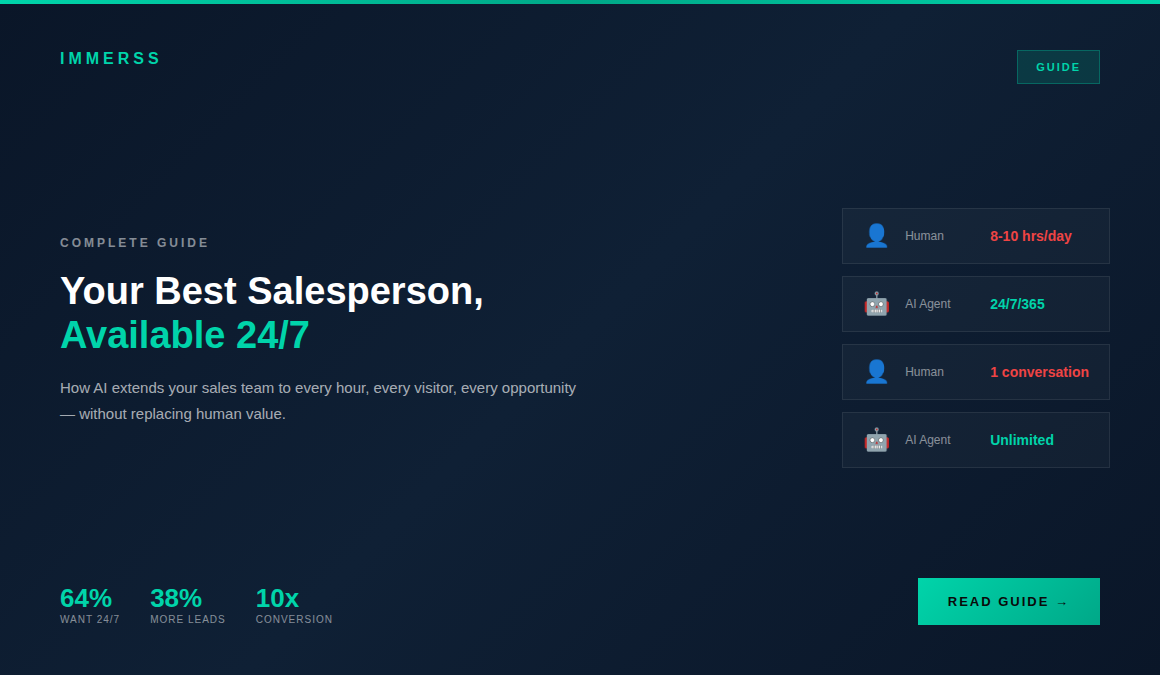

Your Best Salesperson, Available 24/7: The Complete Guide to AI Sales Agents
How AI extends your sales team to every hour, every visitor, every opportunity.
Executive Summary
E-commerce operates around the clock, but human sales teams work limited hours. This guide explores how AI Sales Agents provide 24/7 coverage, what this constant availability delivers in terms of lead capture and conversion, and how AI complements rather than replaces human sales expertise.
Key insight: 64% of consumers cite 24/7 availability as the most important benefit of AI chatbots. Stores deploying AI Sales Agents capture materially more leads during off-hours and see dramatically higher conversion rates among engaged visitors.
The Availability Gap
E-commerce never closes, but human teams have limits.
Customers shop during lunch breaks, late evenings, early mornings, and weekends. They browse from time zones around the world, on holidays, and at moments when purchasing inspiration strikes at unconventional hours.
Traditional staffing can’t match this reality. Even the most dedicated team works limited shifts. Coverage requires multiple people, driving up costs. And gaps always remain — hours when visitors arrive, have questions, and leave without help.
Research shows the impact: 64% of consumers say 24/7 availability is the single most important feature of AI chatbots. Not speed, not personalization, not accuracy — availability.
When no one’s there to help, customers help themselves… to the exit.
The Economics of Human Coverage
Achieving 24/7 human coverage requires substantial investment.
A skilled e-commerce salesperson costs $50,000-$80,000 annually including salary, benefits, and overhead. Round-the-clock coverage requires minimum 3-4 people to handle day shifts, evening shifts, weekends, holidays, and time-off coverage.
Total investment: $150,000-$320,000+ annually for basic 24/7 staffing.
Even with this investment, human coverage has inherent limitations:
One conversation at a time. A human salesperson handles one customer interaction at a time. Ten simultaneous visitors means nine people waiting — or leaving.
Variable performance. Energy levels fluctuate throughout shifts. The service quality at 9 AM differs from 5 PM. Personal circumstances affect professional performance.
Training and turnover. New hires require onboarding. Departures require replacement. Institutional knowledge walks out the door.
Scalability constraints. Handling traffic spikes during sales events or seasonal peaks requires additional temporary staffing or accepting degraded service.
These aren’t criticisms of human teams — they’re the nature of human work. The question is whether technology can address these constraints while preserving human value.
What AI Sales Agents Provide
AI Sales Agents address the availability gap directly.
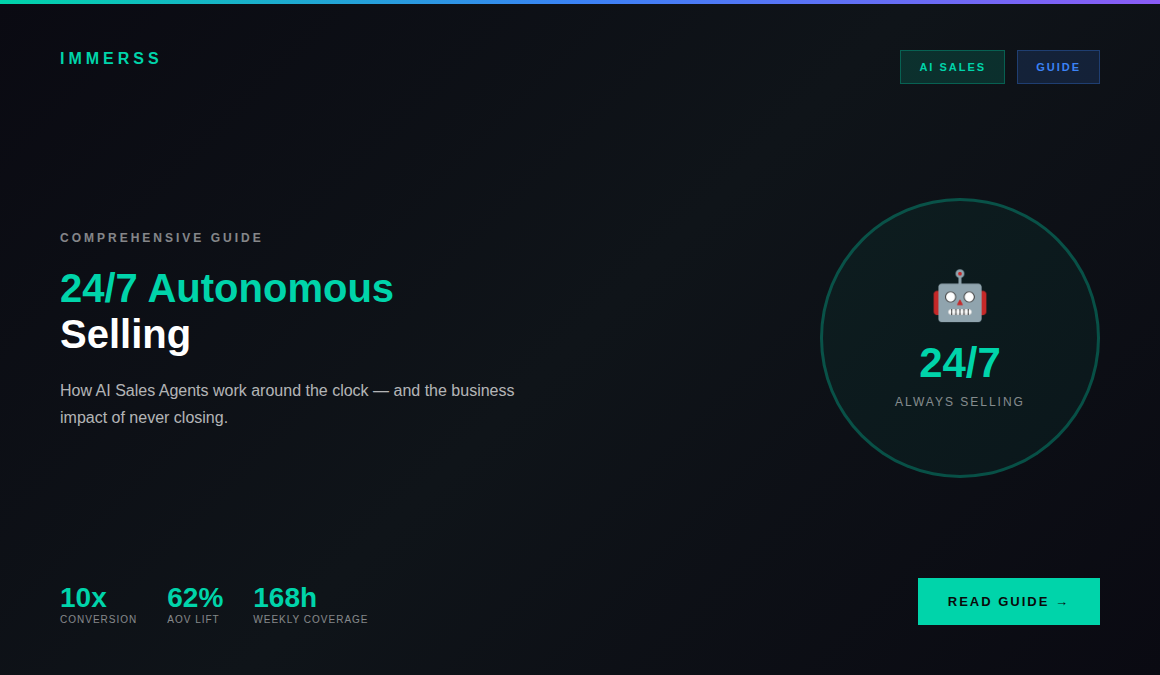
24/7/365 coverage. AI engages visitors at 3 AM with the same energy and expertise as 3 PM. No shifts to schedule, no coverage gaps to fill, no holidays to staff.
Unlimited concurrent conversations. Whether one visitor or one hundred arrive simultaneously, every person receives immediate attention. No waiting, no queuing, no degraded service during peak times.
Consistent quality. Every interaction reflects the same product knowledge, brand voice, and engagement approach. No performance variation between shifts or individuals.
Instant scalability. Traffic spikes from marketing campaigns, press coverage, or seasonal events require no additional resources. AI scales automatically.
Zero fatigue. AI handles the thousandth identical question with the same patience and care as the first. No burnout, no frustration, no declining service quality over time.
These capabilities don’t replace human value — they extend it. AI handles routine interactions at scale while humans focus on situations requiring judgment, creativity, and relationship-building.
What 24/7 Coverage Delivers
The business impact of constant availability shows across multiple metrics.
After-hours lead capture. Stores using Immerss AI Sales Agents capture materially more leads during off-hours compared to periods without AI engagement. These represent visitors who would otherwise browse anonymously and leave without conversion or contact information.
Conversion rate improvement. AI-assisted e-commerce shoppers convert at a dramatically higher rate than unassisted browsers. Availability enables engagement, and engagement drives conversion.
Cart abandonment recovery. AI can intervene when visitors show abandonment intent regardless of time. Industry benchmarks suggest 15-25% of abandoned carts can be recovered with timely engagement.
Customer satisfaction. Research indicates 82% of customers prefer chatbots over waiting for a human representative. Immediate help beats delayed help, even when the help comes from AI.
Response time. 59% of customers expect chatbot responses within 5 seconds. AI meets this expectation consistently, whereas human response times typically range from minutes to hours depending on queue depth and staffing.
AI vs. Human: Complementary Capabilities
The optimal model isn’t AI versus humans — it’s AI and humans working together, each handling what they do best.
AI excels at:
- Routine product questions (sizing, specifications, compatibility)
- Shipping and returns inquiries
- Basic recommendations based on stated preferences
- Checkout assistance and payment guidance
- Proactive engagement based on browsing behavior
- Handling high volumes of simultaneous interactions
- Maintaining consistent quality across all hours
Humans excel at:
- Complex negotiations and custom arrangements
- High-value VIP relationships
- Emotionally sensitive situations
- Creative problem-solving for unusual requests
- Building long-term customer relationships
- Exercising judgment in ambiguous situations
- Handling escalations that require authority
The smart deployment model has AI handling the 80% of interactions that are routine while escalating the 20% requiring human judgment to your team. This maximizes both efficiency and effectiveness.
The Immerss Approach
Immerss AI Sales Agents are designed for this complementary model.
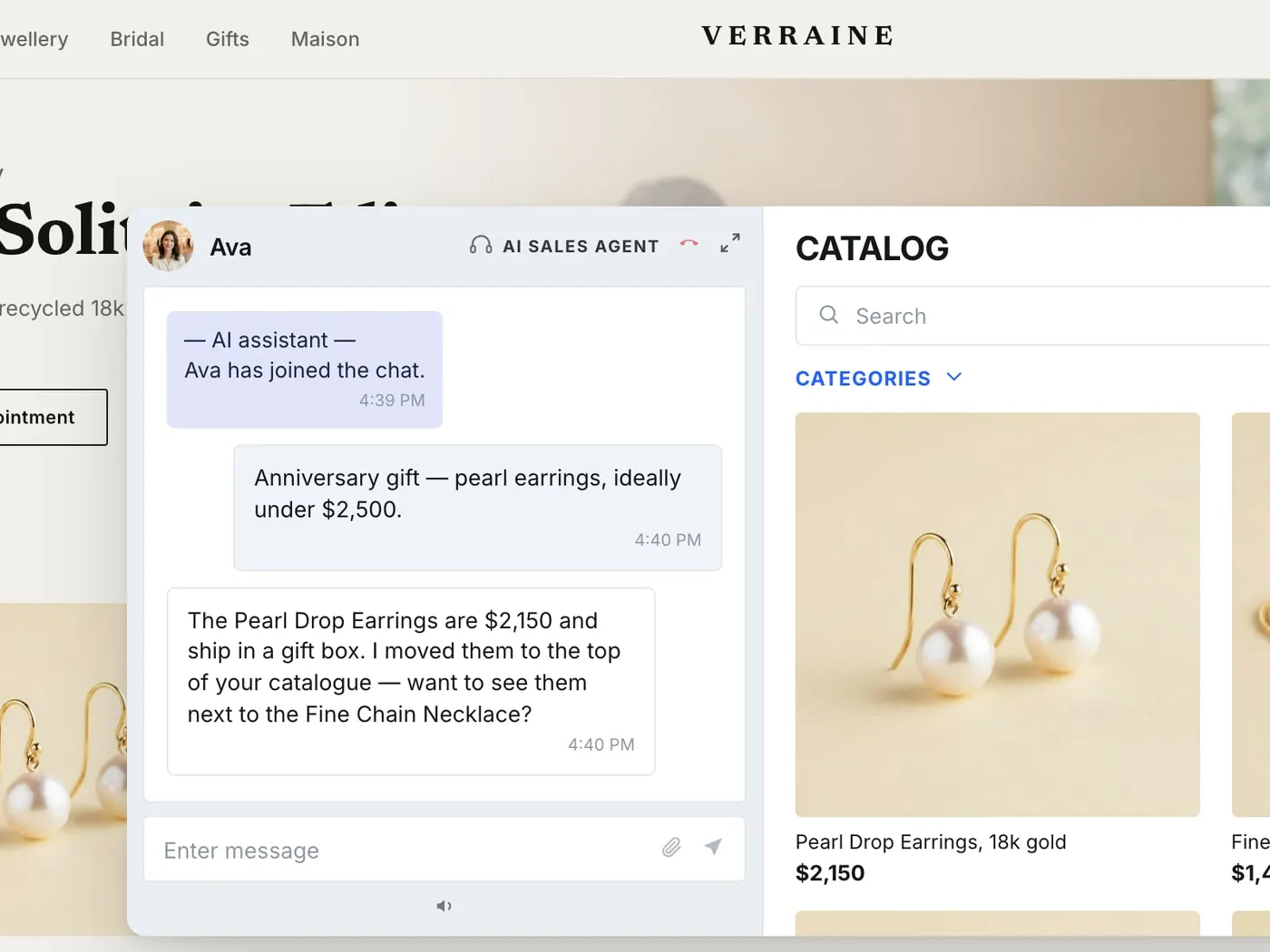
Comprehensive product knowledge. AI is trained on your complete product catalog, enabling accurate answers to specifications, compatibility, sizing, and comparison questions.
Brand voice alignment. AI communicates in your brand’s tone and style, ensuring consistent customer experience whether visitors interact with AI or human team members.
Intelligent escalation. When situations require human attention — complex requests, VIP customers, or explicit preferences for human contact — AI seamlessly hands off to your team.
24/7 engagement. AI proactively engages visitors based on behavior patterns, time on page, and exit intent, ensuring no visitor browses alone regardless of hour.
Analytics and insights. Conversation data reveals common questions, objection patterns, and conversion drivers, informing both AI optimization and human sales training.
Implementation Results
The combination of 24/7 availability and intelligent engagement produces measurable results across Immerss deployments.
Lucchese — the heritage boot brand — saw meaningfully higher Average Order Values with AI-assisted shopping. AI helped customers explore the full collection, understand craftsmanship details, and purchase with confidence at any hour.
Lead capture increases materially during off-hours across deployments. These leads represent incremental opportunity from visitors who would otherwise have departed without engagement.
Conversion rates among AI-engaged visitors run dramatically higher than passive browsers. The combination of availability, proactive engagement, and instant expertise transforms visitor behavior into purchase behavior.
Deployment Guide
Implementing 24/7 AI coverage follows a straightforward process.
Phase 1: Setup (Day 1) Sign up for Immerss (free plan available). Connect your product catalog. Configure basic brand voice and engagement preferences.
Phase 2: Deploy (Day 1-2) Install on your e-commerce platform. Immerss integrates with Shopify, WooCommerce, Magento, and custom platforms. Enable proactive engagement triggers.
Phase 3: Optimize (Week 1+) Review conversation analytics. Identify common questions and refine AI responses. Adjust engagement timing and triggers based on data.
Phase 4: Scale (Ongoing) Expand AI coverage to additional pages and customer segments. Refine escalation rules. Integrate with human team workflows.
Most stores see meaningful impact within the first week of deployment.
The Opportunity Cost of Gaps
Every hour without coverage represents lost opportunity.
Consider a store with 50,000 monthly visitors, where 30% arrive during traditional off-hours (evenings, nights, weekends). That’s 15,000 visitors per month encountering no engagement, no assistance, no guidance.
If AI engagement converts just 2% of these off-hours visitors who would otherwise bounce, that’s 300 additional conversions per month. At $200 average order value, that’s $60,000 in monthly revenue from previously unengaged traffic.
The cost of AI coverage: a fraction of a single employee salary.
The cost of not having coverage is whatever those after-hours sessions would have been worth — a number you can calculate from your own traffic by hour, and one most retailers have never looked at.
Conclusion
E-commerce operates 24/7. Your sales coverage should too.
AI Sales Agents make this possible — providing expert, consistent, personalized engagement every hour of every day. Not as a replacement for human sales teams, but as an extension that ensures no customer ever visits without someone there to help.
If you run on Shopify, our guide to the best AI sales agent for Shopify conversion compares the specific options.
Your best customers don’t shop 9-5. Your best salesperson should be available whenever they are.