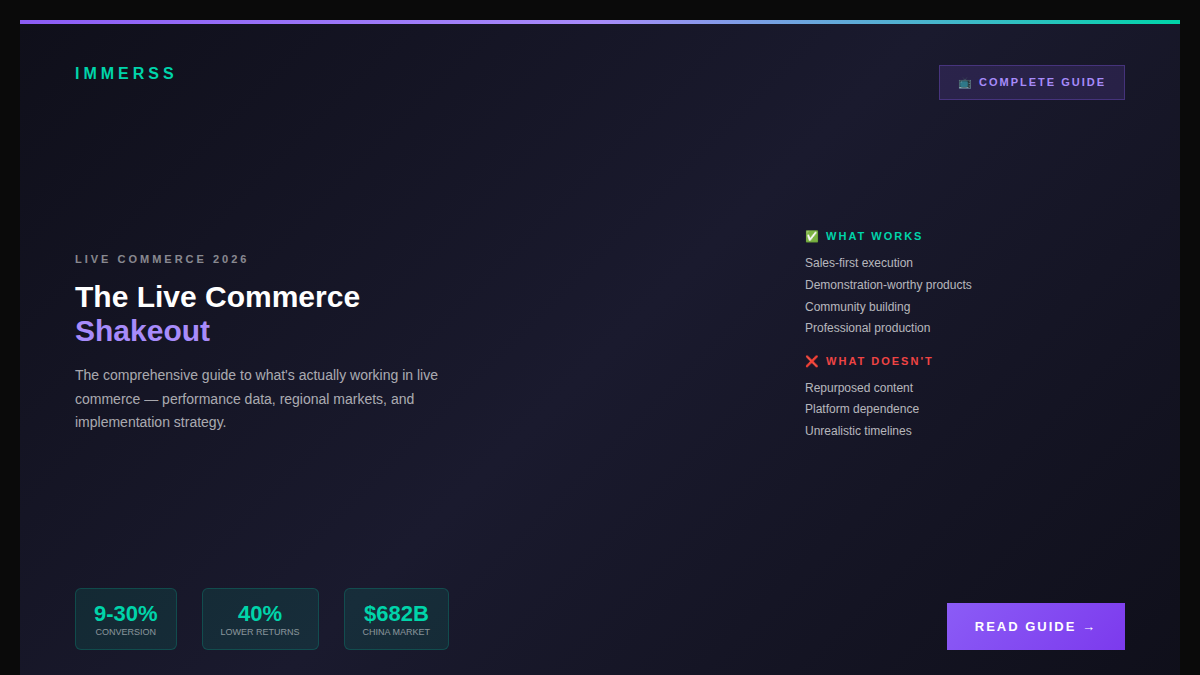

The Live Commerce Shakeout: What's Working in 2026
The comprehensive guide to live commerce performance, platform dynamics, and implementation strategy in the post-hype era.
Executive Summary
Live commerce entered 2026 at an inflection point. After years of predictions about retail revolution, the format faced legitimate questions about whether Western markets would ever match Asian adoption. Early experiments produced mixed results. Some high-profile initiatives quietly ended.
But the data tells a clearer story than the hype ever did. Live shopping conversion rates range from 9% to 30%, compared to 2-3% for traditional e-commerce. Fashion and beauty shows hit add-to-cart rates of 34%. Customers who buy through livestreams return products 40% less than standard online shoppers.
What’s happening isn’t failure — it’s a shakeout. A sorting of what works from what doesn’t, which brands benefit from which don’t, and which implementations drive revenue from which generate only content.
This guide examines what the shakeout has revealed, how regional markets differ, which technologies matter, and how to determine whether live commerce fits your brand.
Part 1: The Shakeout Context
The Credibility Problem
Live commerce arrived in Western markets trailing extraordinary expectations set by Chinese success. When a format generates $682 billion annually — as live commerce does in China — comparisons are inevitable. Early Western experiments that produced modest results seemed like failures against that benchmark.
But the comparison misses important context. China’s live commerce ecosystem developed over years through coordinated platform investment, creator development, payment infrastructure evolution, and consumer behavior change. Expecting instant replication was unrealistic.
The US market has reached approximately $50 billion and is projected to keep growing into a meaningful share of total digital commerce. That’s substantial growth from a lower base. Only 12% of US shoppers have purchased through a livestream, with another 12% expressing intent to try. This suggests early-stage adoption with significant room for expansion — not format failure.
What the Data Actually Shows
The performance data for well-executed live commerce is compelling by any standard.
Well-run live commerce converts on a different scale from a product page, and the reason is not the video: it is that a viewer can ask something and get an answer while still in the room. The events that do best are the ones where the host is a genuine expert on the product rather than a presenter reading a run sheet.
Add-to-cart rates during live shopping events reach approximately 34%, reflecting the urgency and engagement the format creates. Viewers make decisions in real time, influenced by demonstration, social proof from other viewers, and limited-time offers.
Return rates for live commerce purchases run approximately 40% lower than standard online shopping. This reflects the informed buying that live demonstration enables — customers see products in action, ask questions, and buy with greater confidence.
Average order value increases 12-15% during live shopping events. Consumers purchase multiple items during engaging sessions. Buy-now-pay-later options offered during streams boost order values an additional 25-30%.
These outcomes reflect what works. The shakeout is clarifying which approaches deliver them.
Part 2: What’s Working
Sales-First Execution
The brands succeeding in live commerce treat it as sales, not marketing. The distinction matters.
Marketing-oriented live streams focus on brand awareness, engagement metrics, and content creation. They may generate views and comments but often struggle to convert those metrics into revenue.
Sales-oriented live streams focus on conversion. They feature products with clear calls to action, limited-time offers that create urgency, and hosts trained to close. Every element serves the purchase decision.
Douglas, the German beauty retailer, demonstrates this approach. After shifting their live streams toward sales-focused execution with influencer-led workshops, they saw a 40% boost in conversion rates. The content remained engaging, but the structure changed to prioritize purchase outcomes.
Category-Format Fit
Fashion and beauty account for 51% of live shopping sales globally for clear reasons. These products gain from demonstration in ways that other categories don’t.
Seeing how a garment drapes on different body types answers questions that static photography cannot. Watching a makeup application technique demonstrates results that ingredient lists cannot convey. Understanding how a skincare product absorbs and feels provides confidence that reviews cannot fully deliver.
This doesn’t mean other categories can’t succeed — electronics and home goods are emerging as strong live commerce categories as well. But the success of fashion and beauty reflects genuine format advantage, not just early-adopter effects.
Brands should honestly assess whether their products benefit from live demonstration before investing heavily. Products where video adds little to the purchase decision may see weaker results regardless of execution quality.
Community Building
The most sustainable live commerce success comes from building communities rather than chasing audiences.
Research shows 67% of live shopping viewers feel a sense of community during streams. That feeling drives behavior that isolated viral moments cannot — regular viewing, repeat purchases, word-of-mouth referral, and brand loyalty.
The difference is approach. Audience-building focuses on maximizing reach for individual events. Community-building focuses on cultivating relationships with recurring viewers who return for scheduled programming. The former optimizes for peaks; the latter optimizes for consistency.
Brands with successful community approaches create regular programming schedules, recognize returning viewers, incorporate audience feedback into product development, and treat their live commerce viewers as a distinct valuable segment rather than general traffic.
Professional Execution
The gap between amateur and professional live commerce is immediately visible — and conversion rates reflect the difference.
Lighting quality affects how products appear. Audio quality affects whether viewers stay engaged. Camera angles affect demonstration effectiveness. Overlay design affects whether viewers can find products and checkout. Integration quality affects whether purchases complete smoothly.
Brands treating live commerce as serious sales infrastructure invest in each element. They don’t rely on smartphone-quality production for serious revenue channels. The investment reflects the stakes.
Tommy Hilfiger’s live stream in China attracted 14 million viewers and sold 1,300 hoodies in just two minutes. Walmart’s live-streamed fashion event attracted seven times more viewers than usual. These results came from professional execution, not casual experimentation.
Part 3: What’s Not Working
Repurposed Content Approach
Brands that treat live commerce as repurposed marketing content see minimal results. Going live occasionally, without strategy or structure, doesn’t capture the format’s advantages.
Live commerce requires its own playbook — one that combines entertainment value with sales execution. The interactivity, urgency, and social proof that drive conversion must be designed into the experience. Broadcasting a standard marketing video live produces neither the engagement nor the conversion that the format enables.
Unrealistic Timeline Expectations
China’s live commerce ecosystem developed over years. Platforms invested in creator tools, payment integration, and algorithm optimization. Creators developed skills and built audiences. Consumers developed new shopping behaviors.
Western brands expecting immediate China-like results from early experiments set themselves up for disappointment. The US market is still at approximately 12% consumer adoption. Growth is strong, but maturity takes time.
Successful implementations treat live commerce as a capability to build rather than a campaign to launch. They invest in learning, iteration, and audience development over time rather than expecting immediate scale.
Ignoring Audience Fit
Not every brand’s customer base watches livestreams. The format skews younger — most engaged viewers are between 18 and 34. Brands whose core customers are older or who prefer text-based research may see weaker results regardless of execution quality.
The brands struggling with live commerce often failed to validate audience fit before investing. They assumed the format’s general popularity translated to their specific situation. Validating that your audience actually engages with livestream content should precede significant investment.
Platform Dependence
Brands that built live commerce strategies entirely on social platforms discovered vulnerability. Algorithm changes, platform policy shifts, and business model evolution can dramatically impact performance overnight.
TikTok Shop, Amazon Live, YouTube Shopping, Instagram, Taobao Live, and Pinduoduo account for approximately 70% of global live commerce revenue. This concentration creates systemic risk for brands dependent on any single platform.
The resilient approach combines social reach with owned-channel capabilities. Brands stream to social platforms for distribution while simultaneously broadcasting to owned properties where they control experience and data. Every stream feeds multiple channels, reducing dependence on any single one.
Part 4: Regional Market Analysis
China: The Mature Benchmark
China controls approximately 78% of global live commerce revenue. The ecosystem is fully mature — platforms, creators, payments, and consumer behavior are all aligned.
Live commerce generated nearly $682 billion in 2023 and is projected to cross $1.1 trillion by 2026. For Chinese consumers, buying through livestreams is normal shopping behavior, not a novel experience.
This maturity creates the benchmark against which all other markets are measured — sometimes unfairly, given the ecosystem development time involved.
United States: Accelerating from Early Stage
The US market is accelerating from a lower base. Approximately $50 billion in livestream shopping sales, projected to grow 36% by 2026 to account for more than 5% of total digital commerce.
Current adoption sits at approximately 12% of consumers having purchased through a livestream, with another 12% expressing intent to try. This suggests substantial room for growth as adoption broadens beyond early adopters.
TikTok Shop demonstrated how quickly momentum can build in the US market. After its wider rollout, the platform drove $100 million in Black Friday sales in 2024 — triple the previous year — with a single beauty brand earning $2 million from one stream.
Europe: Broader Participation, Defined Profile
Europe shows broader participation than North America but with a more defined user profile. Around 35% of European consumers have made a live commerce purchase.
Users tend to be younger, mostly between 18 and 34, with men making up a slight majority at 53%. The European market is growing at a rapid CAGR of 26.8%, with luxury and fashion brands using live streaming for exclusive previews, product launches, and behind-the-scenes content.
Seller activity is rising quickly. On Whatnot in Europe, active sellers grew 600% year over year, streaming more than 20,000 hours each week.
Southeast Asia and Emerging Markets
Southeast Asia is becoming a competitive hotspot with adoption rates far exceeding Western markets. India leads with 75% of shoppers having used livestream shopping, followed by Thailand at 73% and the UAE at 72%.
India is projected to be the fastest-growing market in the region, with revenue expected to reach $140 billion by 2033.
Latin America shows strong interest among engaged users. 64% of frequent live commerce users attend shopping streams regularly, and 63% say they want to buy more through the format. Social platforms play a major role — 71% of regular users shop through Instagram, while 51% use Facebook.
Part 5: Technology and Future Trends
AI-Generated Hosts
AI-generated hosts represent the most significant near-term shift in live commerce. These virtual presenters can deliver product demonstrations, answer questions in real time, and personalize offers for different viewer segments — simultaneously, in multiple languages, 24/7.
The advantages are substantial. They reduce production costs by eliminating scheduling, talent management, and consistency challenges. They scale campaigns globally without translation and localization complexity. They maintain engagement around the clock, capturing global audiences across time zones.
Early implementations show promise for routine product demonstrations and FAQ handling. The technology will improve rapidly, and brands experimenting now will have advantages as capabilities mature.
Augmented Reality Integration
Augmented reality enhances the try-before-you-buy experience that makes live commerce compelling. Viewers can virtually try on products during streams, seeing how items would look on them specifically.
This reduces the uncertainty that prevents purchase and the returns that erode margin. When a customer sees how a lipstick shade looks on her skin tone or how sunglasses fit her face shape, she buys with greater confidence.
AR integration is moving from novelty to expectation, particularly in beauty and fashion categories where visualization dramatically impacts purchase decisions.
Real-Time Personalization
AI-driven personalization during live streams is becoming standard. Systems analyze viewer behavior in real time and serve personalized product recommendations to individual viewers.
Someone who engaged with a specific color sees more products in that palette. Someone who clicked on a particular price point sees alternatives at that level. The stream appears the same to all viewers, but the recommendations and offers differ based on individual behavior.
This personalization capability increases relevance without fragmenting the shared social experience that makes live commerce engaging.
Platform Evolution
Platform dynamics continue to shift as live commerce matures.
Whatnot demonstrated how live commerce can thrive in niche categories. Streamers on the platform broadcast over 175,000 hours per week — exceeding QVC’s weekly broadcast hours by approximately 800 times. The success came from focusing on collectibles and enthusiast categories with passionate communities.
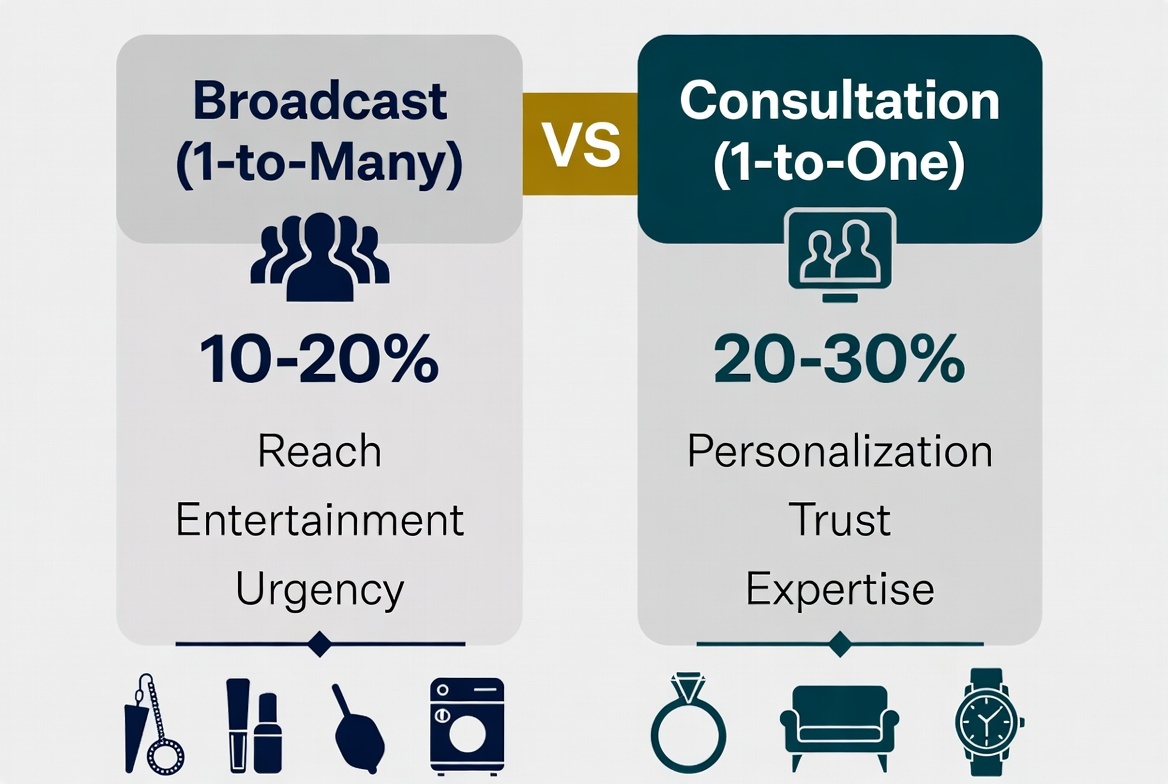
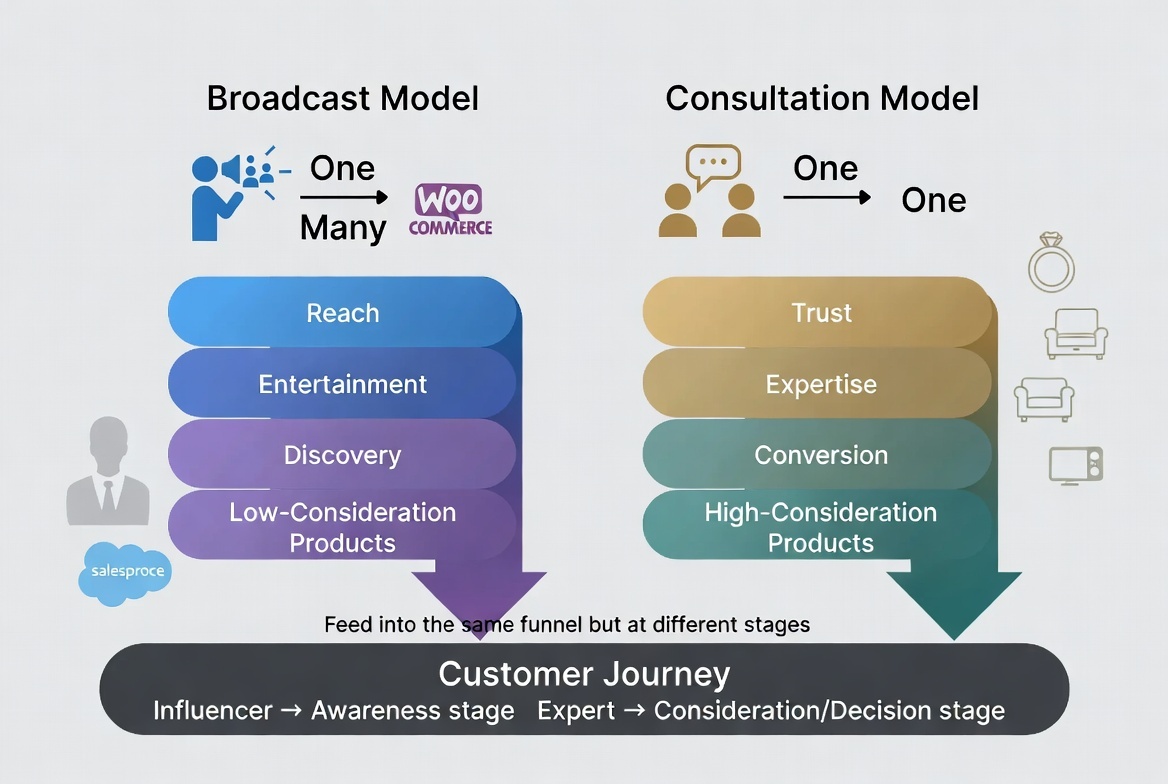
Integration between live commerce and one-to-one video shopping is blurring format boundaries. Instead of one host broadcasting to many viewers, some brands offer live video consultations where individual customers interact with product specialists. This trades scale for personalization and works particularly well for high-consideration purchases.
Part 6: Strategic Assessment
Is Live Commerce Right for Your Brand?
The brands benefiting most from live commerce share certain characteristics.
Products that gain from demonstration do best. If showing your product in action creates understanding or confidence that static images cannot, live commerce adds clear value.
Audiences that consume video content are necessary. If your customer base doesn’t watch livestreams — due to age, preference, or behavior patterns — the format may struggle regardless of execution.
Categories where trust and authenticity influence purchase benefit especially. The human connection and real-time interaction in live commerce build trust more effectively than traditional e-commerce.
Operational capability to execute consistently is required. Live commerce demands regular programming, professional production, trained hosts, and integrated commerce infrastructure. Brands without these capabilities should build them before expecting strong results.
Implementation Principles
For brands proceeding with live commerce, several principles distinguish successful implementations.
Integrate rather than isolate. Live commerce should connect to your existing commerce infrastructure — inventory, fulfillment, customer service, CRM. Treating it as a separate experiment creates operational complexity and limits learning.
Build gradually rather than launching big. Start with limited programming to develop capabilities, test approaches, and build audience. Scale after you understand what works for your specific situation.
Measure what matters. Align metrics with business objectives. If you’re measuring views when you need revenue, you’ll optimize for the wrong outcomes. Define success clearly before investing.
Combine platforms strategically. Broadcast to social platforms for reach while streaming to owned properties for control. Reduce dependence on any single platform while maximizing distribution.
Part 7: The Immerss Approach
Combining Live Commerce with AI Sales
Immerss integrates live video shopping with AI sales agent capabilities. The combination addresses limitations in both standalone approaches.
Live commerce alone requires constant human presence. AI sales agents alone lack the visual demonstration and social proof that drive live commerce conversion.
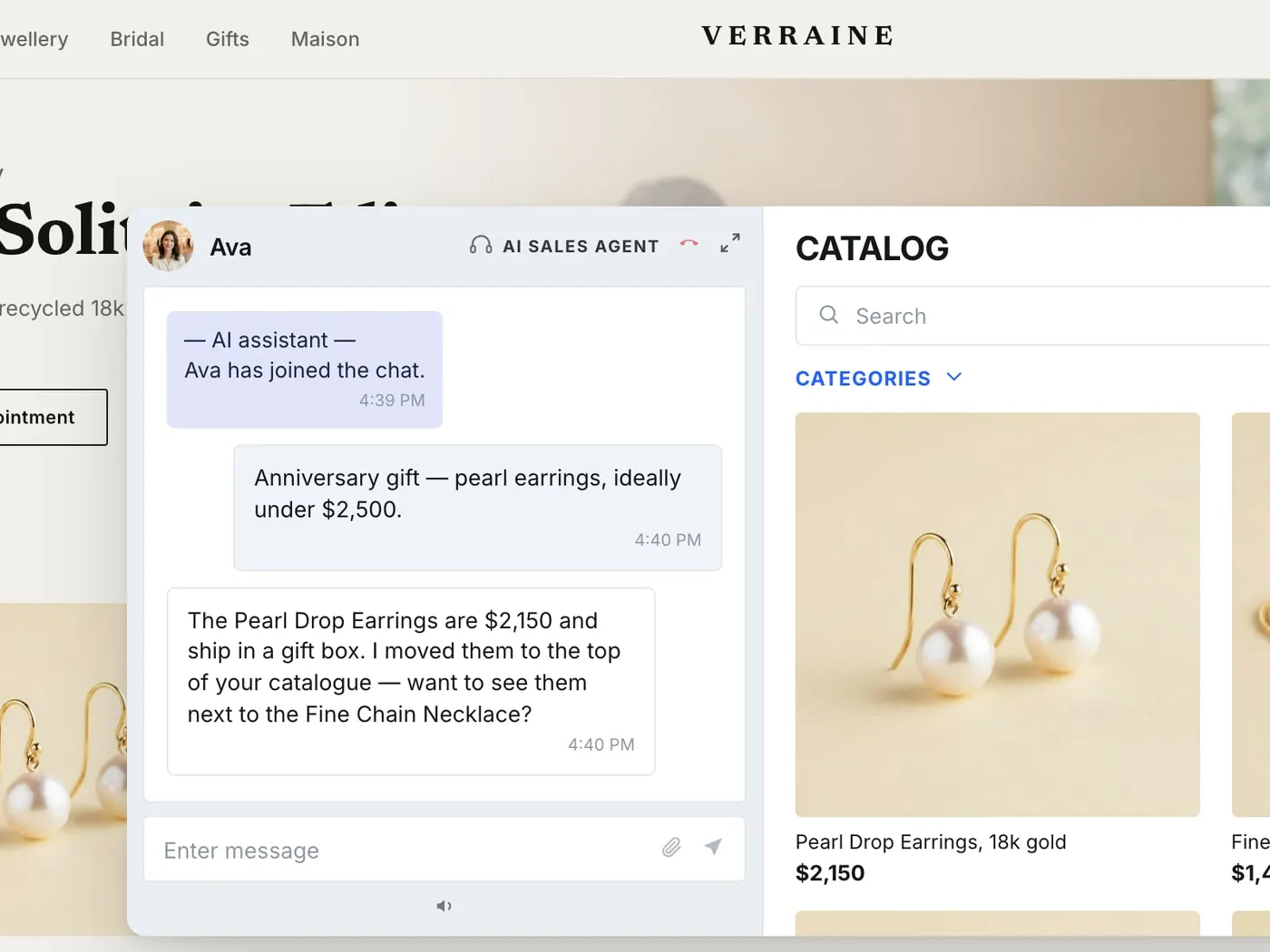
The integrated approach uses AI to handle routine product questions during live streams, freeing human hosts to focus on demonstration and high-value interactions. AI personalizes recommendations to individual viewers while maintaining the shared social experience. After streams end, AI sales agents continue engaging with interested customers who weren’t ready to purchase during the live event.
Continuous Engagement
Live commerce creates peaks of engagement. Immerss extends that engagement beyond scheduled events.
Stream recordings become shoppable content that converts viewers at any hour. AI sales agents engage customers who watched streams with personalized follow-up. The investment in live commerce content generates ongoing returns rather than episodic spikes.
Professional Infrastructure
The technical quality that distinguishes successful live commerce requires professional infrastructure. Immerss provides the commerce integration, overlay systems, analytics capabilities, and checkout optimization that turn amateur broadcasts into professional sales events.
Conclusion: Clarity Through Shakeout
The live commerce shakeout is producing clarity that the hype cycle never offered.
The format works — conversion rates of 9-30% versus 2-3%, return rate reductions of 40%, AOV increases of 12-15% — these are substantial, verified improvements for brands executing well.
But the format doesn’t work for everyone. Products that don’t benefit from demonstration, audiences that don’t watch livestreams, brands without capability to execute consistently — these situations struggle regardless of the format’s general effectiveness.
The shakeout is sorting these situations clearly. The breathless predictions are giving way to measured understanding of where live commerce creates genuine advantage.
For the brands it fits, the opportunity is real. The question is whether it fits you — and if so, whether you’re ready to execute at the level that produces results.