
Livestream vs. 1:1 Video: The Two Live Commerce Models (And Which One Luxury Actually Needs)
Live commerce is now a category. Last year it generated over two hundred billion dollars globally, most of that in Asia-Pacific, with the US market growing faster than any other ecommerce channel. Every major retail platform — TikTok, Amazon, Walmart, Shopify — has launched livestream tooling. The pitch to retailers is consistent: live video commerce is the next evolution, and every retailer needs a strategy.
For luxury brands — jewelers, watchmakers, high-end fashion — the question is not whether to invest in live commerce. The answer to that is yes. The question is which model of live commerce matches the category, because the market has quietly split into two architectures, and the right choice for luxury is not the one generating most of the headlines.
This piece breaks down the two models, explains why luxury specifically needs one rather than the other, and outlines what operators should look for when evaluating tooling.
The Two Models
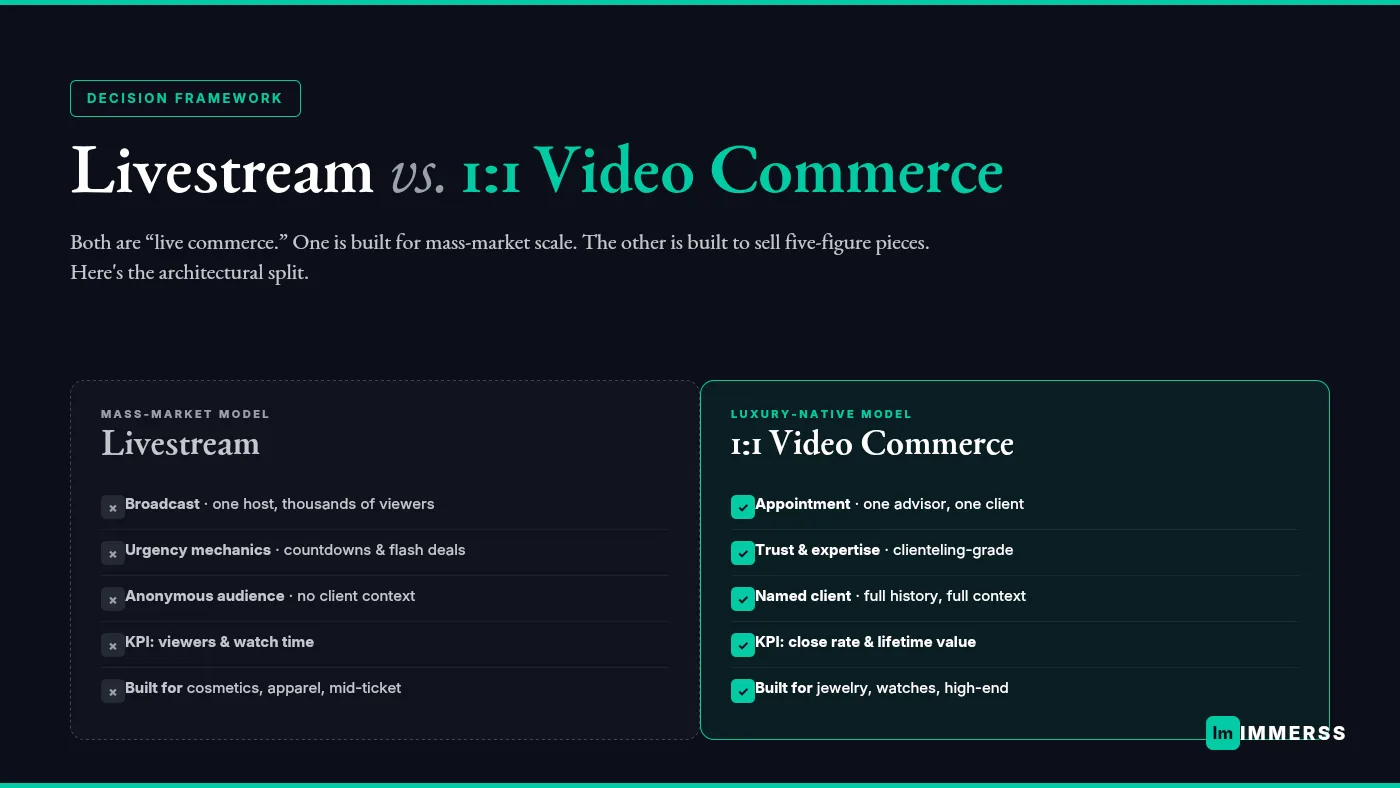
Livestream commerce is the model most people think of when they hear “live commerce.” A host — sometimes a celebrity, often a professional presenter — broadcasts to a live audience of hundreds to millions of viewers. Products are demonstrated, discounts announced, and viewers tap to buy inside the stream. The economics rest on broadcast scale: one host, thousands of viewers, high conversion lift on low-consideration product. This is the model built by TikTok Shop, Amazon Live, Walmart+, and Chinese platforms like Taobao Live and Douyin.
One-to-one video commerce is structurally the opposite. A single advisor on a scheduled video call with a single client. The session is private, appointment-based, and typically initiated either by the client booking a consultation or by an AI layer identifying a high-intent visitor and routing them to the right advisor. The economics rest on close rate and AOV, not on audience size. This is the model emerging across the top tiers of jewelry, watchmaking, and high-end fashion.
Both involve live video. Both are correctly described as “live commerce.” But the assumptions underneath — about who the customer is, what they want, how they buy, and what close looks like — are almost perfectly inverted.
Side-by-Side
| Dimension | Livestream Commerce | 1:1 Video Commerce |
|---|---|---|
| Format | Broadcast, one-to-many | Private, one-to-one |
| Audience | Hundreds to millions of viewers | Single qualified client |
| Scheduling | Fixed broadcast times | On-demand and appointment-based |
| Conversion driver | Urgency, FOMO, social proof | Trust, expertise, relationship |
| Host role | Presenter / entertainer | Trained advisor / clienteling expert |
| Client identity | Anonymous viewer | Named client with history |
| AI role | Recommendation, moderation at scale | Qualification, scheduling, context enrichment |
| Primary KPI | Viewers, watch time, in-stream conversion | Close rate, AOV, lifetime value |
| Purchase consideration | Low to mid | High |
| Best for | Mass-market categories | Luxury, bespoke, high-AOV categories |
Why the Livestream Model Doesn’t Translate to Luxury
Four structural reasons, each meaningful on its own and collectively decisive.
The purchase is high-consideration. Livestream conversion runs on the collapse of deliberation — the host builds urgency, the viewer taps to buy inside a thirty-second window. Luxury purchases do not compress this way. A client evaluating a five- or six-figure piece is comparing across retailers, consulting family, checking provenance, often taking weeks or months to decide. No broadcast window closes that decision. The sale closes through multiple touches, not a moment of urgency.
The client wants privacy. Affluent buyers do not typically want to complete a high-stakes purchase in a public chat window with strangers asking about sizing. The luxury in-store experience has always been one-to-one in a private environment with a named advisor — the digital version has to mirror that psychology, not invert it.
Urgency mechanics hurt the brand. The countdown timers, flash discounts, and FOMO tactics that drive livestream conversion actively devalue luxury positioning. A brand built on craftsmanship, heritage, and real scarcity cannot sustain that positioning while running flash promotions in a broadcast. The tool and the brand equity fight each other.
The relationship is the product. In luxury, a first purchase is often the beginning of a twenty-year client relationship. Clienteling teams know client anniversaries, preferences, family context. Broadcast formats cannot produce that relationship — the host does not know the viewer and cannot. The relationship has to form in private, over time, with a consistent advisor.
Why 1:1 Video Commerce Works
The one-to-one model solves the same underlying problem livestream solves — the gap between seeing a product online and having the confidence to buy — but without any of the structural mismatches above.
The advisor is on video with one client, with full context on what that client has looked at and purchased before. The session happens when the client wants it, often outside traditional business hours. The advisor can show the piece from every angle, model it, zoom in on details, and answer technical questions in real time. The close often happens in-session. The relationship continues.
Three things have made this model viable now at scale:
First, clients have become comfortable with video consultations for high-stakes decisions. The behavioral shift that the pandemic accelerated has stuck — booking a video consultation for a significant purchase is no longer unusual for affluent shoppers.
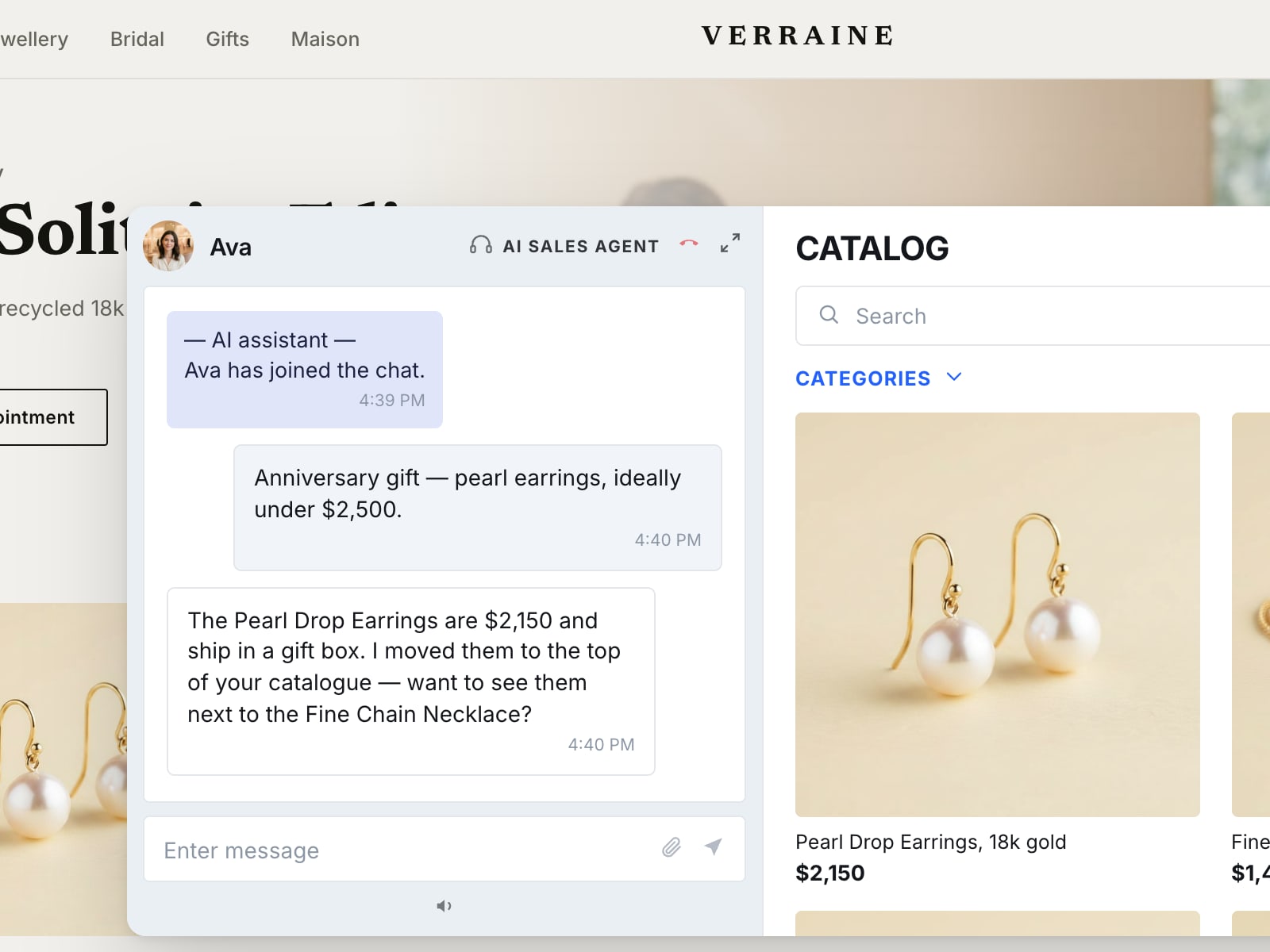
Second, AI has matured to the point where it can handle the qualification and scheduling layer that used to require human labor. An AI that reads session intent, identifies high-value visitors, qualifies them, and books them into the right advisor’s calendar is what makes one-to-one scalable. Without that layer, advisor time would be the bottleneck. With it, the digital surface can handle thousands of simultaneous visitors and still deliver a boutique experience to each one who qualifies.
Third, the measurement stack has caught up. Sessions that start with an AI qualification and end with a closed sale can now be tracked end-to-end, making ROI attribution clear in a way it wasn’t five years ago.
The Decision Framework For Operators
If you are evaluating live commerce tooling for a luxury brand, three questions separate the right kind of vendor from the wrong kind.
What is the product optimized around — audience or individual? If the vendor’s demo emphasizes viewer count, retention curves, and in-stream conversion, they have built a livestream tool. If the demo emphasizes visitor qualification, advisor routing, and session context, they have built a one-to-one tool. Ask directly.
What does their reference customer list look like? If the references are cosmetics, apparel, accessible luxury, and mass-market retail, the model is livestream. If the references are fine jewelry, watchmaking, bespoke, and genuine high-end, the model is one-to-one. Vendors often blur this deliberately. The customer logos are the clearest tell.
How does the system handle an after-hours high-intent visitor? A livestream tool routes them to an FAQ or the next scheduled show. A one-to-one tool qualifies them, checks advisor availability, and either connects them to a live advisor immediately or books them into a session — in their time zone, often the next morning, with context from their browsing session already in the advisor’s notes.
The Practical Takeaway
The investment thesis for live commerce in luxury is correct. Video genuinely does close the gap between seeing a piece and buying it, in a way that static ecommerce never has. That is real, and brands that ignore it will keep watching digital convert at a fraction of store rates.
The mistake is buying the mass-market version of the tool when the category needs the luxury-native version. They look similar on the surface — both involve “live video” — and vendors on both sides will claim the category. Underneath, they are architecturally opposite, and deploying the wrong one is worse than deploying neither.
For jewelers, watchmakers, and high-end retailers, the right architecture is appointment commerce at scale: AI-qualified visitors routed to one-to-one video consultations with trained advisors, measured on close rate and relationship value rather than viewer count. This is the model Immerss is built for, and it is the model the category is quietly converging on.
The livestream hype will keep being loud. The one-to-one model will keep compounding results underneath it. The brands that understand the distinction now will be the ones who look prescient in eighteen months.
Immerss is a luxury live commerce platform combining AI sales agents with one-to-one video consultations. Built for jewelry, watch, and high-end retailers who need appointment commerce, not broadcast commerce.