
Most luxury brands have a chatbot on their site. Very few have a sales-first AI. The distinction is not semantic — it is the difference between a tool that saves support costs and a tool that drives revenue. For jewelers, watchmakers, and high-end retailers operating on five- and six-figure average order values, the difference compounds fast.
This piece breaks down what separates the two, why the luxury category specifically cannot afford to confuse them, and how the right AI layer — paired with live video consultations — is quietly becoming the new standard for digital clienteling.
The Chatbot Was Built for Cost Reduction
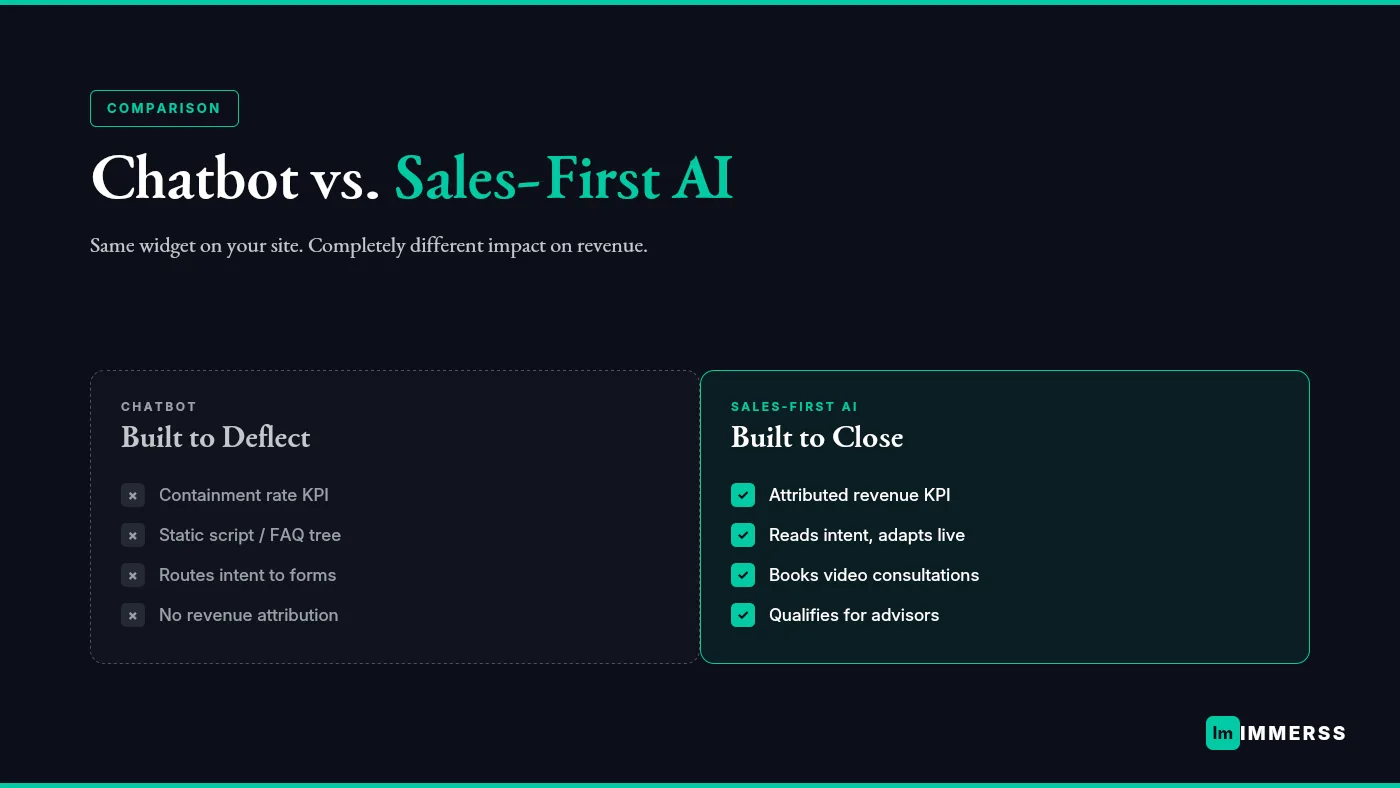
Chatbots, as a category, were designed for mass-market ecommerce. The problem they were built to solve is well-defined: too many inbound support queries, not enough human agents, rising cost-to-serve. Deflection is the goal. A chatbot that keeps fifty percent of support queries from reaching a human is a successful chatbot by the standards of the industry that built it.
That model works for a telco, a Shopify merchant at volume, or a mass retailer. It is a support function, measured by support metrics: containment rate, average handle time, CSAT, tickets resolved.
For a luxury retailer, those metrics are beside the point. A jewelry brand closing fifty pieces a month at a fifteen-thousand-dollar average ticket does not have a cost-to-serve problem. It has a conversion problem — and a chatbot optimized for deflection actively makes that conversion problem worse by routing serious buyers away from the humans who could close them.
What Sales-First AI Does Differently
A sales-first AI is built from a different set of assumptions. The core question it answers is not how do we handle queries efficiently but how do we maximize revenue from every qualified visitor.
That changes how the system is designed from the first interaction forward.
It reads intent, not keywords. A visitor lingering on a single ring for ten minutes, adding it to the wishlist, and returning three days later is not a support query — it is a high-intent prospect. A sales-first AI recognizes this and opens a conversation calibrated to close, not to deflect.
It qualifies the visitor. Like a trained showroom associate, the AI asks the right questions at the right time: is this for an occasion, what timeline are you working within, have we worked with you before. The output is not a resolved ticket — it is a qualified lead with context, handed to the human advisor best suited to close it.
It protects human time. Clienteling and sales associate time is the most valuable resource a luxury brand deploys. Sales-first AI filters the casual browsers out of the funnel so that human advisors only engage with prospects who have signaled real intent. This raises close rates, raises advisor productivity, and raises satisfaction on both sides of the conversation.
It is measured on revenue. The dashboard does not report tickets contained. It reports leads qualified, consultations booked, sessions attributed to closed revenue, AOV lift from AI-assisted visits. Every number tracks back to the P&L.
Side by Side
| Dimension | Chatbot | Sales-First AI |
|---|---|---|
| Core goal | Deflect support queries | Drive revenue and qualified leads |
| Primary metric | Containment rate, tickets handled | Attributed revenue, consultations booked |
| Posture | Reactive — waits for questions | Proactive — reads intent, opens conversations |
| Treatment of high-intent visitors | Routes to FAQ or contact form | Escalates to live advisor or video consultation |
| Relationship to human team | Replaces human interaction | Qualifies and enables human closers |
| Client memory | Session-level, stateless | Integrated with CRM and client history |
| Built for | Mass-market, high-volume support | Luxury retail, high-AOV conversion |
Why Luxury Retail Specifically Needs This
Luxury purchases are high-consideration, relationship-driven, and emotionally weighted. Jewelry, watches, high-end fashion, bespoke goods — none of these are browse-and-add-to-cart categories. Clients expect education, reassurance, and personalized guidance before committing.
The in-store model has always reflected this. Skilled associates, long client relationships, private viewings, personalized outreach around milestones. None of that translates to a generic chat widget asking “how can I help you today?”
Three realities make the case for sales-first AI especially urgent in this category.
Purchase decisions happen on the digital surface now. Even clients who buy in-store research extensively online first. If the digital surface cannot open a real conversation with them, the brand has already lost the influence it used to have at the showroom door.
Human clienteling does not scale around the clock. A serious buyer browsing at 11pm in the client’s time zone does not wait for business hours. Sales-first AI can qualify and book the consultation overnight — so the human advisor starts their morning with appointments on the calendar rather than a cold inbox.
Attribution has finally become possible. With modern tooling, every piece sold can be traced back to the session that generated the lead. For the first time, luxury operators can make the ROI case for AI investment with real numbers rather than general “engagement” metrics.
The Live Video Layer
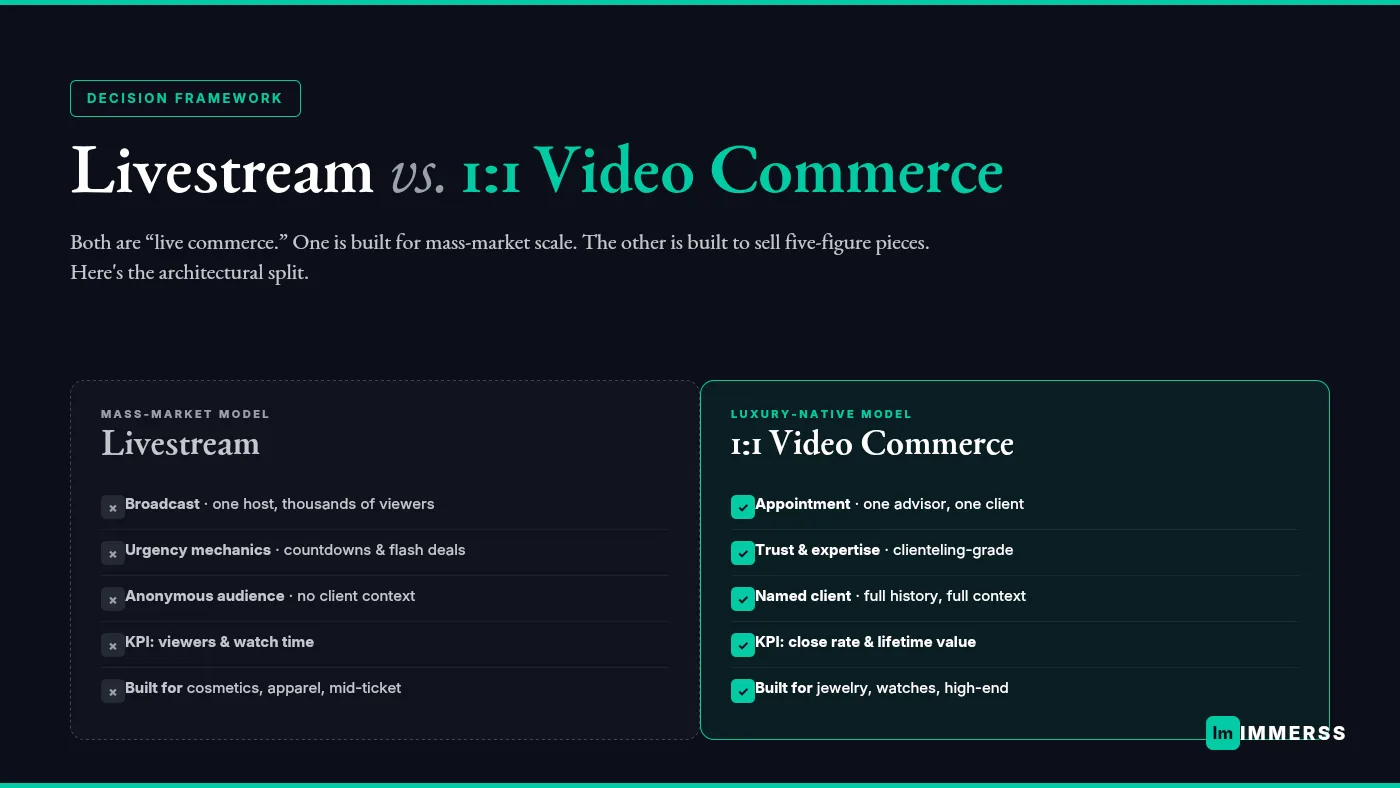
There is one more piece that separates the leading luxury retailers from the ones still buying chatbots: live video consultations.
Text conversation — even excellent text conversation — cannot close high-consideration luxury purchases on its own. Clients need to see the piece, watch it being modeled, ask detailed questions, and read the advisor’s expression. Video closes the gap that text cannot. Across the category, live video consultation sessions convert at rates several times higher than standard ecommerce — often approaching in-store close rates.
The winning stack combines both. A sales-first AI handles the top of the funnel — reading intent, qualifying visitors, booking appointments, enriching CRM. A live video consultation handles the close. Neither piece works as well alone. Together they reproduce the luxury in-store experience on the digital surface, at a scale that no human team could cover on its own.
This is the architecture Immerss was built for. AI that works like a sales associate, integrated with live video consultations that let human advisors close with the same presence they’d have in a boutique. Built specifically for luxury categories where the average ticket is measured in thousands, not dollars.
How to Evaluate Your Current Setup
Three practical questions for any luxury operator reviewing their current AI or chat tooling:
Can you attribute revenue to your AI tool in the last quarter? Not engagement, not containment — revenue. If the answer is no, the tool is not doing the job the category requires.
When a high-intent visitor arrives after hours, what happens? If they get an FAQ response or a form, the brand is leaving its most valuable visitors at the door. The right setup hands those visitors to a live advisor — either immediately on video or through an auto-booked appointment.
Does your AI know who your clients are? A tool that greets every visitor the same way is a chat widget. A tool that recognizes returning clients, references their history, and adjusts the conversation accordingly is a clienteling extension.
The Category Is Moving
The luxury retailers pulling ahead right now are the ones who stopped treating AI as a support cost center and started treating it as a revenue channel. They measure on sales. They pair AI with live video. They extend clienteling to the digital surface instead of abandoning it there.
The ones still running a chatbot in the corner of their site will keep seeing digital convert at a fraction of their store rate — and will keep assuming this is normal. It is not. It is the predictable result of buying a tool built for a different business.
For luxury retailers evaluating what comes next, the right question is not which chatbot should we use. It is what would it look like if our digital surface sold the way our best associates do. The answer to that question is where the category is going.
Immerss is a luxury live commerce platform combining AI sales agents with live video consultations. Built for jewelry, watch, and high-end retailers who treat digital as a sales channel, not a support desk. To see what sales-first AI looks like on your site, book a demo.