
Luxury Fashion E-commerce: Why Static Product Pages Fail — Complete Guide
Luxury Fashion E-commerce: Why Static Product Pages Fail — Complete Guide
Understanding the consultation gap and how AI solves it.
Executive Summary
Luxury fashion has among the lowest e-commerce conversion rates (0.7-0.8%) and highest return rates (30-40%) of any category. These problems persist despite years of investment in photography, site speed, and user experience because they stem from a fundamental limitation: static product pages cannot provide the consultation that luxury fashion purchases require. This guide examines why consultation matters for fashion, how AI Sales Agents deliver it at scale, and the documented results of implementing conversational commerce in fashion retail.
Key insight: Luxury fashion’s e-commerce problems aren’t optimization problems — they’re consultation problems that static pages structurally cannot solve.
The Luxury Fashion E-commerce Problem
The data reveals a category in crisis.
Conversion rates:
- Luxury fashion: 0.7-0.8%
- General fashion: 2.9-3.3%
- Top performers (all e-commerce): 4.7%+
- In-store fashion: 20-40%
Return rates:
- Online apparel: 22-30%
- In-store apparel: 6%
- Fast fashion online: up to 38%
- Seasonal peaks: up to 50%
Cart abandonment: 78%+ for fashion
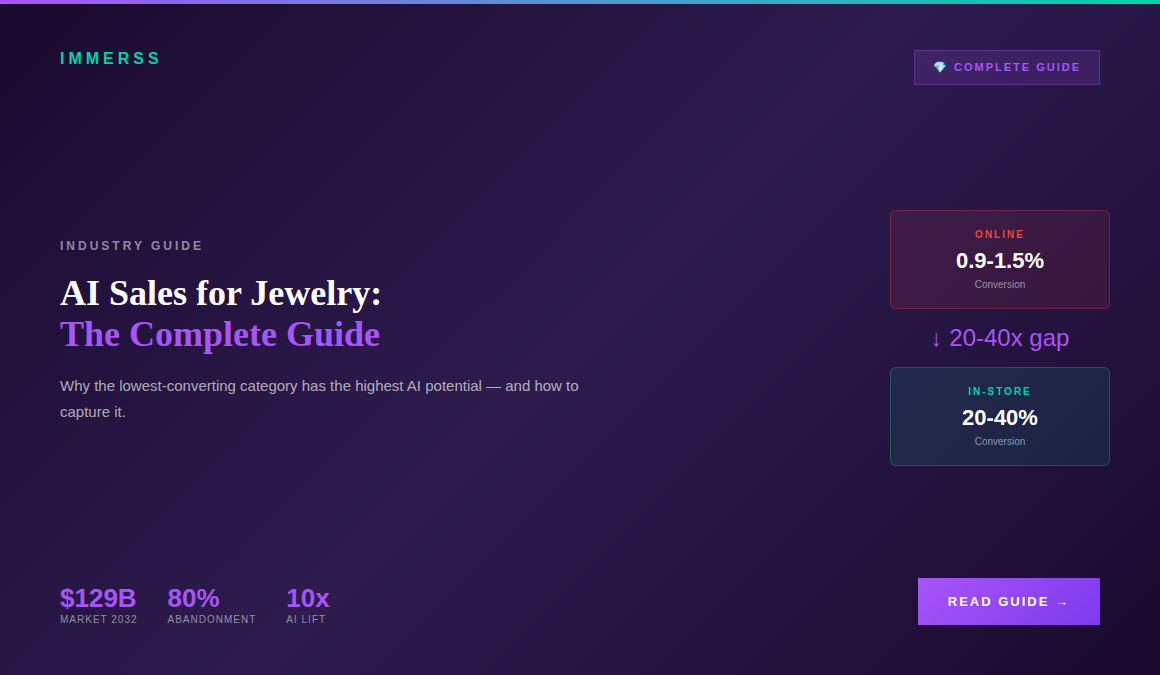
These numbers represent a 20-40x gap between online and in-store conversion, and a 4-5x gap in return rates. The differential persists across brands, price points, and geographies.
Why Static Pages Fail Fashion
Static product pages present information. Fashion purchases require consultation.
The Sizing Problem
34% of all e-commerce returns are size-related — the single largest controllable factor. Size charts provide measurements, but customers need to understand:
- How does this brand’s sizing compare to others I own?
- How is this specific garment cut?
- How will the fabric drape on my body type?
- Should I size up or down for my intended use?
Static pages can’t answer these questions. The result: 48% of shoppers “bracket” — ordering multiple sizes with intent to return all but one. 63% of consumers regularly bracket when shopping online.
Bracketing isn’t fraud or irresponsibility. It’s rational behavior when information is insufficient for confident decisions.
The Styling Gap
Fashion purchases don’t exist in isolation. Customers need to understand:
- What does this pair with?
- How does it fit my existing wardrobe?
- Is it appropriate for my intended occasion?
- What accessories complete the look?
Product pages show items alone or on models. They don’t provide personalized styling guidance for the customer’s specific needs.
The Quality Question
Luxury prices demand confidence in value. Customers need to understand:
- What makes this worth the investment?
- How does the fabric feel and move?
- How will this piece age over time?
- What’s the construction quality?
Photos can show detail but can’t convey hand, drape, or craftsmanship in ways that justify significant investment.
The Confidence Problem
Ultimately, luxury fashion purchases are high-stakes decisions. Customers need confidence that:
- The piece will fit
- The quality matches the price
- The style suits their needs
- They’ll actually wear it
Static pages create uncertainty. Uncertainty leads to abandonment or purchase-then-return behavior.
The In-Store Difference
Physical luxury retail succeeds because it provides consultation.
The in-store journey:
- Sales associate greets customer
- Discussion of needs, occasion, preferences
- Curated selection of relevant items
- Try-on with fit feedback
- Styling suggestions and alternatives
- Quality explanation and care guidance
- Confident purchase decision
Notice what that flow does that a product page cannot: it finds out what the garment is for before showing anything, and it closes the fit question in the room rather than in a returns label. The products are identical to online. The experience is entirely different — and so is the return rate, because nobody is guessing.
The consultation provides:
- Personalized attention focused on specific needs
- Expert guidance on fit, style, and quality
- Real-time answers to questions
- Confidence building through the decision process
Online, customers get none of this. They browse alone, guess at fit, hope about style, and purchase with uncertainty.
AI Sales: Restoring Consultation Online
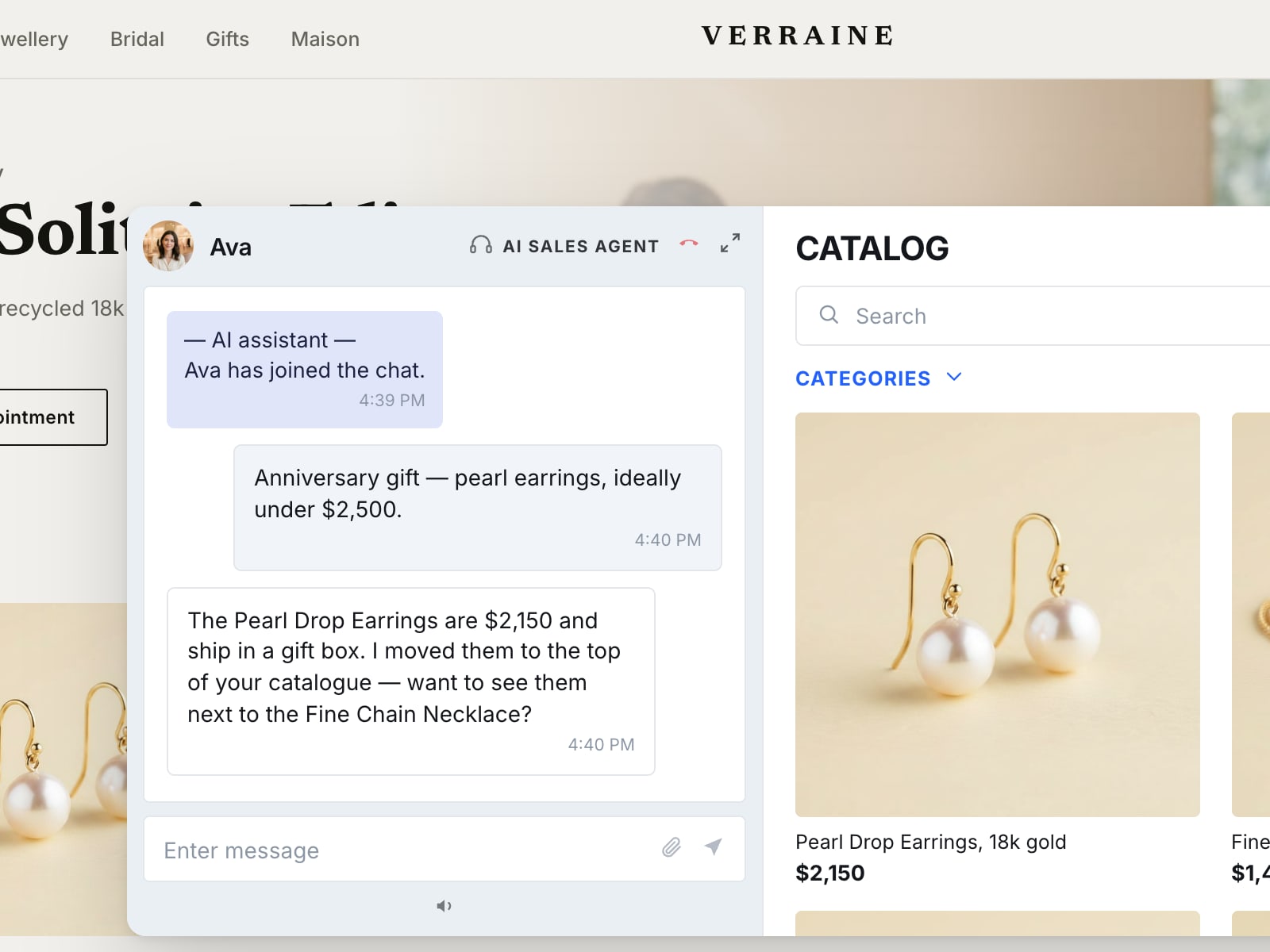
AI Sales Agents provide the consultation that static pages cannot.
Fit Guidance Beyond Size Charts
AI doesn’t just cite measurements — it understands how pieces fit:
Customer: “I usually wear a medium, but I’ve had fit issues with some European brands.”
AI: “This Italian brand runs slim through the waist and hips. Based on your experience, I’d recommend sizing up to large in this piece. The shoulder line will still be structured, and you’ll have more comfortable movement.”
This guidance addresses the actual fit question, not just the measurement data.
Personalized Styling
AI considers the customer’s complete needs:
Customer: “I need something for a conference next month.”
AI: “For a conference setting, this tailored blazer provides polish without being overly formal. It pairs well with the silk blouse you purchased last quarter. For day-to-evening versatility, I’d add the pearl studs — simple enough for sessions, elegant for dinners.”
This styling guidance helps customers see how pieces work in their actual lives.
Quality Education
AI explains value in ways that build confidence:
Customer: “Why is this so much more than similar-looking options?”
AI: “The difference is in construction and materials. This piece uses full-canvas construction rather than fused, which means it drapes better and lasts significantly longer. The wool is sourced from a specific Italian mill known for durability. Many customers report wearing these pieces for 10+ years with minimal degradation.”
This education justifies investment and reduces regret returns.
Confidence Building
Throughout the consultation, AI builds the confidence needed for purchase:
- Addressing concerns immediately rather than letting doubt fester
- Providing reassurance about return policies and guarantees
- Confirming the choice matches stated needs
- Reducing post-purchase anxiety that leads to returns
The Data: Why AI Consultation Works
Research validates consultation’s impact on fashion metrics.
Return Reduction
AI-powered fit prediction reduces size-related returns by 27% on average. Virtual try-on technology shows even greater impact with 34% reduction in fit-related returns.
When customers are confident about fit before purchase, they don’t need to bracket. Returns driven by sizing uncertainty disappear.
Conversion Improvement
Live shopping events for fashion convert at 30%+ compared to standard e-commerce’s 3%. The difference is real-time interaction that provides consultation.
AI provides similar interactive guidance at scale, helping engaged visitors convert at a dramatically higher rate than passive browsers.
AOV Increase
Consultation naturally drives higher order values:
- Styling suggestions lead to multi-item purchases
- Quality explanation justifies premium options
- Confidence enables larger investments
Fashion retailers implementing AI consultation report significant AOV lifts through complete-solution selling.
Lifetime Value
Consultation builds relationships that drive repeat purchases:
- Customers trust guidance and return for future needs
- Personalized attention creates loyalty
- Reduced returns create positive associations
Implementation: The Immerss Approach
Immerss AI Sales Agents are purpose-built for fashion’s consultation requirements, and luxury fashion is one of the verticals the platform is shaped around.
Collection expertise. AI learns your complete catalog — every style, every size, every fabric, every fit characteristic. It can discuss nuances that product pages can’t convey.
Fit intelligence. AI understands how your sizing runs, how cuts work for different body types, how to guide customers toward pieces that will fit well. This intelligence evolves from conversation data.
Styling capability. AI suggests pairings, considers complete outfits, helps customers see how pieces work together. For returning customers, AI remembers previous purchases and builds upon them.
Brand voice. AI communicates in your brand’s distinctive tone. A heritage house sounds different from a contemporary label; a minimalist brand different from a maximalist one. The conversation matches your identity.
24/7 availability. Fashion inspiration doesn’t follow business hours. AI is present whenever customers need guidance — evening, weekend, or browsing from different time zones.
Multi-channel continuity. Conversations can span sessions and channels. A customer who starts on mobile can continue on desktop with full context retained.
The Economics of Fashion Consultation
The financial case for consultation is compelling.
Scenario: Luxury fashion retailer
Current state (static pages):
- 100,000 monthly visitors
- 0.8% conversion = 800 orders
- $800 AOV = $640,000 gross revenue
- 35% return rate = 280 returns
- Return processing cost: $50/return = $14,000
- Net revenue: ~$402,000
With AI consultation:
- 100,000 monthly visitors
- 30% engage with AI = 30,000 conversations
- 5% of engaged convert = 1,500 orders
- $900 AOV (styling-driven) = $1,350,000 gross revenue
- 20% return rate (fit confidence) = 300 returns
- Return processing cost: $50/return = $15,000
- Net revenue: ~$1,065,000
Improvement: 2.6x revenue from same traffic
Additional benefits not captured:
- Reduced customer acquisition cost (better conversion = lower cost per customer)
- Increased lifetime value (relationship-building drives repeat)
- Lower return processing burden
- Higher customer satisfaction scores
The Future of Fashion E-commerce
The industry is evolving toward consultation as standard.
Current state: Static product pages dominate. Conversion stays low. Returns stay high. Brands compete on photography and site speed — factors that don’t address the fundamental consultation gap.
Near-term transition: Early adopters implement AI consultation. They capture market share through superior conversion and reduced returns. Competitive pressure builds.
Future state: Consultation becomes expected for fashion e-commerce. Customers choosing between brands select those that provide guidance. Static product pages become the exception, not the norm.
The brands that move first will establish relationships and loyalty before competitors catch up.