
The Q4 Holiday Gift Concierge: Capturing The High-AOV Gift Buyer
For fine retailers, the Q4 holiday window is the highest-volume period of the year — and the period where the largest pool of high-intent, high-budget traffic underconverts most severely on high-AOV pieces. The cause is not price, product, or photography. It is the unaddressed anxiety of the holiday gift buyer, who is structurally different from the self-buyer the rest of the retailer’s experience is built around.
This piece is the practical playbook for deploying a holiday gift-advisor consultation capability: who the gift buyer is, what they need that the self-service surface cannot provide, how the deployment works for the Q4 window specifically, and why the timing decision is a late-spring decision.
Who The Holiday Gift Buyer Is
The holiday gift buyer is buying a high-consideration luxury item for someone else, under conditions that make them the most anxious buyer of the retail year.
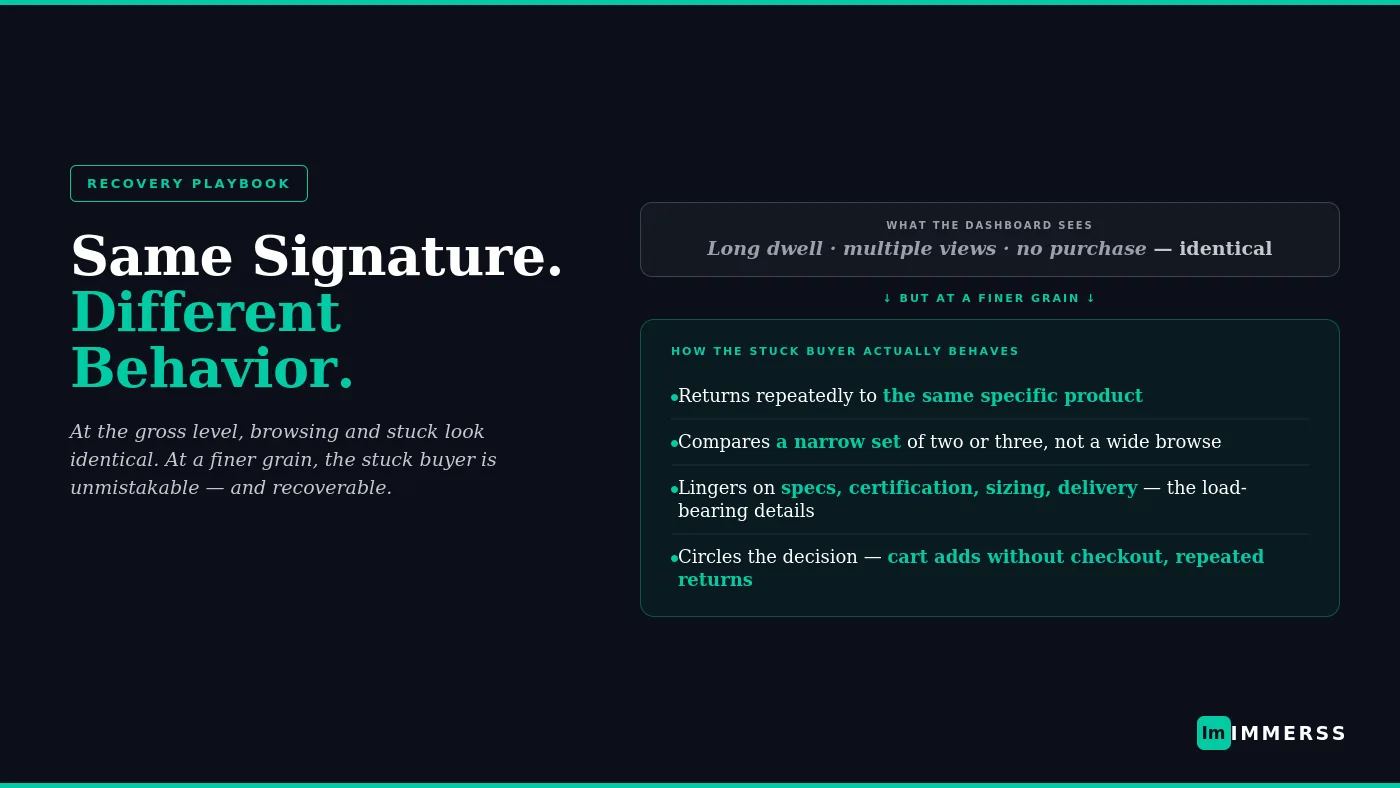
Patterns that consistently identify the high-AOV gift buyer during the Q4 window:
| Signal | What It Indicates |
|---|---|
| Browsing across categories rather than within one | Shopping for someone else, not self |
| Gift-oriented session entry (gift guides, “for her/him”) | Explicit gift intent |
| High dwell with low configurator completion | Intent blocked by uncertainty |
| Returning visits without purchase in the Q4 window | Anxiety-driven deferral under deadline |
| Sizing/gifting/shipping page visits | Practical gift-logistics concerns active |
When these signals combine, the visitor is a high-AOV gift buyer whose conversion is being blocked by anxiety, not by lack of intent or budget.
The Four Anxieties That Block Conversion
The high-AOV gift buyer carries a specific cluster of anxieties that the standard ecommerce surface cannot resolve:
The recipient-fit fear. “Will she actually like this?” The buyer does not know the recipient’s preferences well enough to be confident, and this fear is the single biggest driver of gift-buyer behavior — it pushes them toward the safe downgrade or the abandoned cart.
The sizing problem. Fine jewelry and watches have to fit. The buyer often does not know the recipient’s size and cannot ask without ruining the surprise. This practical problem causes enormous abandonment.
The spending calibration gap. The buyer lacks the self-buyer’s sense of what is appropriate to spend. They fear both overspending (ostentatious, awkward reciprocity) and underspending (cheap). They have no anchor.
The deadline pressure. The gift must arrive by a date. The decision cannot be deferred. The deadline amplifies every other anxiety and pushes the buyer toward whatever resolves the discomfort fastest.
None of these are addressable by the self-service surface. All of them are routinely resolved by an experienced holiday sales associate in the store.
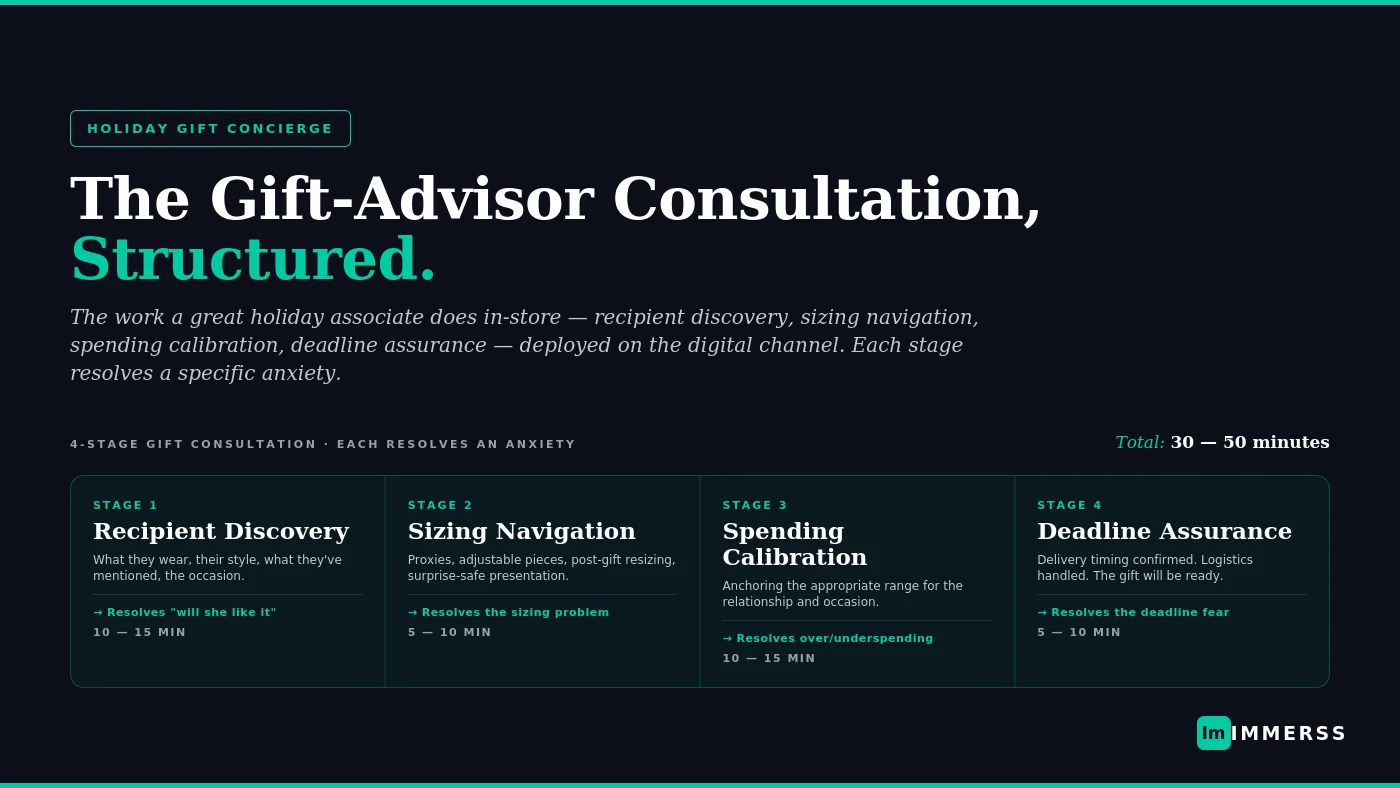
The Gift-Advisor Consultation, Structured
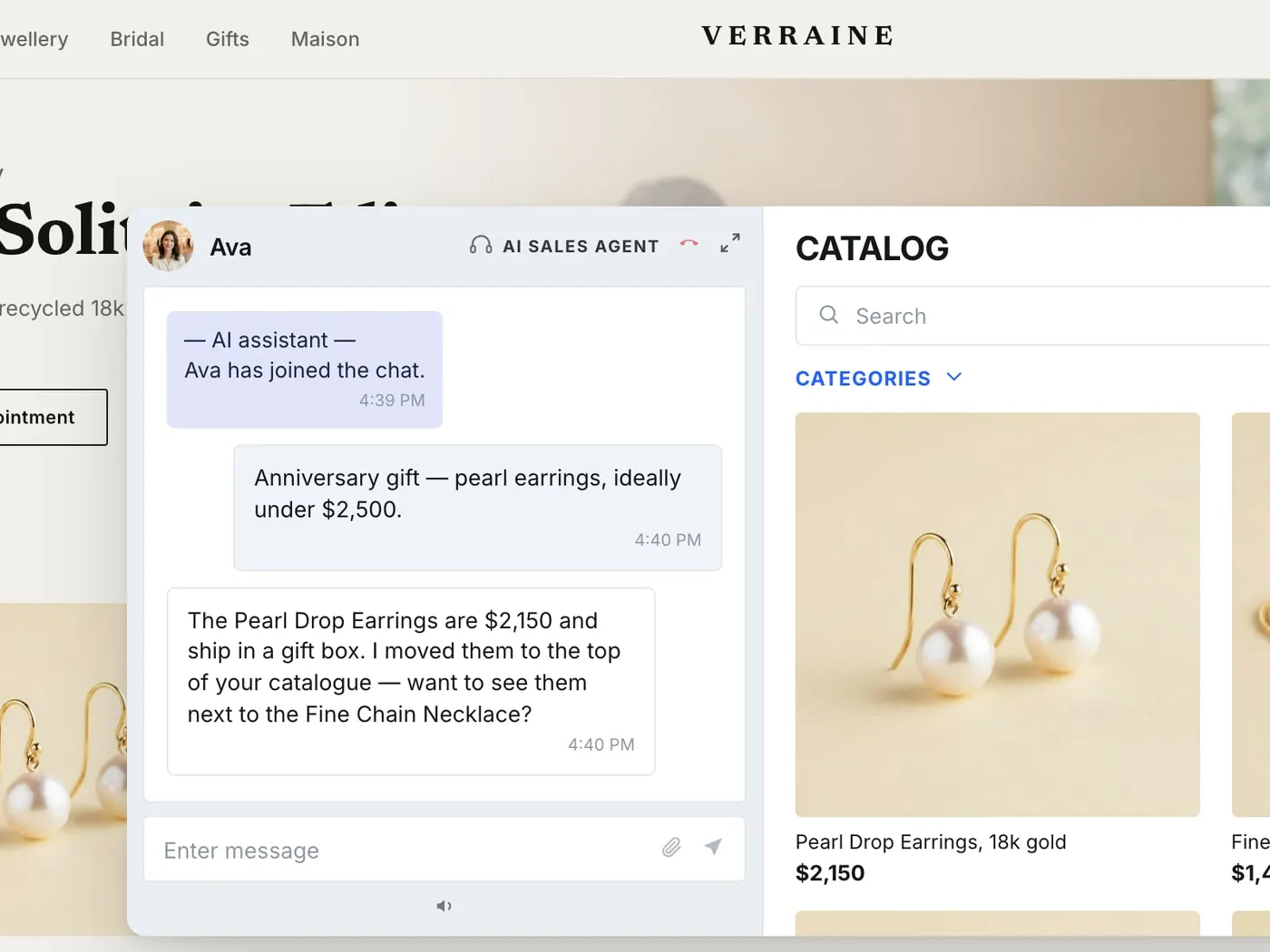
The fix is to deploy the gift-advisor conversation — the work a great holiday associate does in-store — on a video consultation. The structure for the holiday gift context specifically:
Stage 1: Recipient discovery (10-15 minutes). The advisor surfaces what the buyer knows about the recipient. What do they wear? What is their style? Have they mentioned wanting anything? What is the occasion and the relationship? This stage replaces the buyer’s guesswork with the advisor’s experienced judgment and resolves the central recipient-fit anxiety.
Stage 2: Sizing and logistics navigation (5-10 minutes). The advisor solves the sizing problem — through proxies the buyer knows, through adjustable or resizable pieces, through post-gift resizing arrangements, through presentation options that do not require sizing before the surprise. The practical problem that causes the most abandonment gets handled directly.
Stage 3: Piece selection and spending calibration (10-15 minutes). Informed by the recipient discovery, the advisor narrows to specific pieces and anchors the appropriate spending range for the relationship and occasion. The buyer’s over/underspending anxiety resolves into confidence about an appropriate, meaningful piece.
Stage 4: Deadline assurance and commitment (5-10 minutes). The advisor confirms delivery timing, handles the gifting logistics, and provides the reassurance that the gift will be ready. The deadline anxiety that otherwise pushes toward the safe default is removed, and the buyer commits to the meaningful high-AOV piece.
Total consultation: 30-50 minutes. Close rates on completed holiday gift consultations run dramatically above the self-service baseline because the consultation resolves exactly the anxiety that blocks self-service conversion. AOV runs higher because the advisor helps the buyer commit to the meaningful piece rather than retreating to the safe downgrade.
The Q4 Deployment Timeline
For the holiday window specifically, the deployment timeline works backward from the November traffic surge:
Late spring / early summer — Decision. The operator decides to deploy gift-advisor consultations for the Q4 window. This is the decision point that determines whether the capability will be ready.
Summer — Setup and integration. AI sales agent configured against the holiday inventory. Gift-buyer qualification logic calibrated (distinct from the rest-of-year self-buyer pattern). Brand voice training. Video consultation infrastructure prepared.
Early fall — Optimization and advisor scheduling. The capability runs on early-fall traffic for tuning. Advisor scheduling for the holiday surge is planned. The gift-buyer routing logic is refined on real session data.
November-December — The window. The capability is tuned and running as the high-AOV gift traffic arrives. Holiday gift consultations convert the traffic that the self-service playbook loses to anxiety.
The deployment-and-optimization timeline is six to ten weeks. An operator deciding in late spring or early summer is in market for the November surge. An operator deciding in October has missed the window for the year.
What The Holiday Pilot Includes
A structured deployment for the Q4 gift opportunity includes:
- AI sales agent trained on the holiday inventory and the gift-buyer conversation pattern
- Gift-buyer-specific qualification logic — recognition of the cross-category, gift-oriented, anxiety-driven session pattern, distinct from the self-buyer pattern
- Video consultation infrastructure designed for the gift-advisor conversation structure
- Advisor scheduling support for the holiday surge capacity
- Weekly performance insights specific to the gift consultation — conversion, AOV lift, anxiety-resolution outcomes
- Full setup, integration, and optimization handled by Immerss — no engineering lift on the operator team
Who This Deployment Fits
The fine retailers for whom the holiday gift concierge deployment makes the most sense:
- Meaningful Q4 revenue concentration. Operators whose annual revenue is significantly weighted toward the holiday window have the most to gain from capturing the high-AOV gift traffic.
- High-AOV gift-appropriate inventory. The deployment leverages most when the inventory includes significant pieces that gift buyers aspire to give but feel anxious about choosing.
- Advisors who excel at the holiday gift conversation. The model deploys the gift-advisor expertise. Operators with associates who are genuinely good at the recipient-discovery and reassurance work get the most lift.
- Shopify Plus storefront with meaningful holiday traffic. The deployment captures the conversion gap on holiday gift traffic the operator is already attracting.
If your business fits this profile, the structured pilot is a low-risk way to validate the gift-advisor lift on your specific holiday traffic, in time for the season that matters most.
The Strategic Position
The high-AOV holiday gift buyer is the largest pool of high-intent, high-budget, underconverted traffic of the entire retail year. The conventional Q4 playbook — gift guides, promotions, expedited shipping — captures the low-AOV gift purchases but loses the high-AOV ones to anxiety and to the safe downgrade.
The model that deploys the gift-advisor consultation on the digital channel captures exactly the high-AOV gift transactions that the self-service playbook loses. It is the highest-leverage seasonal deployment available in the category, and the holiday window is where it produces the clearest lift.
The decision to capture it this year is a late-spring or early-summer decision. The operators who decide now, deploy through the summer, and enter November with the capability tuned are the ones who will convert the Q4 high-AOV gift traffic that everyone else loses.
Immerss is a luxury live commerce platform combining AI sales agents with one-to-one video consultations. Built for fine retailers whose highest-value transactions require guidance the self-service surface cannot provide — most acutely during the holiday gift season.
Apply for the 60-day AI Sales Agent pilot: landing.immerss.live For Shopify Plus agencies introducing this to fine retail clients: partners.immerss.live