
How to Reduce Cart Abandonment for High-Ticket Stores: Recover Hesitant Buyers Without Discounting (The Unanswered Question)
Cart abandonment sits around 70% across ecommerce, and for high-ticket stores it often looks even worse. But for a $5,000 watch or a $15,000 ring, the standard advice — reminder emails, discount codes, retargeting, urgency timers — is built for the wrong problem and quietly makes a high-value store worse. This guide explains why high-value carts get abandoned, why the usual recovery playbook backfires on luxury buyers, and how to reduce cart abandonment for high-ticket ecommerce by answering the hesitation behind it — at full price.
The short version: for a high-AOV purchase, an abandoned cart is rarely a friction problem. It’s an unanswered question. Fix that, and most of the problem dissolves.
Why do customers abandon high-value carts?
High-value carts are abandoned because of unresolved uncertainty, not checkout friction. A shopper does not walk away from a $15,000 purchase because shipping cost $12 more than expected or because they got distracted — those are reasons a $40 order gets abandoned. A high-ticket cart is abandoned because, at the final step, the buyer hits a wall of doubt they can’t get over alone: Is this the right piece? Will it suit me? Is it the right choice among the options I was weighing? Can I trust this online store with this much money?
That hesitation usually presents as “let me think about it” — and on a considered purchase, “let me think about it” overwhelmingly means never. The decision was hard, and nothing in a self-service checkout helped the customer make it. The cart wasn’t lost to a process failure. It was lost to a question that had nowhere to go.
What is a good cart abandonment rate for high-ticket ecommerce?
There is no single “good” cart abandonment rate for high-ticket ecommerce, and chasing the number is a mistake. Industry-wide abandonment averages roughly 70%, and high-consideration categories often run higher, because deliberation is inherent to the purchase — a high abandonment rate on $15,000 pieces is the nature of the category, not a crisis. A low-AOV store can post an enviable rate simply because its decisions are easy; a luxury retailer can post a “worse” one while building an excellent business.
The rate is close to a vanity metric for high-AOV stores. What matters is not how many carts are abandoned but how many of those hesitations you resolve into a confident, full-price sale. More on that in the measurement section below.
Why the standard cart-abandonment recovery playbook fails for high-AOV stores
The standard recovery playbook fails for high-AOV stores because every tool in it was designed for mechanical, low-value abandonment — and a high-ticket cart is abandoned for the opposite reason. The playbook treats abandonment as a memory or price problem; for a considered purchase, it’s a confidence problem.
- The reminder email assumes the customer forgot. A buyer weighing your $15,000 piece has not forgotten it — they are likely thinking about it more than anything else that week. Reminding them it exists does nothing, because the question is still unanswered.
- The retargeting ad assumes they need repeated reminding across the web. For a luxury purchase, being followed around the internet by the ring they weren’t sure about doesn’t build confidence; it reads as pressure, even desperation.
- The countdown timer assumes they need urgency. Manufacturing false scarcity is the most corrosive move of all, because the high-AOV relationship runs on trust, and the sophisticated buyer you most want to keep is exactly the one who sees through “only 2 left, expires in 14:59.”
Each of these answers a question the high-value customer never asked, and ignores the one they did.
Do cart abandonment emails and discount codes work for luxury products?
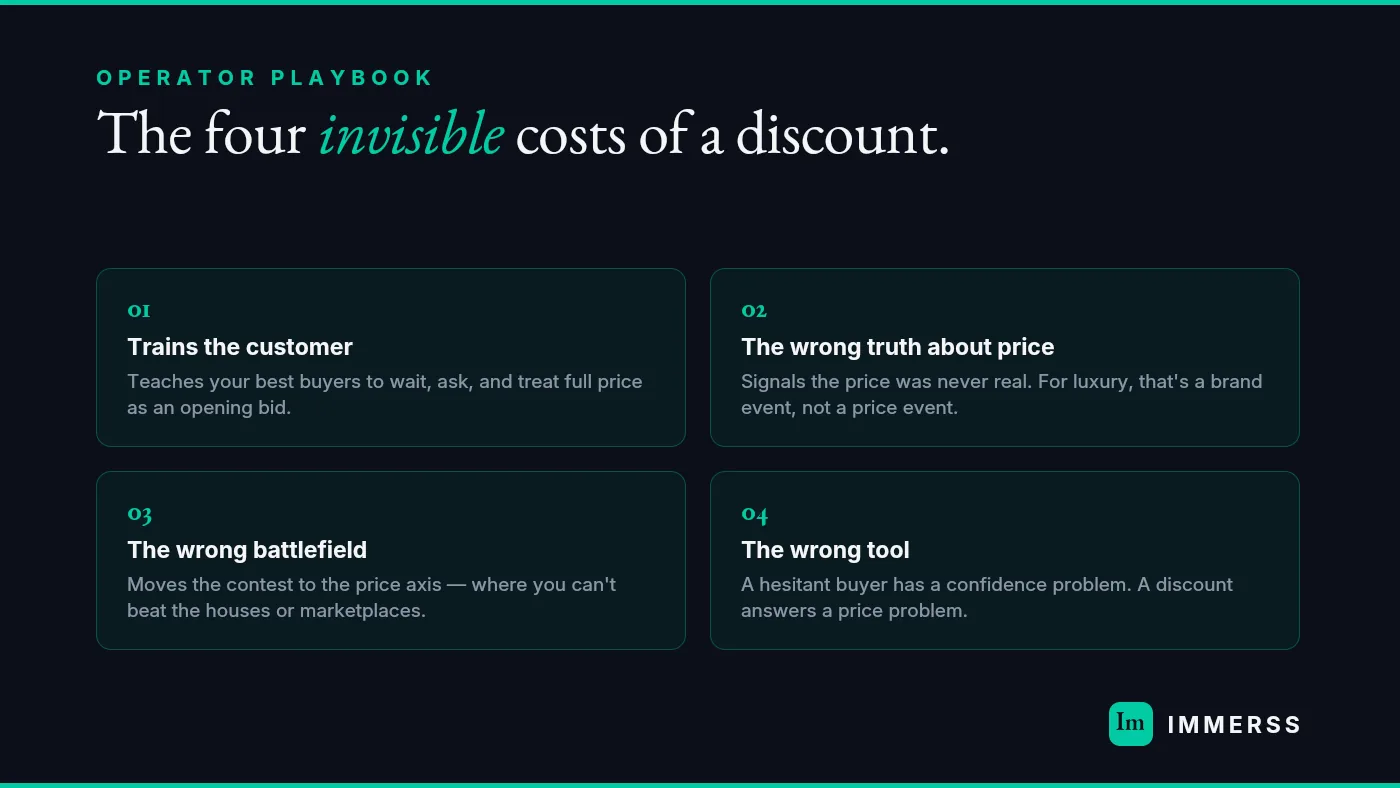
Cart abandonment emails and discount codes work for low-consideration products but backfire on luxury ones. A reminder with a discount can recover a distracted bargain shopper; applied to a high-ticket hesitation, the discount answers a price question the customer wasn’t actually asking — and does lasting damage to a luxury brand’s pricing strategy.
A discount trains your best customers to abandon deliberately and wait for the recovery code. It signals that the price was never quite real, which erodes the credibility that justifies a luxury price in the first place. And it can close a sale the customer wasn’t confident in — exactly the one that comes back as a return. (We unpack this fully in the discount trap.) For high-ticket items, the discount-driven recovery email is a way to spend down your margin and your brand at the same time.
How to tell a friction problem from a confidence problem
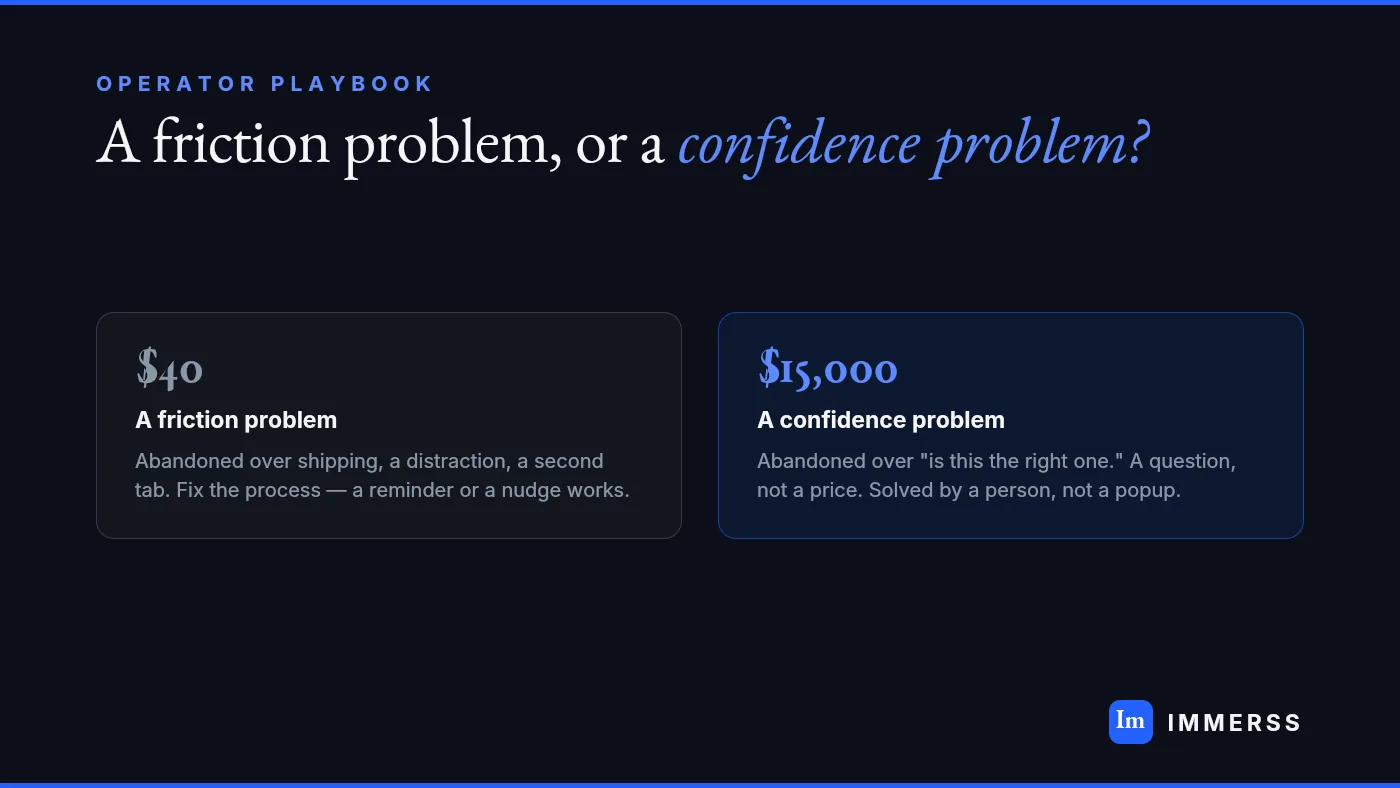
You can tell a friction problem from a confidence problem by looking at price point, consideration time, and where the abandonment happens. Friction problems cluster at low AOV, on quick decisions, and at the mechanical steps — the shipping reveal, the account-creation wall, the payment page. Confidence problems cluster at high AOV, on long-deliberation purchases, and at the threshold of commitment, often after repeat visits to the same product.
The practical test: would a knowledgeable salesperson standing next to this customer have changed the outcome? For a $40 cart abandoned over shipping, no — fix the process. For a $15,000 cart abandoned over “is this the right one,” absolutely — that’s a confidence problem, and confidence problems are solved by people, not popups. A useful rule of thumb: the higher the price and the longer the consideration window, the more of your abandonment is confidence rather than friction — which means the more of it your current recovery tools are structurally unable to touch.
How to reduce cart abandonment for high-ticket ecommerce (without discounting)
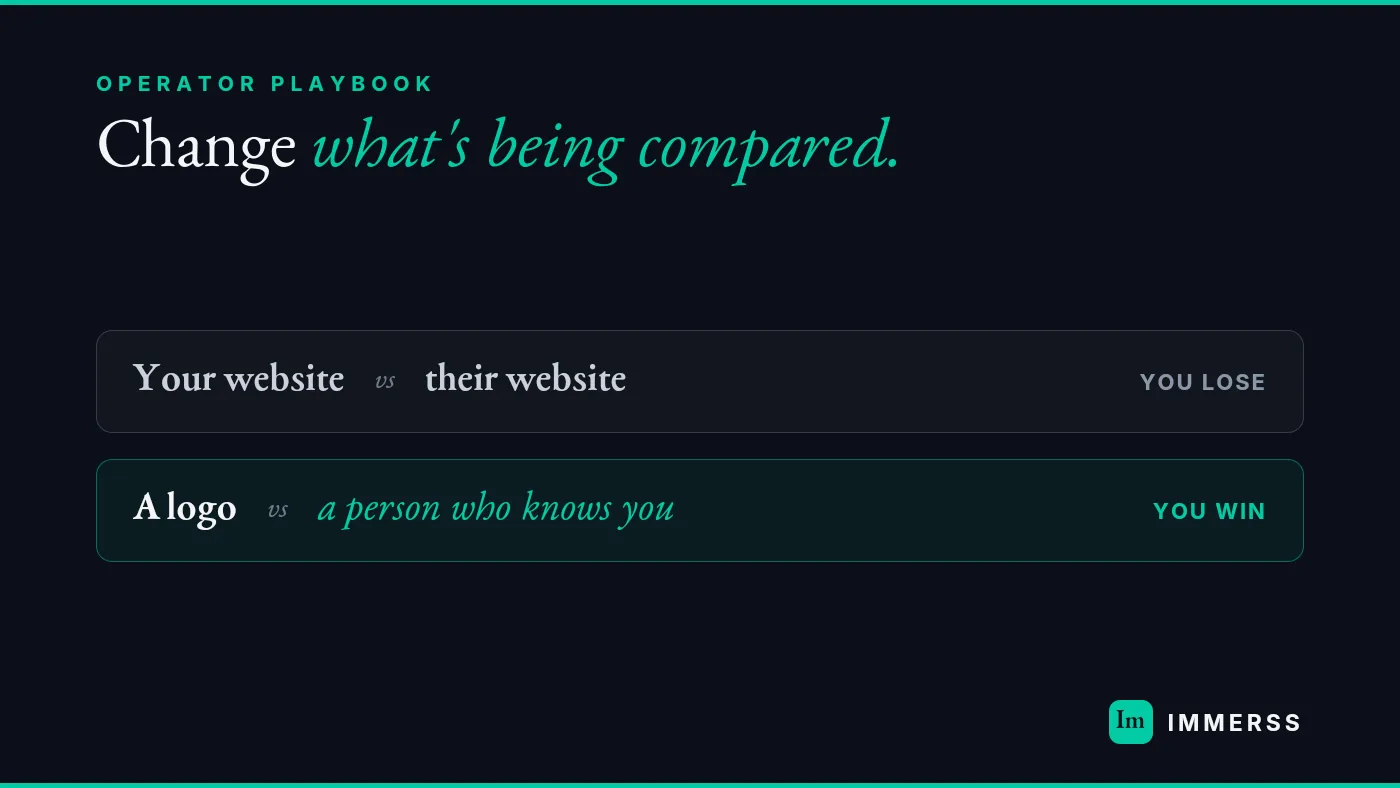
To reduce cart abandonment for high-ticket ecommerce without discounting, answer the hesitation with a person — ideally before the customer abandons, and through genuine outreach if they already have. The goal shifts from remind, incentivize, pressure to answer the question.
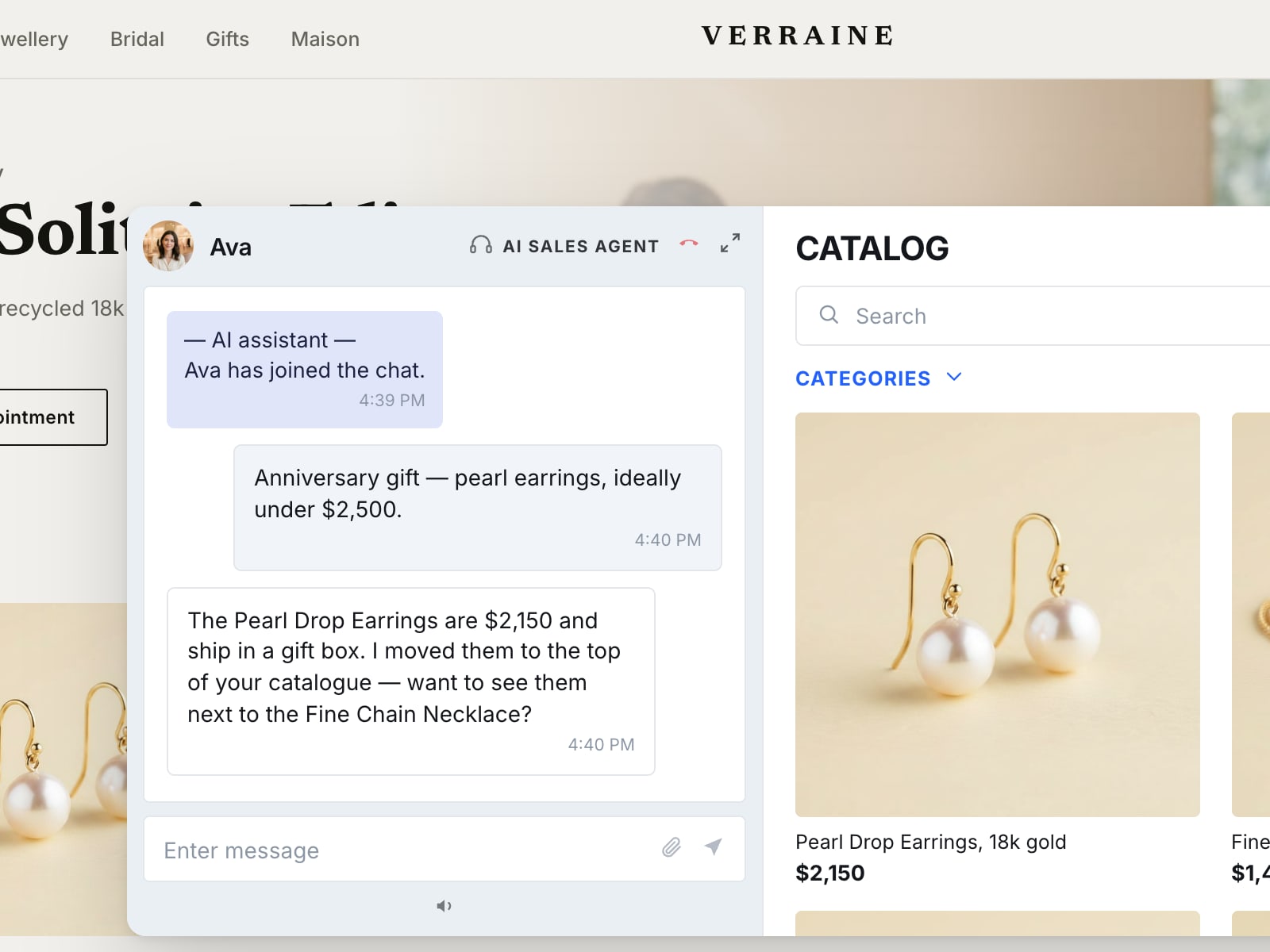
Before abandonment — put the advisor in the moment of doubt. A customer lingering on a high-value product, returning for a third visit, or hovering at checkout is showing you the hesitation in real time. That’s the moment to offer a real conversation — not a popup asking “any questions?” but access to a person who can answer the one they actually have. An AI sales agent can watch for those high-intent, high-hesitation signals and open the door to a live, one-to-one video consultation with an advisor at exactly the right moment. The best cart-abandonment strategy resolves the hesitation before it becomes an abandonment at all — the online version of what a great store has always done.
After abandonment — recover with a conversation, not a coupon. Instead of a templated “you left something behind” email with a discount, the high-value recovery is a personal outreach from an advisor: not “come back and buy” but “I saw you were considering this — can I answer anything?” It reopens the conversation the self-service checkout couldn’t have, and it converts by doing the one thing that was missing: answering the question. This is the same relationship discipline behind digital clienteling and modern conversational commerce, applied at the moment of hesitation.
Done this way, recovery keeps the full margin, preserves pricing integrity, and tends to raise average order value — because a trusted advisor guides the buyer to the right piece, not the cheapest one.
Worked example: what one recovered high-ticket cart is worth
Here’s a calculation you can redo with your own numbers. Take a high-ticket store on Shopify Plus with:
- 150 high-value carts started per month
- $8,000 average order value
- 70% abandonment rate → 105 abandoned carts per month
Now compare two recovery approaches on those 105 abandoned carts:
- Discount-email recovery typically wins back a low single-digit percentage of abandoned carts, and wins them back below full price. Multiply your abandoned carts by that rate and by your discounted order value: that is the recovery, at compressed margin, with the brand cost of discounting baked in.
- Consultation-led recovery answers the hesitation directly, so it resolves a far larger share of carts and resolves them at full price. Use your own recovery rate here — an illustrative figure you own, not an Immerss benchmark — and multiply by full order value, at full margin.
The gap between those two lines is full-margin revenue, and on a high-ticket catalogue it is not close — before counting the brand and lifetime-value benefit of full-price relationships over discounted one-offs. Run it with your own cart count, average order value and recovery rate; the conclusion holds for any genuinely high-ticket store, because the discount half is capped by both a low recovery rate and a reduced price, while the consultation half is capped by neither.
(Recovery percentages here are illustrative and reader-owned, not Immerss benchmarks. Immerss’s documented platform outcomes — materially higher conversion, meaningfully larger average orders, and recovery of a significant share of abandoned carts — are framed as benchmarks, not guarantees; your numbers come from your pilot.)
Is your store in the high-AOV cart-abandonment trap?
Run this ICP filter against your business:
- Shopify Plus, 50K+ monthly visits, AOV $100+ — sweet spot $500+, decisive at $5,000+. The higher the AOV, the more abandonment is a confidence gap, not a friction gap.
- You run the standard recovery playbook — abandonment emails, discount codes, retargeting, timers — and the abandonment rate hasn’t meaningfully moved.
- Your in-store conversion dwarfs your online conversion on the same products. That gap is the advisor your website doesn’t have.
- Customers research, hesitate, and “think about it” rather than impulse-buy.
If two or more are true, your abandoned carts are mostly unanswered questions — and the recovery tools you’re paying for are aimed at the wrong problem.
What to measure instead of your cart abandonment rate
Measure hesitation resolution, not the abandonment rate. For a high-ticket store, the rate will always look alarming and tells you little. These metrics tell you whether you’ve put the answering mechanism back into your store:
- Consultation-assisted recovery rate — share of abandoned high-AOV carts that come back through a real conversation.
- Full-price recovery share — recovered carts closed without a discount, as a percentage of all recovered carts.
- AOV of recovered carts: guided vs. discounted — guided recoveries should run higher.
- Time-to-first-conversation on high-intent, hesitating sessions — how fast a person reaches the doubt.
A store can have a “great” abandonment rate by selling only easy items, and a “bad” one while building an outstanding high-AOV business that converts its hesitations. The resolution numbers, not the rate, tell the real story.
The 60-day pilot, on us
The fastest way to see consultation-led recovery work is to put a person back into the moment of hesitation and measure full-price recovery against your current discount-and-email baseline. That’s what the pilot is for.
We run a structured 60-day pilot, on us — an AI sales agent detecting high-intent, hesitating shoppers, live one-to-one video consultation answering the question that would otherwise become an abandoned cart, and measurement built around consultation-assisted recovery, full-price recovery share, and recovered-cart AOV. You change no checkout, run no risk to margin, and find out whether the carts you’ve been emailing discounts at were ever a price problem — or a missing advisor.
Brands running consultative sessions through Immerss typically see assisted high-AOV interactions recover and convert meaningfully higher at full price than self-service flows, recovering a meaningful share of abandoned carts through timely outreach. We frame those as benchmarks, not promises — the pilot finds your number, with your advisors, on your inventory.
FAQ: high-ticket cart abandonment
What is a good cart abandonment rate? There’s no universal “good” rate — the ecommerce average is around 70%, and high-ticket, high-consideration stores often run higher because deliberation is built into the purchase. For luxury and high-AOV retail, focus on how many hesitations you resolve into full-price sales rather than on the rate itself.
Why do people abandon high-value carts? They abandon because of unresolved uncertainty, not checkout friction. At high price points the blocker is a confidence question — is this the right piece, will it suit me, can I trust this store — that the customer couldn’t answer alone and that no one was there to help with.
Do cart abandonment emails work for high-ticket items? They work poorly. Reminder emails assume the customer forgot, but a buyer weighing a $15,000 purchase hasn’t forgotten it — the question is still unanswered. A discount inside that email can also damage a luxury brand by training customers to wait for markdowns and signaling the price wasn’t real.
How do you recover an abandoned cart without offering a discount? Recover it with a conversation instead of a coupon — a genuine, personal outreach from an advisor that answers the hesitation behind the abandonment. This keeps full margin and pricing integrity, and guided recoveries tend to carry a higher average order value than discounted ones.
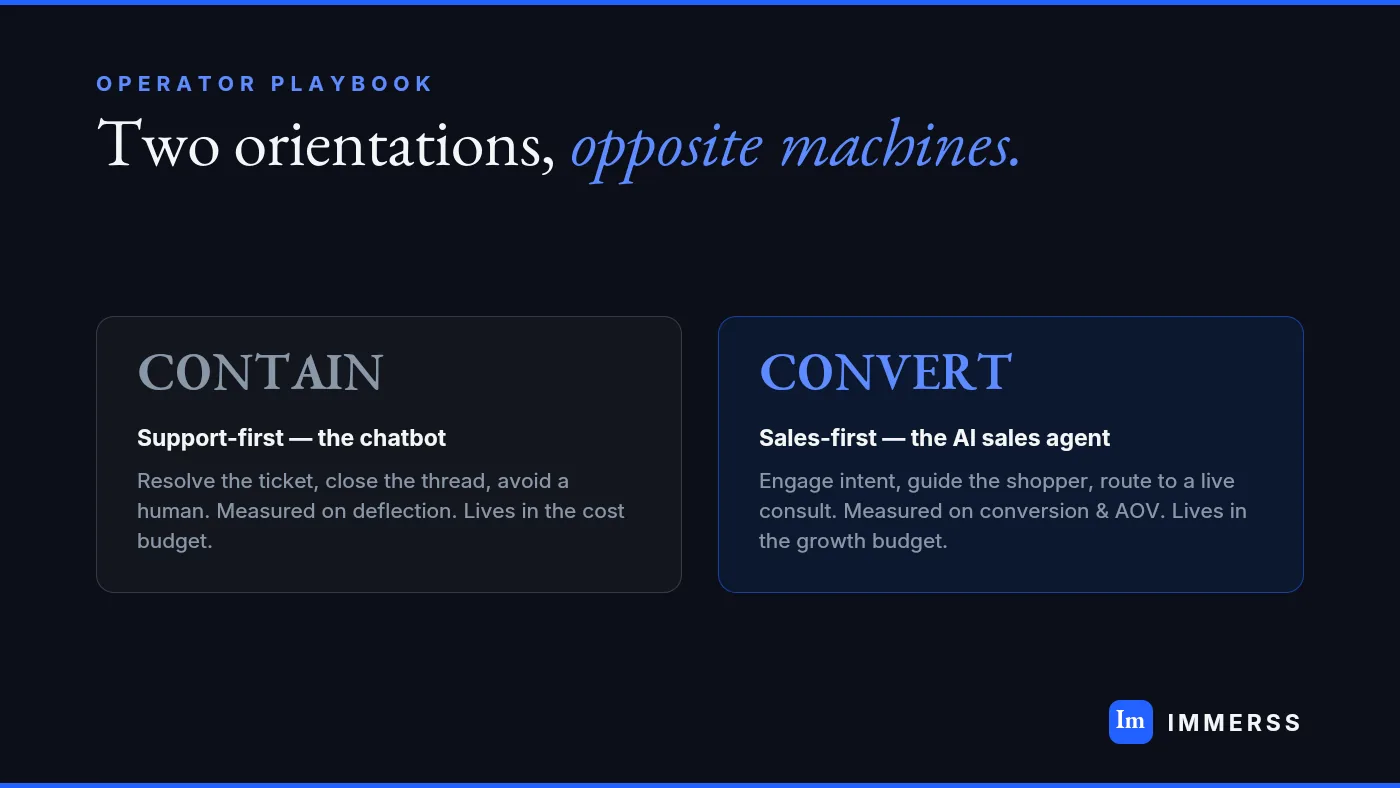
Does live chat or consultation reduce cart abandonment? Live, one-to-one consultation reduces high-value cart abandonment more effectively than automated chat, because it resolves the confidence question in real time. An AI sales agent can detect hesitation signals and route the shopper to a human advisor at the moment of doubt — before the cart is abandoned at all.
See the pilot for merchants: landing.immerss.live Agency partner program: partners.immerss.live
Immerss is a luxury live commerce platform — AI sales agents and one-to-one video consultation for fine jewelry, watches, and high-AOV retail, built on Shopify Plus.