
AI Sales Agent vs Chatbot vs Live Commerce: A Complete Comparison for 2026
Why the distinction between sales-first and support-first architecture matters more than any feature comparison.
E-commerce brands evaluating customer engagement technology face a bewildering landscape in 2026. Every vendor claims AI capabilities. Every platform promises conversion improvements. The categories — chatbots, AI agents, helpdesks, live commerce — blur together until meaningful comparison seems impossible.
But beneath surface-level feature claims, fundamental architectural differences determine whether a platform drives revenue or just deflects support tickets. This guide breaks down the categories, compares specific vendors, and explains why the sales-first versus support-first distinction matters more than any individual feature.
The Fragmented Landscape
E-commerce engagement technology has splintered into three distinct categories, each optimizing for different outcomes.
Support Helpdesks and AI Chatbots focus on automating customer service. Platforms like Gorgias, Tidio, Zendesk, and Intercom route tickets, automate responses to common questions, and reduce human agent workload. Their optimization target is support deflection — resolving inquiries without human intervention.
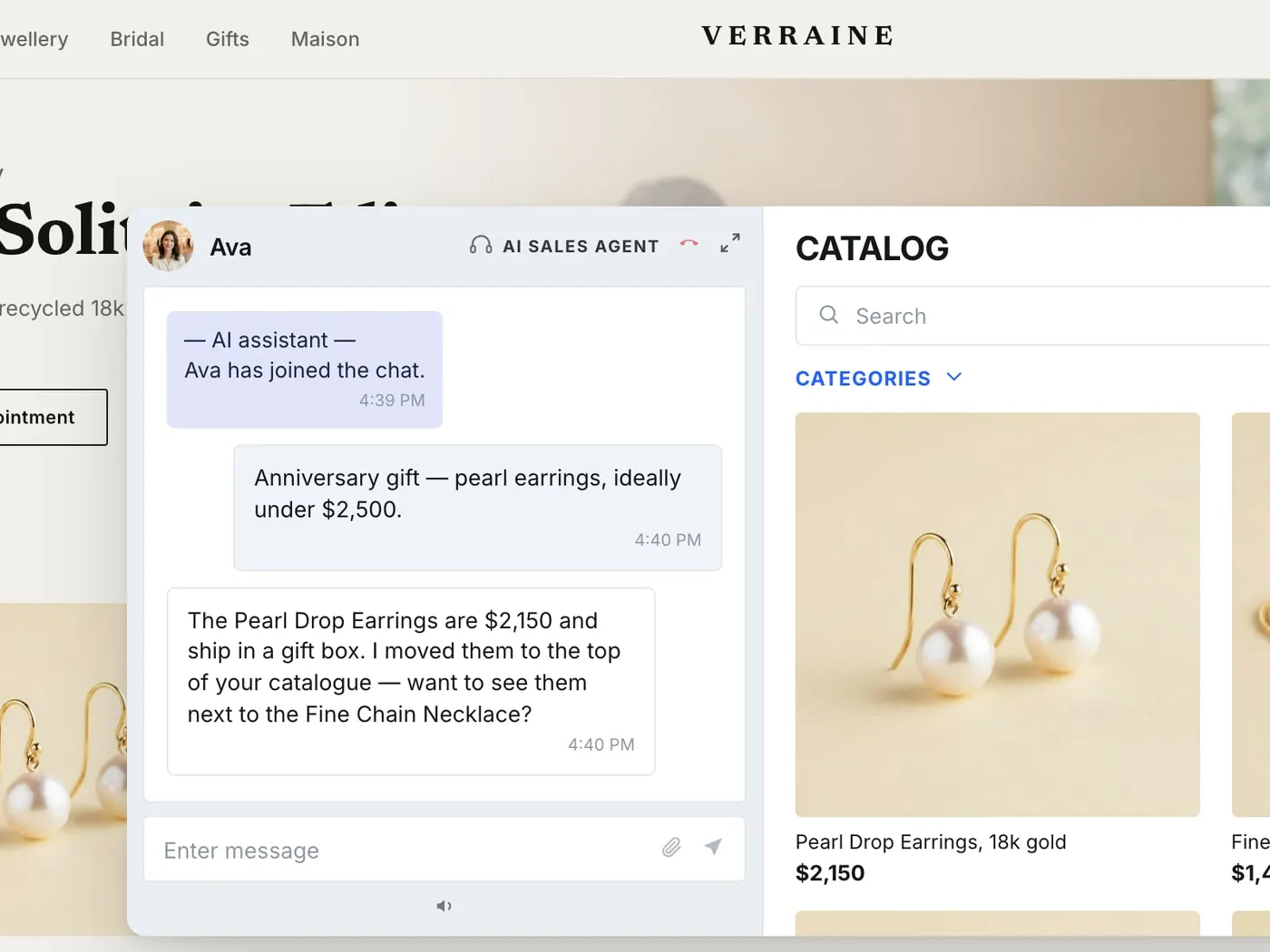
AI Sales Agents focus on converting browsers to buyers. Tools positioning in this space use behavioral AI to identify purchase intent, engage shoppers proactively, and guide them toward conversion. The optimization target is revenue generated per visitor.
Live Commerce Platforms focus on video-based selling. Bambuser, CommentSold, Channelize.io, and similar tools enable livestream shopping events with shoppable overlays. The optimization target is event engagement and live sales velocity.
Most brands end up implementing tools from multiple categories, creating a patchwork of vendors that don’t communicate with each other. A shopper might engage with an AI chatbot, request a video consultation, and later submit a support ticket — interacting with three different systems that share no context about their journey.
This fragmentation creates real costs: integration complexity, data silos, inconsistent customer experience, and ongoing maintenance burden. Understanding the alternatives requires examining each category more closely.
Support-First Platforms: What They Do Well
Platforms like Gorgias and Tidio are purpose-built for customer support in e-commerce. They excel at specific functions.
Gorgias integrates deeply with Shopify, BigCommerce, and Magento. When an agent opens a ticket, they see the customer’s entire order history alongside the message. They can refund, cancel, or edit orders without switching tools. The platform handles email, chat, social DMs, and SMS in a unified inbox.
Gorgias’s AI Agent automates responses to common questions, claiming to resolve 60% of support inquiries without human intervention. For brands processing thousands of support tickets monthly, this automation genuinely reduces staffing requirements.
The pricing model is ticket-based: you buy a ticket allowance and pay more as it grows. AI automation is a per-resolution add-on rather than part of the base plan, and voice and SMS carry their own per-ticket charges — so the sticker price and the bill diverge quickly. Check their pricing page for current tiers.
Tidio combines live chat, chatbots, and helpdesk functionality for small to mid-size e-commerce stores. Its Lyro AI Agent handles common questions automatically, claiming to resolve up to 67% of inquiries without human agents. The visual chatbot builder lets teams create automated flows without coding.
Tidio’s pricing model is conversation-based rather than agent-based, which suits a small team with steady volume. The trap is that AI (Lyro) and automation (Flows) are separate add-ons, so the real cost lands well above the base plan once you have added the features you actually wanted.
Where these platforms fall short: Support-first architecture means the AI is trained to answer questions, not sell products. When a shopper asks about product differences, the AI provides information rather than guiding toward a purchase decision. Proactive engagement is limited. The platforms resolve inquiries rather than create opportunities.
AI Sales Agents: The Revenue Focus
A smaller category of platforms positions specifically around sales conversion rather than support deflection.
Rep AI describes itself as “sales-first, not support-first” with behavioral AI that identifies when shoppers are disengaging and intervenes to guide them toward purchase. The platform claims conversion improvements of 12%+ and AOV increases of 16%+.
Rep AI integrates exclusively with Shopify. The AI syncs with the product catalog and updates every 10 seconds to reflect inventory changes. The system handles product recommendations, upselling, and abandoned cart intervention.
The pricing model is visitor-based, with overage charges per additional thousand visitors. That structure makes costs unpredictable in exactly the month you least want a surprise: a marketing campaign that works raises the bill along with the traffic.
User reviews highlight both strengths (genuine sales lift, responsive support) and weaknesses (AI sometimes creates circular conversations that frustrate shoppers, Shopify-only limits adoption).
Where sales-focused chatbots fall short: Most operate purely in text chat. When a high-value customer needs to see a product from multiple angles or ask detailed questions, the platform can’t escalate to video consultation. Clienteling capabilities — tracking long-term customer relationships across interactions — are typically minimal.
Live Commerce Platforms: The Video Dimension
Live commerce has grown dramatically, with the market projected to exceed $1 trillion in Asia and $68 billion in the US by 2026. Multiple platforms compete for this space.
Bambuser offers both one-to-many livestreams and one-to-one video shopping. The platform integrates with Shopify, Salesforce, Magento, WooCommerce, and other e-commerce platforms. Features include interactive overlays, real-time product tagging, and checkout within the video experience.
Bambuser claims up to 4x higher engagement compared to traditional social video and 9-30% conversion rates during live events. Pricing is enterprise-grade with custom quotes.
CommentSold focuses on social commerce, enabling simultaneous livestreams across Facebook, Instagram, and TikTok. The platform is popular with boutiques running frequent live selling events. It includes automated invoicing and fulfillment features.
Channelize.io provides plug-and-play live commerce for brands wanting video selling on their own website rather than social platforms. The focus is on beauty, skincare, and fashion with consultative selling features.
Where live commerce platforms fall short: Most focus exclusively on video, without integrated AI for text-based engagement. A visitor who arrives when no live event is running encounters a static site. The platforms don’t provide 24/7 AI coverage for the majority of traffic that never joins a livestream. Clienteling and relationship management typically require separate systems.
The Integration Tax
When brands piece together tools from multiple categories — a support helpdesk here, a sales chatbot there, a live commerce platform somewhere else — they pay an integration tax that compounds over time.
Data fragmentation is the most immediate cost. Customer interactions spread across platforms create incomplete views of each relationship. The AI chatbot doesn’t know what happened in the video consultation. The support helpdesk doesn’t know what the AI recommended. When a VIP customer returns, no single system has the full context of their history.
Customer experience suffers from fragmentation. Shoppers repeat context when moving between channels. High-value customers who deserve white-glove treatment aren’t identified until they explicitly request escalation. The journey feels disconnected — because it is.
Operational overhead grows with each integration. API changes, platform updates, and vendor pivots require continuous attention. Each connection point is a potential failure mode. When something breaks, identifying which vendor to contact becomes its own troubleshooting project.
Analytics blind spots emerge when data lives in silos. Which AI conversations convert best? How does video consultation drive AOV? Which customer patterns predict lifetime value? These questions require cross-platform data that integration fragmentation makes difficult to access.
The Unified Alternative
The alternative to point-solution patchworks is unified platforms that combine AI sales, video commerce, and clienteling in a single architecture. When these capabilities share the same data model, interface, and analytics, several advantages emerge.
Contextual continuity means every interaction builds on previous ones. A shopper who browsed on Monday, chatted with AI on Tuesday, and schedules a video consultation for Friday arrives at that call with their entire journey visible. The associate sees what the AI recommended, what products the customer viewed, what questions they asked. Nothing needs to be repeated.
Seamless escalation means high-value opportunities reach humans without friction. When AI identifies a serious buyer with complex needs — or a customer explicitly requests expert help — the transition happens within the same interface. No tool-switching. No context loss. The customer experiences continuity rather than handoffs.
Relationship continuity means clienteling works at scale. Customer profiles accumulate interaction history, purchase patterns, and preferences across all engagement types. Associates see the full relationship when engaging with returning customers. The system identifies VIP customers automatically rather than waiting for them to self-identify.
Unified analytics means understanding the complete customer journey. Which AI conversations drive conversion? Which video consultations produce highest AOV? Which combination of touchpoints predicts customer lifetime value? Cross-channel analytics make these questions answerable.
The Sales-First Architecture Difference
Beyond integration, the fundamental architectural question is whether a platform optimizes for support or sales.
Support-first platforms train AI to resolve inquiries. Success metrics center on deflection rate, ticket closure time, and customer satisfaction with issue resolution. The AI is excellent at answering “Where is my order?” but not designed to help undecided shoppers become buyers.
Sales-first platforms train AI to convert browsers. Success metrics center on conversion rate, AOV, and revenue attribution. The AI proactively engages visitors showing purchase interest, recommends products based on behavior, handles objections, and guides toward checkout.
The same underlying technology — large language models, conversational AI — produces dramatically different outcomes depending on training objectives and architecture. A platform celebrating 97% ticket deflection is not optimizing for the same goals as a platform celebrating dramatically higher conversion.
Evaluating Platform Fit
Different brands have genuinely different requirements. The right platform depends on specific business context.
Average order value — Brands with high AOV ($500+) benefit most from sales optimization and clienteling. The marginal value of each conversion justifies investment in AI that sells rather than just answers. Brands with low AOV may legitimately prioritize support efficiency.
Purchase complexity — Products requiring consultation, customization, or education benefit from AI that guides toward decisions. Commodity products with simple purchase paths may need only basic question-answering.
Customer lifetime value — Brands building long-term customer relationships need platforms that track relationships over time, not just resolve individual transactions. Clienteling capabilities matter when repeat purchase and loyalty drive business value.
Channel requirements — Brands wanting both AI chat and video consultations need platforms that unify these capabilities. Point solutions force integration complexity that unified platforms avoid.
Traffic variability — Visitor-based and ticket-based pricing creates budget uncertainty for brands with variable traffic or seasonal spikes. Predictable subscription models may better fit operations requiring cost stability.
The Comparison at a Glance
Gorgias
- Focus: Support helpdesk
- Best for: Post-purchase support automation
- Pricing: Ticket-based ($10-300/month + AI add-on + channel add-ons)
- Limitation: Support-first, not designed for proactive sales
Tidio
- Focus: Support chatbot with AI
- Best for: Small store support automation
- Pricing: conversation-based, with AI and Flows as separate add-ons
- Limitation: Support-first, real costs 2-3x advertised
Rep AI
- Focus: AI sales agent
- Best for: Shopify stores wanting sales automation
- Pricing: Visitor-based ($99-350/month + $12/1K overage)
- Limitation: Shopify-only, no video, unpredictable costs
Bambuser
- Focus: Live video commerce
- Best for: Enterprise brands running live events
- Pricing: Enterprise custom
- Limitation: Video-only, no integrated AI for non-video traffic
Immerss
- Focus: Unified AI Sales + Video + Clienteling
- Best for: Mid-market to enterprise DTC brands ($10M-$500M+)
- Pricing: Predictable subscription model
- Differentiation: Sales-first architecture, three integrated modules, high-AOV focus
The Strategic Choice
The e-commerce technology decision isn’t just about features or pricing — it’s about architectural alignment with business strategy.
Brands prioritizing support efficiency and cost reduction may legitimately choose support-first platforms. The deflection metrics they optimize for genuinely reduce staffing requirements.
Brands prioritizing revenue growth and customer relationships need sales-first platforms. The conversion and AOV metrics they optimize for directly impact top-line results.
Brands wanting AI, video, and clienteling together choose between integration complexity with point solutions or streamlined operations with unified platforms.
The architectural choice compounds over time. Each customer interaction either builds integrated context or fragments it across systems. Each analytics query either accesses complete journey data or partial snapshots. Each escalation either flows seamlessly or requires tool-switching.
The Bottom Line
The e-commerce engagement technology market in 2026 offers more options than ever. But more options don’t automatically mean better outcomes. The proliferation of point solutions has created integration complexity that unified platforms avoid.
The fundamental questions remain simple:
Is your platform built to deflect support tickets or convert browsers to buyers?
Does your architecture unify AI, video, and clienteling — or fragment them across vendors?
Do your analytics capture the complete customer journey or isolated touchpoints?
The answers to these questions matter more than any individual feature comparison. They determine whether technology drives revenue or just handles transactions.
Choose accordingly.
Immerss provides unified AI Sales Agents, Clienteling, and Video Commerce for mid-market and enterprise DTC brands. Our sales-first architecture delivers measurable conversion improvements and AOV increases for high-consideration purchases in jewelry, luxury fashion, beauty, home, and electronics.