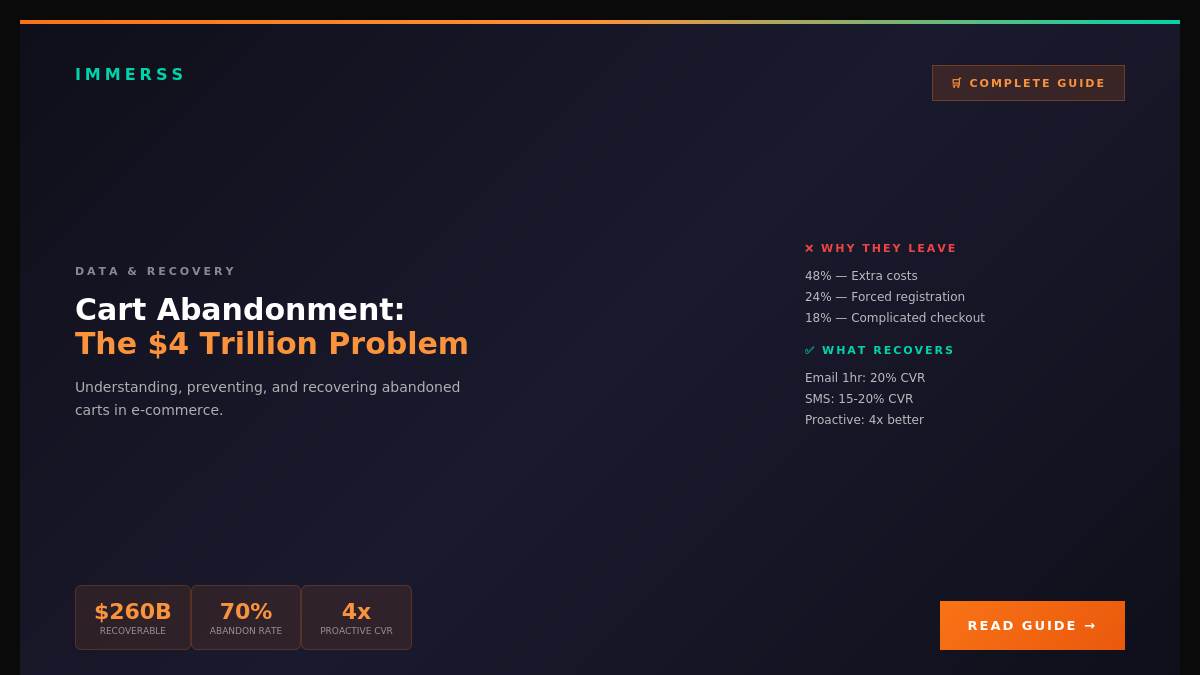

Cart Abandonment: The $4 Trillion Problem
Executive Summary
Every year, approximately $4 trillion worth of merchandise is left in abandoned shopping carts globally. The number is staggering — and misleading. Most of that value was never going to convert. Shoppers use carts as wish lists, comparison tools, and browsing aids without any intention to purchase.
The more actionable figure comes from Baymard Institute: $260 billion in lost orders are recoverable in the US and EU alone through better checkout flow and design. That’s revenue that could have been captured — and still can be.
This guide examines why cart abandonment happens, what the current data shows, which recovery tactics actually work, and how proactive engagement can prevent abandonment before it occurs. The goal isn’t to eliminate cart abandonment (impossible) but to capture the revenue that’s genuinely capturable.
Part 1: The Scale of the Problem
The Numbers in Context
The global cart abandonment rate in 2026 sits at approximately 70-78%, depending on methodology and measurement. This number has remained remarkably stable for nearly two decades. Better checkout technology, faster sites, and smoother payment options haven’t fundamentally changed the baseline.
Why? Because cart abandonment isn’t primarily a technology problem. It’s a human behavior problem. People browse, compare, save for later, get distracted, change their minds. Technology can reduce friction, but it can’t eliminate human psychology.
Dynamic Yield tracked a 76.8% abandonment rate based on 200 million unique monthly users throughout 2025. Statista recorded 78.77% in August 2025, the highest month of the year. December sees the lowest rates at 71.36%, driven by holiday purchase intent and urgency.
E-commerce retailers lose approximately $18 billion annually due to abandoned carts. That’s roughly 0.3% of total e-commerce revenue — significant, but manageable when you understand which portion is recoverable.
The Recovery Opportunity
Baymard Institute’s research offers the most actionable framing: $260 billion in lost orders are recoverable in the US and EU through better checkout design. The average large e-commerce site can gain a 35.26% increase in conversion rate through checkout improvements alone.
The average site has 39 potential areas for checkout optimization. Even Fortune 500 companies that have invested in multiple optimization projects still have substantial gains available. The opportunity exists regardless of where you start.
For individual stores, the math scales proportionally. A mid-sized online store generating $2 million annually typically has $7-8 million in abandoned cart value — almost 4x their actual sales. Recovering even 10% represents $700,000-$800,000 in additional revenue.
Part 2: Why People Actually Abandon
The Research
Baymard Institute’s extensive research identifies the primary reasons shoppers abandon carts. Understanding these reasons is essential because most are addressable through design and process changes.
Extra costs (48%): When shipping, taxes, or fees exceed expectations at checkout, shoppers abandon. The solution is transparency — showing total costs early in the shopping process rather than surprising customers at the end.
Required account creation (24%): Forcing registration before purchase creates significant friction. Nearly a quarter of abandoners leave specifically because they don’t want to create an account. Guest checkout eliminates this barrier entirely.
Slow delivery (21%): Customers who need items by specific dates abandon when delivery timelines don’t meet their needs. Clear delivery estimates early in the process let customers self-select before investing time in checkout.
Trust issues (19%): Shoppers who don’t feel confident entering payment information won’t complete purchase. Security badges, professional design, clear policies, and established payment options build the trust that converts.
Complicated checkout (18%): Every unnecessary step, confusing form field, or unclear instruction costs conversions. Checkout complexity is directly correlated with abandonment rates.
Hidden total costs (17%): Related to extra costs but specifically addressing inability to see totals upfront. Customers want to know what they’ll pay before committing to checkout.
Unsatisfactory return policies (15%): Uncertainty about returns prevents purchase. Clear, generous return policies remove this barrier and actually increase conversion despite the potential for more returns.
The Psychology
Beyond specific friction points, cart abandonment reflects fundamental shopping psychology.
Many shoppers use carts as consideration tools, not purchase commitments. They add items to compare, to save for later, to see totals. This behavior isn’t going away — it’s how people shop.
Uncertainty drives abandonment. Uncertainty about fit, quality, appropriateness, value. When shoppers aren’t confident they’re making the right choice, they delay or abandon.
Urgency drives completion. The lowest abandonment rates occur during Black Friday (58-62%) when shoppers believe deals are time-limited. Genuine urgency converts browsers into buyers.
Part 3: Device and Industry Variations
The Mobile Problem
Mobile abandonment runs significantly higher than desktop: approximately 80% on mobile versus 66% on desktop. The gap of 8-10 percentage points represents substantial lost revenue given that over 60% of e-commerce traffic now comes from mobile devices.
The reasons are structural. Smaller screens make product comparison difficult. Typing is harder, leading to more form errors. Distractions are more common on mobile. Browsing tends to be more casual, with lower purchase intent.
Mobile optimization isn’t optional — it’s where most traffic lives and where most abandonment occurs. The specific solutions include streamlined checkout flows, one-tap payment options (Apple Pay, Google Pay), effective autofill, progress indicators, and thumb-friendly interface design.
Industry Variations
Abandonment rates vary considerably by industry, reflecting different purchase psychology and consideration patterns.
Fashion and apparel see 72-74% abandonment. Fit uncertainty and style consideration drive higher rates.
Electronics track 74-76%. High prices and extensive research needs increase consideration time.
Beauty and cosmetics run 70-72%. Product matching concerns and personal preference uncertainty affect rates.
Luxury goods hit 78-82%. High prices mean longer consideration cycles and more abandonment.
Food and grocery see the lowest rates at 62-65%. Need-based purchasing with less consideration drives completion.
Part 4: Recovery Tactics That Work
Email Recovery
Abandoned cart emails remain the most widely used recovery tactic, and the data supports their effectiveness.
Open rates average 50.5% — two to three times higher than typical marketing emails. Abandoned cart emails get attention because they’re relevant to demonstrated interest.
Timing is critical. Emails sent within one hour convert at 20.3%. Those sent after 24 hours drop to 12.2%. The window for effective recovery closes quickly.
Click-through rates average 21% after opening. Of those who click, 50% complete their purchase. The math compounds: 50% open x 21% click x 50% convert = approximately 5% overall recovery from email.
Best practices include showing the abandoned products, clear calls to action, urgency elements (low stock, limited time), and potentially incentives (discount codes, free shipping thresholds).
SMS Recovery
SMS often outperforms email for cart recovery due to higher engagement rates.
Text messages achieve 98% open rates and get read within 90 seconds on average, compared to 90 minutes for email. The immediacy of SMS drives faster action.
SMS recovery campaigns convert at 15-20%, often exceeding email’s 10.7% average. The directness of text messages cuts through inbox clutter.
SMS works best for high-value carts where the cost per message is justified by potential recovery. It’s a complement to email, not a replacement.
Phone Recovery
Phone calls achieve the highest engagement rates: 70-85% connection rates for abandoned cart recovery. When you reach a customer by phone, they’re far more likely to complete purchase than through any other channel.
The challenge has always been scale. Phone calls require human agents, making them expensive for lower-value carts.
AI phone agents change this equation. Automated calls within minutes of abandonment can now reach customers at scale, guiding them back to checkout conversationally. What was previously impossible economically is now viable for any cart value.
Exit-Intent Popups
Exit-intent popups catch shoppers at the moment of abandonment rather than attempting recovery after.
Average conversion rates hit 17% — nearly two in ten people change their mind when presented with a well-designed popup before leaving.
Effective popups include clear value propositions (discount, free shipping), email capture for later recovery, or assistance offers (chat with an expert).
Part 5: Prevention Over Recovery
The Proactive Approach
Traditional cart abandonment strategy is reactive: wait for abandonment, then attempt recovery. But recovery is always less effective than prevention.
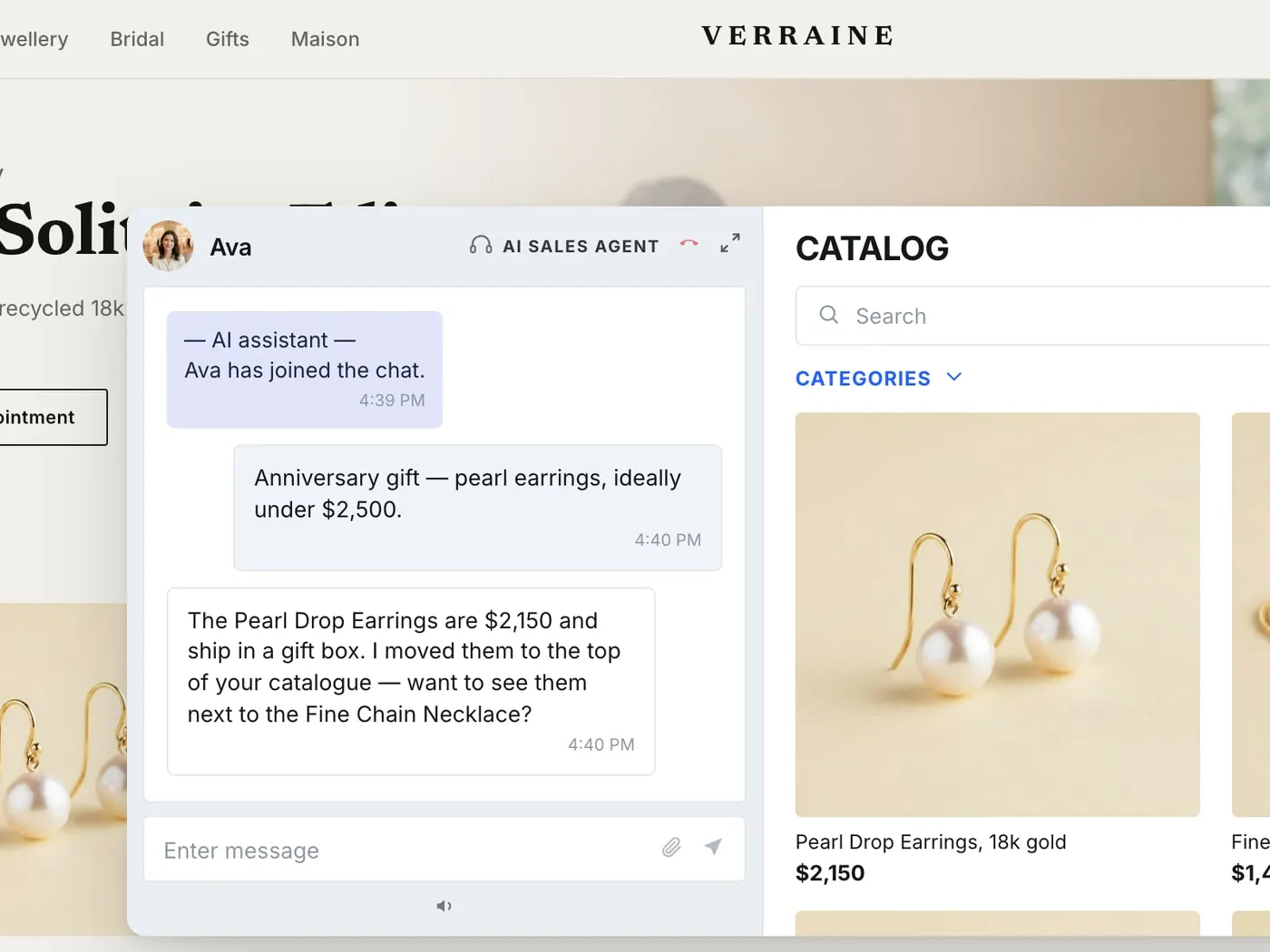
Proactive engagement intervenes before abandonment occurs. When AI detects signals suggesting a shopper might leave — extended time on checkout, back-and-forth between pages, cart additions without progress — it reaches out with assistance.
The results are dramatic. AI-engaged shoppers convert at a dramatically higher rate than self-service browsers. The mechanism is simple: conversation resolves the uncertainty that causes abandonment.
During Black Friday 2025, proactive engagement drove 50% of conversation-driven purchases. Half of conversational commerce success came from reaching out rather than waiting for customers to ask.
What Proactive Engagement Addresses
The top abandonment reasons — uncertainty about costs, concerns about fit, questions about quality — are all addressable through conversation.
A shopper uncertain about sizing can ask an AI agent and get immediate answers. Someone with questions about shipping can get clarity before abandoning. Concerns about return policies can be addressed in real time.
Proactive chat transforms the self-service browsing experience into an assisted shopping experience. The difference in conversion rates reflects the value of that assistance.
Part 6: Building Your Strategy
The Prevention Layer
Start with checkout optimization. Address the known friction points: show costs early, offer guest checkout, minimize form fields, accept multiple payment methods, display security indicators.
The average site has 39 potential improvements. You don’t need to implement all of them — but the more friction you eliminate, the less abandonment you’ll need to recover.
Implement proactive engagement. Deploy AI chat that reaches out when behavior signals suggest abandonment risk. Convert browsers to buyers before they leave.
The Recovery Layer
Email within one hour. First message should be helpful, not pushy. Show the abandoned products, offer assistance, make return easy.
Follow up strategically. Second email at 24 hours, third at 72 hours if needed. Each subsequent email can increase urgency or sweeten the offer.
Add SMS for high-value carts. The immediate attention of text messages recovers sales that email misses.
Consider AI phone for highest-value opportunities. A phone call within minutes of abandoning a $500 cart can recover revenue no email ever would.
The Measurement Layer
Track abandonment rate by device, traffic source, and customer segment. Identify where abandonment is highest and prioritize improvements there.
Track recovery rate by channel. Understand which tactics recover most revenue per dollar spent.
Track time-to-recovery. Learn when customers return and optimize your timing accordingly.
Track reasons for abandonment. Exit surveys and session recordings reveal specific friction points to address.
Part 7: The Immerss Approach
AI Sales Agents
Immerss deploys AI sales agents that engage shoppers proactively, not just reactively. When behavior signals suggest potential abandonment, the AI intervenes with assistance.
The AI understands product catalogs, answers questions about specifications and fit, addresses concerns about shipping and returns, and guides shoppers toward confident purchase decisions.
The result: materially higher conversion for AI-engaged shoppers versus self-service browsing.
Live Video for High-Consideration
For complex purchases where AI alone isn’t sufficient, Immerss enables live video connections with human specialists. Customers can see products demonstrated, ask detailed questions, and get the confidence they need to complete high-value purchases.
Unified Prevention and Recovery
Rather than treating cart abandonment as a separate problem, Immerss integrates prevention and recovery into a continuous engagement strategy. Proactive outreach prevents abandonment. Conversation resolves uncertainty. Recovery tactics capture customers who still leave.
Conclusion: The Recoverable Opportunity
The $4 trillion headline is attention-grabbing but misleading. Most abandoned merchandise was never going to convert.
The $260 billion opportunity is real. This is revenue that could have been captured — and still can be — through better checkout design, smarter recovery tactics, and proactive engagement.
For individual stores, the numbers scale proportionally. A 10% improvement in cart recovery on a $2 million store means $700,000-$800,000 in additional revenue.
Cart abandonment isn’t solvable completely. Some shoppers will always browse without buying. But the gap between current performance and potential performance is vast for most stores.
The question is whether you’ll close that gap.