
The Personalization Paradox: Why More Data Isn't Enough
Executive Summary
E-commerce companies have never known more about their customers. Every click is tracked, every purchase recorded, every browse session analyzed. Data warehouses grow daily with increasingly granular customer information.
And yet personalization keeps failing.
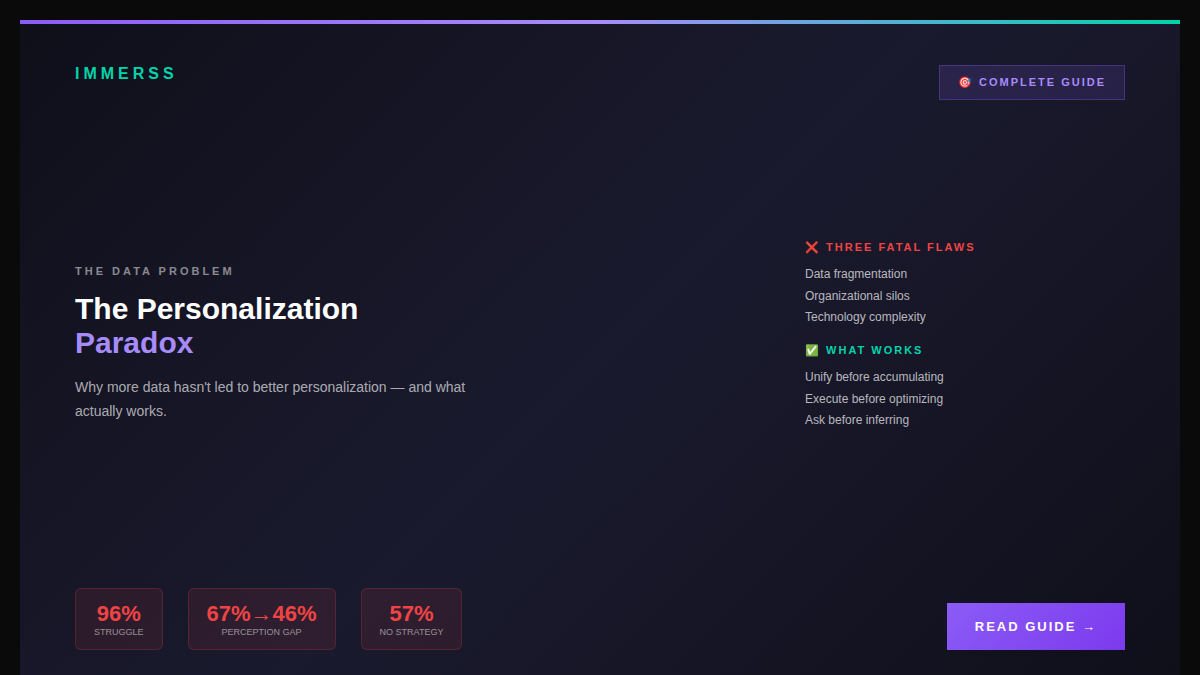
The numbers reveal a striking disconnect: 96% of retailers struggle with executing effective personalization. Sixty-seven percent rate themselves as good at personalization, but only 46% of consumers agree — a 21-point perception gap between what brands think they’re delivering and what customers actually experience.
This is the personalization paradox: more data hasn’t led to better personalization. It’s led to more complexity, more silos, and more frustrated customers.
This guide examines why the data accumulation approach fails, what actually works for personalization, and how conversational commerce offers an alternative path that bypasses many traditional personalization challenges.
Part 1: The Promise vs. The Reality
Why Personalization Matters
The business case for personalization remains compelling. The research is clear and consistent.
Seventy-one percent of consumers expect personalized interactions, and 76% are frustrated when they don’t happen. Eighty-one percent prefer companies that offer personalized experiences. Eighty percent are more likely to purchase from companies offering tailored experiences.
The financial impact is equally clear. Fast-growing companies generate 40% more revenue from personalization than slower-growing counterparts. McKinsey research shows personalization can reduce customer acquisition costs by up to 50%, lift revenue by 5-15%, and increase marketing ROI by 10-30%.
The market opportunity is massive. Mastercard identifies a $2 trillion opportunity over the next five years for e-commerce brands that can effectively implement and scale personalization. The personalization software market will reach $11.6 billion by 2026.
Where Reality Falls Short
But the reality falls far short of the promise. Most brands remain trapped in approaches that consistently fail.
Ninety-six percent of retailers struggle with executing effective personalization. This isn’t a marginal failure rate — it’s near-universal. Despite massive investment in data infrastructure, marketing technology, and personalization platforms, almost no one is getting this right.
The perception gap compounds the problem. Sixty-seven percent of retailers rate themselves as good at personalization, but only 46% of consumers agree. Brands think they’re succeeding while customers experience something very different.
Only 35% of companies offer truly omnichannel personalized experiences. Only 24% effectively invest in omnichannel personalization. Only 13% of retail executives say their e-commerce platform provides a fully tailored experience.
The gap between data collection and effective execution defines the personalization paradox.
Part 2: Three Fatal Flaws
Research reveals three structural problems that defeat personalization efforts regardless of how much data companies collect.
Flaw #1: Data Fragmentation
Different systems store different pieces of customer information. Marketing has email engagement data. E-commerce has purchase history. Customer service has support interactions. Web analytics has browsing behavior. The mobile app has its own data store.
But nobody has the complete picture. Each system contains a fragment of the customer’s reality, but no system contains the whole.
Gartner predicts that 30% of generative AI projects will be abandoned after proof of concept by the end of 2025 due to poor data quality. The AI is only as good as the data feeding it, and fragmented data produces fragmented results.
The practical consequences are visible to customers. They receive emails promoting products they’ve already purchased. They see homepage messaging contradicting the campaign that brought them to the site. Different teams manage different touchpoints without coordination, creating experiences that feel incoherent.
Forty-three percent of companies struggle with maintaining accurate, real-time customer data. Twenty-nine percent struggle with providing internal teams with a single source of truth. The data exists but can’t be unified into actionable customer understanding.
Flaw #2: Organizational Silos
Teams work in isolation with different data sources, conflicting priorities, and separate measurement frameworks.
Marketing optimizes for engagement — email open rates, click-through rates, social engagement. Sales focuses on conversion rates and average order value. Customer service tracks satisfaction scores and resolution times. E-commerce teams measure traffic, bounce rates, and checkout completion.
Nobody coordinates these efforts into coherent personalization strategies. Each team optimizes for its own metrics without considering how those optimizations affect other touchpoints or the overall customer experience.
Fifty percent of e-commerce brands don’t have dedicated personalization support, leaving efforts to ad hoc resources or operating without them entirely. Without a dedicated team driving personalization across groups and functions, progress stalls despite initial successes.
Fifty-seven percent lack a singular audience strategy for approaching ideation, execution, and analysis. Without unified strategy, personalization efforts become siloed and channel-specific rather than cross-functional and multichannel.
The organizational dysfunction creates disjointed experiences. Customers interact with what feels like multiple different companies rather than one brand that knows them.
Flaw #3: Technology Complexity
The personalization industry has convinced brands that more tools equal better results. The martech stack grows ever larger. New platforms promise to solve problems that previous platforms created.
But adding another platform to the martech stack doesn’t solve data fragmentation — it worsens it by creating additional silos requiring integration. Every new tool needs to connect to existing systems, creating integration complexity that most organizations can’t manage effectively.
Hiring more specialists doesn’t improve organizational alignment; it creates more silos with competing priorities and measurement frameworks. Each new hire brings different perspectives on how personalization should work, but nobody owns the end-to-end customer experience.
Investing in AI doesn’t eliminate technology limitations; it amplifies them without proper foundations. AI algorithms require clean, unified data to function effectively. When the data foundation is fragmented, AI perpetuates inconsistencies at scale, making personalization problems worse rather than better.
Only 17% of marketing executives currently use AI/ML extensively for personalization, despite 84% believing in its potential. The gap between belief and adoption reflects the difficulty of implementing AI effectively on fragmented foundations.
Part 3: The Paradox of Choice
Beyond structural issues, personalization faces a fundamental challenge: it often increases cognitive load rather than reducing it.
When “Personalization” Overwhelms
When customers face hundreds or thousands of products, they often choose nothing at all. This is the paradox of choice — too many options paralyze decision-making.
Effective personalization should address this by cutting through the noise, showing relevant options, and making decision-making easier. Product recommendations that genuinely match customer needs reduce friction and accelerate purchase decisions.
But poorly executed personalization does the opposite. It overwhelms customers with “personalized” recommendations that don’t feel relevant. It creates anxiety about whether the algorithm knows too much. It generates suspicion when products follow customers across the internet.
The difference between good and bad personalization isn’t the volume of data — it’s whether that data creates genuine helpfulness or just sophisticated surveillance.
The Privacy Equation
Customers are increasingly aware of data collection. Trust in how companies use data is declining — no industry achieves more than 50% consumer trust in the Thales 2025 Digital Trust Index.
Yet customers will share data when the exchange is valuable. Eighty-three percent are willing to share data in exchange for personalized experiences. The key phrase is “in exchange” — customers expect value in return for their information.
First-party data — information collected directly from customer interactions — has become essential as third-party data faces restrictions. Zero-party data — information customers intentionally share — is even more valuable because customers explicitly communicate their preferences.
The brands succeeding at personalization treat privacy as a feature, not a constraint. They create genuine value exchanges that make customers want to share information rather than attempting to extract data through manipulation.
Part 4: What Actually Works
The brands succeeding at personalization share characteristics that have little to do with data volume.
Unify Before You Accumulate
Rather than collecting more data, successful brands focus first on making existing data usable. They invest in creating a single customer view that all systems can access before building new capabilities.
This foundation makes everything else possible. When marketing, sales, service, and e-commerce all access the same customer understanding, personalization becomes coherent rather than fragmented.
The investment feels less exciting than implementing the latest AI platform, but it’s far more valuable. Clean, unified data enables simple personalization to work effectively. Fragmented data defeats sophisticated personalization regardless of technology investment.
Align Organizations Around Customer Experience
Instead of letting each team optimize for its own metrics, successful brands create shared accountability for end-to-end customer journeys. Someone owns the complete experience, not just individual touchpoints.
Fifty-four percent of brands now allocate business, technical, and creative talent to personalization, up 4% from 2025. The trend is toward cross-functional teams with clear owners rather than siloed specialists optimizing in isolation.
The organizational change is harder than technology implementation but more impactful. When teams share goals and coordinate efforts, personalization naturally becomes more coherent.
Prioritize Relevance Over Sophistication
Simple personalization done well outperforms complex personalization done poorly.
Using a customer’s name. Remembering their last purchase. Acknowledging their preferences. Recommending products that actually match their needs. These basics matter more than algorithmic wizardry that produces impressive-sounding but irrelevant recommendations.
Thirty-nine percent of brands fail to action their findings in subsequent tests. The gap isn’t insight — it’s implementation. Focus shifts from discovering more to executing better.
Focus on Moments That Matter
Not every interaction needs personalization. Identifying the moments where personalization creates genuine value concentrates effort where it produces results.
Product discovery is high-leverage — helping customers find relevant products drives conversion. Consideration moments benefit from personalization that addresses specific concerns. Post-purchase personalization builds loyalty through relevant follow-up.
Routine interactions often don’t need personalization. Applying personalization everywhere dilutes impact and increases complexity without corresponding value.
Part 5: The Conversation Alternative
There’s another path beyond the data-accumulation approach: replacing algorithmic inference with actual dialogue.
From Prediction to Conversation
Traditional personalization tries to predict what customers want based on behavioral data. Browse history, purchase patterns, click streams — all become inputs to algorithms that infer preferences.
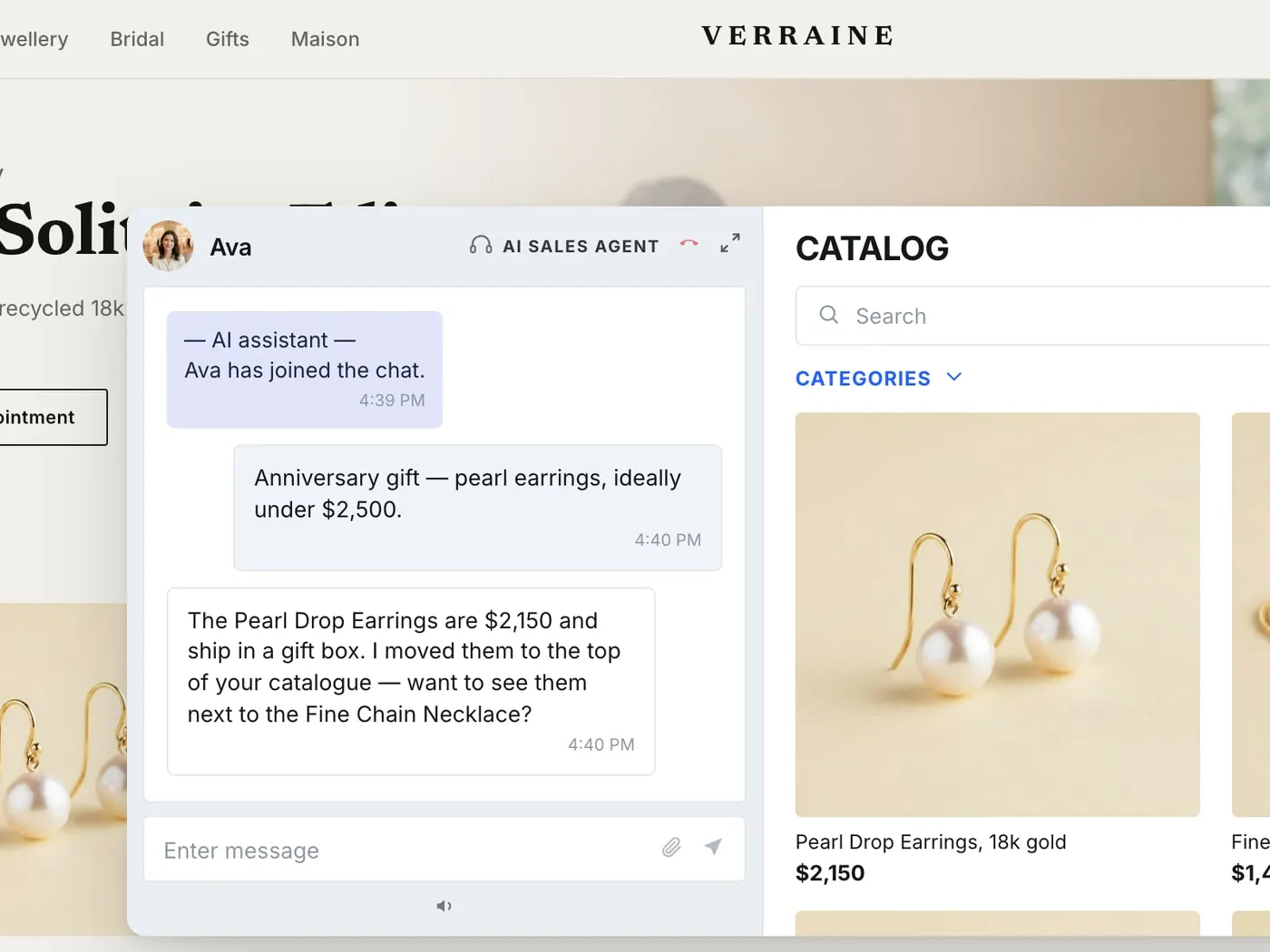
Conversational commerce takes a different approach. Rather than inferring preferences from behavior, AI sales agents engage customers in conversation, understand their needs explicitly, and make relevant recommendations.
The shift transforms the personalization challenge from “what can we predict about this customer?” to “what does this customer actually need right now?”
Why Conversation Works Better
Conversation bypasses many personalization challenges because it works with explicit preferences rather than inferred ones.
Data fragmentation matters less when you’re asking customers directly what they want. Organizational silos matter less when the conversation interface handles the complete interaction. Technology complexity reduces because conversation replaces algorithmic inference.
When AI recommends products through genuine conversation, 80% of resulting purchases happen the same day. The compression from days or weeks to same-day purchase reflects how effectively conversation removes the friction that plagues traditional personalization.
AI-engaged shoppers convert at a dramatically higher rate than self-service browsers. The gap isn’t explained by better algorithms — it’s explained by the fundamental difference between inference and dialogue.
The Immerss Approach
Immerss implements conversational personalization through AI sales agents that engage customers in genuine dialogue.
Rather than presenting “personalized” product grids based on behavioral inference, these agents ask customers what they’re looking for. They understand needs through conversation. They recommend products based on explicit preferences rather than algorithmic guesses.
For high-consideration purchases where conversation alone isn’t sufficient, live video shopping adds human expertise. Customers connect with specialists who demonstrate products, answer complex questions, and provide the personal attention that builds confidence.
The combination — AI for scale and 24/7 availability, humans for depth and connection — creates personalization through conversation rather than surveillance.
Part 6: Breaking the Paradox
The personalization paradox persists because companies keep trying the same approaches while expecting different results. More data. More tools. More specialists. More complexity.
Breaking the cycle requires different thinking.
Start with Unification
Before collecting more data, make the data you have usable. Create a single source of truth that all systems can access. Audit existing data for completeness and accuracy. Build the foundation before adding more layers.
This investment unlocks everything else. Without it, additional data collection only worsens fragmentation.
Prioritize Execution
The gap isn’t insight — it’s implementation. Thirty-nine percent of brands fail to action findings. Sixty-two percent haven’t aligned on a singular audience strategy.
Simple personalization that actually ships beats sophisticated personalization that stays in planning. Focus on getting basics right before pursuing advanced capabilities.
Measure Customer Experience
The 21-point gap between how retailers and consumers rate personalization reveals a measurement problem. Brands measure their efforts; customers measure their experiences. The metrics don’t align.
Add customer-centric measurement alongside operational metrics. Survey customers about their actual experience. Track perception alongside delivery. Let customer feedback guide optimization.
Consider Conversation
When you can ask customers what they want, you don’t need to guess. Conversational interfaces often produce better personalization than algorithmic approaches because they work with explicit preferences rather than inferred ones.
This doesn’t mean abandoning data-driven personalization entirely. It means recognizing that conversation offers an alternative — or complement — that bypasses many traditional challenges.
Conclusion: The Real Question
The personalization paradox isn’t ultimately about data or technology. It’s about whether companies are genuinely trying to help customers or just trying to manipulate them more effectively.
Customers can tell the difference. That’s why 76% are frustrated by personalization that doesn’t happen and why 62% will ditch brands without it. They want to be helped, not targeted. They want relevance, not surveillance.
The brands that resolve the paradox will be those that shift from “what can we predict about customers?” to “how can we actually help them?” That shift changes everything — the data needed, the technology approach, the organizational structure.
More data isn’t the answer. Better use of data might be. But the best answer is often the simplest: just ask.