
Beauty & Skincare: Personalized Recommendations at Scale
The definitive guide to AI-powered personalization in beauty e-commerce — from skin analysis to intelligent recommendations to customer retention.
Executive Summary
Beauty and skincare represent the perfect use case for AI personalization. The category’s inherent complexity, personal nature, and repeat-purchase dynamics create conditions where AI delivers exceptional results.
This guide examines why beauty works so well with AI, what leading brands are doing, and how to implement personalization that drives both conversion and loyalty.
The headline findings: ninety-four percent of beauty marketers report sales boosts from personalization. AI-driven approaches can improve conversion rates by up to fifty percent. And online beauty sales are growing nine times faster than in-store, creating urgency for brands to deliver digital experiences that match the consultation quality of physical retail.
Part 1: Why Beauty Is Perfect for AI
The Personalization Imperative
Beauty is perhaps the most personal category in e-commerce. Every customer has unique skin, unique concerns, unique preferences. What works beautifully for one person causes breakouts for another. What flatters one skin tone looks completely wrong on the next. What hydrates one skin type overwhelms another.
This creates both a challenge and an opportunity. The challenge is that traditional e-commerce fails spectacularly in beauty. Customers face overwhelming choice across thousands of SKUs. They have uncertain fit because they can’t test products. They experience high return rates when products don’t work. The industry calls this “the paradox of choice,” and in beauty, it’s particularly acute.
The opportunity is that AI can solve this at scale. And the data shows it does so dramatically well.
Data Richness
Beauty customers generate signals that actually mean something. Their skin type isn’t just demographic information — it’s a filter that eliminates thousands of products and surfaces the handful that might actually work. Their past purchases reveal ingredients they tolerate. Their browsing patterns reveal concerns they’re trying to address. Their reviews reveal what worked and what didn’t.
This creates personalization that feels genuinely helpful rather than creepily accurate. When a beauty brand recommends a moisturizer because it knows you have dry skin, avoid fragrance, and prefer lightweight textures, you appreciate the guidance. It saves you from the trial-and-error that previously defined skincare discovery.
Category Complexity
With thousands of SKUs spanning skincare, makeup, haircare, and fragrance, no human associate could maintain comprehensive product knowledge. The ingredient lists alone require expertise most consumers lack. The interactions between products — what layers well, what conflicts, what enhances — add another layer of complexity.
But AI can process vast datasets that no human could hold in working memory. Proven Skincare’s “Skin Genome Project” analyzes over twenty thousand ingredients, one hundred thousand products, and twenty-five million consumer reviews to formulate genuinely customized products. This scale of analysis enables recommendations that a single expert could never generate.
The Repeat Purchase Dynamic
Beauty customers come back. They replenish products they love. They explore adjacent categories once they trust a brand. They try the next product in a line once the first one works.
This creates a flywheel where good recommendations generate purchases that generate data that improves future recommendations. Unlike categories where each purchase is independent, beauty builds cumulative understanding of each customer that makes every subsequent interaction more valuable.
Part 2: What the Data Shows
The Success Rate
The beauty industry has embraced AI personalization faster than almost any other category, and the results justify the investment overwhelmingly.
Ninety-four percent of beauty marketers report sales boosts from personalization. This near-universal success rate reflects something important about the category: the data is rich enough and the customer need is acute enough that personalization actually delivers value rather than creating noise.
This isn’t about sending more emails or showing more products. It’s about surfacing the right products to each customer based on genuine understanding of their needs. When personalization works, customers notice — and respond.
Conversion Impact
AI-driven personalization can improve conversion rates by up to fifty percent in beauty e-commerce. This isn’t theoretical speculation — it’s documented across implementations from indie DTC brands doing a few million in revenue to enterprise retailers like Ulta Beauty, which recently reported double-digit e-commerce growth driven specifically by AI personalization in their automated marketing engine.
The mechanism is straightforward: customers who receive relevant recommendations feel understood. They trust the guidance. They convert at higher rates because the products suggested actually match their needs. And they return fewer products because the recommendations were accurate.
Revenue Concentration
The revenue impact concentrates in specific touchpoints that AI optimizes particularly well. Nearly half of all beauty email revenue — forty-seven percent — comes from abandoned cart recovery flows. When those flows are hyper-personalized based on the specific products abandoned, the customer’s skin concerns, and their past purchase patterns, recovery rates climb dramatically higher than generic “you forgot something” messages.
Personalized email marketing powered by AI delivers targeted promotions based on individual skincare concerns or makeup preferences. These campaigns typically see three to four times higher engagement than generic messaging because they’re actually relevant. The customer who receives a promotion for hydrating serums because she previously purchased dry-skin products responds differently than she would to a generic sale announcement.
Growth Trajectory
Online beauty sales are growing nine times faster than in-store, according to Nielsen NIQ’s State of Beauty 2025 report. This trajectory makes AI investment not optional but essential. The brands capturing this growth are those making the online experience feel as personal and guided as the best in-store experiences — and AI is the only way to deliver that at scale.
Implementing AI in a beauty e-commerce business can increase sales by up to fourteen percent annually while reducing operational costs through automated inventory management and customer service optimization. The combination of revenue growth and cost reduction creates compelling ROI that justifies aggressive investment.
Part 3: Applications Across the Journey
Skin Analysis
Skin analysis technology has evolved to detect and evaluate an impressive range of concerns with remarkable precision. Perfect Corp’s AI can perform fifteen types of instant skin analysis, scoring parameters including hydration levels, texture, pigmentation, pore size, wrinkles, and more.
The customer experience is simple: upload a photo or use your camera, and within seconds receive an assessment that would previously require a dermatology appointment. This transforms product discovery from guesswork into guided consultation. The customer doesn’t browse thousands of products hoping to find one that works — she receives recommendations based on her actual skin condition.
The technology employs specialized AI models, deep learning algorithms, and augmented reality overlays to highlight and measure skin conditions that might be invisible to the naked eye. This ensures even subtle concerns are identified and addressed through appropriate product recommendations.
Virtual Try-On
Virtual try-on removes another major barrier to beauty e-commerce: uncertainty about how a product will actually look. Color cosmetics in particular suffer from this challenge — how a lipstick looks on a model tells you little about how it will look on you.
YSL Beauty created the Rouge Sur Mesure device, which uses AI to formulate custom lipstick shades by combining real-time environmental data with personal preferences. Customers see themselves in the product before purchasing, dramatically reducing returns and increasing confidence.
The technology has applications across color cosmetics, hair color, and even skincare (showing projected results over time). Each application reduces the risk that previously made customers hesitant to purchase beauty products online without testing them in person.
Intelligent Recommendations
Intelligent recommendation engines connect analysis to action. These systems don’t just say “you have dry skin” — they surface specific products with ingredients that address dryness, in formulations compatible with other products the customer uses, at price points consistent with their purchase history.
The sophistication has moved far beyond “customers who bought this also bought that.” Modern beauty recommendation engines consider ingredient compatibility, routine layering (what order to apply products), potential sensitivities based on past reviews, and even external factors like climate and season.
Function of Beauty employs AI algorithms to develop bespoke hair and skincare formulations tailored to individual assessments. Prose considers over eighty-five factors through AI before creating personalized hair care products. These examples show the depth of personalization now possible — not just recommending from existing products but creating entirely new formulations for individual customers.
Part 4: The Consultation Gap
What In-Store Provides
In-store beauty shopping includes consultation. A knowledgeable associate asks questions, observes your skin, considers your concerns, and makes recommendations. She might test products on your hand or face. She explains why certain products work better than others for your specific situation.
This guidance builds confidence. It reduces returns because customers purchase products appropriate for their needs. It increases basket size because the associate recommends complementary products. And it creates loyalty because the customer feels understood and served well.
What Online Lacked
Online beauty shopping traditionally offered none of this. You browsed alone. You read descriptions written for everyone, not for you specifically. You guessed whether a product would work based on reviews from people whose skin might be completely different from yours. And if the product didn’t work, you returned it or wrote it off as a loss.
This limitation held back beauty e-commerce for years. The category seemed inherently unsuited to digital because the personal guidance that made in-store shopping effective couldn’t be replicated through static product pages.
How AI Closes the Gap
AI recreates the consultation experience in digital form. Not as a gimmick — as a genuine service that improves outcomes.
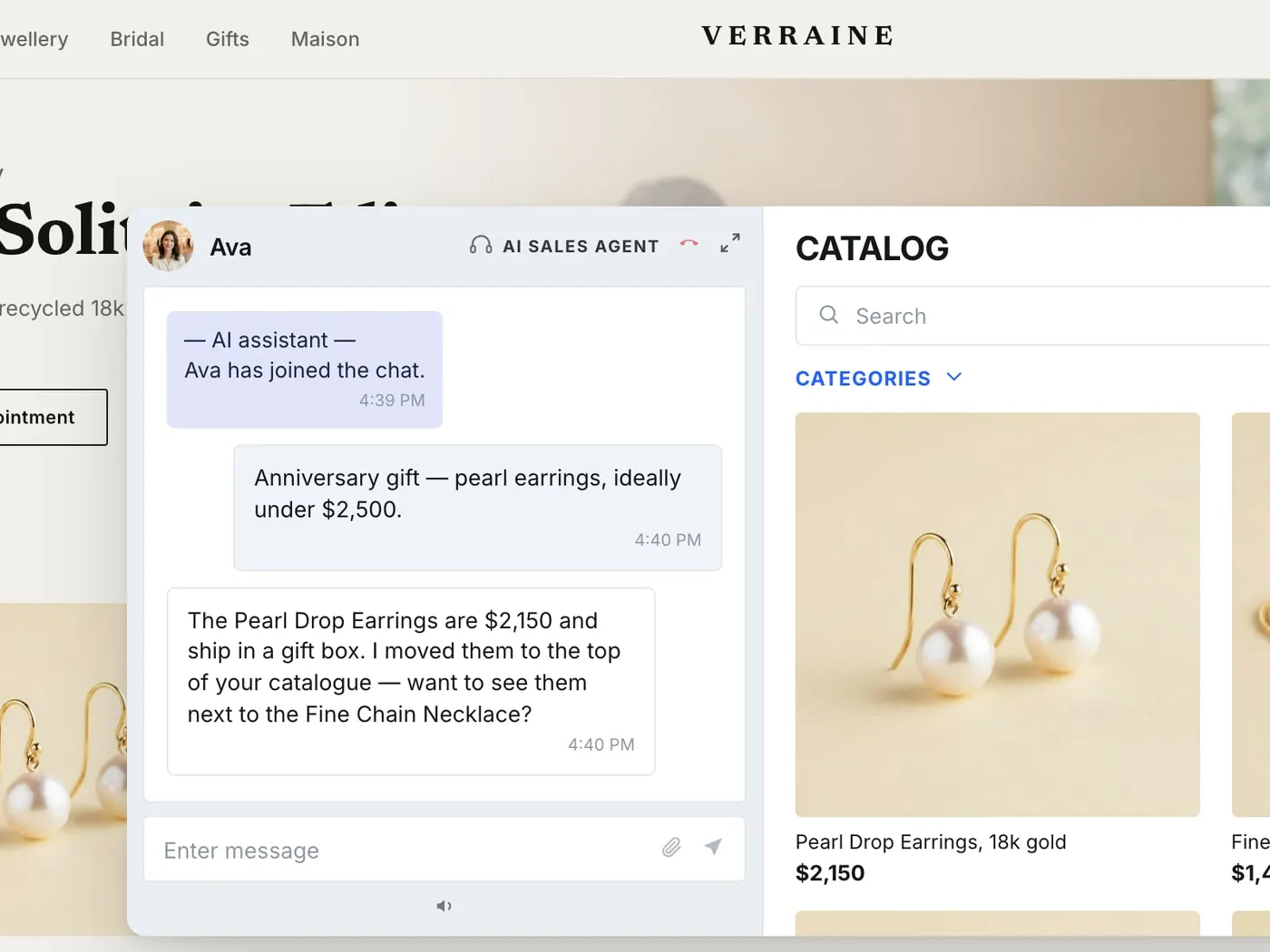
An AI Sales Agent in beauty asks the questions a skilled associate would ask: What’s your skin type? What concerns are you trying to address? What have you tried before? What ingredients do you want to avoid? Based on the answers, it surfaces three or four products that actually fit the criteria, explaining why each might work for the specific needs described.
This isn’t chatbot-style FAQ deflection. It’s genuine sales consultation — the kind that builds confidence, reduces returns, and increases average order value because customers add the complementary products the AI recommends.
The data supports the effectiveness: e-commerce platforms adopting AI retain customers more effectively than those that don’t. Loyalty is no longer built on discounts alone — it’s driven by recognition, relevance, and trust. When a brand demonstrably understands your needs and consistently surfaces products that work, you return.
Part 5: Implementation Patterns
Starting Points
Brands taking advantage of AI in beauty range from small direct-to-consumer operations doing five million in annual revenue to holding companies doing billions. The technology has democratized access to personalization capabilities that previously required massive data science teams.
The most successful implementations share a common pattern: they master one key area initially before expanding. Some focus on skin analysis. Others on product recommendations. Others on virtual try-on. Others on personalized email flows. The brands that try to implement everything simultaneously often struggle with data integration and customer experience coherence.
This focused approach allows brands to prove ROI in a contained area before expanding investment. It also ensures the customer experience feels polished rather than experimental.
Data Requirements
Effective beauty personalization requires data collection that happens naturally through the shopping experience. Quizzes that ask about skin type and concerns. Browse behavior that reveals product interest. Purchase history that shows what’s worked. Review data that indicates satisfaction.
The challenge is collecting this data without creating friction. The best implementations make data collection feel valuable to the customer — she answers questions because the resulting recommendations are genuinely helpful, not because the brand extracts information.
Most successful brands also integrate data across touchpoints. The quiz data connects to the email system connects to the recommendation engine connects to the customer service platform. This unified view enables consistency that builds trust.
Integration Points
AI personalization delivers maximum value when integrated with broader marketing systems. When AI-generated insights feed into email marketing tools, brands can send timely, relevant follow-ups — product refills when supply runs low, skincare tips relevant to the season, personalized offers on products the customer browsed but didn’t purchase.
Unfortunately, most brands still fail to fully integrate their AI tools into broader marketing systems, missing a critical opportunity to nurture relationships. Hyper-personalized communication based on purchase history, preferences, or values like “cruelty-free” or “fragrance-free” can dramatically increase lifetime value.
Part 6: What’s Coming Next
Longevity-Focused Skincare
Longevity-focused skincare is accelerating, with brands investing in proteomics, peptides, and regenerative ingredients. Lancôme now offers proteomic skin analysis that measures protein biomarkers, assessing not just current skin condition but long-term cellular health.
This shifts the conversation from “looking younger” to supporting skin biology over time, creating new branding opportunities. AI makes this complexity manageable for consumers who would otherwise be overwhelmed by the science. The analysis can be sophisticated while the recommendations remain actionable.
Peptides are emerging as key growth drivers, while regenerative ingredients like PDRN are gaining traction after breaking into the mainstream in 2025. These technical innovations require AI to translate them into meaningful guidance for consumers.
AI-Guided Routines
On TikTok, a growing number of users are sharing prompts for using ChatGPT to get personalized skincare guidance. While reactions are mixed regarding accuracy, the format is gaining traction because it’s fast, convenient, and often cheaper than trial-and-error product testing.
This signals consumer appetite for AI-guided beauty decisions — appetite that brands can capture with their own, better-trained tools. The consumers using ChatGPT for skincare advice would prefer guidance from a brand that actually knows its products. This creates opportunity for brands with sophisticated AI to capture demand currently flowing to general-purpose tools.
Live Commerce
Live commerce continues to accelerate, with the market projected to grow at nearly forty percent annually. Beauty brands like BK Beauty, Made By Mitchell, and Kiehl’s have demonstrated how livestreams can drive both engagement and conversion, combining entertainment, education, and instant checkout into a single experience.
The combination of AI personalization with live commerce creates particularly powerful experiences. AI can surface relevant products to each viewer based on their profile while the host demonstrates and discusses products. This hybrid approach captures the engagement of live content with the relevance of personalization.
Part 7: The Immerss Approach
Sales-First Architecture
Immerss AI Sales Agents are built specifically for sales consultation, not ticket deflection. In beauty, this means guiding product discovery, answering ingredient questions, recommending routine combinations, and moving customers toward confident purchase.
The AI asks the questions a skilled associate would ask. It listens to concerns. It surfaces recommendations with explanations for why each product fits the customer’s specific needs. And it handles objections in real time — addressing concerns about ingredients, explaining differences between similar products, suggesting alternatives if something isn’t quite right.
Beauty-Specific Capabilities
Beauty presents specific challenges that generic AI can’t address. Ingredient interactions matter — some products shouldn’t be layered together. Routine order matters — applying products in the wrong sequence reduces effectiveness. Skin type matters — a product that works for oily skin may not work for dry.
Immerss AI understands these nuances. It can recommend a complete routine rather than isolated products. It can warn about ingredient conflicts. It can adjust recommendations based on climate, season, and stated preferences.
Results
The outcomes reflect the approach. Customers who engage with AI Sales Agents convert at significantly higher rates because they receive the guidance that builds confidence. Average order values increase because the AI recommends complementary products that genuinely make sense together. Return rates decrease because recommendations match actual customer needs.
Most importantly, customers return. They’ve experienced a brand that understood them, served them well, and consistently surfaced products that worked. That experience builds the loyalty that drives long-term value.
Conclusion: The Personalization Imperative
Beauty and skincare represent the ideal category for AI personalization. The complexity of the category, the personal nature of the products, and the repeat-purchase dynamics create conditions where AI delivers exceptional value.
The data is unambiguous. Ninety-four percent of beauty marketers report sales boosts from personalization. AI-driven approaches can improve conversion by up to fifty percent. Online beauty is growing nine times faster than in-store, and the brands capturing this growth are those delivering consultation-quality experiences through AI.
The question for beauty and skincare brands isn’t whether to implement AI personalization. The question is how quickly and how well. The brands that move first will capture the loyalty of customers seeking guidance in an overwhelming category. The brands that wait will find themselves competing on price in a market where personalization has become the expected baseline.
In a category as personal as beauty, understanding your customer isn’t just competitive advantage — it’s the foundation of everything that follows.