
Best Live Shopping Platforms in 2026: Complete Comparison & Buying Guide
Last updated: July 2026
Introduction
Most live shopping comparisons fail in the same way: they hand you a price list. Price lists are the fastest-rotting fact in this category — plans get renamed, free tiers appear, view caps move, and the number you memorised last quarter is wrong today. Worse, a monthly figure tells you almost nothing about what you’ll actually pay, because these platforms don’t charge on the same axis. One bills you per view. One bills you per module. One takes a cut of the sale. “$79 a month” and “$8,000 a month” aren’t comparable numbers — they’re different questions.
So this guide compares the things that hold still: which selling model each platform serves, how it charges you, and what happens to your bill when it works. Where you need a current number, we link to the vendor’s own pricing page rather than repeat a figure that will rot here.
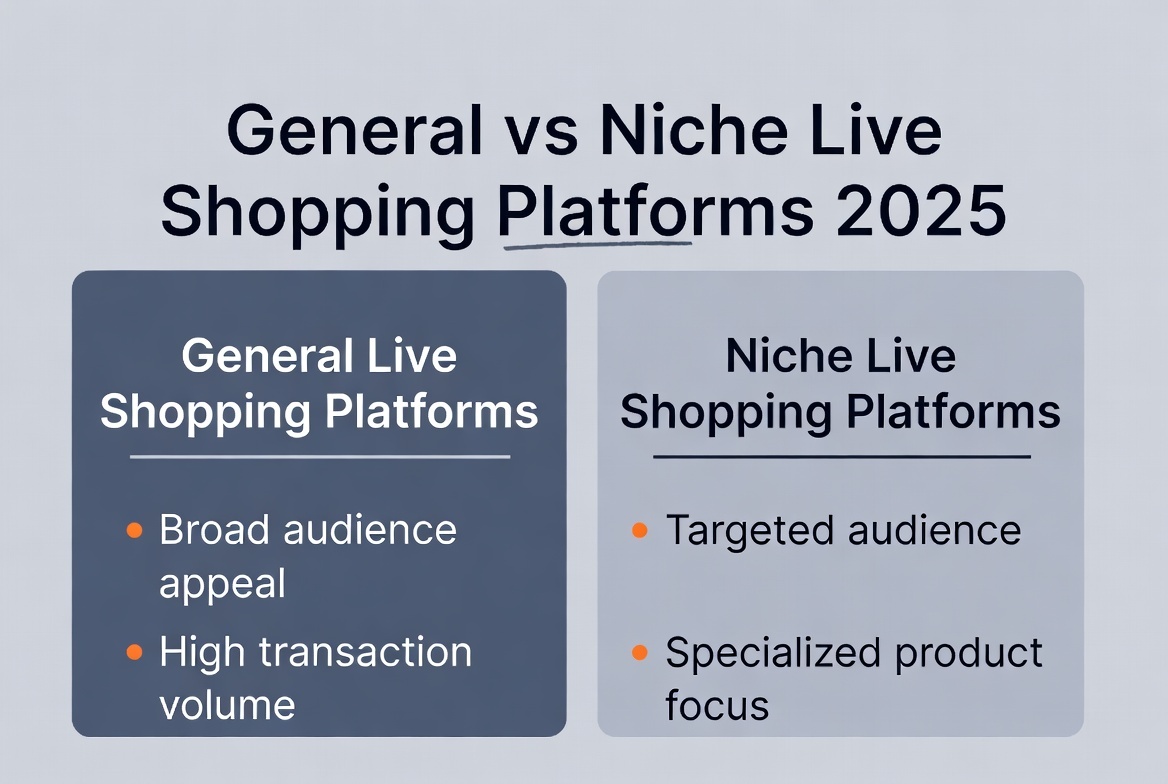
The category splits into two models that are genuinely different businesses, not two flavours of the same product. Nearly every bad purchase in live commerce comes from buying across that line.
Understanding Live Shopping Models
Model 1: Broadcast Commerce (One-to-Many)
Architecture: Single stream → many concurrent viewers → immediate purchase
Where it fits:
- Lower-priced goods bought on impulse
- Purchase decisions made in seconds or minutes
- Fashion, beauty, electronics, trending and drop-driven items
- Mass-market audiences you already have, or can buy
Technical characteristics:
- Low-latency streaming (a few seconds)
- Concurrent viewers from hundreds to six figures
- Chat and interaction systems
- In-stream checkout
- Real-time inventory sync
The economics: you’re paying for reach and converting a small slice of it. That’s a volume game — it rewards frequency, a promotion calendar, and products that don’t need explaining.
Model 2: Consultation Commerce (One-to-One)
Architecture: Appointment or live request → private video session → guided purchase
Where it fits:
- Considered, high-value purchases
- Decisions that take days or weeks and involve questions
- Jewelry, watches, luxury fashion, bespoke and custom goods, B2B equipment
- Qualified buyers, not passing traffic
Technical characteristics:
- High-definition video, often with external cameras for close work
- Small sessions (one buyer, one expert, sometimes a partner or family member)
- Scheduling and calendar integration
- Customer history and clienteling notes
- Screen sharing for certificates, appraisals, specifications
- Payment and CRM integration
The economics: you’re not converting a slice of a crowd — you’re closing a conversation. That rewards expertise, preparation and follow-up, and it makes the number of qualified conversations, not the number of viewers, the metric that matters.
The line between them is price and doubt, not industry. If your buyer needs a person to answer something before they’ll commit, broadcast won’t fix it and no amount of reach will.
Platform Comparison Matrix
| Platform | Model | Best for | How it charges you | What that means when it works |
|---|---|---|---|---|
| TikTok Shop | Broadcast | Fashion, trending products | Free to start, commission per sale | Cost scales with revenue — predictable, but you rent the audience |
| Instagram Live | Broadcast | Visual products, existing following | Free | No platform cost; you pay in audience-building and labour |
| Amazon Live | Broadcast | Products already on Amazon | Free for sellers; creator commissions | Inside Amazon’s funnel — buyer intent is high, the customer isn’t yours |
| YouTube Shopping | Broadcast | Demos, education, long watch time | Free; eligibility requirements | Streams keep earning as VOD after the fact |
| CommentSold | Broadcast | Social boutiques, drops | Subscription tiers | Fixed and predictable at a given volume |
| Bambuser | Both | Enterprise brands running live at scale | Free tier, then view allowances with per-view overage | A spike bills you by the view after the fact — success costs more, and unpredictably (their pricing) |
| Immerss | Consultation + video commerce | High-consideration retail | Free tier, then per module, banded by traffic | Inside a band the bill is fixed; a spike moves you to the next band deliberately rather than billing per view (pricing calculator) |
| Zoom + manual process | Consultation | Testing the model before buying | Per seat | Cheapest way to learn whether consultation works for you at all |
Two columns there do the work. Model tells you whether a platform is even in your business. How it charges you tells you what you’re signing up for — and it’s the column most comparisons skip, because a price list looks more decisive than a pricing model. It isn’t.
Broadcast Platforms (One-to-Many)
TikTok Shop
Short-form video plus live streams, with TikTok’s discovery algorithm doing the audience work. In-app checkout means no redirect. Free to start, with a commission on each sale.
What you’re really buying: access to an audience you don’t own, on terms you don’t set. That’s a genuine advantage when you have no list and no traffic — and a genuine risk to build a business on.
Fits: fashion, beauty, impulse-priced goods, brands with creator relationships. Doesn’t fit: anything a buyer needs explained before they’ll pay.
Instagram Live
The lowest-friction way to test broadcast if you already have followers. No platform cost, native to an audience you’ve already built, weak on commerce tooling — checkout and catalogue depend on what you’ve connected.
What you’re really buying: nothing, in cash. You pay in labour and in the audience you spent years assembling.
Amazon Live
Streams inside Amazon’s shopping experience, which means the buyer already arrived intending to buy something. Free for sellers, with creator commission arrangements.
Worth knowing in 2026: Amazon Inspire, the short-form shopping feed launched in 2022, was discontinued in February 2025, while Amazon Live has stayed and grown. Amazon’s own bet is on intent-driven commerce over social-style feeds — which tells you something about where livestream shopping actually converts.
What you’re really buying: high intent, no customer relationship. The buyer is Amazon’s.
YouTube Shopping
Long watch times, demo-friendly, and streams keep working as VOD after the broadcast ends — the only broadcast platform where the content has a real second life. Requires Partner Program eligibility and a Merchant Center product feed.
Fits: products that reward explanation — tech, hobby, specialty goods.
CommentSold
Purpose-built for social boutiques and drops, sold as subscription tiers rather than commission. Predictable at a given volume, which is precisely what the commission platforms aren’t.
Consultation and Hybrid Platforms
Bambuser
Enterprise video commerce, used by large brands, covering both broadcast and one-to-one. Technically strong and genuinely proven at scale.
How it charges you — and why it matters: Bambuser prices on views. There’s a free tier to start, paid plans carry monthly view allowances, and going past your allowance costs a per-view overage fee. Pro and Enterprise are quoted rather than listed. Check their pricing page for today’s numbers.
Read that model carefully before you sign, because it has a shape: your bill grows exactly when things go well. A stream that overperforms costs more than one that flops. Spiky traffic — a launch, a viral moment, a holiday — is where the cost becomes hard to forecast. If your calendar is a few big events a year, that’s a real budgeting problem. If you’re always-on, it compounds.
That’s not a flaw, it’s a choice: view-based pricing is honest for a platform built around audience size. It just means you should price your worst-case month, not your average one.
Immerss
Immerss is a live commerce platform rather than a single tool, and it runs across three modules: an AI Sales Agent that works the storefront around the clock, Clienteling (one-to-one live co-shopping plus outbound), and Video Commerce (live shopping events, shoppable video, and video on the product page). Brands typically start with one and add the next when the first one earns it.
How it charges you: each module has a free tier you can start on without talking to anyone, and paid plans are banded by your monthly traffic rather than metered per view. The pricing calculator takes your traffic and the modules you want and shows the band you land in.
Why the model matters: inside a band your bill is fixed. A launch, a holiday or a stream that overperforms doesn’t generate a per-view charge after the fact — it eventually moves you to the next band, which is a decision you make rather than an invoice you receive. That’s the practical difference from view-metered pricing, and it’s worth more to a finance team than a lower headline number.
Two ways in, and they’re for different people. If you’re small and want to see whether any of this works, the free tier is genuinely there — start, run a few consultations, no conversation required. If you’re a brand in the $10M–$500M range weighing a live commerce programme across modules, the calculator won’t answer the real question, which is what to run and in what order. That one is a conversation, and the entry point is a 60-day pilot, on us.
What it’s built for: the human part of a high-value sale. Not a widget bolted to a product page, but the sales associate who knows the product, on video, with the customer’s history in front of them, and the outcome measurable afterwards. Human, personal, measurable — in that order, because the first two are what the buyer feels and the third is what lets you keep doing it.
In practice that looks like Lucchese, where bootmaking expertise is the product as much as the boots are, and Hammitt, where accessible-luxury handbags get the attention a considered purchase needs. In both cases the platform isn’t the story — the person on the other end of the call is.
If you’re weighing this against a support-first chatbot or a broadcast tool, the AI sales agent vs chatbot vs live commerce comparison draws the lines more carefully, and the pillar guide to AI sales agents covers the always-on module in depth.
Zoom and a manual process
Zoom plus a spreadsheet is the honest way to find out whether consultation selling works for you before you buy anything built for it.
What you give up: no product catalogue, no in-call checkout, generic branding, no customer history, no follow-up automation, and appointment management by hand. Every one of those is survivable for your first dozen appointments and none of them is survivable at forty a month.
When to stop: when the manual work starts eating the selling time. That’s the signal — not a threshold number someone invented for a blog post.
Technical Requirements
For broadcast
- Connection: wired, not WiFi. Upload headroom well past what the platform asks for.
- Camera: a real 1080p webcam at minimum.
- Audio: a USB or XLR microphone — never the laptop’s. Viewers forgive soft video and leave over bad sound.
- Machine: enough CPU to encode without dropping frames, plus a second screen for chat.
- Lighting: a three-point setup. This matters more than the camera.
- Software: OBS or a web-based studio, plus the platform’s own app.
For consultation
- Camera: high-definition, with a macro-capable lens if you’re showing stones, stitching, movements or grain. This is the one place to overspend.
- Lighting: controlled and consistent. Jewelry and leather are lit, not shot.
- Audio: as above, and more so — the whole product here is a conversation.
- Background: quiet and branded. The customer is judging the house, not just the item.
- Connection: stable upload with room to spare; a dropped call in a five-figure sale is not a technical problem, it’s a lost sale.
The gap between a laptop webcam and a proper setup is smaller than the gap between a prepared associate and an unprepared one. Buy the camera, then spend the real budget on training.
How to Think About the Economics
We’re not going to invent a spreadsheet for you. Numbers pulled from the air are why most platform comparisons don’t survive contact with a real quote. But the shape of the calculation is worth having, and it’s different for each model.
Broadcast: you’re paying mostly in labour and promotion, so the question is cost per stream against revenue per stream. Platform fees are often near zero; the real cost is the hours and the audience-building. Break-even usually arrives at a handful of sales per stream — which is why broadcast looks so attractive on paper and so demanding in practice. It works when you can sustain frequency.
Consultation: platform and equipment are close to fixed, so cost per month barely moves. What moves is how many qualified conversations you can hold and what fraction close. Break-even arrives at a small number of sales because the order values are large — and the binding constraint is almost never the software. It’s whether you can generate qualified appointments and staff them with someone who knows the product.
The trap in both: counting the platform fee and forgetting the labour. The platform is the cheapest line in either model.
If you want real numbers to sanity-check your own, our 2026 ecommerce benchmarks are sourced rather than invented.
Decision Framework
Step 1 — Which model is your business in?
Not “which platform is best.” Ask instead: does your buyer need a person to answer something before they’ll pay? If yes, you’re in consultation, and no broadcast tool will close that gap. If no, and your margins survive converting a small slice of a crowd, you’re in broadcast.
Products in the middle are genuinely ambiguous. Test both, small, and compare revenue per hour invested — not conversion rate, which flatters consultation and misleads you.
Step 2 — Can you actually feed it?
- Broadcast needs frequency (several streams a week, sustained), an audience or a budget to rent one, someone comfortable on camera, and products that don’t need explaining.
- Consultation needs product expertise on staff, hours in the day to hold appointments, and a way to generate qualified ones. That last item is where most consultation programmes actually fail — the software works fine and nobody books.
Step 3 — Price the model, not the month.
Ask each vendor the same three questions:
- What happens to my bill in my best month? (View-metered pricing and traffic-banded pricing answer this very differently, and only one of them can surprise you after the fact.)
- What’s quoted versus listed, and what triggers a re-quote?
- What do I pay before I know whether this works?
The third question is the one that separates vendors. Some want an annual contract to find out. We’d rather you ran a 60-day pilot and had an answer.
Common Implementation Mistakes
Wrong model for the product. Five-figure jewelry on TikTok Shop. The reach is real and the buyers aren’t.
Buying on the monthly price. The monthly price is the smallest number in the deal and the least stable. Buy on the pricing model and the labour cost.
Under-equipping the close. A laptop webcam for jewelry macro work. You’ve spent years on the merchandise and are showing it through a lens worth eleven dollars.
No lead generation behind consultation. The platform doesn’t book appointments. This kills more consultation programmes than any technical failure.
Inconsistent broadcast schedule. Streaming when you feel like it. Broadcast is a habit business; the algorithm and the audience both punish irregularity.
Winging it. Prepared talking points, product knowledge, customer history in front of you. The difference between a consultation and a video call is preparation.
Doing everything at once. Broadcast and consultation and three platforms. Master one, then expand — the second one is much easier once the first is earning.
Conclusion
Three things decide this, and none of them is the feature grid:
Your buyer’s doubt. If they need a person, buy consultation. If they don’t, buy reach.
Your ability to feed it. Broadcast eats frequency and audience. Consultation eats expertise and qualified appointments. Both eat labour, which no pricing page lists.
The pricing model, not the price. Metering by the view means a good month arrives as an invoice you didn’t forecast. Banding by traffic means it arrives as a decision to move up. Commission means you’re renting someone’s audience and the rent scales with the sale. None of these is wrong; one of them fits how you actually sell, and the headline number tells you almost nothing about which.
The platform is a tool. What converts a considered purchase is a person who knows the product, talking to a customer who has a question — and a way to measure whether it worked. Everything above is just plumbing for that.
If you want to see what that looks like on your own storefront, book a demo and we’ll walk your catalogue, not a slide deck.
Last updated: July 2026