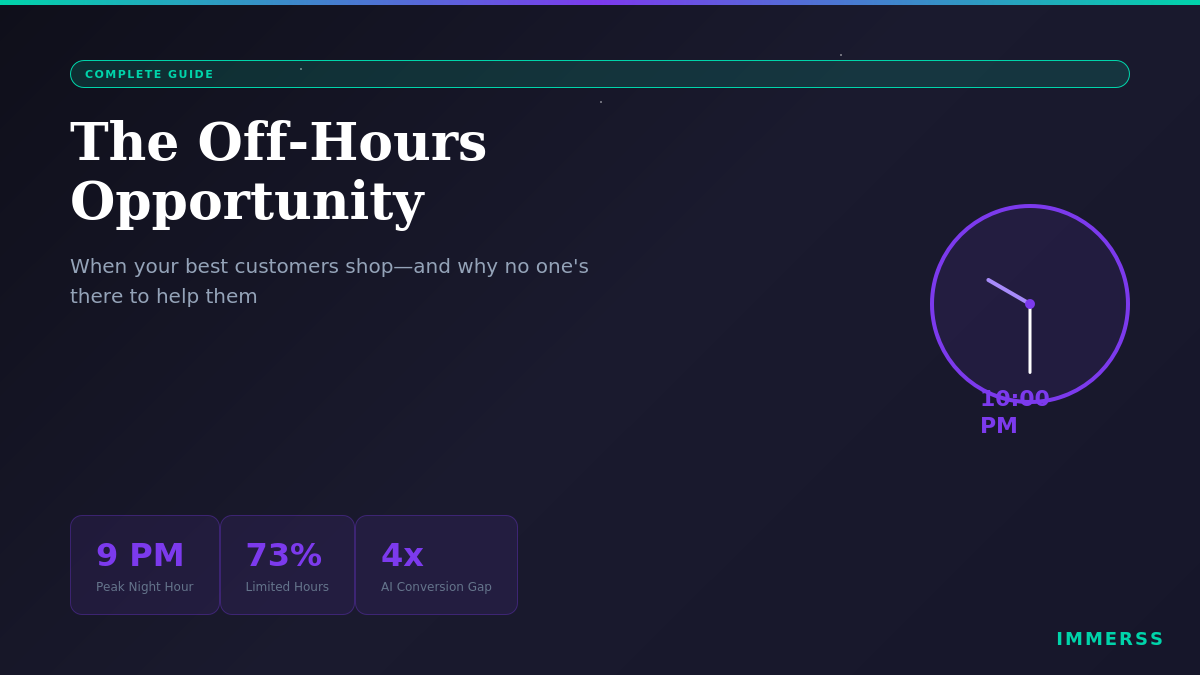

The Off-Hours Opportunity: When Your Best Customers Shop (And Why No One's There to Help Them)
The Midnight Paradox
Every e-commerce site faces the same invisible challenge: their highest-intent customers often arrive when their sales team has gone home.
It happens at 9 PM when a customer researches engagement rings after putting the kids to bed. At 11 PM when someone finally has time to evaluate that camera they’ve been considering. At 2 AM when an international shopper in a different time zone finds exactly what they’re looking for.
These aren’t casual browsers. They’re motivated buyers who’ve done their research, made their decisions, and arrived ready to purchase. They just have one or two questions — about sizing, shipping, compatibility, or customization options.
When those questions go unanswered, the sales go elsewhere.
This guide examines the off-hours opportunity: the data behind when customers actually shop, why traditional support models systematically miss high-intent buyers, and how AI Sales Agents are transforming after-hours traffic from revenue desert into revenue engine.
Part 1: The Reality of Modern Shopping Patterns
The Clock Doesn’t Match the Schedule
The assumption that shopping happens during business hours was reasonable twenty years ago. Today, it’s a costly illusion.
Research tracking shopping activity throughout the day reveals patterns that should reshape how retailers think about staffing and availability. The lunch hour shows high activity, with 1 PM and 2 PM registering the highest shopping indices of the day. But evening hours tell an equally important story. Activity at 9 PM represents the peak night shopping hour, with elevated engagement extending to 10 PM and remaining notably active even at 11 PM.
This isn’t casual scrolling. Studies examining big-ticket purchases — electronics, furniture, appliances, and luxury goods — show that 55% of mobile sales occur after 6 PM. Evening shoppers on mobile devices are often completing purchase journeys that began earlier in the day. They researched during lunch. They compared options on their work computer. Now they’re home, relaxed, and ready to buy.
The Weekend Intensifies Everything
Weekly patterns add another dimension to the off-hours challenge. In the US, Friday through Sunday sees the highest shopping volume, with activity building through the week and peaking as the weekend begins. Yet this is precisely when support staffing typically drops.
Most companies reduce customer service coverage on Friday afternoons. Weekend crews, if they exist at all, operate at skeleton levels. The result: the highest-traffic days of the week receive the lowest levels of sales support.
Conversion rate data by day of week reveals an interesting dynamic. Tuesday typically shows the highest conversion rate (around 2.5%), followed by Monday (2.25%). Weekend rates drop to approximately 2.1% — more browsing but lower purchase intent. Some of this reflects natural consumer behavior, but some reflects the absence of support that could convert browsers into buyers.
Regional Variations Compound the Problem
Shopping patterns differ significantly by geography. In the UK and Germany, most online shopping happens in the early evening from 7 PM onwards, as consumers place orders after their workday ends. US consumers show more midday activity with stronger weekend purchasing patterns.
For any retailer with international customers, this creates an impossible staffing challenge. When it’s 10 PM in New York, it’s 3 AM in London and morning in Singapore. A single support team based in one time zone will inevitably leave customers in other regions without coverage during their peak shopping hours.
The expectation of immediate response doesn’t adjust for geography. A customer in Tokyo browsing a US retailer’s site at 8 PM local time expects the same instant assistance that domestic customers receive at 2 PM. Failing to deliver that experience hands sales to local competitors who provide round-the-clock engagement.
Part 2: The Hidden Cost of Limited Hours
The 73% Gap
Research reveals a fundamental mismatch between customer expectations and business operations. Studies show that 73% of businesses still operate on limited hours for customer support, despite the fact that 52% of customers expect instant service regardless of when they reach out.
This gap has measurable consequences. When customers can’t get answers, they leave. HubSpot research found that 67% of consumers expect their support tickets resolved within three hours. The average response time for customer service emails? A staggering twelve hours.
For a customer with a question at 10 PM, that means waiting until the next afternoon for a response. By then, they’ve likely purchased from a competitor, moved on to other priorities, or simply lost the purchase momentum that had them ready to buy.
The Invisible Revenue Loss
The financial impact of limited hours is significant but often invisible in standard analytics.
Lost sales from unanswered questions don’t appear as abandoned carts because the transaction never started. A customer who couldn’t get sizing information simply navigates away — recorded as a bounce or a short session, not as a lost sale. A shopper uncertain about return policies decides the risk isn’t worth it — shown as a page view, not as revenue that almost closed.
These invisible losses compound nightly. Industry analysis suggests that 26% of all customer calls go unanswered, with rates exceeding 60% in some sectors during off-hours. Each unanswered interaction represents not just a missed sale but potential reputation damage and lifetime value erosion.
The Speed Factor
Harvard Business Review research crystallized the importance of response timing: contacting leads within the first hour increases conversion likelihood by sixty times compared to delayed responses.
Sixty times.
At 10 PM on a Saturday, most retailers aren’t contacting anyone. The leads that arrive during those hours — often the most motivated buyers, having carved out personal time to make purchasing decisions — wait until Monday for responses that arrive too late to matter.
Part 3: Understanding the Night Shopper
Different Time, Different Mindset
Late-night shopping isn’t daytime shopping that happens to occur after dark. The psychology and behavior patterns differ in meaningful ways.
Research surveying over a thousand consumers found that late-night shoppers demonstrate high purchase intent but also elevated uncertainty. They’re often browsing on smartphones while relaxing at home, having shifted from the research mode of their lunch break to decision mode. The same shopper who compared options at noon is now ready to buy — but only if their remaining questions can be answered.
This shift from research to decision creates a window of opportunity. The customer has moved through the consideration phase and arrived at the purchase phase. They need confirmation, not persuasion. But when that confirmation isn’t available, the window closes.
Category Patterns Reveal Intent
The categories purchased after hours reveal which customers need the most assistance.
Clothing, shoes, and jewelry lead late-night purchases, followed by electronics and big-ticket items. These are precisely the categories where customers typically have questions: sizing, specifications, compatibility, warranty details, customization options.
A customer buying commodity goods — paper towels, basic office supplies — might complete a purchase without assistance. But someone considering a $3,000 engagement ring, a $2,500 television, or a $500 pair of designer shoes almost certainly has questions. When those questions can’t be answered at the moment of decision, the sale often doesn’t happen.
Mobile Amplifies the Challenge
Smartphones dominate evening shopping, but mobile conversion rates significantly trail desktop — often by 40% or more.
Part of this gap stems from user experience issues: smaller screens, more complex checkout processes, harder-to-navigate product information. But part of it comes from the difficulty of getting questions answered on mobile.
Typing out a detailed email inquiry on a phone is cumbersome. Waiting hours for a response while moving on to other activities means losing the purchase momentum. The friction created by delayed communication kills mobile sales at higher rates than desktop sales simply because the mobile context makes waiting feel more frustrating.
The After-Hours Abandonment Problem
Studies show that 72% of late-night shoppers have filled a cart but abandoned it before checkout within the past three months.
Many of these abandonments aren’t lost to price comparison or second thoughts. They’re lost to unanswered questions. A customer adds a product to cart, realizes they need to know about shipping timelines, can’t find an immediate answer, and decides to “come back tomorrow” to finish the purchase.
Tomorrow, they forget. Or they find the answer somewhere else — along with a competitor’s product. The cart sits abandoned, one of millions filling up nightly across e-commerce while no one is available to close the sale.
Part 4: The AI Solution to 24/7 Sales
Why Traditional Approaches Fail
Traditional approaches to 24/7 coverage require massive investment: distributed teams across time zones, night-shift premiums, and the inevitable quality inconsistencies that come with fatigued staff working unconventional hours.
For most retailers, the math never worked. The cost of round-the-clock human coverage exceeded the revenue recovered from after-hours sales. Only the largest enterprises could justify the investment, and even they struggled with consistency and training across globally distributed teams.
This created an uncomfortable equilibrium: everyone knew off-hours revenue existed, but capturing it cost more than leaving it on the table.
AI Changes the Economics
AI changes that equation entirely.
The data on AI-powered customer engagement is striking. Studies show that websites implementing AI chatbots see conversion rate improvements of 20-30%. More specifically, shoppers who engage with AI convert at a dramatically higher rate than those navigating alone.
The mechanics behind these improvements are straightforward. AI provides instant answers to the questions that block purchases: Is this available in my size? What’s the return policy? Will this arrive before the holiday? Does this come with a warranty?
When a customer at 10 PM can get immediate, accurate answers, the friction that typically kills late-night sales disappears. The questions that would have gone unanswered until morning get resolved in seconds. The uncertainty that causes cart abandonment gets addressed in real-time.
The Most Valued Feature
Survey data reveals that 64% of consumers cite 24/7 availability as the single most valuable chatbot feature — more important than personalization, more important than speed during business hours.
The ability to get help at any time represents the primary value proposition for most customers interacting with AI. They don’t necessarily prefer AI to human assistance. They prefer immediate assistance to delayed assistance. When AI is the only option at 11 PM, AI wins.
This preference has significant implications for retailers. Customers aren’t asking for AI specifically. They’re asking for availability. The technology enabling that availability matters less than the availability itself.
Support vs. Sales: The Critical Distinction
Most chatbots are designed as deflection tools, intended to reduce support ticket volume by answering FAQ-style questions. They’re reactive, waiting for customers to initiate contact, and focused on resolving issues rather than driving revenue.
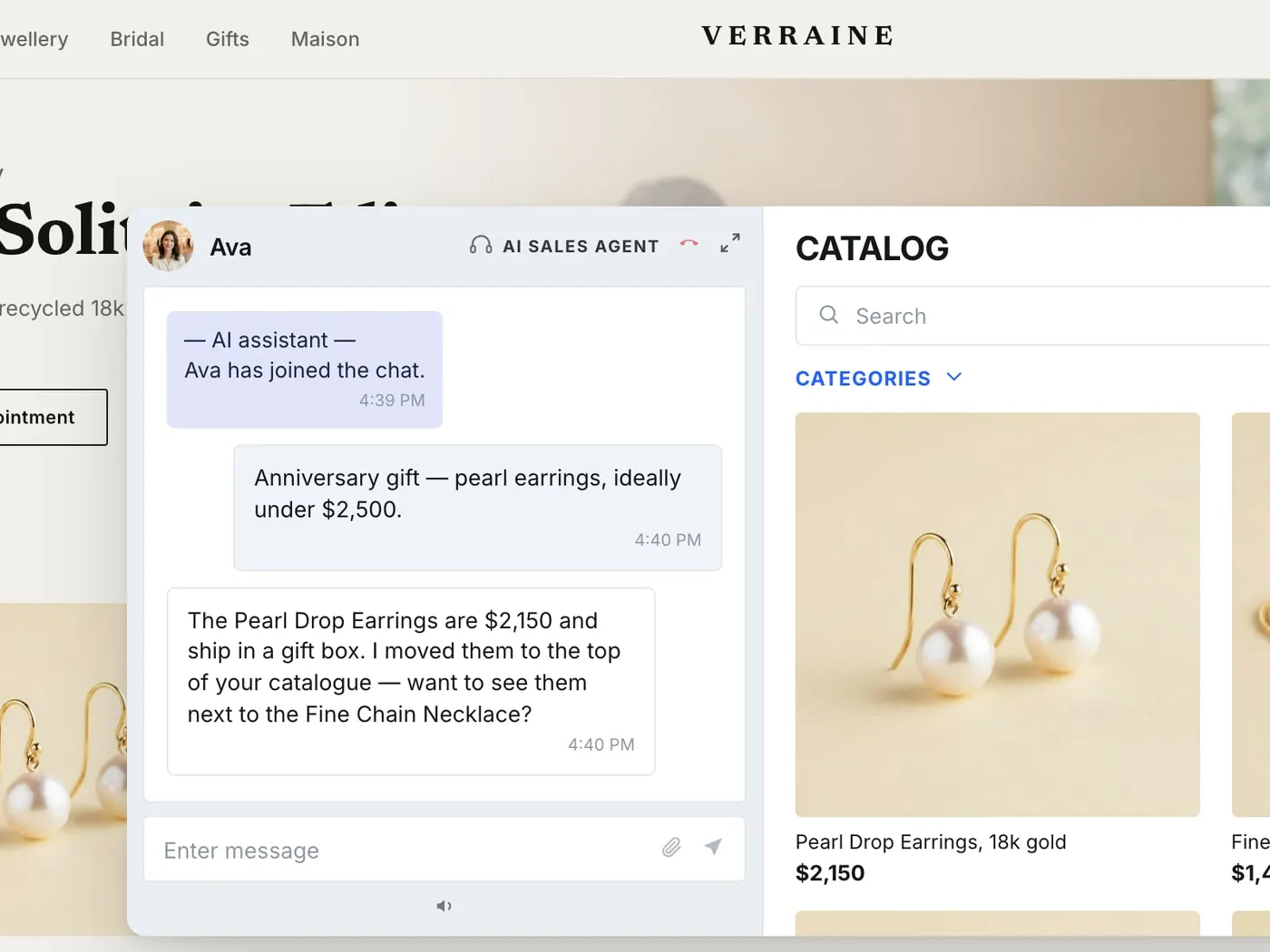
AI Sales Agents operate differently. They engage proactively, recognizing high-intent behaviors and intervening before questions become abandoned carts. They recommend products, address objections, and guide customers toward purchase — the same functions a skilled in-store salesperson performs, but available every hour of every day.
The distinction between support AI and sales AI is crucial. A support chatbot that answers “What are your store hours?” provides marginal value at midnight. An AI Sales Agent that responds “I see you’re interested in the cushion-cut diamonds — our most popular choice is the 1.5 carat VS1, and we’re offering interest-free financing through the end of the month” actively captures revenue.
Part 5: Proactive Engagement After Hours
Why Reactive Fails at Night
Reactive support waits for customers to ask for help. This model works reasonably well during business hours when customers know assistance is available. It fails systematically after hours.
Night shoppers often assume no one is available to help. They see chat widgets and assume they’re offline. They have questions but don’t bother asking because they expect to wait until morning for answers. The assumption of unavailability becomes self-fulfilling — customers don’t engage because they don’t expect response, and the opportunity passes unnoticed.
Proactive Changes the Dynamic
Proactive engagement reaches out before help is needed.
When AI notices that a customer has viewed a product page three times without adding to cart, a well-timed message can address the unspoken hesitation: “I noticed you’re looking at the oval sapphire rings. Would you like help comparing the platinum and white gold settings?”
This kind of proactive intervention works particularly well after hours. The customer who wouldn’t have initiated contact — assuming no one was there — suddenly discovers that assistance is available. The question they were going to leave unanswered gets addressed. The sale that was drifting toward abandonment gets pulled back to completion.
The Data on Proactive Engagement
Data on proactive AI engagement shows dramatically improved results compared to reactive-only approaches.
AI-driven proactive chats recover a meaningful share of abandoned carts — significantly higher than standard email recovery campaigns. The difference comes from timing. Proactive engagement catches customers while they’re still engaged, addressing concerns in real-time rather than attempting to re-engage them hours or days later when purchase intent has faded.
For luxury retailers, this proactive capability becomes especially valuable. High-ticket purchases involve longer consideration periods and more complex decision criteria. A customer evaluating a significant jewelry purchase might need reassurance about authenticity, information about financing options, or simply confirmation that they’re making the right choice.
When AI provides this guidance at 10 PM — when the customer is ready to decide — it converts sales that would otherwise slip away while waiting for morning support.
Part 6: Implementing the Off-Hours Strategy
Start with Assessment
Capturing off-hours revenue begins with honest assessment of current performance.
Most analytics platforms can provide hourly breakdowns of site visits, engagement, and conversion rates. The key is comparing these patterns to current support staffing. Where are the gaps? When does traffic arrive without corresponding assistance availability?
Common patterns emerge from this analysis. Many retailers discover that their highest-traffic hours (evenings and weekends) correspond to their lowest support coverage. Others find that international customers in key markets consistently arrive during overnight hours with no engagement options available.
Configure for Sales, Not Just Support
For retailers already using AI tools, the critical question is whether those tools are configured for sales or merely support.
Review the prompts, flows, and capabilities of existing chatbots. Do they answer questions, or do they also recommend products? Do they wait for customer initiation, or do they engage proactively based on behavior signals? Do they handle objections and guide toward purchase, or do they simply deflect to FAQs?
The difference between support AI and sales AI often comes down to configuration and training rather than underlying technology. The same platform can be optimized for ticket deflection or revenue generation depending on how it’s implemented.
Measure What Matters
Traditional support metrics — ticket deflection, resolution time, CSAT scores — don’t capture the value of after-hours sales capability.
The relevant metrics for off-hours AI include:
- Conversion rate by hour (comparing business hours vs. off-hours)
- After-hours revenue as percentage of total
- Engagement rate during off-hours (what percentage of visitors interact with AI)
- Conversion gap between AI-engaged and self-serve customers
- Revenue recovered from off-hours proactive engagement
Retailers tracking these metrics typically discover that their off-hours represent their single largest improvement opportunity — not because the traffic isn’t there, but because it’s never been properly served.
Part 7: The Luxury and High-Consideration Advantage
Why High-Ticket Benefits Most
The off-hours opportunity is particularly pronounced for luxury and high-consideration retailers.
Low-ticket, commodity purchases can often be completed without assistance. A customer buying a $15 item will rarely have questions worth asking. But as price and consideration increase, so does the need for support.
A customer considering a $5,000 jewelry purchase has questions. About authenticity. About the difference between similar-looking options. About payment plans and return policies. About how the piece will look with their existing collection.
When these questions can be answered at 10 PM, when the customer has time and attention to devote to an important decision, sales close. When they can’t, the consideration extends — often indefinitely.
The Evening Decision Window
Luxury purchasing often follows a specific pattern. Research happens during fragmented moments throughout the day — a lunch break, a few minutes between meetings. But the actual purchase decision, which requires focused attention and often joint consideration with a partner, happens in the evening.
This creates a decision window that corresponds almost perfectly with the support gap. The customer has done their homework. They’re sitting with their spouse, discussing the options. They have one or two remaining questions. The retailer who can answer those questions — right then, in that moment — wins the sale.
The retailer who displays “Available Monday-Friday, 9 AM-6 PM” loses to whoever can provide assistance now.
Trust at Scale
For luxury retailers, AI Sales Agents provide something particularly valuable: consistent expertise at every hour.
A human sales team varies in knowledge and skill. The newest associate might handle a high-value customer at the wrong moment. Training gaps create inconsistent experiences. Night and weekend shifts, if they exist at all, often feature less experienced staff.
AI Sales Agents deliver the same level of product knowledge and sales skill at 3 AM as at 3 PM. The diamond expertise available at midnight equals the expertise available at noon. For customers making significant purchases, this consistency matters.
Conclusion: The 24/7 Imperative
The shopping day doesn’t end at 6 PM. It never did, really — but mobile devices and the normalization of always-on commerce have made after-hours shopping the rule rather than the exception.
Every night, your highest-intent customers are browsing while your sales team sleeps. Every weekend, motivated buyers arrive at your site while skeleton support crews handle only the most basic inquiries. Every time zone mismatch means potential international customers encounter a store that’s functionally closed when they’re ready to buy.
This isn’t a technology problem anymore. The solutions exist and are proving their value across industries. AI Sales Agents can provide genuine selling capability around the clock, at a fraction of the cost of distributed human teams.
The off-hours opportunity represents millions in recoverable revenue for most e-commerce retailers. The only question is whether you’ll capture it — or continue leaving it on the table every night while competitors figure out what you’re missing.
Your customers are shopping at 10 PM. Your sales capability should be there to meet them.
Key Takeaways
The Data:
- 9 PM is the peak night shopping hour; 55% of mobile sales occur after 6 PM
- 73% of businesses operate on limited hours despite 52% of customers expecting instant service
- 72% of late-night shoppers have abandoned carts after hours in recent months
- Contacting leads within the first hour increases conversion by 60x
The Opportunity:
- Dramatically higher conversion for AI-engaged customers than for self-serve browsers
- 64% of consumers say 24/7 availability is the most valuable AI feature
- AI-driven proactive chats recover a meaningful share of abandoned carts
- The gain comes from answering at all: at 11pm the alternative is not a slower answer, it is no answer until the shopper has already bought elsewhere
The Action:
- Analyze traffic patterns by hour to identify your specific off-hours gaps
- Configure AI for sales, not just support deflection
- Implement proactive engagement triggered by high-intent behaviors
- Measure after-hours revenue separately from business-hours performance