
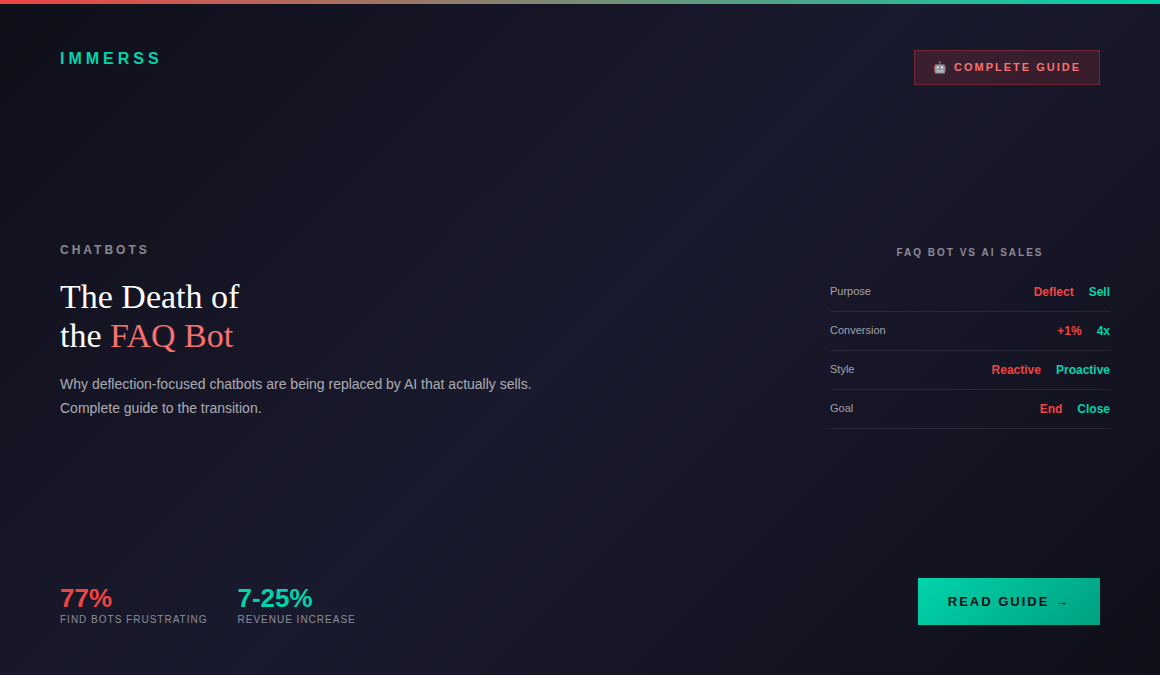
The Death of the FAQ Bot: Complete Guide to AI Sales Agents
Why deflection-focused chatbots are being replaced by AI that actually sells.
Executive Summary
Traditional FAQ chatbots were built to deflect support tickets — and they succeed at that narrow goal. But deflection-focused design fundamentally conflicts with sales. Research shows 77% of consumers find chatbots frustrating, while AI Sales Agents achieve dramatically higher conversion rates than passive shopping. This guide examines why FAQ bots fail at sales, what makes AI Sales Agents different, and the documented business results of making the transition.
Key insight: The gap between FAQ bots and AI Sales Agents isn’t technology sophistication — it’s purpose. One is built to end conversations; the other is built to close sales.
The FAQ Bot’s Original Purpose
Traditional chatbots emerged from a clear business case: reduce support costs through automation.
The logic was simple:
- Every question a bot answers is a question that doesn’t need a human agent
- Routine queries (order tracking, return policies, store hours) follow predictable patterns
- Automate the predictable; reserve humans for the complex
- Reduce headcount while maintaining service coverage
This worked. Chatbots handle 80% of routine questions without human intervention. Support costs decrease. Simple query resolution improves.
The problem: This cost-reduction mindset became the entire chatbot playbook — even when the goal shifted from support to sales.
Why Customers Hate Chatbots
The research is unambiguous:
77% of adults find customer service chatbots frustrating.
85% of consumers believe their problems need human support.
75% prefer speaking to a human agent.
67%+ report having had a bad chatbot experience.
52% say the worst issue is bots misunderstanding their question.
38% are frustrated by scripted, impersonal responses.
Only 9% use chatbots daily to connect with businesses.
These numbers reveal a fundamental mismatch. Customers experience chatbots as obstacles rather than assistance — because most chatbots are designed to end conversations, not facilitate them.
The Deflection Mindset
When a chatbot’s purpose is ticket deflection, every interaction optimizes for one outcome: close the conversation as quickly as possible.
Customer asks a question → Bot provides answer → Conversation ends.
This is efficient for support metrics. It’s catastrophic for sales.
The questions that deflection handles:
- “What’s your return policy?”
- “Where’s my order?”
- “What are your store hours?”
- “Do you ship internationally?”
The questions that drive purchases:
- “Which of these would work for my situation?”
- “Is this the right size for me?”
- “How does this compare to the other option?”
- “Is this worth the investment?”
FAQ bots deflect the first category. They fail completely at the second category — because buying questions require understanding, guidance, and conversation rather than retrieval and closure.
The Performance Gap: Quantified
The difference between FAQ bots and AI Sales Agents shows clearly in conversion data.
Traditional chatbot implementations: Add approximately 1% on top of baseline conversion rates. A site converting at 2% might reach 3% with a well-implemented FAQ bot.
AI Sales Agents: Research shows shoppers who engage with AI-powered chat convert at a dramatically higher rate than those without AI assistance.
That’s a dramatic improvement — not from better scripts, but from different purpose.
Additional AI Sales Agent outcomes:
- Materially higher conversion rates
- Dramatically higher conversion for sales-focused implementations
- Meaningful sales uplift in fashion and beauty
- A dramatic conversion boost in documented case studies
- Markedly faster purchase completion with AI assistance
- Recovery of a meaningful share of abandoned carts with proactive intervention
- Meaningfully more spending from returning customers with AI chat
What AI Sales Agents Do Differently
The gap between FAQ bots and AI Sales Agents isn’t incremental improvement — it’s fundamental difference in approach.
Reactive vs. Proactive
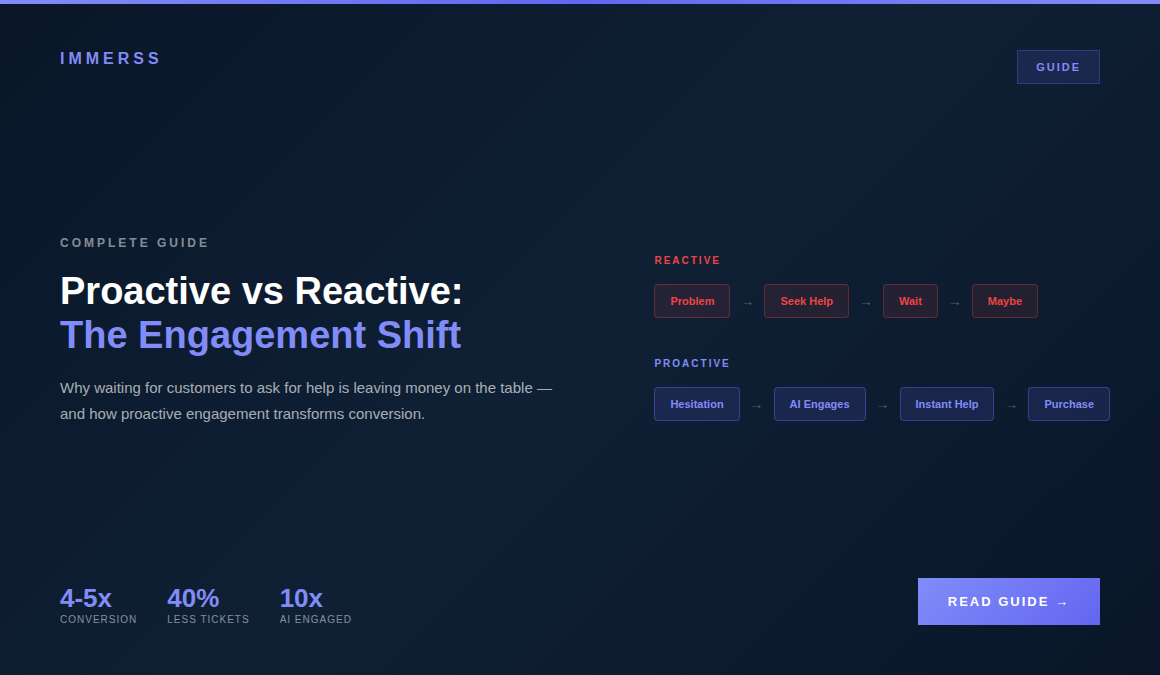
FAQ bots wait. Customers must notice the chat widget, decide to click it, formulate a question, and hope the bot understands.
AI Sales Agents engage. They recognize behavior patterns and intervene strategically:
- Cart hesitation triggers helpful outreach
- Repeat product visits prompt personalized assistance
- Time on page suggests decision paralysis
- Exit intent triggers retention conversation
When shoppers are greeted proactively by an AI assistant, 45% engage. That’s engagement FAQ bots never capture because they’re invisible until summoned.
Retrieval vs. Guidance
FAQ Bot conversation:
Customer: “What’s the difference between the Pro and Standard version?”
Bot: “The Pro version includes additional features. See our comparison page: [link]”
AI Sales Agent conversation:
Customer: “What’s the difference between the Pro and Standard version?”
AI: “Good question — it depends on how you’ll use it. The Pro adds [specific features]. If you’re using it for [use case customer mentioned], the Pro makes sense because [benefit]. But if [alternative scenario], Standard would work perfectly. What’s your primary use case?”
One provides information and deflects. One guides toward a decision.
Ending vs. Advancing
FAQ bots measure success by resolution — did the customer stop asking questions?
AI Sales Agents measure success by progression — did the customer move closer to purchase?
These are fundamentally different goals that produce fundamentally different conversations.
The Revenue Case
The financial impact of the transition from FAQ deflection to AI sales is substantial.
Conversion Impact
- AI chatbots increase conversion rates materially on average
- Sales-focused implementations achieve dramatically higher conversion than traditional methods
- 26% of all sales in bot-using companies begin with a bot interaction
- 64% of AI-powered sales come from first-time shoppers
Average Order Value
- Returning customers spend meaningfully more when using AI chat
- Digital assistants contribute to upselling in 20% of cases
- Complete-solution selling through conversation increases AOV naturally
Overall Revenue
- Companies implementing AI sales agents report meaningful revenue increases
- Companies with AI agents experienced markedly higher growth rates during the 2025 holiday season
- Proactive cart abandonment recovery adds recovered revenue with minimal cost
Comparison Example
Same traffic, different approach:
FAQ Bot:
- 100,000 visitors
- 5% engage with bot
- Bot deflects to pages
- +1% conversion lift
- Minimal revenue impact
AI Sales Agent:
- 100,000 visitors
- 15% engage (proactive + reactive)
- AI guides purchase decisions
- dramatically higher conversion among engaged
- meaningful total revenue increase
Why FAQ Bots Can’t Evolve Into Sales Agents
Some argue that FAQ bots will eventually become AI Sales Agents through iteration — add more scripts, cover more questions, improve keyword matching.
This fundamentally misunderstands the problem.
FAQ bots operate on retrieval logic: Question → Pattern match → Return pre-written answer
AI Sales Agents operate on sales logic: Understand intent → Assess needs → Guide decision → Handle objections → Close sale
You can’t iterate retrieval into guidance. The architectures are different. The training is different. The purpose is different.
It’s like iterating a library catalog into a librarian. More catalog entries don’t create a person who understands what you need and can recommend accordingly.
What to Evaluate
If you’re assessing whether your current implementation is FAQ deflection or AI sales, examine these dimensions:
| Dimension | FAQ Bot | AI Sales Agent |
|---|---|---|
| Primary Purpose | Reduce support tickets | Increase revenue |
| Success Metric | Deflection rate | Conversion rate |
| Conversation Goal | End quickly | Advance to purchase |
| Engagement Style | Reactive (wait for questions) | Proactive (engage based on behavior) |
| Response Type | Retrieve pre-written answers | Generate contextual guidance |
| Product Knowledge | FAQ database | Deep product expertise |
| Customer Understanding | Keyword matching | Intent recognition |
| Outcome | Question answered | Decision made |
If your implementation leans left on these dimensions, it’s optimized for support cost reduction rather than sales generation.
The Immerss Approach
Immerss AI Sales Agents are built from the ground up for sales, not deflection.
Sales-first architecture. The system is designed to understand customer needs, recommend products, handle objections, and guide purchases — not to route queries to FAQ pages.
Deep product expertise. AI learns your complete catalog with full understanding of features, benefits, and differentiation. It can discuss products the way your best salesperson would.
Proactive engagement. AI recognizes buying signals and engages appropriately — not intrusively, but helpfully. Cart hesitation, repeat visits, and decision paralysis trigger relevant assistance.
Conversation intelligence. AI understands context, remembers previous interactions, and adapts to customer needs rather than pattern-matching to scripts.
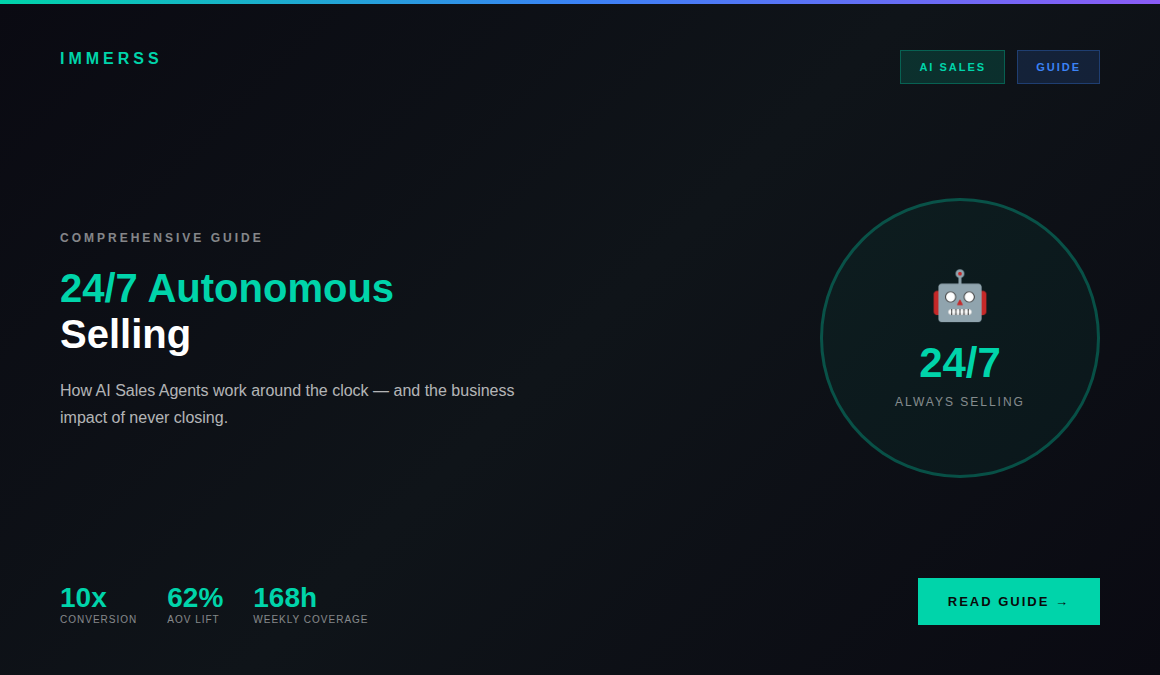
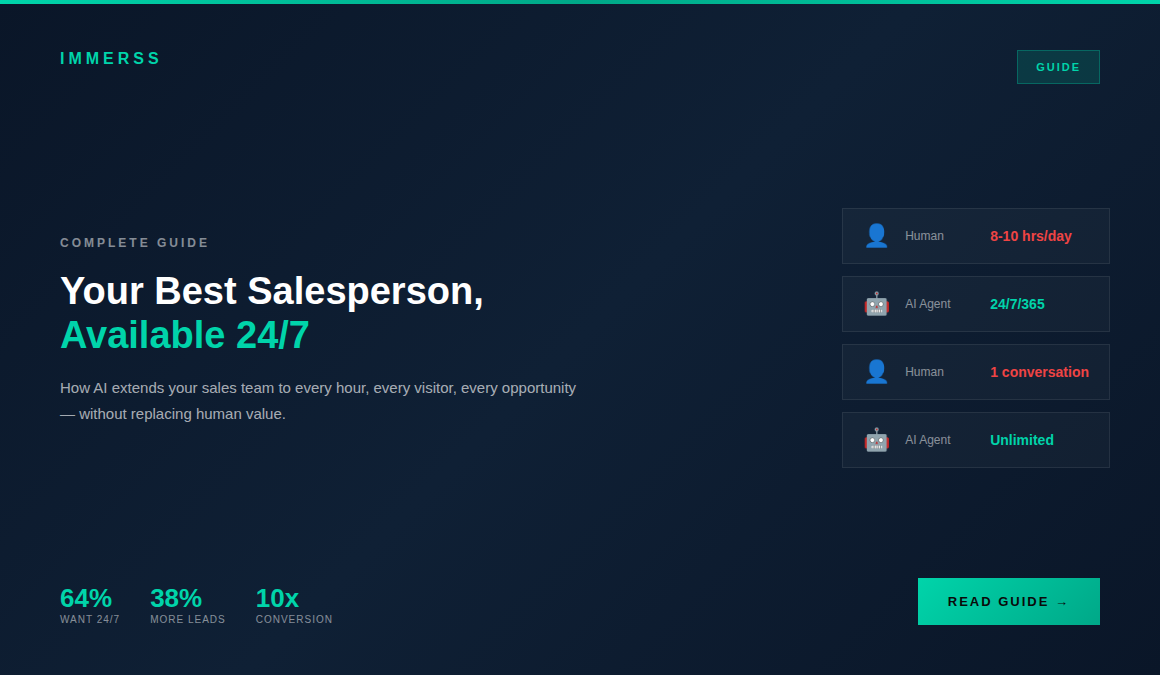
24/7 sales coverage. Unlike human sales teams, AI is always available to engage customers when they’re ready to buy — evenings, weekends, and holidays.
Brand voice. AI communicates in your brand’s distinctive tone, creating conversations that feel native rather than generic.
The Transition
Moving from FAQ deflection to AI sales requires mindset shift before technology change.
From: “How do we handle more inquiries with fewer agents?” To: “How do we convert more visitors into buyers?”
From: “Did we resolve the question?” To: “Did we advance the sale?”
From: “What’s our deflection rate?” To: “What’s our AI-influenced revenue?”
The companies making this transition are seeing dramatic conversion improvements, meaningful revenue increases, and markedly higher growth rates.
The companies still optimizing for deflection are watching competitors pull away.
The Future
The market is shifting decisively.
54% of organizations use chatbots or virtual assistants for customer-facing roles.
97% of retailers plan to increase AI spending in the coming fiscal year.
33% of enterprise software will include agentic AI by 2028 (up from <1% in 2024).
The question isn’t whether to implement AI. Everyone has chatbots. The question is whether that AI deflects support tickets or drives sales.
FAQ bots served their purpose. That era is ending.
The next era belongs to AI that sells.