
The Mother's Day Playbook: How AI + Live Video Captures the 72-Hour Peak
Mother’s Day is consistently one of the top three jewelry holidays in the United States. For most independent jewelers, it represents 15-25% of Q2 revenue. The bulk of that revenue moves in a seventy-two-hour window before the holiday — and most of that window falls outside standard business hours.
This piece is a tactical playbook for capturing the Mother’s Day late-window peak using AI sales agents and one-to-one video consultations. It is structured around the specific operational reality of the holiday: who is buying, when they are buying, what they need, and what tooling produces measurable lift in close rate, AOV, and Q2 contribution.
The Mother’s Day Buyer Profile
Mother’s Day buyers cluster into three distinct profiles, and the playbook needs to handle each differently.
The Planner shops two to four weeks out. They are typically already on the operator’s email list. They respond well to standard email cadences, gift guides, and curated collections. The standard CRM playbook captures most of this segment effectively. This is not the segment the new playbook is designed for.
The Considered Buyer shops in the seven-to-ten-day window. They have a budget in mind, a recipient in mind, and need help narrowing options. They will engage with email content if they receive it, but most of their decision-making happens on the website during evening hours. They are open to a scheduled consultation. The standard playbook captures a moderate share. The video-enabled playbook captures significantly more.
The Late-Window Buyer shops in the seventy-two hours before the holiday — most heavily Friday evening through Saturday afternoon. They are time-stressed, often male, often shopping outside their normal comfort zone, often a first-time buyer with the operator. They will not engage with email at this point because the urgency is too acute. They need synchronous help. This is the segment with the highest revenue concentration and the lowest current capture rate. Closing this gap is the single biggest opportunity on the holiday.
Where Revenue Is Won and Lost
For independent jewelers and high-end specialty retailers, the after-hours late-window represents disproportionate revenue concentration relative to staffing. The pattern is consistent across operators:
- Friday evening (after 6pm local) sees significant traffic spikes on high-AOV product pages
- Saturday traffic stays elevated all day, with secondary peaks around lunch and after dinner
- Sunday morning produces last-minute panic purchases, often for same-day pickup
- Cart abandonment rates during these hours run substantially higher than weekday baseline
- Average dwell time on individual product pages extends well beyond planning-window norms
The standard ecommerce surface — product pages, FAQ sidebars, contact forms — is built for the planner. It does not match the operational need of the considered or late-window buyer, both of whom need synchronous human guidance in the buying moment.
The Three-Layer Stack
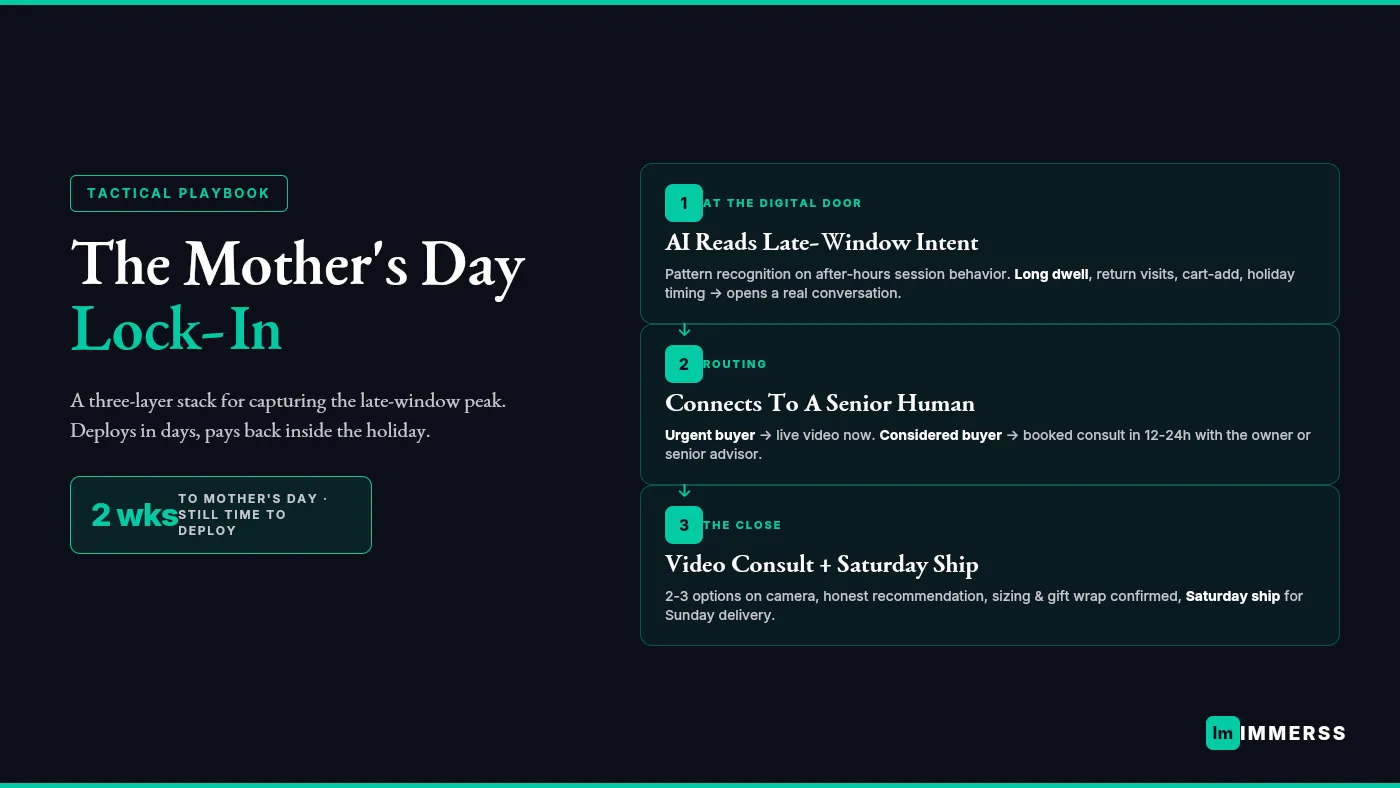
The playbook that captures this revenue runs three integrated layers.
Layer 1: AI Qualification at the Digital Door
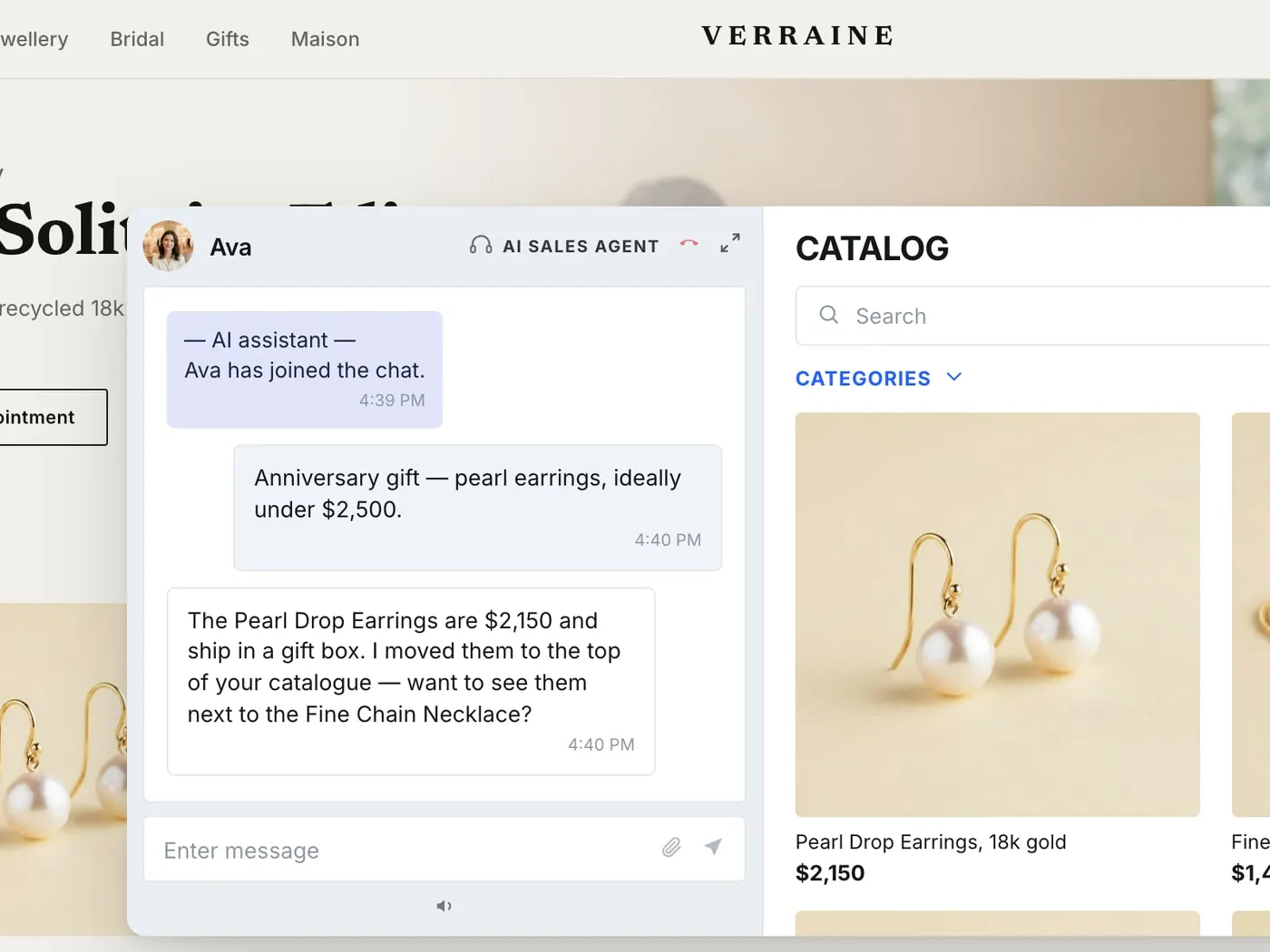
An AI sales agent monitors session behavior on the site during the holiday window, watching for high-intent signal patterns: extended dwell on single high-AOV pieces, multiple return visits within twenty-four hours, cart-add without checkout, time-of-day matching the after-hours peak. When the pattern triggers, the AI opens a real conversation calibrated to the buyer’s apparent intent.
The opening is not a generic chatbot prompt. It is something closer to what a showroom associate would say to a man hovering over a pearl pendant on the Friday before Mother’s Day. The AI’s role is to read intent, ask the qualifying questions a senior advisor would ask, and route the conversation to the appropriate next step.
Practically, the AI handles three core qualifications: who is the recipient, what is the budget range, and how acute is the timeline. From those three answers, the routing decision is essentially deterministic.
Layer 2: Routing to a Human
The two routing paths cover the two operational realities.
For the urgent buyer — anyone with a deadline shorter than the next business day — the AI offers an immediate live video consultation. This requires a senior advisor or owner on call during the peak hours of the holiday weekend. The trade-off is concentrated and measurable: thirty hours of dedicated coverage across Friday evening, Saturday, and Sunday morning, in exchange for the opportunity to capture the highest-intent buyer pool of the year.
For the considered buyer — anyone with at least 24-48 hours of flexibility — the AI books a scheduled consultation, in the buyer’s time zone, typically within the next twelve to twenty-four hours. The buyer leaves the session knowing exactly when the call will happen and with whom. The booking rate on these confirmations runs well above traditional contact-form fill rates because the commitment is concrete and time-bounded.
Layer 3: The Video Close
The video consultation is where the close happens. The advisor walks the buyer through two or three appropriate pieces, models them on-camera, gives an honest recommendation based on what the buyer has said about the recipient, confirms sizing, confirms gift wrapping, confirms delivery commitment.
For the operator running this play, the close rate on video consultations during the Mother’s Day window typically runs at multiples of the standard ecommerce conversion rate. AOV often lifts because the buyer who has personal guidance feels comfortable buying up — frequently to a higher tier than they had originally selected. Return rates drop because the buyer made a confident decision with expert input rather than a hesitant decision based on a product page.
What Operators Need To Deploy
For Mother’s Day specifically, the deployment timeline is short. The three layers can be live within days, not weeks, with the right tooling. The harder operational decisions are about coverage and inventory.
Coverage: Designate one or two senior people — typically the owner or a longstanding senior advisor — to be on call during the peak hours of the holiday weekend. Friday 5pm to 10pm local. Saturday 9am to 8pm local. Sunday 9am to 12pm local. This is roughly thirty hours of dedicated coverage. Compensation can be structured as commission against captured sales rather than salaried time.
Inventory: Identify the ten to fifteen most likely “Mother’s Day winner” pieces in the active inventory — pieces in the typical Mother’s Day price band, photogenic on camera, available for Saturday afternoon shipping. Pre-stage these for video sessions. The advisor should be able to pull any of them for camera in under sixty seconds.
Logistics: Confirm Saturday afternoon shipping cutoffs with carriers for Sunday delivery. Pre-stage gift wrapping. Confirm the team handling pack-out is on duty Saturday afternoon. None of this is novel — most operators handle these logistics already — but the video close adds a layer of in-session commitment that requires the logistics to execute reliably.
The Q2 Math
For an independent jeweler doing Q2 revenue in the low-to-mid eight figures, Mother’s Day typically contributes a meaningful share. Of that share, the after-hours late-window represents the highest concentration of buyer intent and the highest cart abandonment rate.
A capture rate improvement of even single-digit percentage points on the after-hours late-window flow translates directly to recovered revenue. For most operators, this recovered revenue alone justifies the tooling investment for the rest of the year — and the same playbook compounds across Father’s Day, the engagement season, the year-end holidays, and Valentine’s Day.
In other words, deploying the playbook for this Mother’s Day is not a one-holiday investment. It is an investment in the holiday-window revenue capability that the category increasingly requires, with Mother’s Day as the first deployment.
What To Decide This Week
For operators evaluating whether to deploy something for this Mother’s Day specifically, the decision points are:
- Is the AI qualification layer something we can deploy in the next ten days? (For most operators, yes.)
- Can we identify the senior person who will cover the peak weekend hours? (For most independents, the owner, or the most experienced advisor.)
- Is our inventory and logistics able to support a Saturday afternoon ship for Sunday delivery? (For most operators, already in place.)
If the answers are yes, the deployment is straightforward and the revenue payback is concentrated in the holiday weekend itself. If the answers are no, the same playbook applies to Father’s Day in June, the engagement uptick in summer, and the Q4 holiday season — with more runway to deploy carefully.
The category is moving toward this model. The operators capturing the late-window now compound the advantage across multiple holidays per year. The seventy-two-hour Mother’s Day window is the cleanest place to start.
Immerss is a luxury live commerce platform combining AI sales agents with one-to-one video consultations. Built specifically for independent jewelers and high-end specialty retailers who need to capture holiday-window revenue that the standard ecommerce playbook misses. Book a demo to see how the playbook deploys for your team.