
How to Sell Jewelry Gifts Online in 2026: A Jeweler's Guide
Selling jewelry gifts online in 2026 comes down to a problem most jewelers overlook: the gift-buyer isn’t the wearer, so they’re shopping blind — choosing an expensive, personal, taste-dependent piece for someone else, often without knowing size, style, or what the recipient already owns. A product grid gives them more options when their real problem is not knowing which option she’ll love. This guide explains why gifting is uniquely hard, what the gift-buyer actually needs, and how live consultation turns an anxious guess into a confident gift — and a one-time buyer into a repeat, calendar-driven customer.
The short version: the gift-buyer needs a translator, not a bigger catalog — someone to turn what they know about the recipient into a confident choice.
How do you sell jewelry gifts online in 2026?
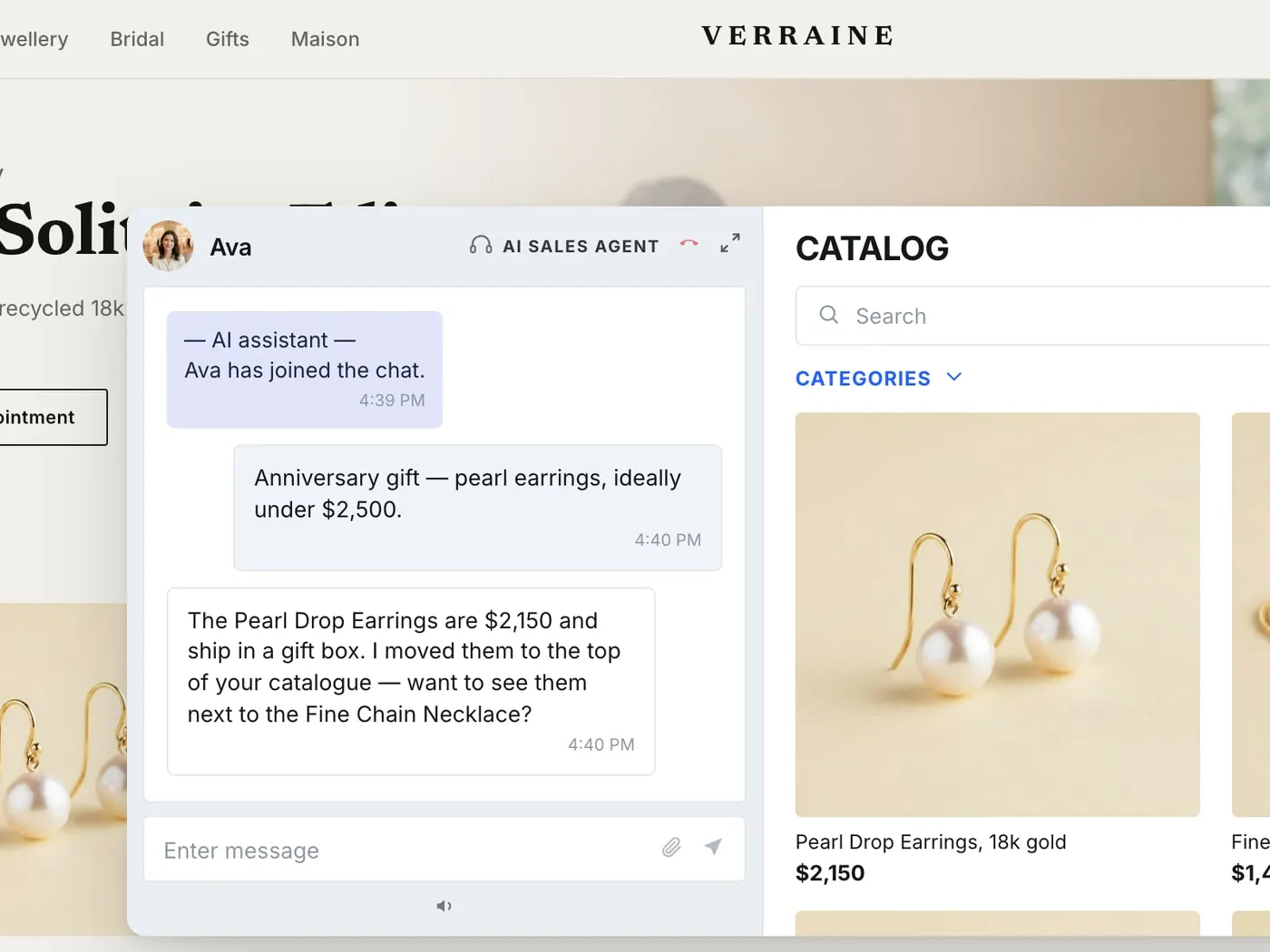
You sell jewelry gifts online in 2026 by giving the gift-buyer a personal shopper instead of a product grid: an advisor who decodes the recipient from the clues the giver can provide, recommends with confidence, and dissolves the practical anxieties of sizing, timing, and returns. The gift-buyer’s problem isn’t a shortage of options — it’s that no amount of options tells them which piece the recipient will love. The jewelers who convert gift traffic well add a guided layer — the one we build for jewelry and watch brands: an AI sales agent that engages the shopper and senses they’re buying for someone else, handing them to a live one-to-one consultation. The sections below explain why, and how.
Why is selling jewelry as a gift so hard online?
Selling jewelry as a gift is hard online because the buyer isn’t the wearer, which removes nearly everything that normally guides a purchase. The giver can’t rely on their own taste, can’t judge fit or size, and often doesn’t know what the recipient already owns or truly prefers. They’re making an expensive, emotionally loaded decision on behalf of someone whose taste they’re reading from the outside — shopping blind. A self-service grid, built to let a buyer choose for themselves, has no mechanism for “help me choose for a specific other person,” which is exactly the gift-buyer’s need. That mismatch, not lack of demand, is why gifting converts poorly online and why so many gift-buyers default to something safe and generic — or leave for a store. And the demand is enormous: a large share of all fine-jewelry purchases are gifts, concentrated in predictable seasonal spikes, which makes the gap between high gift-intent traffic and low gift conversion one of the most valuable problems a jeweler can fix.
What does the jewelry gift-buyer actually need?
The jewelry gift-buyer needs a translator, not more inventory — someone to turn what they know about the recipient into a confident recommendation. Givers usually aren’t clueless; they know quite a lot (“she wears gold, never silver”; “she has an understated style”; “she loves her grandmother’s necklace”), but they lack the expertise to translate those clues into the right piece. What they want is exactly what a great jeweler always provided across the counter: to hand over their scattered clues and receive, in return, “based on what you’re telling me, this is the one.” That translation — from fuzzy knowledge of a person to a confident choice — is the core value of a jeweler in the gift purchase, and it’s what disappears in a self-service grid. Crucially, it also raises average order value in the right way: a confident giver buys the piece that fits, not the cheapest one they’re least likely to regret, so guidance lifts the sale by removing the hedging that pushes anxious gift-buyers toward safe, lower-value defaults. (See how this differs from selling to a buyer choosing for themselves as an anxious novice.)
Why doesn’t a product grid work for gift-buyers?
A product grid doesn’t work for gift-buyers because their problem is the opposite of too few options — they’re overwhelmed by options and can’t tell which is right for a specific person who isn’t them. A grid’s filters narrow by the giver’s inputs (metal, price, category), but the giver’s most valuable knowledge about the recipient isn’t filterable: “vintage-looking but not fussy,” “a milestone for her new job,” “she already has three tennis bracelets, so not that.” A person can interpret those human clues in a two-minute conversation; a filter can only process “vintage-style: yes/no” and returns wrong results confidently. Selling a gift is a translation problem, and a grid can’t translate. Worse, a grid actively works against the anxious giver: faced with a wall of plausible options and no way to judge them, the giver’s uncertainty grows rather than resolves, pushing them toward the safest, cheapest, most generic choice — or toward abandoning the purchase entirely. More options don’t reassure a blind buyer; they overwhelm one.
What emotional stakes make jewelry gifting different?
Jewelry gifting carries unusually high emotional stakes because the gift is a statement about a relationship — “this is how well I know you,” “this is how much you mean to me.” Get it right and the recipient’s reaction is the whole point; get it wrong and it’s a small, specific heartbreak — something generic she thanks the giver for and never wears. The dominant emotion for the gift-buyer isn’t about money; it’s the fear of buying something that signals they don’t know the recipient as well as they should. A grid does nothing to soothe that fear, while a knowledgeable advisor who says “she’ll love this, and here’s why” resolves it directly — which is why guidance converts the anxious gift-buyer where self-service can’t.
How do you handle sizing, timing, and returns for jewelry gifts?
You handle the practical anxieties of gifting the way a person does — with real strategies and reassurance a self-service page can’t offer. For sizing without spoiling the surprise: adjustable pieces, sizing after delivery, or gifts where size doesn’t matter (necklaces, earrings, bracelets), plus discreet ways to find a ring size. For timing: clear, personal confirmation that the gift will arrive gift-ready before the occasion, not just a cold shipping estimate. For personalization: whether engraving is possible and still meets the deadline. For returns: a graceful, low-embarrassment exchange path, promised by a real person. Each of these anxieties makes a nervous giver more likely to abandon or downgrade; an advisor untangles them all in a single conversation.
How does live video consultation help sell jewelry gifts?
Live video consultation helps sell jewelry gifts by giving the blind gift-buyer a personal shopper. On a one-to-one video call, an advisor asks the few questions that decode the recipient, listens to the giver’s scattered clues, and translates them into two or three confident recommendations — then handles sizing without spoiling the surprise, confirms gift-ready delivery in time, and removes the returns fear. The giver goes from anxious and blind to confident and relieved, and buys the piece they now believe the recipient will love. An AI sales agent can handle the front door — engaging the shopper, sensing a gift purchase, and offering the consultation — before handing to the advisor. (See how the AI sales agent and consultation work together.)
Want to see what that consultation looks like on your own catalog? See it on your store.
How to sell a jewelry gift online: a step-by-step approach
A practical framework for the guided online gift sale:
- Detect the gift-buyer. An AI sales agent engages the shopper and recognizes signals they’re buying for someone else (occasion language, “for my wife,” gift wrapping interest).
- Offer a personal shopper. Move from “browse our gift guide” to “let me help you find something she’ll love” — a live consultation.
- Decode the recipient. The advisor asks the few unlocking questions and listens to the giver’s clues about style, occasion, and what she already owns.
- Recommend with confidence. Translate the clues into two or three strong options, with reasons — replacing a blind guess with expert conviction.
- Dissolve the logistics. Handle sizing, personalization, gift-ready delivery timing, and a graceful returns path.
- Keep the giver. Capture them for the next occasion with ongoing 1:1 clienteling — gifting is recurring, and the giver you help returns for every calendar event.
Worked example: the cost of selling gifts from a grid
Here’s a calculation you can redo with your own numbers — the figures below are illustrative assumptions, not benchmarks. Take a jeweler with a month of gift-intent sessions at a healthy AOV:
- Self-service grid: anxious gift-buyers convert at a low rate, with many defaulting to a safe, lesser piece or leaving to shop in person.
- Guided consultation: offer the blind giver a personal shopper on a slice of that traffic and convert a far higher share of those who take a consultation → several times the sales, at higher AOV (advisors guide to the right piece, not the cheapest) — plus the repeat, calendar-driven purchases each giver brings.
Even a conservative slice of the guided uplift dwarfs the grid result — because the gift-buyer was never going to be converted by more options; they were going to be converted by someone helping them choose. Swap in your own traffic, consultation rate, conversion, and AOV.
Is your store ready to sell gifts this way?
Run this filter:
- Shopify Plus, meaningful gift-driven traffic (spikes around holidays, Valentine’s, Mother’s Day, anniversaries), AOV $300+.
- Your gift-season traffic converts poorly relative to its volume and intent.
- You see high bounce on gift and “for her/him” pages.
- You have the product expertise to guide — you just haven’t made it available to the anxious giver.
If two or more are true, a guided model is your opportunity. (See where you stand on the benchmarks.)
What to measure
Track the things a guided gifting funnel should move:
- Consultation take-rate from gift-intent traffic.
- Consultation conversion and gift AOV (guidance tends to lift AOV toward the right piece).
- Return/exchange rate on gifts (good guidance lowers it).
- Repeat purchase rate of gift-buyers across occasions — the calendar-driven lifetime value.
The 60-day pilot, on us
The best way to see what a personal shopper does for your gift sales is to run it on your own traffic and measure it. That’s what the pilot is for.
We run a structured 60-day pilot, on us — an AI sales agent engaging and qualifying gift-intent shoppers, live one-to-one video consultation as the selling mechanism, and measurement around consultation conversion, gift AOV, and repeat rate. The model is deliberately human (a real advisor decoding the recipient, not a script), personal (one-to-one, helping this giver choose for this person), and measurable (every consultation, sale, and returning gift-buyer tracked). You change no platform and risk no margin to see what guiding the anxious gift-buyer does for your store.
See the pilot for merchants: landing.immerss.live Agency partner program: partners.immerss.live
Immerss is a luxury live commerce platform — an AI Sales Agent, 1:1 Live Co-Shopping and outbound clienteling, and video commerce for fine jewelry, watches, and high-AOV retail, built on Shopify Plus.
Frequently asked questions
By giving the gift-buyer a personal shopper rather than a product grid. The buyer isn't the wearer, so they need help translating what they know about the recipient into the right piece, plus help with sizing, timing, and returns — which a live consultation provides and a self-service page can't.
Because they're shopping blind and a grid can't tell them which piece the recipient will love, and because practical anxieties (sizing without spoiling the surprise, delivery timing, returns) go unresolved. Many default to a safe, generic choice or leave for a store. Guidance resolves both.
With strategies a real advisor can offer: adjustable settings, resizing after delivery, discreet ways to find her size, or choosing a gift where size doesn't matter (necklaces, earrings, bracelets). A consultation walks the giver through the safest option for their situation.
When taste is uncertain, versatile, size-independent pieces (necklaces, earrings, bracelets) and meaningful-but-not-overly-specific styles are safer — but the best answer depends on the recipient. An advisor decoding her style and the occasion beats any generic 'best gifts' list.
Because gifting is recurring and calendar-driven — anniversaries, birthdays, holidays never stop. A giver who was helped through one gift returns to the same jeweler for the next, making a well-served gift-buyer a loyal, repeat, high-lifetime-value customer.
Ahead of the seasonal spikes — the Q4 holidays, Valentine's Day, Mother's Day, and anniversary season drive the bulk of gift demand. A guided gifting experience should be live and staffed before traffic climbs, so the surge of anxious, high-intent gift-buyers meets a personal shopper rather than a grid.