
Jewelry Ecommerce Benchmarks 2026: Where Do You Stand (and Which Numbers Actually Matter)
Most jewelers benchmark their online store against general ecommerce averages — roughly 2–3% conversion, ~70% cart abandonment — and feel reassured when they hit them. For a high-AOV, high-consideration jewelry purchase, those benchmarks are set by a completely different kind of business, and passing them can hide your single biggest opportunity. This guide lays out realistic jewelry ecommerce benchmarks for 2026, a “where do you stand” scorecard, and the one benchmark that actually matters: your own in-store conversion rate.
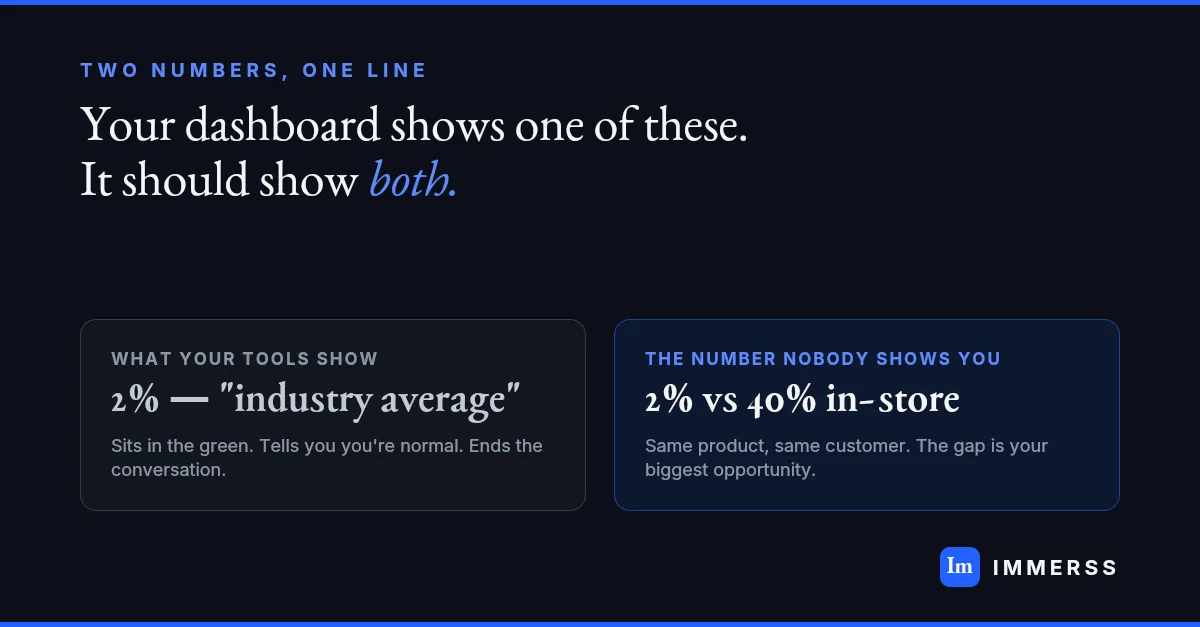
The short version: the right ruler for fine jewelry isn’t the ecommerce average. It’s your store floor — and the gap between the two is the number to chase.
What are the jewelry ecommerce benchmarks for 2026?
Jewelry ecommerce benchmarks in 2026 differ sharply from general ecommerce, because jewelry is a high-AOV, high-trust, high-consideration purchase rather than a fast impulse buy. Self-service online conversion for fine jewelry typically runs at or below the general 2–3% average; cart abandonment runs high (often 75%+) and is largely uninformative on its own; AOV is high but varies widely; and the metrics that truly predict a healthy jewelry business — repeat rate, lifetime value, consultation conversion — barely appear on a standard dashboard. The sections below give realistic ranges and, more importantly, the benchmark you should measure against instead of the ecommerce average. (For the broader, all-category picture, see the general ecommerce benchmarks 2026 edition.)
What is a good conversion rate for jewelry ecommerce?
A good self-service conversion rate for fine jewelry ecommerce is roughly 1–2%, which is at or slightly below the general ecommerce average — and that’s the problem, not a sign of health. The higher the price and consideration, the worse a self-service flow converts, because a five-figure purchase needs guidance a checkout can’t provide. The number that reveals the truth is your own in-store conversion rate: a serious buyer who engages an advisor in a showroom converts at a completely different order of magnitude, on the same product. Consultation-led online selling closes a large share of qualified high-AOV buyers too, because it restores the same mechanism — but the figure that matters is the one your own advisors produce on your own appointments, not a published range. So “good” depends entirely on the experience: 1–2% is normal for self-service and a sign of lost value. The practical move is to stop asking “is my conversion rate good for ecommerce?” and start asking “is my online conversion anywhere near my in-store conversion?” — because for a high-AOV jeweler, the second question is the one with money in it.
Why is your online conversion so much lower than your in-store conversion?
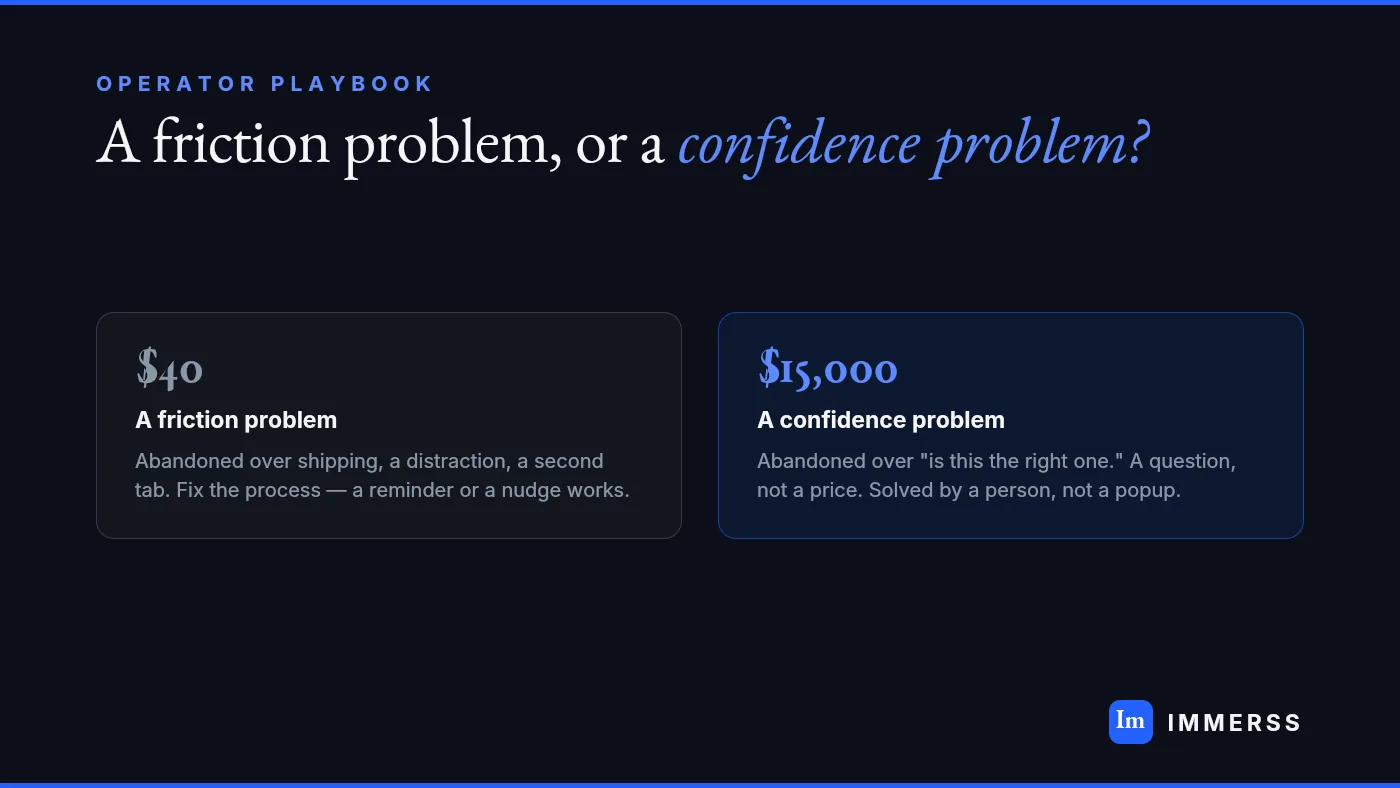
Your online conversion is far lower than your in-store conversion because the website removed the mechanism that does the converting: the advisor. In the store, a knowledgeable person shows the piece, answers the real question, and builds the trust a high-value purchase runs on. Online, a self-service checkout processes decisions but can’t help a customer make one, so the same high-intent buyer hits a wall at the moment of doubt and leaves. The gap isn’t because “people won’t buy jewelry online” — they will, when guided. It’s because the online experience stripped out guidance and then got benchmarked against an industry (mass-market, self-service retail) that never relied on guidance in the first place. Closing the gap means restoring the mechanism, not optimizing the grid. (See reducing high-ticket cart abandonment.)
What is a good cart abandonment rate for jewelry?
There’s no “good” cart abandonment rate for fine jewelry, and chasing the number is a mistake. The general ecommerce average is ~70%, and high-consideration jewelry often runs higher (75%+), because deliberation is inherent to a five-figure purchase — a high abandonment rate is the nature of the category, not a failure. Focus instead on how many of those abandonments you resolve into a full-price sale through a real conversation, not on the rate itself.
What’s a typical average order value for online jewelry?
Online jewelry AOV varies enormously by segment — from a few hundred dollars for fashion-leaning pieces to five and six figures for fine and bridal — so the headline number is less useful than the spread. The benchmark worth watching is the difference between assisted (consultation-led) and unassisted (self-service) AOV: guided sales typically carry a meaningfully higher AOV, because a trusted advisor guides the buyer to the right piece rather than the cheapest one. If your assisted AOV isn’t higher than your self-service AOV, your guidance isn’t doing its job. And if you’re tempted to lift conversion by discounting, watch the direction of travel: discounting drags AOV down while training customers to wait for markdowns, whereas guidance lifts both conversion and AOV at once — the two levers move in opposite directions, and only one of them builds the business.
Which jewelry ecommerce metrics actually predict a healthy business?
The metrics that predict a healthy jewelry ecommerce business are relationship metrics, not traffic metrics: repeat-purchase rate, customer lifetime value, advisor-attributed revenue, full-price conversion, and the share of high-AOV sales that ran through a guided conversation. Jewelry runs on returning, clienteled customers who come back for the next milestone and refer others — so a business can have a “mediocre” conversion rate and a thriving future if its repeat and referral engines are strong. These numbers rarely appear on a standard ecommerce dashboard, which is exactly why so many jewelers measure the wrong things.
It’s worth being concrete about why these beat the headline metrics. A single clienteled jewelry customer might buy across an engagement, a wedding band, anniversaries, and upgrades over a decade, and refer several friends along the way — a lifetime value many multiples of the first transaction. A dashboard optimized for first-purchase conversion rate is structurally blind to that, because it stops counting at the first sale. Two jewelers with identical conversion rates can have completely different futures depending on whether their customers come back, and only the relationship metrics will tell them which jeweler they are. Track them, and you start managing the business that actually exists rather than the one the generic dashboard assumes.
Where do you stand? A jewelry ecommerce benchmark scorecard (2026)
Locate your store against realistic 2026 jewelry benchmarks. These are directional ranges for fine/high-AOV jewelry, not guarantees, and they’re meant to be read together — a “typical” self-service conversion sitting next to a strong in-store number is the signal to act, not to relax:
| Metric | Below | Typical | Strong |
|---|---|---|---|
| Self-service online conversion | <1% | 1–2% | 2%+ |
| In-store conversion (your real benchmark) | <25% | 30–50% | 50%+ |
| Consultation-led online conversion | <30% | 30–50% | 50–70% |
| Online-vs-in-store conversion gap | 20×+ | ~10× | closing |
| Cart abandonment | — | 70–80% (normal) | — (track resolution) |
| Assisted vs. self-service AOV | same/lower | +10–25% | +25%+ |
| Repeat-purchase rate | <15% | 20–35% | 35%+ |
| High-AOV sales via consultation | ~0% | 10–30% | 30%+ |
The single row that matters most is the conversion gap. If your online conversion is a fraction of your in-store conversion on comparable traffic, you have an enormous, capturable opportunity — and no general-ecommerce benchmark will ever show it to you.
Worked example: the cost of benchmarking against the wrong industry
Here’s a calculation you can redo with your own numbers. Take a jeweler with:
- 60,000 monthly visits, 2% reaching a high-intent buying moment → 1,200 high-intent sessions/month
- AOV $6,000
Now compare the conversion benchmark you measure against:
- At the “industry average” self-service rate, a small fraction of those 1,200 sessions become sales. The dashboard reports it as “on par with ecommerce” — reassuring, and also the ceiling.
- Routed to a guided experience, the same high-intent sessions convert at something much closer to your store-floor rate, on the same inventory at full margin. Run the multiplication with your own showroom number rather than a published one: that is the gap, and it is the only figure in this article that is genuinely yours.
Even capturing a fraction of that gap dwarfs the self-service result. The point isn’t that every high-intent session converts like a showroom walk-in overnight — it’s that benchmarking against 2% hid the existence of the gap entirely. Swap in your own visits, intent rate, AOV, and conversion figures; the lesson holds for any genuinely high-AOV jeweler. Even a conservative move — say, lifting blended conversion on high-intent sessions from 2% to 8% by guiding a portion of them — quadruples the revenue from the same traffic, at full margin, without spending a dollar more on acquisition. The gap is the cheapest growth in the business, because the demand is already there.
Is your store measuring against the right benchmark?
Run this filter — and be honest, because the whole point of benchmarking is to tell yourself the truth rather than a comfortable story:
- Shopify Plus, 50K+ monthly visits, AOV $500+ (decisive at $5,000+).
- You quote “industry-average” conversion (~2%) as a sign you’re doing fine online.
- You’ve never put your in-store conversion next to your online conversion on comparable traffic.
- Your dashboard has no row for repeat rate, advisor-attributed revenue, or consultation conversion.
If two or more are true, you’re measuring against the wrong industry — and almost certainly leaving your store-floor result on the table online.
What jewelers should measure in 2026 instead
Replace the flattering ecommerce metrics with the ones that tell the truth about a high-AOV business:
- In-store vs. online conversion gap — your real performance benchmark and opportunity size.
- Consultation conversion rate and share of high-AOV sales via consultation — whether the converting mechanism is online yet.
- Repeat-purchase rate and customer lifetime value — the relational engine.
- Assisted vs. self-service AOV and full-price conversion — whether guidance is lifting value and holding price.
- Advisor-attributed revenue — how much of the business runs through a real relationship.
Report these five next to your traffic metrics, and the story your dashboard tells flips from “we’re an average ecommerce store” to “we’re a high-AOV business with a measurable, capturable gap between what we sell online and what we sell in person.” That second story is the true one — and it’s the one that points at where the growth is.
(For why discounting to “fix” conversion backfires, see how to stop discounting and close at full price; for the mechanism itself, the guide to AI sales agents. For the jewelry-specific tooling, see the best live shopping platforms for jewelry in 2026 and where the category is heading in jewelry ecommerce trends 2026.)
The 60-day pilot, on us
The fastest way to close the gap the right benchmark reveals is to route your high-intent online traffic through a guided experience and measure its conversion against your self-service baseline — and against your store floor. That’s what the pilot is for.
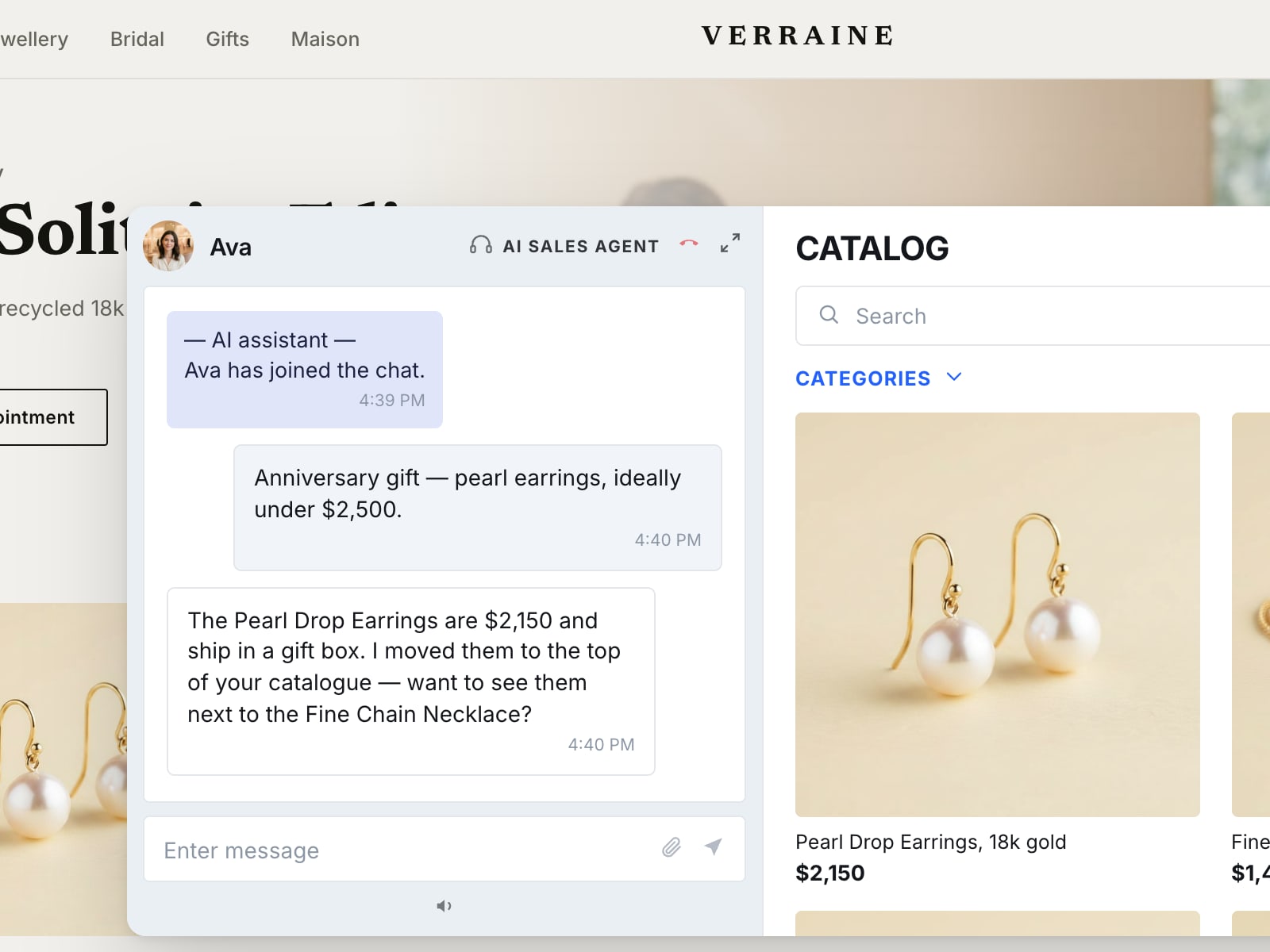
We run a structured 60-day pilot, on us — an AI sales agent engaging and qualifying high-intent jewelry shoppers, live one-to-one video consultation as the converting mechanism, and measurement built around consultation conversion, assisted AOV, and the in-store-vs-online gap. You change no platform and risk no margin to find out how much of your store-floor result you can bring online. Documented Immerss outcomes include materially higher conversion, meaningfully larger average orders, and recovery of a significant share of abandoned carts — framed as benchmarks, not promises, and measured on the setup we build for jewelers. Book a demo to scope it for your store.
FAQ: jewelry ecommerce benchmarks 2026
What is a good conversion rate for jewelry ecommerce? For self-service online sales, 1–2% is typical for fine jewelry — at or below the general ecommerce average. But the right benchmark is your in-store conversion (30–50%+), and consultation-led online selling converts qualified high-AOV buyers at 40–70%. A “good” rate depends entirely on whether the experience guides the buyer.
What is a good cart abandonment rate for jewelry? There isn’t one worth chasing. The ecommerce average is ~70% and high-consideration jewelry often runs higher, because deliberation is built into a five-figure purchase. Measure how many abandonments you resolve into full-price sales, not the rate itself.
What is the average order value for online jewelry? It ranges from a few hundred dollars for fashion pieces to five or six figures for fine and bridal, so the headline figure matters less than the spread between assisted and self-service sales. Guided (consultation-led) sales typically carry a higher AOV than self-service ones.
Why is my jewelry store’s online conversion so low? Because the website removed the advisor who drives your in-store conversion. A self-service checkout can’t answer the trust-and-guidance questions a high-value buyer has, so they hesitate and leave. Restoring a guided, one-to-one experience is what closes the gap.
What metrics should a jeweler track in 2026? Track relationship metrics: repeat-purchase rate, customer lifetime value, advisor-attributed revenue, consultation conversion, assisted-vs-self-service AOV, and above all the gap between your in-store and online conversion rates.
Why shouldn’t I use general ecommerce benchmarks for my jewelry store? Because general ecommerce benchmarks are dominated by low-price, high-velocity, self-service retail that behaves nothing like a high-AOV jewelry purchase. Measuring a five-figure, trust-driven sale against the impulse-buy average makes a poor result look “normal” and hides the real opportunity — the gap between your in-store and online conversion on the same product.
See the pilot for merchants: landing.immerss.live Agency partner program: partners.immerss.live
Immerss is a luxury live commerce platform — AI sales agents and one-to-one video consultation for fine jewelry, watches, and high-AOV retail, built on Shopify Plus.