
How to Increase AOV on High-Ticket Products Without Discounting (2026)
Discounting is the easy way to move a high-ticket cart — and the wrong one. Here’s how to raise average order value without touching price.
The short answer
To increase AOV on high-ticket products without discounting, raise the value of each order rather than cutting price. Upsell and cross-sell apps (Rebuy, ReConvert) and curated bundles help, and they protect margin. But for high-AOV buys, the biggest, most durable lift comes from consultative selling — an expert who recommends complementary pieces and sells the higher tier at full price. Immerss delivers that at scale: an AI Sales Agent plus live one-to-one guidance, keeping it Human, Personal, and Measurable.
Why discounting is the wrong lever for high-ticket
Discounts are seductive because they work immediately — and they quietly cost more than they earn. For high-ticket and luxury brands, a discount erodes already-hard-won margin, trains customers to wait for the next promotion, and can undercut the perception of quality that justifies the price in the first place. We make the full case in how to stop discounting and close luxury sales at full price.
The deeper issue is that discounting answers a question high-ticket buyers aren’t really asking. They don’t hesitate because the price is a few percent too high; they hesitate because they’re not yet sure, and they want guidance and trust before committing. Grow AOV by addressing that — and the order rises without a markdown.
The honest landscape
The non-discount ways to raise AOV fall into a few groups:
- Automated upsell & cross-sell apps — Rebuy (an AI personalization and dynamic-bundle engine) and ReConvert (post-purchase and thank-you-page offers) add relevant items at the cart or after checkout. Reliable, margin-safe, and largely hands-off.
- Bundling & anchor pricing — curated bundles and value framing nudge shoppers toward a larger order without a discount, and work well for repeatable, lower-consideration baskets.
- Free-shipping thresholds — a progress bar toward free shipping encourages adding low-cost items; useful for volume, less so for five-figure carts.
- Consultative selling — a proactive AI Sales Agent and a live human who curate a complete, higher-value purchase the way an in-store associate would. The strongest lever for high-AOV.
All of these avoid discounting. The difference is how well each fits a high-ticket basket — and whether a person is involved.
Comparison at a glance
| Approach | How it raises AOV | Protects full price / margin | Fits high-ticket | Needs a person |
|---|---|---|---|---|
| Discounts & free-shipping thresholds | Incentives to add more to the cart | ➖ (erodes margin, trains discounting) | ➖ | No |
| Upsell & cross-sell apps (Rebuy, ReConvert) | Automated add-ons at cart / post-purchase | ✅ | Partial (impersonal for considered buys) | No |
| Bundling & anchor pricing | Curated bundles and value framing | ✅ | Partial | No |
| Consultative selling (Immerss) | Expert recommends complementary high-value pieces live | ✅ | ✅ | Yes (AI + associate) |
This table reflects each approach’s core design focus, not a claim that any tool can’t be used another way. Pricing and features for named apps change — verify current details with each vendor.
Where each approach wins
- Upsell & cross-sell apps (Rebuy, ReConvert) win for steady, margin-safe lift across a broad catalog — relevant add-ons and dynamic bundles that run automatically.
- Bundling & anchor pricing win when you have natural product pairings and want to frame value without a markdown.
- Free-shipping thresholds win for lower-AOV, higher-volume stores where nudging a few extra items moves the average.
- Consultative selling wins for high-ticket and luxury, where the lift comes from a person curating a complete, full-price purchase — the matching earrings, the second watch strap, the upgraded stone.
What about financing, warranties, and loyalty?
A few adjacent levers raise high-ticket order value without a discount, and they’re worth knowing. Financing (Affirm, Klarna) doesn’t change your price but makes a larger purchase feel attainable, often lifting the order a buyer is willing to place. Extended warranties, service plans, and care packages add genuine value to a high-ticket item and increase the total order while deepening the relationship. Loyalty and membership programs reward larger or repeat purchases with status and perks rather than markdowns.
None of these is a discount, and each can support a higher AOV. But they share the same limit as upsell widgets: they make a bigger order possible, while a person makes it happen. For high-consideration purchases, financing and warranties convert best as options an expert introduces at the right moment in a guided conversation — not as banners a shopper has to notice and weigh alone. The lever does the math; the associate makes the case.
How to choose your AOV strategy
The right mix depends on your price point and how your customers buy:
- What’s your AOV and consideration level? Lower-AOV, impulse-friendly catalogs benefit most from apps, bundles, and thresholds. High-AOV, considered purchases benefit most from guidance.
- Where does the bigger order come from — a widget, or a conversation? For five-figure baskets, a person who can explain why two pieces belong together outperforms an automated offer.
- Will it protect your brand? Anything that leans on discounting risks the premium positioning high-ticket brands depend on.
- How will you measure it? Attach-rate and post-purchase conversion, or AOV and full-price sell-through from guided sessions? Buy for the metric you’re judged on — and keep it Measurable.
Most brands combine approaches: apps and bundles for the baseline, consultative selling for the high-AOV orders that move the average most.
Why brands choose Immerss to raise AOV
Immerss grows average order value the way the best stores always have — through expert guidance, not markdowns. Three integrated modules work together:
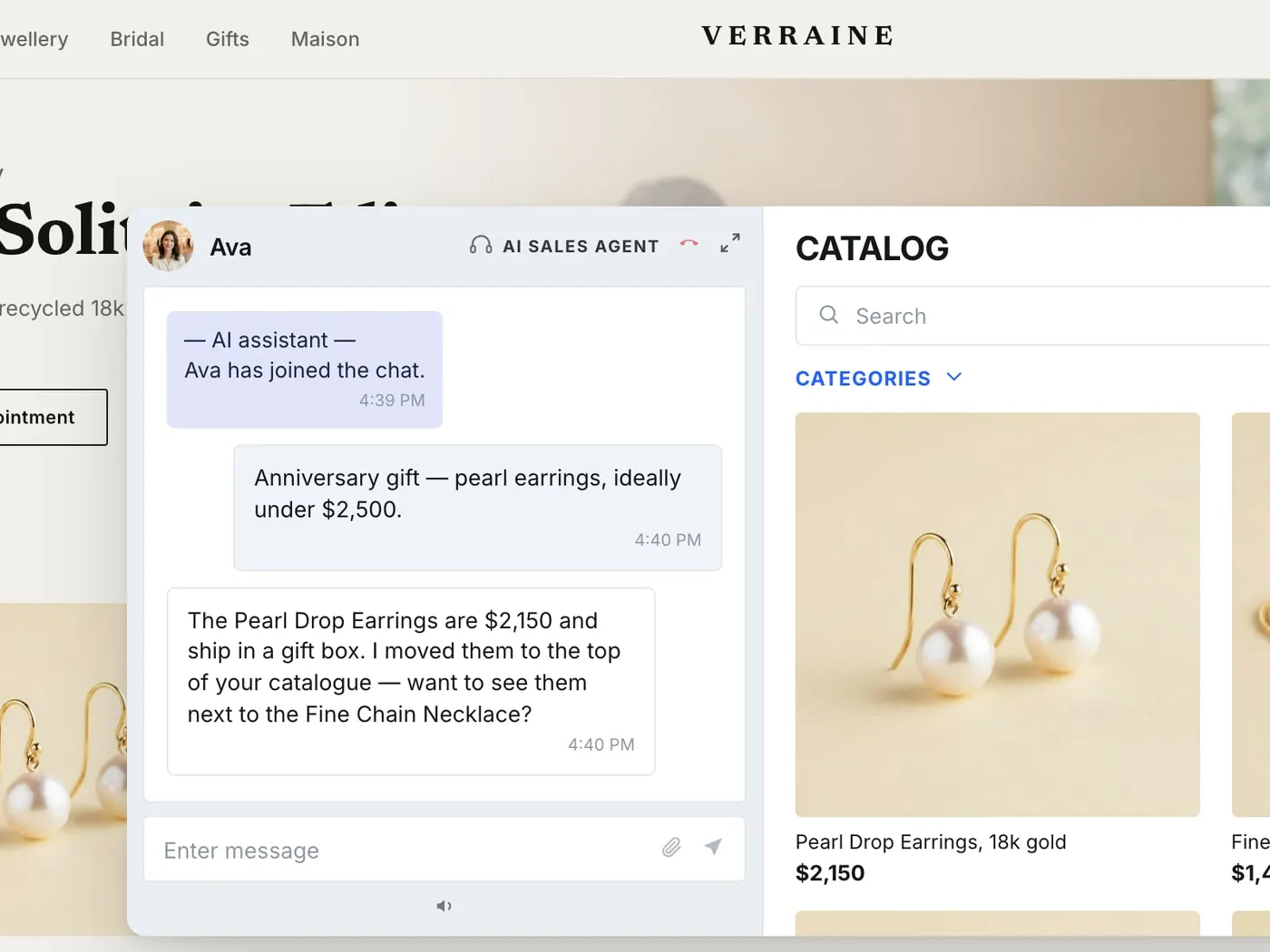
- AI Sales Agent — proactively engages every visitor, recommends complementary products from your catalog, and guides toward a larger, full-price order 24/7.
- Clienteling — Live Co-Shopping puts an associate and customer on one-to-one video to curate a complete purchase and sell the higher tier with confidence; Outbound handles VIP follow-up.
- Video Commerce — Live Shopping Events, a Shoppable Video Library, and PDP videos that showcase pairings and upgrades in motion.
The difference from an upsell widget is the conversation: a real person can recommend the matching pieces and earn the trust that turns one item into a complete order — the same model that lets a luxury brand like Lucchese sell five-figure custom orders at full price online. To see it on your store, book a demo and we’ll map an AI Sales Agent, Clienteling, and Video Commerce setup to your catalog.
Related reading
Frequently asked questions
By raising the value of each order instead of cutting price. The main non-discount levers are upsell and cross-sell apps, curated bundles, anchor pricing that frames value, and — most powerfully for high-ticket — consultative selling, where an expert recommends complementary higher-value items the way an in-store associate would. The goal is a bigger, full-price basket, not a discounted one.
Discounting erodes margin and trains customers to wait for the next sale, which is especially damaging for luxury and high-AOV brands whose value depends on perceived quality. A discount can also signal the opposite of premium. For considered, high-ticket purchases, buyers respond to guidance and trust far more than to a price cut — so the durable way to grow AOV is value, not promotions.
Partly. Automated upsell and cross-sell apps like Rebuy and ReConvert reliably lift AOV by offering relevant add-ons at the cart or after purchase, and they protect margin because they don't discount. But for high-consideration, high-AOV buys, an impersonal widget rarely persuades someone to add another expensive item — that usually takes a person who can explain why the pieces go together.
Consultative selling. When an expert guides the purchase — in person or on live video — they can recommend the matching earrings for the necklace or the strap for the watch, and build the trust needed to sell the higher-tier option at full price. That personal guidance lifts AOV more durably than promotions for luxury, jewelry, and considered goods, without eroding margin.
Yes. A proactive AI Sales Agent recommends relevant products, answers questions, and surfaces complementary items as it guides a shopper toward checkout — raising AOV without a discount. For the highest-value baskets, the strongest results come from the AI handing the shopper to a human on live video, where an associate can build the larger, full-price order in a real conversation.
Lead with guidance, not discounts. Pair a proactive AI Sales Agent that recommends complementary pieces with a live one-to-one consultation where an associate can curate a complete look and sell the higher-tier option at full price. Keep upsell apps and bundles as supporting tactics, but make consultative selling the centerpiece — it protects margin and fits how luxury is actually bought.