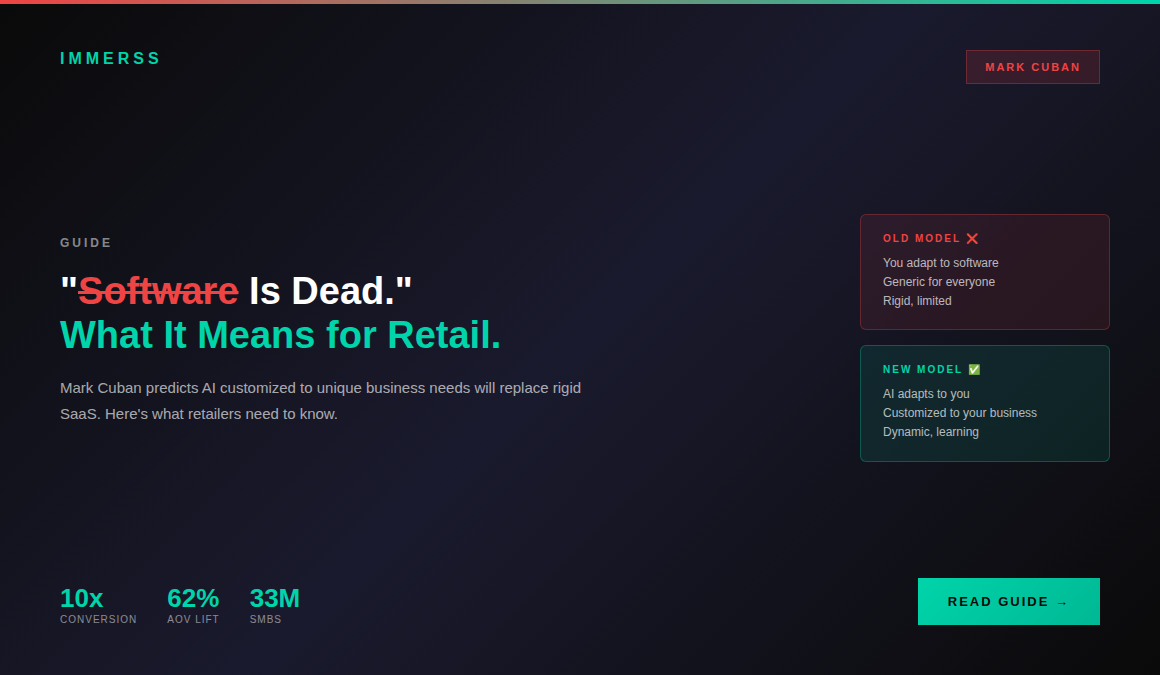

Mark Cuban Says "Software Is Dead." What It Means for Retail.
Why AI customized to your unique utilization is the future — and how retailers can embrace it today.
Executive Summary
Billionaire entrepreneur Mark Cuban recently declared “software is dead” — predicting that rigid SaaS platforms will be replaced by AI that customizes itself to each business’s unique needs. This shift has profound implications for retail, where generic tools are giving way to AI Sales Agents that learn specific products, brand voices, and selling approaches. This guide explores what Cuban’s prediction means for retailers and how to position for the AI-customized future.
Key insight: The value has shifted from building generic platforms to implementing AI for specific business needs. Retailers who adopt AI that customizes itself — rather than forcing businesses to adapt — will gain structural competitive advantages.
The Cuban Proclamation
In a viral interview on the Technology Brothers podcast, Mark Cuban delivered a sobering forecast for the software industry:
“Software is dead because everything’s going to be customized to your unique utilization.”
Cuban argued that the era of “static” tools — where businesses must bend their workflows to fit software limitations — is rapidly ending. In its place: AI systems that mold themselves around specific business needs in real time.
The market appears to agree. Software ETFs have dropped 17-19% in 2026, underperforming broader indices significantly.
The Old Model: Bend to the Software
Traditional software follows a familiar pattern.
You evaluate platforms built for generic use cases. You select one that seems closest to your needs. You implement it, training your team on its interface. You adapt your processes to work within its constraints. You accept limitations because rebuilding isn’t feasible.
Every business using the same platform gets fundamentally the same experience:
- Same features
- Same interface
- Same limitations
- Same generic approach
This model made sense when customization required expensive development. Building software to individual specifications wasn’t economically viable for most businesses.
The result: businesses bent to fit software rather than software bending to fit businesses.
The New Model: AI That Adapts to You
Cuban sees AI fundamentally changing this equation.
Instead of static tools requiring adaptation, AI creates dynamic systems that customize themselves. The intelligence learns your specific context — your products, your customers, your processes — and adapts its behavior accordingly.
“Everything’s going to be customized to your unique utilization.”
This isn’t incremental improvement. It’s a structural shift in how businesses access technology capability.
Cuban identified a massive opportunity in translating AI power for the 33 million small-to-medium businesses in the U.S. that lack dedicated AI departments. These businesses can’t build custom AI solutions. But they can adopt AI that customizes itself to their needs.
“Learn all you can about AI,” Cuban advised, “but learn more on how to implement them in companies.”
The value isn’t in creating new AI models. It’s in applying AI to specific business problems.
What This Means for Retail
Cuban used a telling example: a retail shoe store.
He described walking into a legacy business and showing them how to customize a model for their specific operations. That’s where the future lies.
For retail, the implications are immediate and significant.
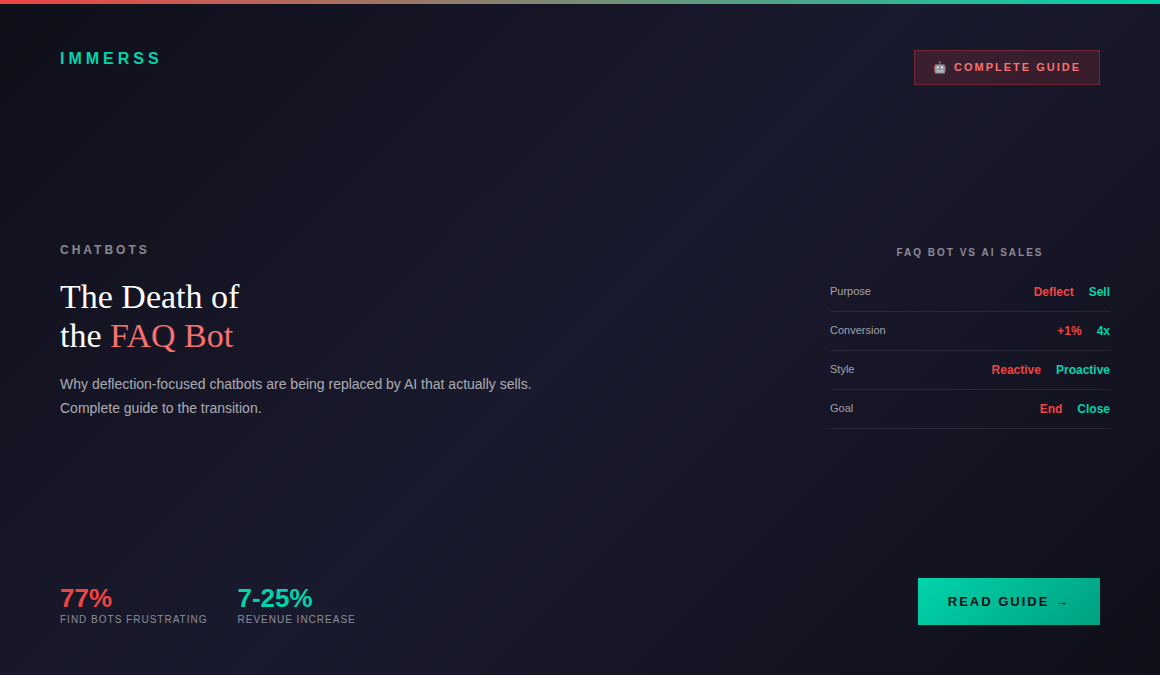
Generic tools are becoming obsolete. Chatbots that provide the same responses for every store — regardless of products, brand, or customer base — represent the “dead software” Cuban describes. They force retailers to accept generic capabilities rather than solutions customized to their business.
Customized AI is the new standard. AI that learns your specific catalog, speaks your brand voice, and sells using approaches that work for your customers represents the future Cuban envisions.
Consider the difference:
Traditional chatbot:
- Same scripts for every retailer
- No knowledge of your specific products
- Generic brand voice
- Can’t actually sell — just answers questions
- Requires your customers to adapt to its limitations
AI Sales Agent (customized):
- Trained on your specific product catalog
- Understands your brand voice and values
- Sells using approaches that work for your customers
- Learns and improves based on your unique patterns
- Adapts to your business, not the other way around
This is the shift Cuban is describing — from software you adapt to, to AI that adapts to you.
The Implementation Challenge
Cuban identified the critical bottleneck preventing businesses from capturing AI value:
“There is nothing intuitive for a company to integrate AI. Companies don’t understand how to implement AI right now.”
This implementation gap is especially pronounced for small and medium businesses:
- They lack dedicated AI departments
- They don’t have technical staff to build custom solutions
- They can’t afford enterprise-grade AI consulting
- They know AI matters but don’t know where to start
Cuban predicted that “Technical Translators” — professionals who bridge AI capabilities with business needs — will become the most essential role in the economy.
For most SMB retailers, however, the solution isn’t hiring translators. It’s adopting AI that translates itself — technology designed to customize without requiring technical implementation.
The Immerss Approach
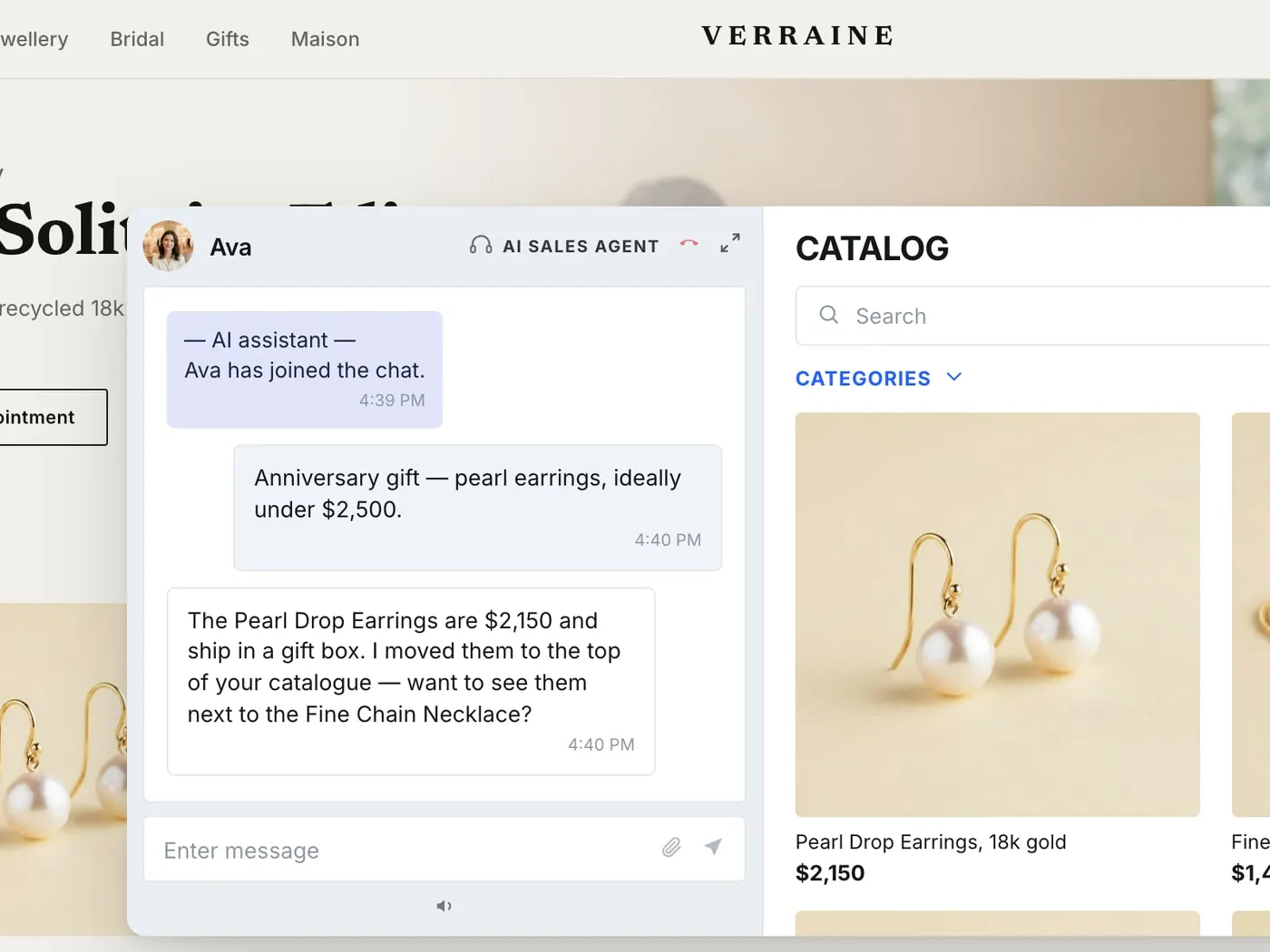
At Immerss, we’ve built exactly what Cuban describes: AI Sales Agents that customize themselves to each retailer’s unique utilization.
Product expertise. AI learns your entire catalog — every SKU, feature, and price point. It becomes an expert in your specific products, not a generic assistant with no product knowledge.
Brand voice. AI communicates in your brand’s tone and style. A luxury jeweler sounds different from a western boot company. The AI adapts to match your unique brand identity.
Selling approach. AI develops selling techniques based on what works for your customers. It learns from your specific patterns, not generic best practices.
Continuous customization. Every conversation makes the AI smarter about your business. It evolves in real time based on your unique utilization — exactly as Cuban describes.
No technical implementation. AI works out of the box and improves automatically. No AI department required. No custom development. No “bending” to fit software limitations.
Results: Customization in Action
The performance difference between generic tools and customized AI is measurable.
Lucchese — the 140-year-old western boot maker — deployed Immerss AI Sales Agents customized to their specific products and brand voice. Results:
- meaningfully higher AOV compared to unassisted purchases
- AI that understands the difference between their boot styles, leather options, and customization possibilities
- Brand voice that matches Lucchese’s heritage and craftsmanship positioning
Across clients:
- Dramatically higher conversion among visitors who engage with customized AI compared to passive browsers
- Materially more leads captured during off-hours through always-available AI
- Significantly higher customer satisfaction scores compared to generic chatbot interactions
The pattern is consistent: AI customized to unique utilization dramatically outperforms generic one-size-fits-all tools.
Positioning for the Future
Cuban’s prediction has implications for how retailers should evaluate and adopt technology.
Question generic tools. When evaluating any software, ask: does this adapt to my business, or do I adapt to it? Generic platforms that treat every retailer the same represent the dying model.
Prioritize customization. Seek technology that learns your specific products, brand, and customers. AI that customizes itself to your unique utilization will increasingly outperform static alternatives.
Don’t wait for technical resources. The implementation gap Cuban identified doesn’t require hiring AI departments. It requires adopting AI designed to customize without technical overhead.
Measure differentiation. Track whether your technology creates experiences unique to your business or generic experiences indistinguishable from competitors.
The Bottom Line
Mark Cuban is right: software as we knew it is dying.
The shift from “bend to fit the software” to “AI that adapts to your business” represents a fundamental change in how companies access technology capability.
For retail, this means:
- Generic chatbots are becoming obsolete
- AI customized to your products, brand, and customers is the new standard
- The implementation barrier is solved by AI that customizes itself
- Businesses that embrace this shift gain structural competitive advantages
Don’t adapt to the software. Use AI that adapts to you.