
For Shopify merchants doing meaningful traffic and AOV, the most underinvested part of the funnel right now is what happens after the click. Acquisition is well-optimized. The product page is clean. The pricing is competitive. Conversion has been roughly flat for eighteen months because the gap is conversational — the shopper has questions the storefront cannot answer, and the standard chat widget was never built to answer them.
The fix is a sales-grade AI agent on the storefront. Not a chatbot. A guided shopping experience that engages shoppers proactively, understands intent, anticipates the questions that drive non-buying, and helps the shopper buy. Same job a senior in-store associate does in a boutique, deployed across every session, twenty-four hours a day.
This piece walks through how a structured 60-day pilot of an AI sales agent works on a Shopify storefront — what it actually does, what merchants typically see, what’s required to deploy, and how to evaluate whether the program is right for your business.
What An AI Sales Agent Does on a Shopify Site
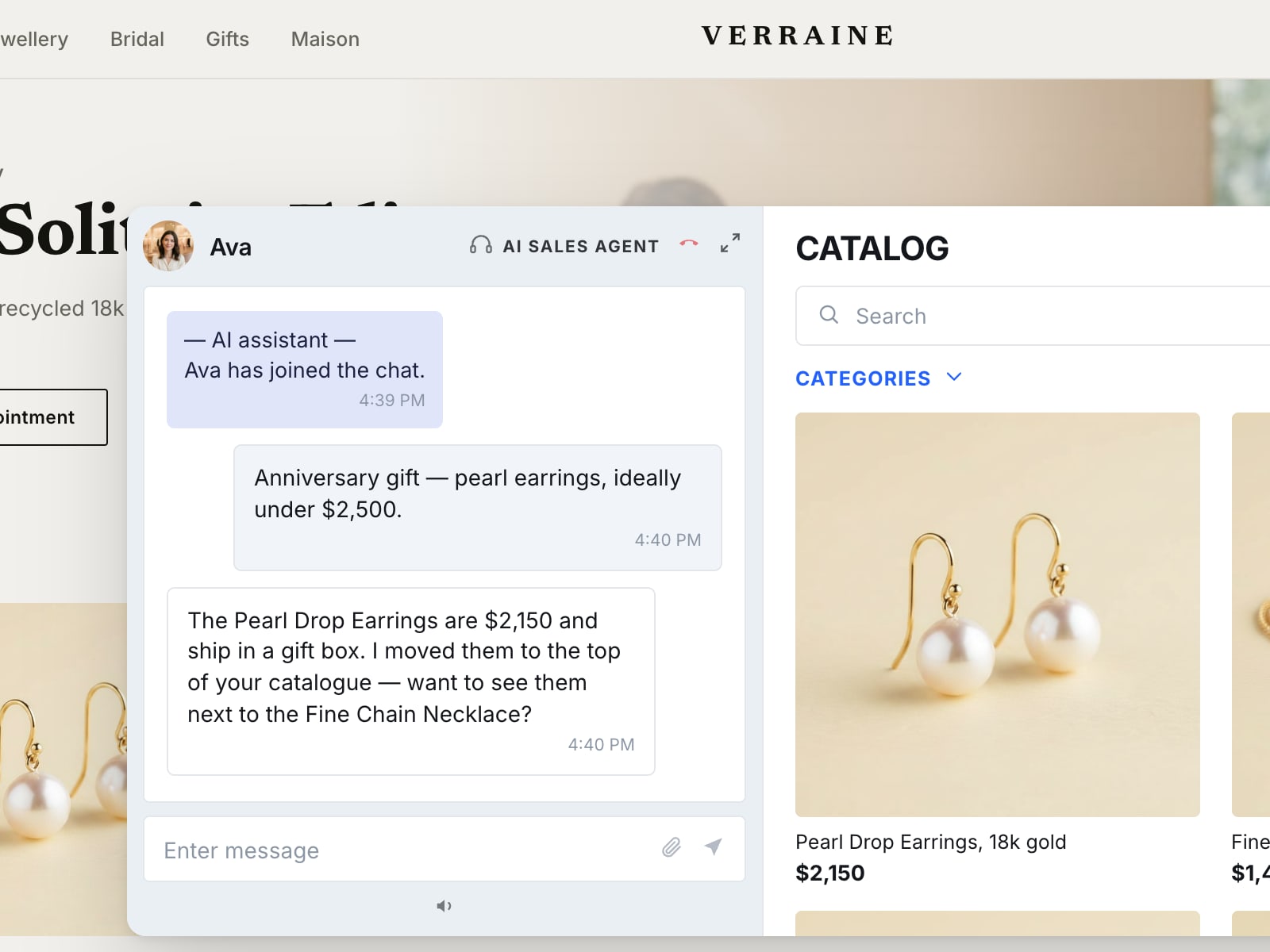
The agent is a conversational layer that lives on the storefront and engages shoppers in real time. The behavior breaks into a few distinct functions that work together.
Intent reading. The agent watches session signals — page dwell, navigation paths, return visits, items in cart, time of day, returning customer status — and recognizes patterns that indicate where the shopper is in their decision. A first-time visitor casually browsing is treated differently than a returning customer who has been on the same product page three times this week.
Proactive engagement. Instead of waiting for the shopper to type a question, the agent opens conversations calibrated to the moment. A shopper hovering on a product detail page with cart-add but no checkout gets a different opening than a shopper who has been comparing three SKUs across multiple visits. The opening is appropriate to the brand voice and the shopper’s situation.
Context-aware response. The agent runs against the actual product catalog, the actual inventory, the actual customer record, and the actual order history when applicable. It can answer specific product questions, compare options, recommend based on stated needs, confirm sizing or fit, address objections that typically derail purchases.
Sales focus. The agent’s measure of success is purchase, not query resolution. It is built to help the shopper buy. The conversation patterns reflect that — qualifying questions when needed, recommendations when the shopper is uncertain, reassurance when the hesitation is emotional rather than informational, escalation to a human advisor when the moment calls for it.
The result is the digital equivalent of having a senior associate on the floor of every shop, every time zone, around the clock. Shoppers who would have bounced because their question went unanswered do not bounce. Shoppers comparing options get help picking one. AOV lifts because recommendations are real recommendations.
What Merchants Typically See
The performance benchmark we see across mid-market and enterprise Shopify deployments is conversion lift in the range of 15-30% on assisted sessions, with corresponding lift in AOV and reduction in cart abandonment. These are benchmarks, not guarantees, and the actual numbers vary by category, AOV, traffic profile, and how aggressively the agent is configured to engage.
The metrics worth instrumenting from day one of a pilot include:
- Conversion rate on assisted sessions vs unassisted baseline
- AOV on assisted sessions vs baseline
- Cart abandonment rate on engaged traffic
- Lead capture rate on previously-bouncing traffic
- Revenue directly attributable to agent-assisted sessions
- Shopper satisfaction signals on the conversation experience
Properly measured, the agent’s contribution to revenue is unambiguous within the first thirty days for most operators, with the second thirty days giving the optimization layer a chance to refine messaging, targeting, and conversation flow.
How The 60-Day Pilot Works
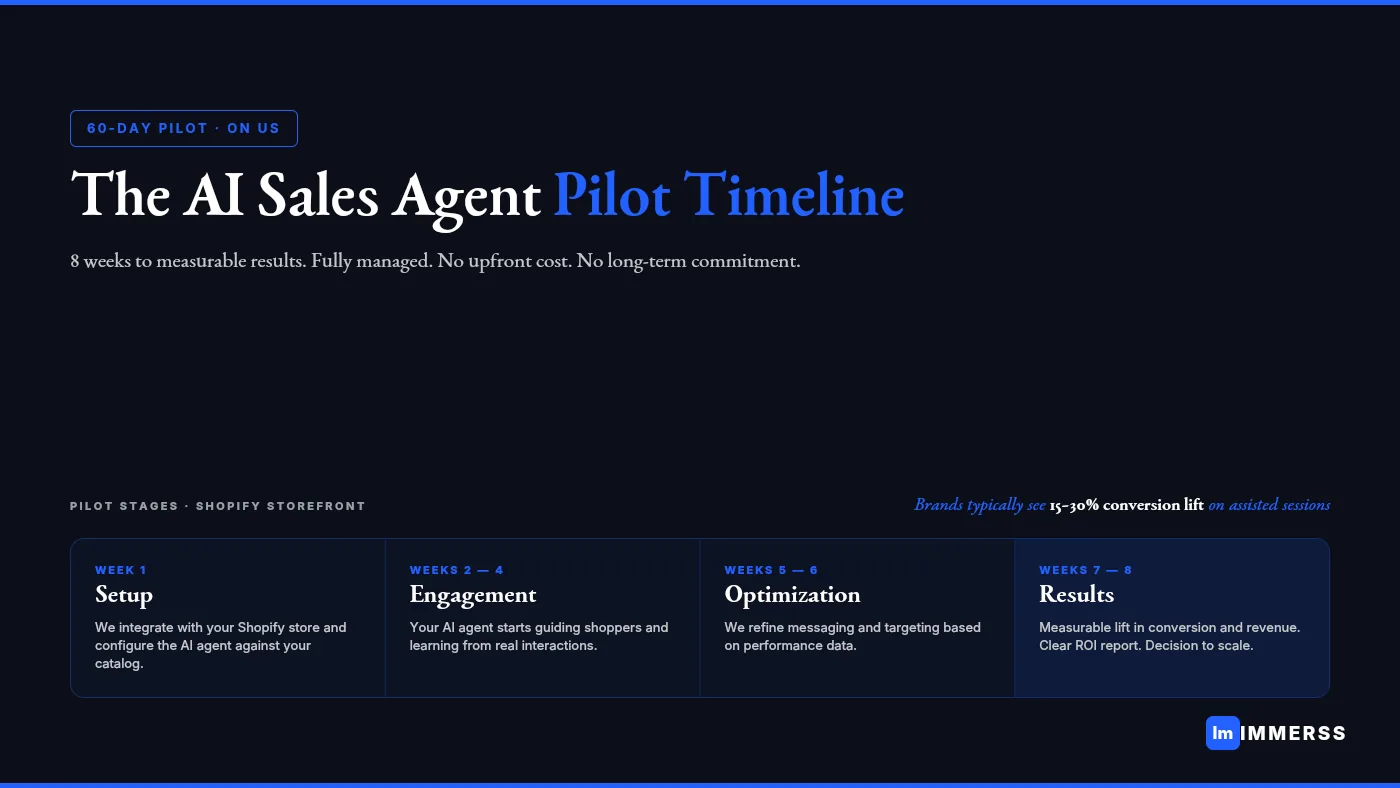
The pilot is structured as a fully-managed deployment in eight weeks, with the merchant providing access and brand context but no implementation work.
Week 1 — Setup. Integration with the Shopify store. Configuration of the AI agent against the product catalog, inventory feed, and customer data. Training on brand voice. Initial behavioral rules calibrated for the merchant’s category.
Weeks 2-4 — Engagement. The agent goes live and starts engaging real shoppers. It begins learning from interactions — which conversations close, which conversations stall, which questions come up most, which product comparisons drive the most non-buying. The merchant starts seeing data flow in from real sessions.
Weeks 5-6 — Optimization. Based on the engagement data, the conversation flow is refined. Messaging is tuned. Targeting is adjusted to focus on the highest-leverage shopper segments. The agent’s behavior is calibrated to whatever specific patterns the merchant’s traffic exhibits.
Weeks 7-8 — Results. The merchant sees measurable lift in conversion and revenue against baseline. A clear performance report with attributed revenue and recommendations for the post-pilot scale path is delivered.
The pilot is fully managed by the Immerss team. The merchant is not responsible for setup, integration, or ongoing optimization. The merchant team’s role is to provide brand context at the start, review weekly insights as the pilot runs, and decide at the end whether to scale.
What’s Included
A complete pilot includes:
- AI Sales Agent custom-trained on the merchant’s products, brand voice, and customer data
- Weekly performance insights showing engagement, conversion, and revenue impact
- Shopper data — the actual questions shoppers are asking and what’s holding them back from purchase
- Final ROI report breaking down revenue generated against pilot investment
- Full setup and ongoing optimization handled by the Immerss team
- Dedicated support with direct access to the team throughout the 60 days
Who This Pilot Is Designed For
The merchants for whom this pilot makes the most sense share a few characteristics:
- Shopify merchants with at least 50,000 monthly site visits. Traffic volume needs to be large enough to produce statistically meaningful results inside sixty days.
- Average order value above $100. The math on the agent’s contribution becomes most decisive at higher AOVs, where every captured session translates to substantial revenue.
- High-consideration product categories. Fine jewelry, watches, premium home, technical equipment, considered apparel, bespoke goods — anywhere the buyer needs help making a decision rather than help completing a transaction.
- Conversion-focused operating teams who are ready to test, measure, and iterate based on data.
If your business fits this profile, the structured pilot is a low-risk way to find out whether the lever works on your traffic specifically.
What Risk-Free Means In This Pilot
The pilot is designed with intentional asymmetry. There is no upfront cost. Setup, integration, and optimization are handled by Immerss — there is no engineering or technical lift on the merchant team. There is no long-term commitment; the program is structured to prove value in 60 days.
If the agent drives measurable lift, the merchant scales it past the pilot. If it does not produce the lift expected on the merchant’s specific business, the merchant walks away with session-level intelligence about why their traffic was not converting — data that is more valuable than the status quo regardless of the pilot outcome.
This structure exists because the only honest way to find out whether sales-grade AI works on a specific Shopify business is to run it on that business and measure what happens. Frameworks and case studies are informative. The actual answer comes from the actual deployment. The pilot is built to make that answer affordable to obtain.
What To Decide
For Shopify merchants doing the traffic and AOV that fits this pilot, the practical decision is timing. The category is real, the math has changed, and the merchants piloting now will be running tuned, calibrated systems through Q4 and into next year. Merchants who wait will be deploying later, into a category their competitors are already iterating on.
The pilot is structured to be a low-risk test of a high-leverage hypothesis. The downside is data. The upside is a meaningful lift in conversion that compounds across every peak window for the next several years.
The right next step is a short call to look at the specific fit between your store and the pilot program — your AOV, your traffic profile, your category. From there, the application takes about two minutes.
Still comparing options? Our guide to the best AI sales agent for Shopify conversion shows where this hybrid AI-plus-human-video approach fits against Rep AI, Shopify Inbox, and Klaviyo.
Immerss is a luxury and high-AOV ecommerce platform combining AI sales agents with one-to-one video consultations, built for Shopify merchants whose conversion problem is conversational, not technical.
Apply for the 60-day AI Sales Agent pilot: landing.immerss.live