

"Has It Shipped?" at Eleven at Night: 3 Approaches Compared
A client has bought a significant piece, often for a particular date. Late one evening, she wonders whether it has shipped. She would ask her advisor, but it is eleven at night.
How the house answers that small question says a good deal about it. Here are three approaches, compared.
The approaches at a glance
| Approach | What the client gets at night | Who handles changes | Best for |
|---|---|---|---|
| 1. Her advisor replies in the morning | Nothing until the morning | The advisor | Houses where advisors handle every order personally |
| 2. A tracking page or email | The status, if she finds the link | Client services | Houses with an established client-services team |
| 3. The AI gives the status; changes go to a person (Shopify only) | The status, at once, in the house’s chat | A person from the house | Houses on Shopify whose clients ask at any hour |
1. Her advisor replies in the morning
The most personal approach, and the slowest. For a client waiting on a piece for an anniversary, a night without an answer is a small anxiety the house could have spared her.
2. A tracking page or email
The status is there at any hour, if she has the link and the order number. It is efficient but impersonal, and it takes her away from the house’s own chat.
3. The AI gives the status; changes go to a person
For houses on Shopify connected through the Immerss app.
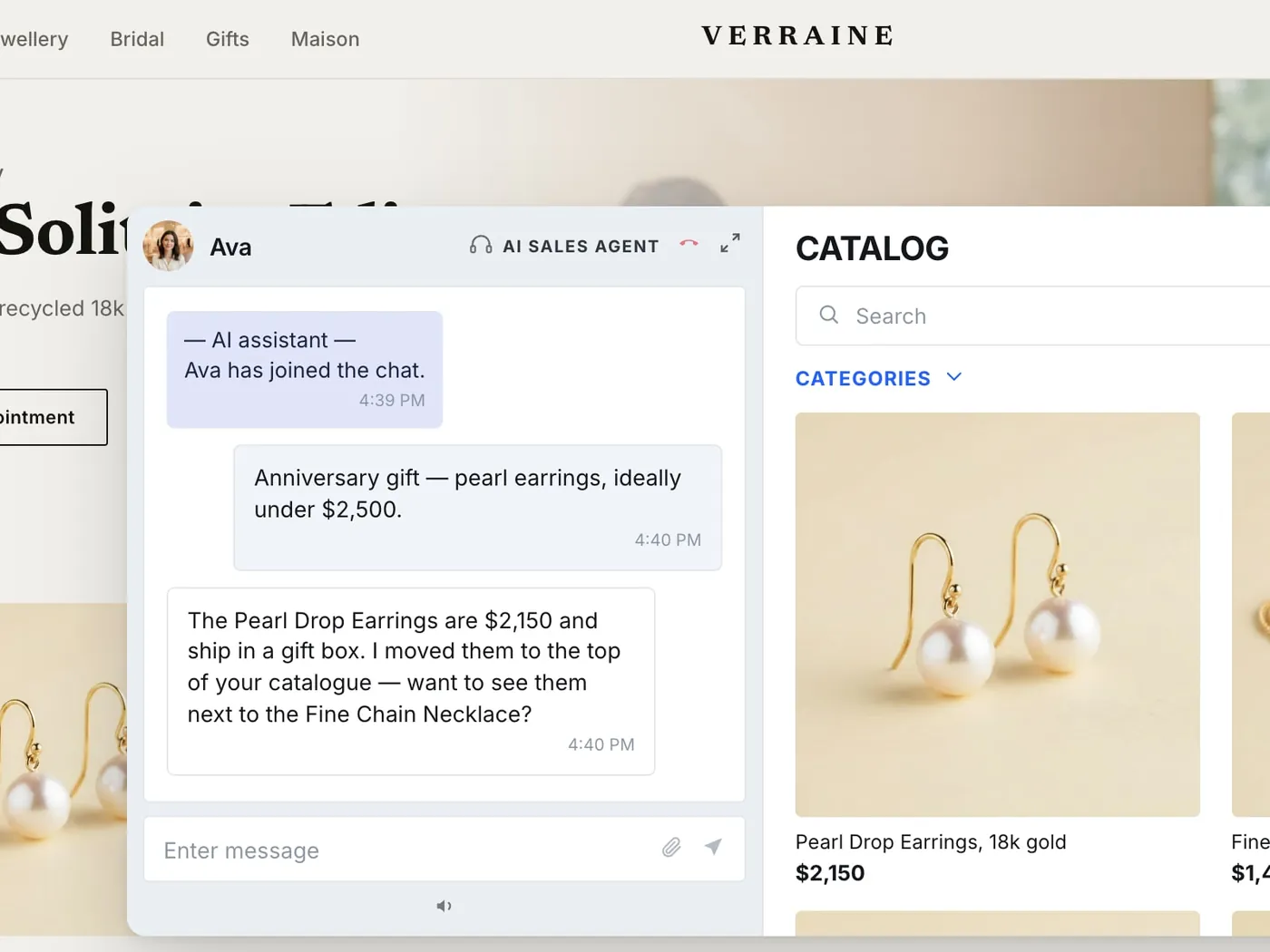
The client asks in the house’s chat. If she is signed in to her account, the AI already sees her recent orders; otherwise it asks for her order number and the email used at checkout. It answers in plain words: payment status, delivery status, tracking, the items, totals and any refunds. If an order was cancelled, that is the first thing she hears.
Anything that changes the order, whether a cancellation, a return, an exchange or a new delivery address, the AI does not attempt. It says it cannot do that and offers a person. The status is answered at once; the decisions stay with the house.
It reads orders from the last 60 days. For an older order it says it cannot see it and offers a person. It does not send delivery notifications of its own.
Which approach fits the house?
- Every order handled personally by an advisor, and clients who prefer to wait: approach 1.
- A client-services team and a strong tracking experience already in place: approach 2.
- Clients who ask at any hour, on Shopify: approach 3, with any change to the order handled by the house.
The evening question is not only about orders. We’ve compared three approaches to the boutique’s chat after hours.
What to know before switching it on
- It is off by default: AI Hub → Settings → “Order support” → “Answer order status questions”. The block appears only for houses on Shopify connected through the Immerss app.
- Recognising a signed-in client needs the Immerss widget enabled in the Shopify theme; otherwise she is asked for her order number and email.
- It works when the AI agent is on and is the one handling the conversation.
What to measure
How many order questions arrive in the house’s chat, and at what hours.
How many of them end with a request for a person, and what those requests are: a change of address, a return, a question about a date.
How many conversations that began with “has it shipped?” go on to a question about another piece.
Where Immerss fits
Immerss is a live commerce platform, and two of its modules carry this decision.
- AI Sales Agent: answers the client in the house’s own chat, under the house’s chosen name, out of the house’s catalogue and, with order support on, her order on Shopify. When she asks for a change, it hands her to a person.
- Clienteling: the advisor who picks up her request has the conversation in front of them and can follow up by text, email or phone from a shared client record.
The arrangement stays human, because every change to an order is made by a person from the house; personal, because the answer comes in the house’s own chat, not on a carrier’s page; and measurable, because the house can count order questions and see which of them turn into a conversation about the next piece.
For a house, the entry point is a conversation.
At eleven at night, the status. In the morning, the advisor, for anything that needs one.
Frequently asked questions
It can let the client wait for her advisor in the morning, send her to a tracking page, or let an AI agent give her the status at once in the house's own chat, with anything that changes the order left to a person from the house. Houses whose clients ask at any hour usually need the third.
No. With Immerss, the AI only reads the order: payment and delivery status, tracking, the items, totals and any refunds. For a cancellation, a return, an exchange or a new delivery address, it says it cannot do that and offers a person.
Not if she is signed in to her account: the AI already sees her recent orders. Otherwise it asks for her order number and the email used at checkout.
Houses on Shopify connected through the Immerss app. It reads orders from the last 60 days, does not send delivery notifications of its own, and is off until the house switches it on.