Give every product a video, without a shoot













What the clip settles, and what it hands on
A film on the product page is the widest part of the funnel — it works while nobody is staffed and it never asks the shopper to commit to a conversation. What matters is knowing which questions it closes and which it should be handing over.
It answers the volume. Most fit and build questions arrive at eleven at night, and most of them are answerable by showing the thing rather than describing it. A short film does that at scale and asynchronously, for the majority of shoppers who will never open a chat or book a call — which is most of the people who leave without buying.
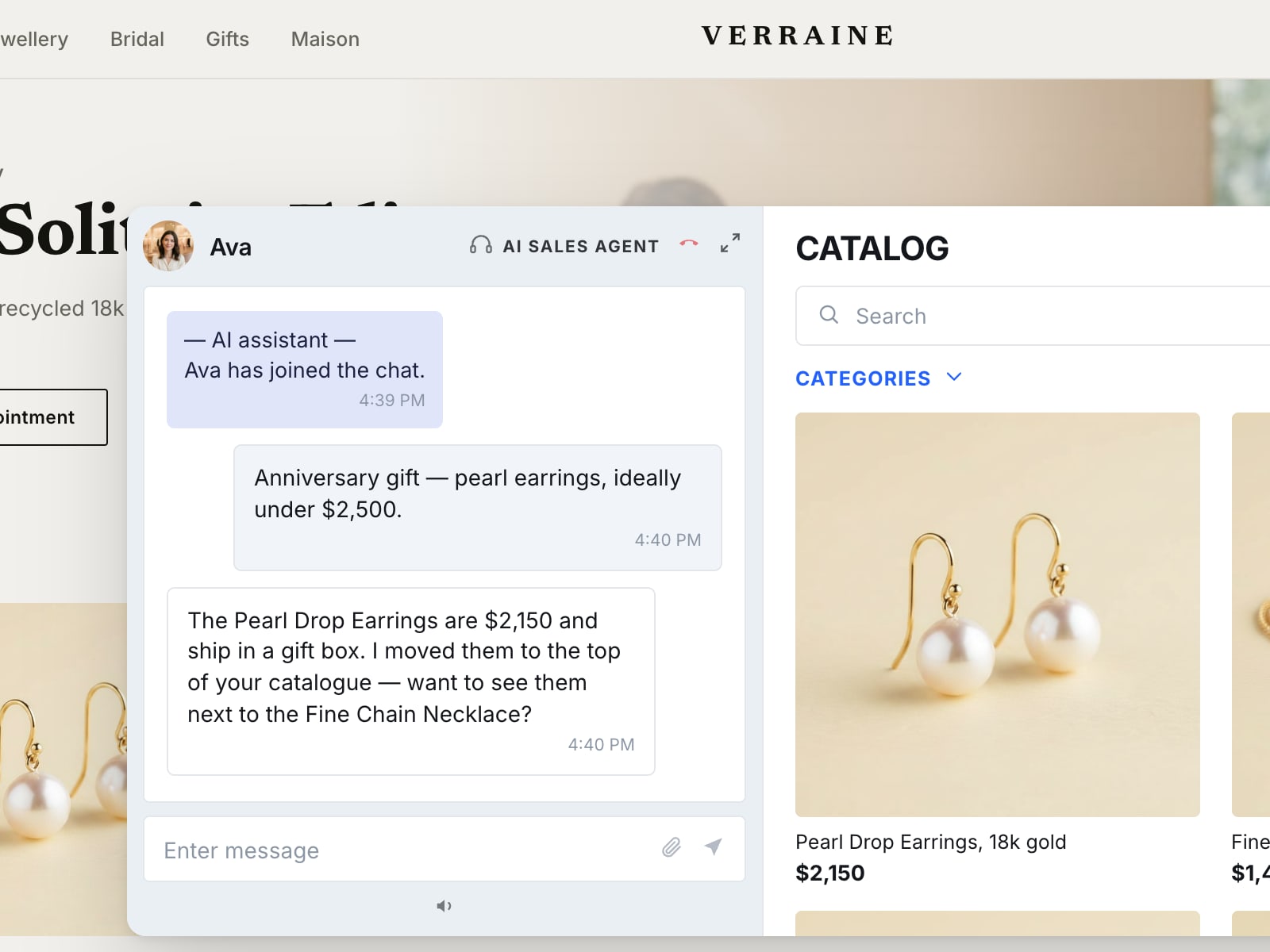
It knows what it cannot settle. For the highest-value pieces a video usually needs to lead to a conversation rather than replace one. That is where the rest of the toolbox picks up: the AI Sales Agent takes the question the clip raised and answers it around the clock, and hands to a named advisor on live co-shopping when the answer needs a person holding the piece.
It is the same film, working a second shift. A recording that sold well in the room and sits in your Shoppable Video Library does not have to stay there. Attached to the card of the piece it shows, it stops waiting to be browsed to and starts meeting the shopper who is already looking at the thing.
Commissioning the video, and using the video you have
Producing for the top of the catalogue is a real plan and often the right one — our own framework opens with it. What it does not do is reach the rest of the range, because the second hundred products never justify their own booking.
Where a photograph leaves the question open


FAQs
No, and trying is how these programmes stall. Start where the question a shopper cannot answer from a photograph is a physical one — how it is built, how it moves, how big it actually is — and where the order value justifies the effort. For the highest-consideration pieces, video often needs to lead to a conversation rather than replace one, so treat it as the thing that gets a serious buyer to raise their hand.
It used to, and that was a fair objection: file weight pushed load times up and slow loading costs conversion by as much as fifteen per cent. The penalty has been shrinking for years — network speeds have moved by an order of magnitude and delivery is done on a CDN rather than out of the page — and for most audiences it is now close to nothing. The honest version of the answer is that this is worth measuring on your own pages rather than taking on trust from anybody, including us.
It moves the part of the problem that comes from a shopper guessing. In footwear, where somewhere between half and nine tenths of returns are attributed to size and fit, a clip that shows how a style is built and where it runs narrow answers the question the size chart does not. What it will not do is take the rate to zero, and anyone promising that is selling something. Measure it the way it should be measured: return rate on orders that saw the video against orders that did not, rather than the headline number.
It has to be good enough for what the product costs. Customer-made video works, and works measurably — one apparel brand put video from its own customers onto the matching product pages and saw a ten per cent lift in sales on those pages, with no production budget behind it. The counterweight is just as real: cheap production alongside an expensive piece reads as carelessness and costs you trust. Match the finish to the price, not to a rule.