
Briefing the AI Like a New Advisor: 4 Approaches Compared
A new advisor at a house does not meet a client on their first morning. They spend time learning what is not on the price tag: what the warranty covers, how each material is cared for, how ring sizing works, what engraving involves, how a service visit is arranged.
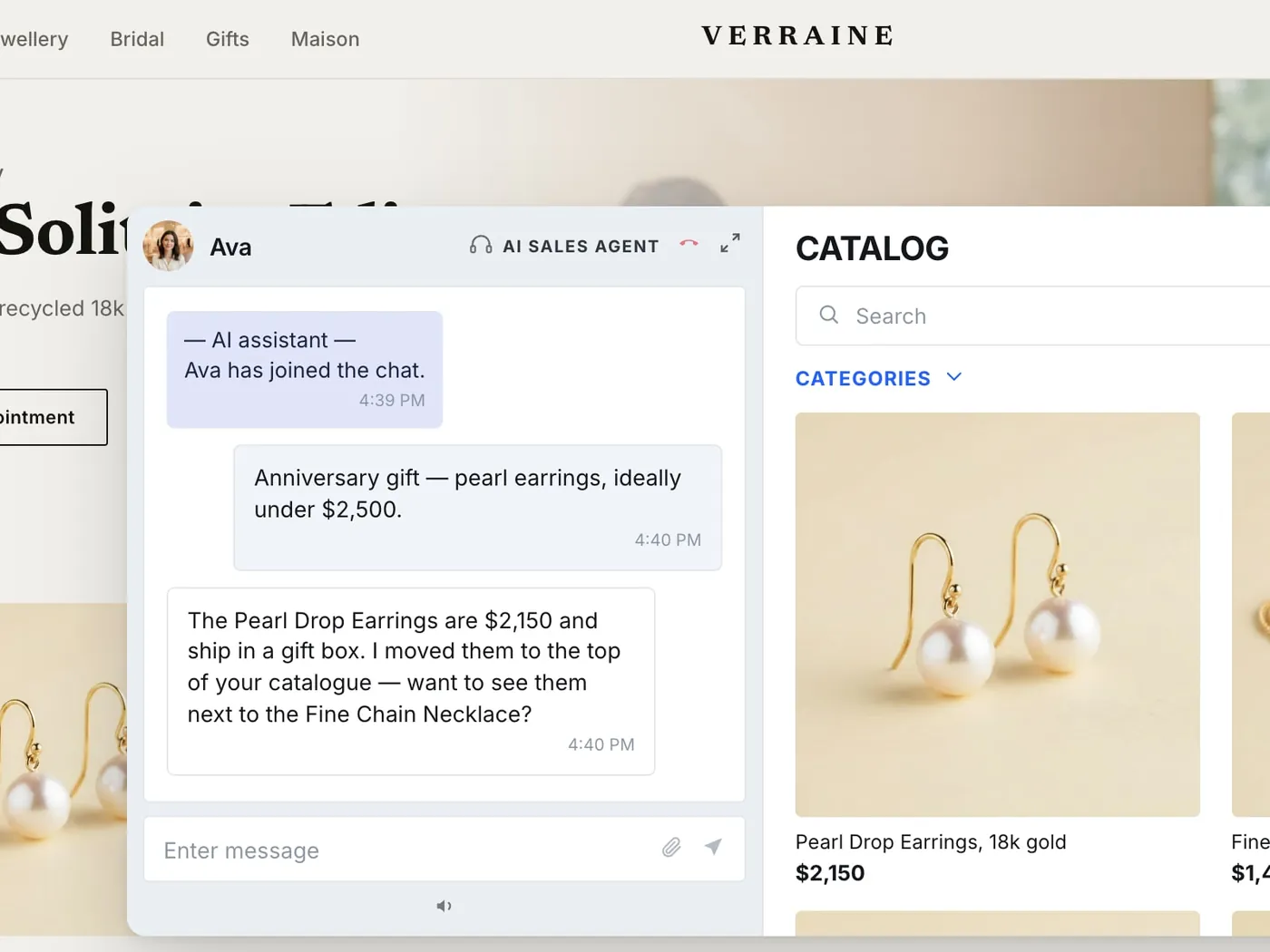
An AI agent needs the same briefing. It already knows the pieces: in Immerss, the catalogue reaches it on its own, with names, descriptions, variants with prices, links and selected details. What it must be given is everything around them. Here are four ways a house can do that, compared.
The approaches at a glance
| Approach | Suits | Keeping it current |
|---|---|---|
| 1. The house’s own pages (warranty, delivery, returns, service) | Policies the house already publishes | Edit the saved text, or add the page again |
| 2. The house’s documents (care guides, sizing guides, warranty terms) | Material that lives in documents | Edit a text file; replace a PDF or Word document |
| 3. A written brief (notes on what is not published) | Engraving, resizing, service arrangements, the house’s preferences | Edit the note |
| 4. Questions clients ask (question-and-answer pairs) | The questions advisors hear every week | Delete the pair and write it again |
1. The house’s own pages
The house’s delivery, returns, warranty and service pages, added by address in AI Hub → Library → “Add item” → “Store pages”. Each address is read and saved as one page; the AI does not wander through the rest of the site, so each page it should know is added in turn.
2. The house’s documents
Care guides for each material, a ring-sizing guide, the warranty terms, uploaded as PDF, DOCX, TXT or MD. A PDF must contain real text; a scanned page is not read. Text files can be edited; PDF and Word documents are replaced when they change.
3. A written brief
Much of what a new advisor learns is not published anywhere: how engraving is arranged, whether a ring can be resized and how often, how a service visit is booked. A short written note, added under “Manual”, gives the AI the same understanding.
4. Questions clients ask
A small set of questions and answers in AI Hub → FAQ: the ones advisors hear every week. Each pair is written once; when the answer changes, it is deleted and written again.
How the AI uses the briefing
The AI answers from what the house has given it, in conversation rather than by reading documents back, and can show the pieces it speaks about. Contact details, such as the boutique’s telephone or the service address, it gives exactly as written.
Some limits are worth knowing before briefing it:
- Everything given is a copy taken at that moment. When a policy changes, the AI’s copy must be updated; it does not update itself.
- It does not know stock. Pieces out of stock in every variant, or unpublished, are usually not in its knowledge.
- It does not know a reduced piece’s original price.
- There is no import from shared drives or other tools; material goes in through the four approaches above.
- Platform rules apply on top of the house’s text, for example no legal or medical advice, and cannot be switched off.
Which approach fits the house?
- Policies the house already publishes: approach 1.
- Care and sizing material in documents: approach 2.
- What advisors know but nobody wrote down: approach 3.
- The questions heard every week: approach 4.
Most houses use all four, and treat every policy change as a moment to update the AI’s copy too. Our AI sales agent training playbook covers the catalogue, the voice and the handoff; this is the part around the pieces.
What to measure
Which questions about the house reach the chat, and which of them the briefing answers: warranty, care, sizing, engraving, service.
How many conversations end with a request for an advisor, and why: a question the briefing does not cover is a note waiting to be written.
How long a changed policy takes to reach the AI’s copy. The answer should be: no time at all.
Where Immerss fits
Immerss is a live commerce platform, and two of its modules carry this decision.
- AI Sales Agent: answers the client in the house’s own chat, out of the house’s catalogue and the briefing given to it in AI Hub → Library and AI Hub → FAQ, so the answer is the house’s, not a general one.
- Clienteling: when a question needs an advisor, the advisor has the conversation in front of them and can follow up by text, email or phone from a shared client record. Order questions follow the same line: the AI gives the status, a person makes any change.
The arrangement stays human, because advisors decide what the AI is told and take every question it should not answer; personal, because the client hears the house’s own rules, not an industry average; and measurable, because the house can see which questions the briefing answered and which it still lacks.
For a house, the entry point is a conversation.
A new advisor is briefed before meeting a client. The AI should be too, and briefed again whenever anything changes.
Frequently asked questions
What a new advisor learns before meeting a client: what the warranty covers, how each material is cared for, how sizing works, what engraving involves and how a service visit is arranged. With Immerss, the catalogue reaches the AI on its own; the rest the house adds.
Four ways: the house's own pages, added by address; its documents, such as care and sizing guides; a written note on what is not published anywhere; and question-and-answer pairs for the questions advisors hear every week.
No. Everything given to it is a copy taken at that moment. When a policy changes, the house updates the AI's copy as part of the same change.
No. It does not know stock levels, and pieces out of stock in every variant, or unpublished, are usually left out of its knowledge.