
Promo Code Fields on Luxury Checkouts: 4 Approaches Compared
In a boutique, nobody at the counter asks a client for a promo code. Online, many houses’ checkouts do, through a small empty box beside the total. To a client paying full price for a piece she has thought about for weeks, that box says something no house intends: some people pay less.
Here are four ways to handle it, compared.
The four approaches at a glance
| Approach | What it protects | What it costs | Best for |
|---|---|---|---|
| 1. Keep the generic field | Flexibility for staff, partner and event codes | Signals a discount culture to every client | Houses that run regular public promotions |
| 2. Remove the field | Price integrity; no invitation to search | Codes must reach clients another way; platform-dependent | Houses that never discount publicly |
| 3. Invitation-only codes, via an advisor | Discretion; the privilege feels personal | Advisor time; codes must be tracked | Private sales, events for VICs, gestures after a service failure |
| 4. Privileges instead of price | The price stays the price | Privileges must be genuinely valued | Houses built on full-price positioning |
1. Keep the generic field
How it works: the standard checkout box, open to any code.
Strengths: easy for corporate gifting codes, staff purchases and partner programmes.
Weaknesses: every client sees it. The client who has been considering a piece for weeks now wonders whether others, better connected or simply better at searching, pay less. Some will search the house’s name with “discount code” and find aggregator pages listing codes the house never issued. That is not a conversation a house wants its clients having.
Choose it if: public promotions are genuinely part of the house’s model. Even then, say plainly near the box which codes exist and who receives them.
2. Remove the field
How it works: the box simply isn’t there. Whether this is possible depends on the house’s platform and checkout setup, so confirm it with the technical team before deciding.
Strengths: the checkout says what the boutique says: the price is the price.
Weaknesses: legitimate codes for staff, events and partners need another route, usually links that apply the benefit automatically, or orders placed by an advisor.
Choose it if: the house never discounts publicly and wants the online experience to reflect that.
3. Invitation-only codes, delivered by an advisor
How it works: no public box, or one reserved for codes issued personally: for a private sale, an event, a gesture after a service failure. The advisor sends the code, or applies it while placing the order with the client.
Strengths: the benefit arrives as recognition from a person, not as a field to fill. It mirrors how privileges work in the boutique.
Weaknesses: advisors have to be involved in online orders, and codes need careful tracking so they don’t end up on aggregator sites.
Choose it if: the house already runs private sales or programmes for very important clients and wants them to carry the same discretion online.
4. Privileges instead of price
How it works: instead of money off, the client receives something that adds to the piece: complimentary engraving, a private preview of a new collection, an appointment with a specialist, priority access to an allocation.
Strengths: the price is never questioned. The incentive deepens the relationship rather than recalibrating what the piece is worth. We’ve written about why discounting costs a house more than the margin.
Weaknesses: privileges must be valued by the client, not chosen for convenience by the house. And they must be delivered reliably: a promised preview that never happens is worse than none.
Choose it if: full-price positioning is central to the house, and it has the people to deliver privileges well. The same logic carries the season’s busiest week, in our note on Black Friday for luxury and high-ticket brands.
Which approach fits the house?
- Never discounts, wants the checkout to match the boutique: approach 2, with approach 3 for the rare exception.
- Runs private sales for known clients: approach 3.
- Wants to reward loyalty without touching price: approach 4, delivered by the client’s own advisor where possible.
- Runs public promotions: approach 1, but answer the box’s question in plain words beside it.
Whichever the house chooses, one principle holds: the client should never have to leave the site to find out whether she’s paying a fair price. If she has a question about price, someone from the house should answer it.
What to review
Search the house’s name with “discount code” and see what clients find.
Look at the checkout as a client would: without a code, on a phone.
Ask advisors how often clients raise discounts, and how they currently answer.
What to measure
How often clients ask about price or codes before buying, and where on the site they ask.
Which orders carry a code, and where each code came from: an advisor, a link, or a site the house never authorised.
How privileges are taken up: offered, accepted, delivered.
Where Immerss fits
Immerss is a live commerce platform, and two of its modules carry this kind of question.
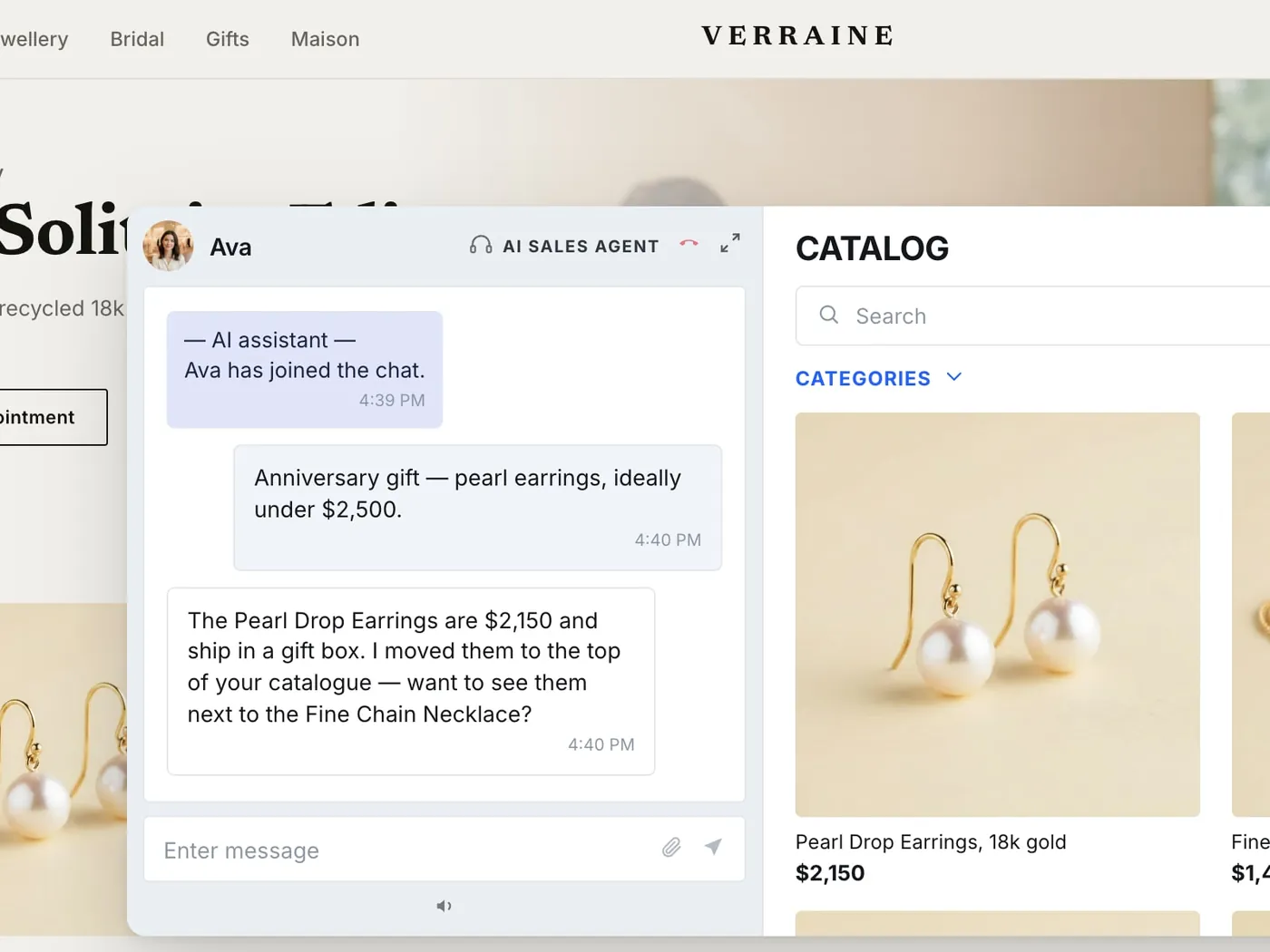
- AI Sales Agent: answers the client’s questions out of the house’s own catalogue and the policies it provides, including how the house approaches pricing, at any hour and on the house’s own site. When she wants a person, it hands her to an advisor.
- Clienteling: Live Co-Shopping brings an advisor onto one-to-one video in one tap, with no download and no appointment. The advisor can discuss the piece, extend a privilege the house has authorised and place the piece in her cart during the call. Outbound Clienteling lets the house reach her by text, email or phone from a shared client record, which is where an invitation to a private sale or a privilege can come from a person rather than a box.
Codes, privileges and pricing remain the house’s decisions and stay in its own commerce platform. Immerss does not create or apply them.
The answer stays human, because a person from the house speaks to her about price; personal, because a privilege reaches her from her own advisor rather than from a field; and measurable, because the house can count how often clients ask about price, where its codes come from and how its privileges are taken up.
For a house, the entry point is a conversation and a 60-day pilot, on us.
In a boutique, nobody asks for a promo code.
The checkout shouldn’t either, unless the house means it.
Frequently asked questions
Only if public promotions are genuinely part of its model. For every other client, an empty code box says that some people pay less. Houses that never discount publicly can remove the field, where their platform and checkout setup allow it, and route legitimate codes through links or through an advisor.
Through invitation-only codes delivered by an advisor: for a private sale, an event, or a gesture after a service failure. The advisor sends the code personally, or applies it while placing the order with the client, so the benefit arrives as recognition from a person rather than as a field to fill.
A privilege that adds to the piece rather than taking from its price: complimentary engraving, a private preview of a new collection, an appointment with a specialist, or priority access to an allocation. Privileges must be ones the client values, and they must be delivered reliably.
No. Codes, privileges and pricing remain the house's decisions and stay in its own commerce platform. Immerss answers clients' questions from the house's catalogue and policies, brings an advisor onto live video in one tap, and lets the advisor follow up from a shared client record.