
Peak-Season Clienteling: 4 Approaches Compared
From mid-November to the end of December, a house’s advisors are at their busiest: in the boutique, on the phone, preparing pieces for collection. It is also when many clients first approach the house online, often buying a gift, often with a date in mind, and often expecting the same attention they would receive in the boutique.
Here are four approaches to serving those clients at peak, compared.
The four approaches at a glance
| Approach | Does the client wait? | Keeps the house’s standard | Advisor time per client | Risk at peak | Best for |
|---|---|---|---|---|---|
| 1. Booked appointments only | Yes, until the next slot | High, once she’s in the appointment | High | Slots fill; a client buying a gift can’t wait | Clients who plan ahead |
| 2. Live chat staffed by advisors | Only when advisors are free | High when answered; low when queued | High | Queues and holding messages at the busiest hours | Houses with a dedicated online team |
| 3. Callback requests | Yes, hours or a day | Medium: personal, but delayed | Medium | The call comes after the moment has passed | Considered, non-urgent purchases |
| 4. AI-first triage with advisor escalation | No, for most questions | High, if the hand-over is seamless | Low for routine questions; full for the rest | An AI that sounds unlike the house | Houses with high online demand at peak |
Most houses will combine approaches. The question is which one carries the weight in December.
1. Booked appointments only
How it works: online clients book a virtual or in-boutique appointment, and their questions wait for it.
Strengths: each appointment receives full attention, exactly as on the floor.
Weaknesses: at peak, slots fill days ahead. A client buying a gift for the 20th cannot wait until the 18th to ask whether the bracelet can be resized.
Choose it if: the house’s clients typically plan well in advance, and capacity can be added for December.
2. Live chat staffed by advisors
How it works: advisors answer an online chat in real time.
Strengths: personal and immediate, when someone is free.
Weaknesses: the busiest hours online are the busiest hours in the boutique. When advisors are with clients, the chat becomes a queue or an automated holding message, which undermines the register of the house more than no chat at all.
Choose it if: the house has a dedicated online advisory team that is not also covering the floor.
3. Callback requests
How it works: the client leaves her number and her question, and an advisor calls her back.
Strengths: personal; the advisor can prepare before calling.
Weaknesses: at peak, callbacks slip from hours to a day. For a gift with a date, the moment often passes before the phone rings.
Choose it if: purchases are considered and rarely urgent.
4. AI-first triage with advisor escalation
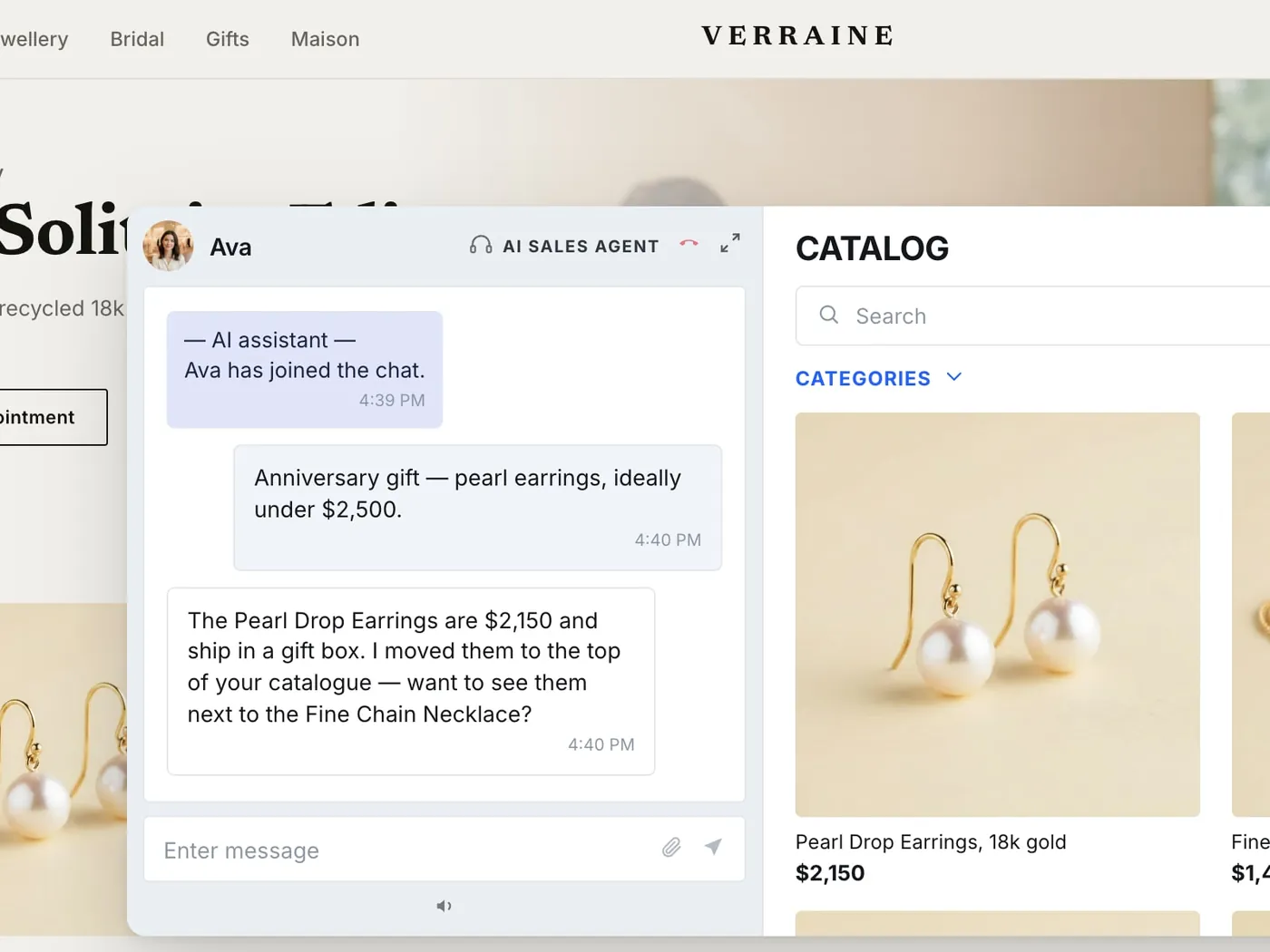
How it works: an AI sales agent that knows the house’s catalogue and the information it provides (care, sizing, delivery, services such as engraving) answers routine questions at once. When the client wants an opinion, a recommendation for someone specific, or to see the piece, she is brought to an advisor on live video.
Strengths: routine questions never queue, so advisors’ time goes to the conversations that need a person.
Weaknesses: the AI must speak in the house’s voice and know when to step aside. A clumsy hand-over, or an AI that tries to answer what an advisor should, damages the experience.
Choose it if: online demand rises sharply at peak, and the house wants advisors focused on judgement rather than repetition.
Which approach fits the house?
- Clients plan ahead, capacity can flex: approach 1, with appointments added for December.
- Dedicated online advisory team: approach 2.
- Considered, non-urgent purchases: approach 3.
- High online demand at peak, advisors stretched: approach 4, with approach 1 for clients who prefer to book.
The client most affected by the choice is the one buying a gift with a date in mind; we’ve written about the holiday gift buyer and about Black Friday for luxury and high-ticket brands.
Before peak: what to review
Last December’s online enquiries: what was asked, when, and how long clients waited.
The questions only an advisor should answer, and how quickly a client can reach one.
How the house sounds when no one is available: every automated message a client might see at peak.
What to measure
How long clients wait for a first answer at the busiest hours, and for an advisor when they ask for one.
Which questions reach an advisor, and which are answered without one.
How many conversations at peak end in a purchase, with an advisor and without.
Where Immerss fits
Immerss is a live commerce platform, and two of its modules carry approach 4.
- AI Sales Agent: answers clients’ questions out of the house’s own catalogue and the information it provides, at any hour and on the house’s own site. When the client wants a person, it hands the conversation to an advisor.
- Clienteling: Live Co-Shopping brings a named advisor onto one-to-one video in one tap, with no download and no appointment, with the conversation so far and what she has been viewing already in front of them. The advisor can show the piece and place it in her cart during the call. Outbound Clienteling lets advisors follow up afterwards by text, email or phone from a shared client record.
Appointment booking and callback requests stay in the house’s own systems.
At peak, the service stays human, because the conversations that need judgement go to an advisor; personal, because the advisor picks up her conversation rather than starting again; and measurable, because the house can count how long clients wait, which questions reach an advisor and how many of those conversations end in a purchase.
For a house, the entry point is a conversation and a 60-day pilot, on us.
In December, a house is judged by how it answers when it is busiest.
Frequently asked questions
By deciding in advance which questions need an advisor and which don't. Routine questions about care, sizing, delivery and services can be answered at once from the house's own information, so advisors' time goes to the conversations that need judgement: an opinion, a recommendation for someone specific, or seeing the piece.
For clients who plan ahead, yes. At peak, though, slots fill days in advance, and a client buying a gift with a date in mind often can't wait for the next one. Many houses keep appointments for clients who prefer to book and add a faster route for everyone else.
Because the busiest hours online are the busiest hours in the boutique. When advisors are with clients, the chat becomes a queue or an automated holding message, which undermines the register of the house more than no chat at all.
No. Appointment booking and callback requests stay in the house's own systems. Immerss answers clients' questions from the house's catalogue and information, hands the conversation to an advisor on live video in one tap, and lets advisors follow up from a shared client record.