
Near, Not Hovering
Ask experienced advisors what separates the best of them from the rest, and many will describe something that sounds almost too simple: knowing when to approach.
A client walks in. A good advisor acknowledges her with a greeting or a glance, and then leaves her alone. She’s given room to look. The advisor stays near enough to be found, never close enough to crowd.
Then, at a particular moment, the advisor approaches. Not on arrival, but when the client returns to a case for the second time, picks up a piece, or lingers over one long enough that a question is clearly forming. Would you like to see it on?
That timing is most of the craft. It is also almost entirely missing online.
The two ways it goes wrong online
Luxury sites tend to fail at timing in one of two opposite ways.
The greeting at the door. A chat window that opens seconds after arrival, Welcome! How can we help?, before the client has looked at anything. It’s the online equivalent of an advisor rushing to her the moment she steps in. At this level it does more than irritate: it breaks the register of the house, and makes a considered space feel like a sales floor. It also teaches her to close the window, so it’s out of sight by the time she has something to ask.
No one there at all. The opposite: help hidden or absent, so that when the client does have a question, about a case size, a clasp, whether the colour matches what she owns, there’s nowhere obvious to take it.
Both miss the same thing. The question isn’t whether help should be there. It’s when it should be offered.
What the moment looks like online
The signals an advisor reads on the floor have close equivalents on a site.
A long look at one piece. The client has moved from browsing to considering.
A return to the same piece within her visit. On the floor, this is the classic moment to approach.
Moving between two pieces. She’s choosing, and comparison is where an advisor helps most. It’s the moment to show them side by side, in the same light.
Studying sizing, the clasp, or delivery details. A practical question is forming, often about what the piece needs before it’s ready to wear, the subject of the piece that completes it.
Each of these is a far better moment for a quiet offer than the instant of arrival.
The offer, and the line not to cross
When the moment comes, the offer should be quiet, specific and fitting. Would you like to see it on? Shall I show you both side by side? An invitation the client can take or ignore without awkwardness.
And one line should never be crossed. The offer may fit what she’s doing; it must never narrate it. I see you’ve returned to this piece three times turns attentiveness into surveillance. A good advisor notices without ever making the client feel observed. The digital version has to do the same.
A presence, not an interruption
Alongside the timed offer, the client should always be able to reach someone on her own initiative, through a discreet, permanent way to ask that never interrupts her. An advisor on the floor is always findable, and never in the way. The site should be the same.
What good looks like
No greeting at the door. Nothing opens on arrival.
A permanent, discreet way to ask: always visible, never intrusive.
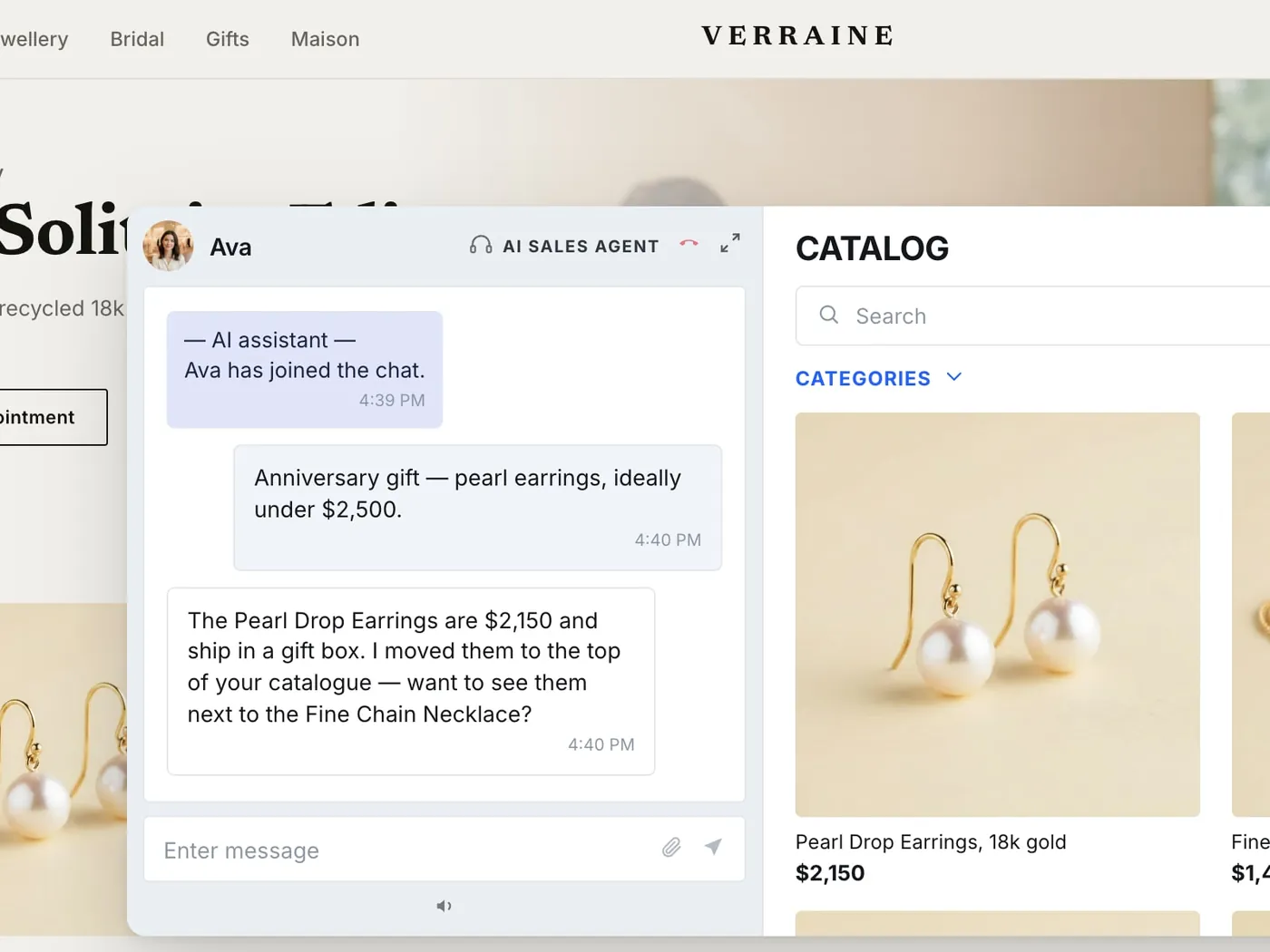
A quiet offer at the moment of interest: a second look, a comparison, a practical question.
Words that fit the moment, never words that report it.
A real advisor behind it, reachable on live video when the piece needs to be seen.
What to measure
How often an early prompt is dismissed, if one exists. This is the cost of the greeting at the door.
Consultations begun at a moment of interest compared with those begun on arrival, and how each converts.
Where clients’ questions actually arise: which pages, which pieces.
Where Immerss fits
Immerss is a live commerce platform, and two of its modules carry this kind of timing.
- AI Sales Agent: answers out of the house’s catalogue at any hour, on the house’s own site, and follows browsing signals as the client moves through it. It can open the conversation itself, when she’s comparing the same two pieces again or sitting on a full bag without proceeding, rather than on arrival, and its first line can be about the piece in front of her.
- Clienteling: Live Co-Shopping brings a named advisor onto one-to-one video in one tap, with no download and no appointment. The advisor sees what the client is looking at, shows the piece and places it in her bag during the call.
When the opening line comes, and what it says, remain the house’s judgement; the software carries the moment and the conversation.
The approach stays human, because the second look is answered by an advisor who knows the pieces; personal, because the offer fits the piece she’s considering, not a greeting written for everyone; and measurable, because the house can count dismissed prompts, consultations begun at a moment of interest and how they convert.
For a house, the entry point is a conversation and a 60-day pilot, on us.
On the floor, the best advisors are always near and never hovering.
Online, that means no greeting at the door, and a quiet offer at the second look.
Frequently asked questions
Rarely on arrival. A good advisor acknowledges the client, leaves her room to look, and approaches when a question is clearly forming: when she returns to a piece a second time, picks it up, or lingers over it.
Yes. It is the online equivalent of an advisor rushing to a client the moment she steps in. Before she has looked at anything there is nothing useful to offer, and at this level it breaks the register of the house, making a considered space feel like a sales floor.
A long look at one piece, a return to the same piece within a visit, moving between two pieces, and studying sizing, the clasp or delivery details. Each is a better moment for a quiet offer than the instant of arrival.
Let the offer fit what the client is doing, never narrate it. "Shall I show you both side by side?" is service. "I see you've returned to this piece three times" turns attentiveness into surveillance.