
Strict Department or Anyone Available? 3 Service Policies Compared
In a boutique, a client asking about an engagement ring is greeted by the bridal specialist. If the specialist is with another client, a decision is made at once, often without anyone noticing it: does she wait, or does a colleague welcome her?
Online, the same decision has to be made, and it is better made deliberately. Here are three service policies a house can choose, compared.
The policies at a glance
| Policy | Who greets the client | When the specialist is busy | Best for |
|---|---|---|---|
| 1. One shared queue | The first advisor free | Not applicable: anyone answers | A single collection, advisors who know every piece |
| 2. Strictly the specialist | An advisor of the chosen department | The consultation stays with the department | Bridal, high jewellery, pieces where expertise is the service |
| 3. The specialist, then anyone available | An advisor of the chosen department | The consultation passes to the general group of advisors | Broad collections where a prompt welcome matters most |
1. One shared queue
Every advisor takes every consultation. Graceful when the collection is focused; less so when a question about a setting reaches the watch specialist.
2. Strictly the specialist
The client chooses a department, such as Bridal, High jewellery or Watches, or is asked in the conversation, or arrives through a link that already chose it, such as one on the house’s bridal pages. Only the advisors of that department are called, and the advisor who answers sees which department she chose.
If none is available, the consultation remains with the department. Where the house has set its AI agent to answer last, the agent takes it up; otherwise the client waits and is then offered a form to leave a message.
3. The specialist, then anyone available
The same choice of department, with one difference: when no advisor in the department is available, the consultation passes to the general group of advisors. Someone greets her, though not necessarily the specialist.
Which policy fits the house?
- A focused collection with advisors who know every piece: policy 1.
- Collections where the specialist is the point, such as bridal or high jewellery: policy 2.
- Broad collections where a prompt welcome matters more than the exact specialist: policy 3.
What a house needs
In Immerss, policies 2 and 3 are the same setup with one difference, the “Forced selection” setting: on for policy 2 (the default), off for policy 3. Departments can be nested, and advisors are assigned to them in User management. Only the account owner can set up departments.
Some things are kept for the house as a whole. There is one AI agent for the whole house, not one per department, and no separate working hours per department. If the AI is set to answer first, it greets every client, whatever department she chose, and departments decide which advisors are called when it passes her on. Within a department, advisors are called in groups, chosen at random: the system does not rank them by seniority. The department is chosen by the client, asked in the conversation, or set by a link, never guessed from the page. And a link addressed to a particular advisor goes to that advisor, outside departments, as described in your advisor, by name.
What to measure
How many consultations each department receives, and at what hours: a sign of where a second specialist is needed.
How many consultations in a strict department end with a message form rather than a conversation. If the number grows, the house can add advisors to the department, set the AI to answer last, or reconsider the policy for that collection.
What consultations lead to by department. If clients who waited for the bridal specialist buy more often than those greeted by anyone, the wait is worth it.
Where Immerss fits
Immerss is a live commerce platform, and two of its modules carry this decision.
- Clienteling: advisors are organised into departments, and each consultation reaches the advisors of the department the client chose, with the policy the house set for when they are busy.
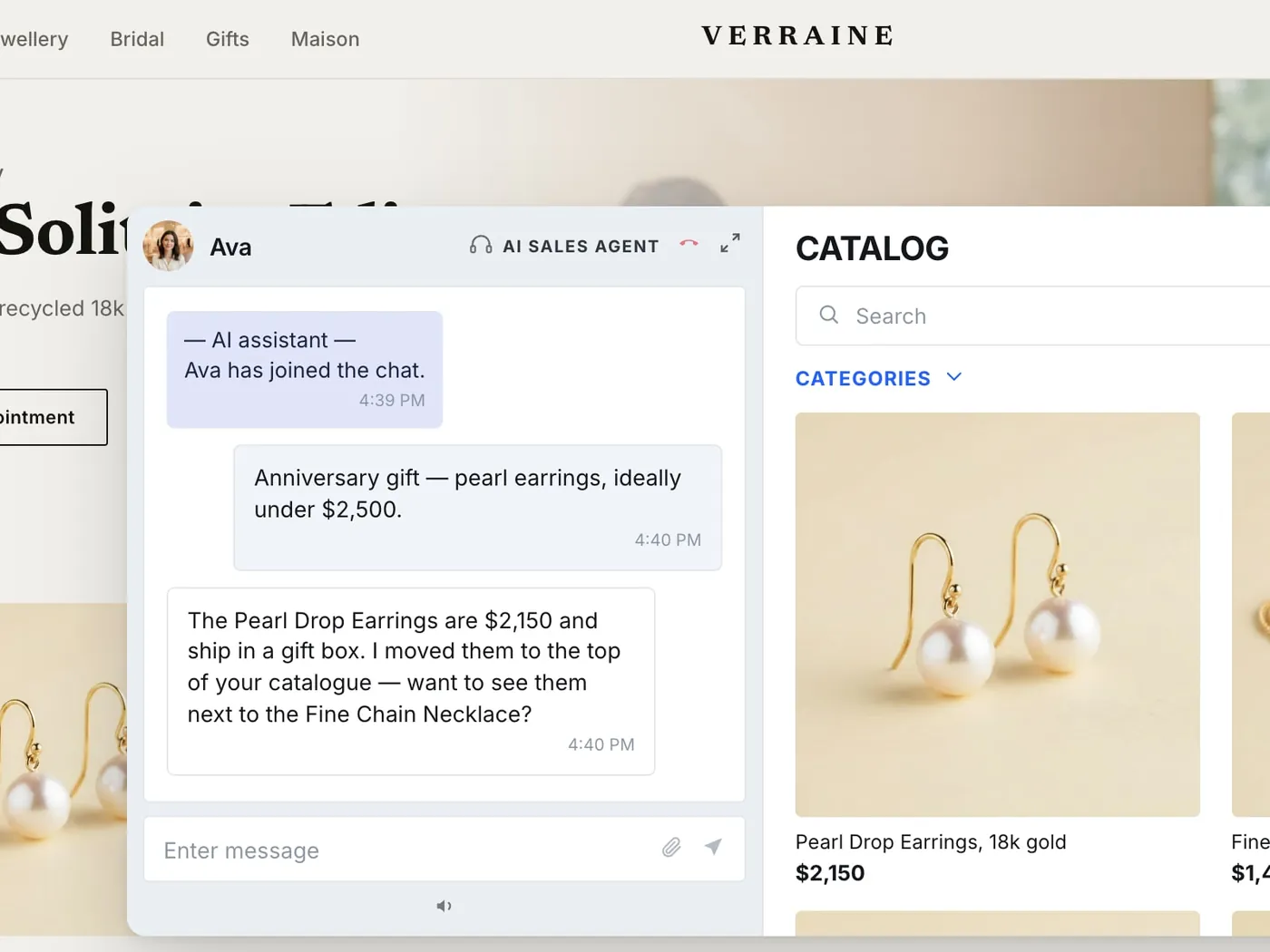
- AI Sales Agent: with a strict department, the AI can take up the client when every specialist is engaged, so she is answered rather than left with a form. More on that choice in when every advisor is with a client.
The arrangement stays human, because the client meets the specialist for her question, or a colleague the house chose to send; personal, because the house decides, collection by collection, what kind of welcome she receives; and measurable, because the house can see each department’s consultations and how many ended with a note rather than a conversation.
For a house, the entry point is a conversation.
In the boutique, the bridal specialist greets the bridal client. Online, the house should decide who does, on purpose.
Frequently asked questions
A house decides that in advance, per its collections. Where expertise is the service, as in bridal or high jewellery, the consultation can stay with the specialist's department. Where a prompt welcome matters more, it can pass to the general group of advisors when the department is busy.
With Immerss and "Forced selection" on, the consultation stays with the department. If the house's AI agent is set to answer last, it takes the client up; otherwise she is offered a form to leave a message. With "Forced selection" off, the consultation passes to the general group of advisors.
No. Working hours and the AI agent are set for the house as a whole. Within a department, advisors are called in groups, chosen at random: the system does not rank them.
No. The client chooses it, is asked in the conversation, or arrives through a link that already chose it, such as one on the house's bridal pages.