
When Every Advisor Is With a Client: AI First or AI Last?
In a boutique, an advisor who is with one client still acknowledges the next one at the door: a glance, a word, I’ll be with you in a moment. No one who walks in is left unnoticed.
Online, a small advisory team can’t do that. When every advisor is with a client, on a call or preparing a piece, a client who opens the house’s chat simply waits. And if no one answers, she is shown a form.
A house can decide in advance what happens in that moment. Here are three approaches, compared.
The approaches at a glance
| Approach | Who receives the client first | When advisors are occupied | Keeps the house’s register | Best for |
|---|---|---|---|---|
| 1. Advisors only, with a message form | Whichever advisor is free | A “leave a message” form | Yes when answered; no when she meets a form | Houses with advisors dedicated to the online channel |
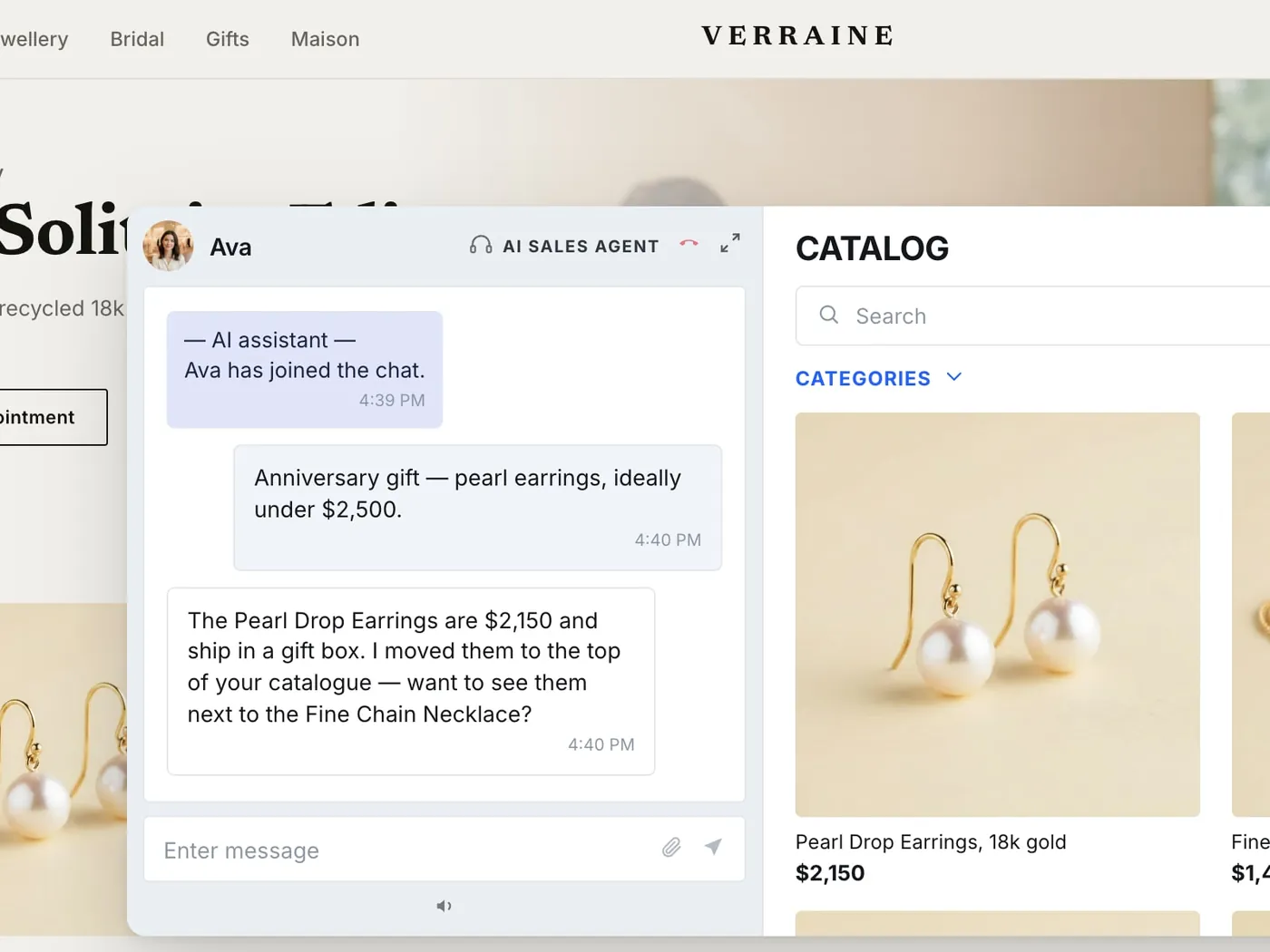
| 2. AI first | The AI agent, in chat, under the house’s chosen name | The AI keeps helping and offers an advisor when needed | Yes, if the AI is set up in the house’s voice | Small teams often away from the screen |
| 3. AI last | The advisors | The AI receives the client when no one can | Yes: advisors first, the AI as discreet cover | Teams who want to receive every client personally |
1. Advisors only, with a message form
The chat rings the advisors; if none answers in time, a form appears.
When an advisor answers, this is the house at its best. When none can, the client, who may be about to buy a significant piece, is asked to leave her details. For a house, that’s the equivalent of an empty counter.
2. AI first
The client opens the widget and the AI agent receives her straight away, in chat, under the name and avatar the house chose. Advisors are not involved until the AI hands the conversation over.
This suits a small team whose advisors spend much of their day with clients in the boutique. No one has to step away from a client to type a greeting, and advisors join the online conversations that need them.
3. AI last
The conversation first rings the house’s advisors, as it does today. The AI agent receives the client only when there is no one to ring: every advisor is offline, occupied, outside their working hours, or has already been rung without answering.
This keeps advisors first in line, with the AI as discreet cover. One caveat: the house’s overall wait limit still applies. It is “Call duration before timeout (seconds)” on Settings → Calls & Chat, between 30 and 180. If it runs out while advisors are still being rung, the client sees the “leave a message” form rather than the AI. A team with many advisors and a short limit should check that the ringing can reach the AI.
When she asks for an advisor and none is free
If the AI was helping, offered an advisor, and none took the conversation in time, the AI takes it back and tells the client:
“Sorry to keep you waiting — no one is free to join us just this minute. I am still here and happy to keep helping, and I will pass our conversation along as soon as someone is free.”
She is never left with silence, and she knows an advisor is still coming.
What a house should know
- The AI converses in text. Conversations with the AI agent are always text chat.
- It replies rather than opens, unless the house adds the step “AI initiates chat” to its programmable messages, so that the AI writes first.
- A client’s personal advisor stays hers. A conversation addressed to a specific advisor through a personal link is never taken by the AI.
- One AI agent for the house, not one per department or page.
- It waits for the client to finish. “Delay in reply (sec)”, from 1 to 7 seconds, lets her finish her message before the AI answers it whole.
Which approach fits the house?
- Advisors largely in the boutique, with clients: AI first.
- Advisors who want to receive every client personally: AI last, with a wait limit long enough for the AI to provide cover.
- A dedicated online advisory team that is always available: advisors only may suffice.
The same question becomes sharper in December, when advisors are booked solid; we’ve compared four approaches to peak-season clienteling.
What to measure
How long clients wait for a first reply when every advisor is occupied.
How many clients meet the message form, and at which hours.
Which conversations reach an advisor, and how many of them end in a purchase.
Where Immerss fits
Immerss is a live commerce platform, and two of its modules carry this decision.
- AI Sales Agent: answers clients’ questions out of the house’s own catalogue and the information it provides, on the house’s own site and in the house’s chosen name. The house sets once, in AI Hub → Settings, whether it answers first or last, and the reply delay. AI Hub is available when the AI Sales Agent module is on the house’s plan.
- Clienteling: when a conversation is handed over, a named advisor picks it up with the conversation so far and what the client has been viewing already in front of them, and can follow up afterwards by text, email or phone from a shared client record.
The service stays human, because the house decides when an advisor receives the client; personal, because her own advisor’s conversations are never taken by the AI; and measurable, because the house can count how long clients wait and how many meet a form instead of a person.
For a house, the entry point is a conversation.
In a boutique, no client is left unnoticed at the door. Online, the house should decide who receives her when every advisor is busy.
Frequently asked questions
A house decides that in advance. With "AI first", the AI agent receives every client in chat under the house's chosen name and passes her to an advisor when needed. With "AI last", advisors are rung first and the AI receives the client only when no one can. The approach a house should avoid is a chat that rings several busy advisors and then shows a form.
Not always. The house's overall wait limit, "Call duration before timeout (seconds)", between 30 and 180, still applies. If it runs out while advisors are still being rung, the client sees the "leave a message" form rather than the AI, so a team with many advisors should check that the ringing can reach the AI.
No. A conversation addressed to a specific advisor through a personal link is never taken by the AI.
No. Conversations with the AI agent are always text chat. A client who wants to talk or see a piece is passed to an advisor.