
How to Get Products Recommended by AI Assistants (2026 Guide)
A growing share of shopping now starts with a question to an assistant rather than a search box — and the answer names two or three products. Here is how that selection works, and what to do about the shoppers who arrive already holding a shortlist.
For a growing share of your shoppers, something will describe your product before you do. It will use whatever it can read about you: your feed, your product pages, and what third parties have written. Whether your product is one of the two or three named is decided by data hygiene and by content most stores have never written down.
This guide covers how assistant selection actually works, why technically clean stores still go unnamed, and what has to change on the page a referred shopper finally lands on.
How do AI assistants decide which products to recommend?
AI assistants combine structured product feed data with what they can read about your products on the open web, then reason about which item best fits the specific situation the shopper described.
That is a meaningfully different process from ranking. A search engine matches a query to pages. An assistant is handed a description of a person’s circumstances — a nursery, a wide foot, an older model of something they already own, a budget — and assembles a case for a specific product.
Two consequences follow. First, feed data determines whether you are in the candidate set at all. Second, the tie-break between candidates that match on price and category comes down to evidence about fit: specific, verifiable claims that connect the product to a requirement the shopper actually stated.
Does ChatGPT use my Google Merchant Center feed?
Not directly — ChatGPT Merchant runs its own feed specification, and the file is pushed to an OpenAI endpoint over SFTP rather than uploaded to a merchant center.
This is the detail most guides get wrong, and it matters because it changes who has work to do. The ChatGPT feed accepts CSV, TSV, XML, or JSON, supports updates as often as every fifteen minutes, and asks for attributes beyond what most merchants bother filling in for Google Shopping. Those extra fields are what let an assistant answer a specific question rather than a generic one.
Who has to act depends on your platform. Shopify and Etsy stores are auto-enrolled through the platform and submit nothing directly. WooCommerce, BigCommerce, and custom stores apply through OpenAI’s merchant portal at chatgpt.com/merchants, get verified, and then push a feed containing product identity, price, availability, images, and URLs.
The practical implication is uncomfortable but useful: the file that decides whether you get considered may be one nobody at your company has opened in a year, maintained only when something gets disapproved — not the product page you spent months art-directing.
What are ACP and UCP in agentic commerce?
ACP and UCP are the two open protocols that let AI assistants transact with merchants: ACP, the Agentic Commerce Protocol, is maintained by OpenAI and Stripe, and UCP, the Universal Commerce Protocol, was co-built by Google and Shopify.
You do not need to implement either one yourself to benefit from assistant discovery. They matter for two reasons.
The first is direction of travel: the ecosystem is standardising on machine-readable commerce, which raises the value of clean structured data everywhere. The second is that platform support for these protocols increasingly determines which AI surfaces your catalog can appear on at all — which makes this a platform-selection question rather than a development project. We have written separately about what UCP means for luxury and jewelry retail, where the agent-mediated purchase runs into products that people do not buy unseen.
Do Shopify stores get AI assistant discovery automatically?
Largely yes — Agentic Storefronts is a sales channel in the Shopify admin that syndicates catalog data to AI platforms, and it went live for US merchants in March 2026 alongside Shopify Catalog and UCP.
Three details are worth separating out. Channel eligibility varies: ChatGPT and Microsoft Copilot reach broad swathes of the merchant base, while AI Mode in Google Search and the Gemini app started with selected brands selling to US buyers. Across all of them the merchant remains the merchant of record — refunds, service, taxes, and returns stay with you, and Shopify acts as the data conduit rather than the retailer. And there are no transaction fees beyond standard processing rates.
Shopify also shipped an AI sales associate inside Shopify Inbox in its Spring ‘26 Edition. It sits on the storefront, answers buyer questions and suggests products from catalog, inventory, and policy data, personalises for shoppers signed in with Shop, and lets the merchant set the tone and decide when a human is looped in.
Both facts point the same way, and it is not the way most vendor blogs read them. Platform-level distribution means baseline assistant discovery is becoming table stakes rather than an edge — if it is automatic for everyone on the platform, it is not differentiation. And a native on-site assistant raises the floor on what a shopper expects when they land, which makes the bar for an answering layer higher, not lower.
Why isn’t my store being recommended by AI assistants?
The most common causes are incomplete feed attributes, disagreement between your feed and your site, and product content that describes the item without describing who it suits.
Inconsistency deserves particular attention because of how it fails. If your feed lists a price, availability, or specification that does not match your product page, the result generally is not a warning or a correction — it is exclusion from consideration. A mismatch reads as unreliable data, and unreliable data is cheaper to drop than to reconcile.
Other frequent causes: AI crawlers blocked in robots.txt, thin descriptions carrying no attributes, missing or incomplete product structured data, and stale availability that makes the whole catalog untrustworthy.
There is also a category problem worth checking before any of the technical ones. Assistants are asked about situations, not product categories. A shopper describes a nursery, a wide foot, a rental kitchen, a machine they already own. If nothing you publish connects your product to a situation, you can be perfectly indexed and still never surface, because nothing you have written matches the shape of the question being asked.
This is the most common failure among stores with otherwise clean technical setups, and it is invisible in every diagnostic tool, because nothing is broken. The catalog is fine. It simply does not say who anything is for.
Are AI crawlers allowed to read your site?
Before any content strategy matters, the assistants have to be able to fetch your pages — and a surprising number of stores block them without knowing it.
The blocks usually come from somewhere other than a deliberate decision: a years-old robots.txt line, a CDN or bot-management default, or a security tool that treats an unfamiliar user agent as a threat. The check takes fifteen minutes. The agents worth explicitly allowing:
- OAI-SearchBot — ChatGPT
- Claude-SearchBot — Anthropic
- PerplexityBot — Perplexity
- Amazonbot — Amazon and Alexa
- Googlebot — powers Gemini and AI Overviews
Structured data does the other half of the job. Product schema with real attributes helps an assistant match your item to a described requirement; FAQ schema gives it self-contained answers to lift; and organisation schema with sameAs links to your profiles elsewhere helps it treat your brand as one entity rather than several. The rule that matters most: whatever the schema says must match the feed, which must match the page.
What content makes a product more likely to be recommended?
Question-shaped, specific content about fit — the kind of thing a salesperson says, not the kind marketing writes.
Take an inventory of what your store currently publishes about a product. Descriptions you wrote about yourself. Specs, usually the manufacturer’s. Marketing copy optimised for feeling. Reviews, mostly stars and short praise.
Now notice what is missing: any record of what shoppers actually ask about this product, with honest answers. Does it run small. Does it work with the older model. Is the green closer to olive. Can you hear it from another room. How is it on a wide foot.
That is exactly the material an assistant needs to make a fit judgment, and most stores have never written any of it down anywhere machine-readable — not out of ignorance, but because it lives in support inboxes, DMs, and the founder’s head rather than in content.
Content that includes the negative case performs unusually well here: stating plainly who a product is not for gives an engine something to reason with that pure promotion cannot. Three format rules follow from how the extraction works. Lead each section with the answer rather than building to it, because the assistant may never read past your opening sentence. Keep paragraphs to two or three sentences. And structure around the questions themselves, since a complex question gets broken into sub-queries that are matched separately.
How is this different from ordinary SEO?
Generative engine optimisation builds on SEO fundamentals but changes the unit of competition, which changes what “doing well” even means.
Traditional SEO optimises at the page level — titles, headings, internal links, backlinks. Assistant recommendation optimises at the fact level: a single sixty-word passage may be lifted from a three-thousand-word article and the rest ignored. Each claim needs to stand on its own, because it will be quoted on its own.
Three structural differences matter more than any tactic. There is no position ten — an answer names a few products, so you are in it or you are absent. You cannot see the query, because assistant conversations are private and no rank tracker substitutes for that feedback loop. And because the recommended unit is a product assembled from feed, page, schema, and third-party writing, disagreement between those sources is not untidiness — it is disqualification.
One more consequence is easy to miss: strong Google rankings no longer guarantee assistant visibility. A brand on page one for a product term can be entirely absent from the shortlist an assistant reads out for the same need.
What happens after the assistant sends a shopper to your store?
She arrives mid-decision, holding a shortlist and usually one specific unresolved question — which is the reason she clicked through instead of accepting the first suggestion.
This is the half most stores are least prepared for, and it is the half that decides whether the work above earns anything. The page she lands on is typically identical to the one shown to a cold interest-targeted ad click: same hero image, same generic description, same buy button, same absence of anyone to ask.
The dynamic is harsher than the one it replaced. Losing a shopper to a competitor used to require her to go and find the competitor. Now the alternatives are one message away, pre-vetted, in a conversation she is already having. An unanswered question does not cause a bounce so much as a return — to the assistant that sent her, which will happily name someone else.
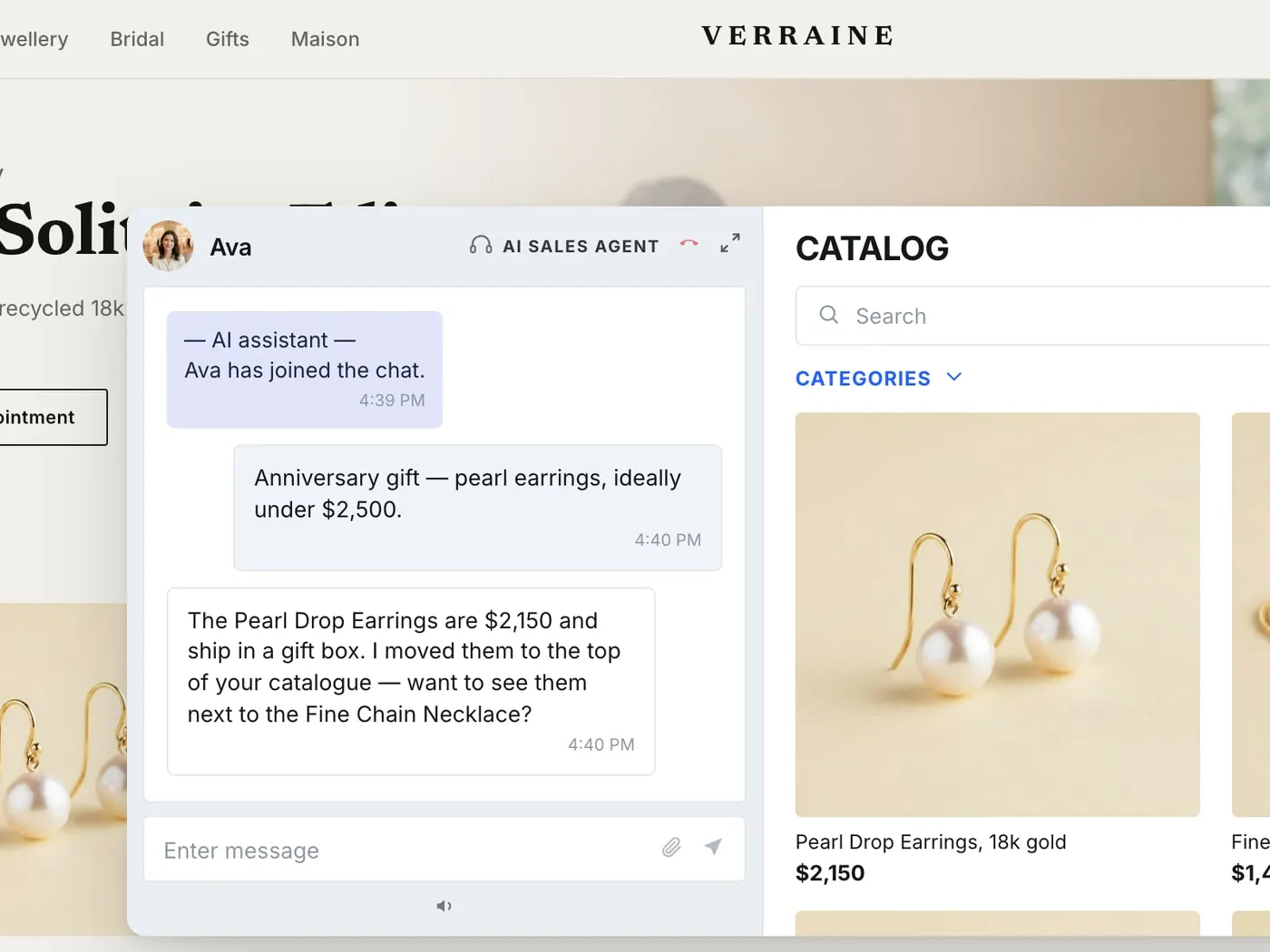
Answering in the session is therefore not a support function; it is the conversion step. For high-consideration categories that answer often has to be human — a real expert on live video who can turn the ring, show the fit, and say which of two options is wrong for her. That is the argument for pairing an AI sales agent that engages every referred visitor with one-tap escalation to a person, so the personal half of the answer is available at the moment the question surfaces rather than in an email the next day.
There is a second return on the same work. Live sessions, shoppable video, and product-page video are where fit questions actually get answered out loud — which makes them the raw material for the written fit content assistants read. The clienteling conversation and the video library feed each other: one produces the honest answers, the other publishes them. See how the pieces compare in our AI sales agent, chatbot, and live commerce comparison.
How do you measure any of this?
Segment referral traffic by assistant domain, then supplement it with manual citation checks — because the visible traffic is a sample of a much larger pool, not a total.
Four things are worth tracking monthly, and they should be measurable in the sense that you can act on a move in any of them:
- Assistant referral sessions, segmented by source domain.
- Conversion rate of assistant referrals against your site average. Expect it to be higher, because these visitors arrive pre-qualified. If it is not, your landing pages are not serving people who are already mid-decision. Our e-commerce benchmarks are a reasonable place to check your baseline.
- Recommendation rate. Ask the major assistants ten questions a real customer would ask in your category and record how often you are named. Crude and manual, and still more visibility than most stores have.
- Feed error and disapproval counts, which are a leading indicator of exclusion.
Two honest caveats. Attribution here is imperfect: some assistant-influenced purchases arrive as direct or branded search, because the shopper looked you up separately after seeing your name. And a page can be doing its job while sending you almost nothing — being named in an answer that resolves the question is a real outcome that produces no click. Treat these numbers as directional evidence, not accounting.
Where to start
Audit consistency first. For your top five products, open the feed, the product page, and the reviews side by side. Check price, availability, dimensions, materials, compatibility. Every disagreement is a reason to distrust that item. This is an afternoon of work and the failure mode it fixes is silent.
Complete the feed. Fill every applicable attribute, and write titles and descriptions the way a person describes a thing out loud — these are read by systems doing language understanding, not term matching.
Open the door. Confirm AI crawlers are not blocked, and that product and FAQ structured data are present and agree with the feed.
Publish the fit questions. For each significant product, take the six questions your support inbox answers repeatedly and publish them with specific answers, including who the product is not right for.
Then build the page for someone with one question left. That is the step that converts everything above, and the one most stores skip.
For a growing share of your shoppers, something will describe your product before you do. It will do that more accurately, and more favourably, when specific, question-shaped information exists rather than only your own marketing about yourself. If you want to see what an answering layer looks like on your own catalog, book a demo and we will walk through it with your products.
Frequently asked questions
Three things have to be true. Your product data has to reach the assistant — through a product feed, a platform channel like Shopify's Agentic Storefronts, or crawlable product pages. That data has to agree with your site, because a feed that contradicts your product page reads as unreliable and gets dropped rather than corrected. And something you publish has to connect the product to a situation a shopper would describe, because assistants are asked about circumstances — a wide foot, a rental kitchen, an older model — not about categories.
Not directly. ChatGPT Merchant uses its own feed specification, pushed to an OpenAI endpoint over SFTP rather than uploaded to a merchant center, and it accepts CSV, TSV, XML, or JSON. Its attribute set goes beyond what most merchants fill in for Google Merchant Center. Shopify and Etsy stores are auto-enrolled through their platform; WooCommerce, BigCommerce, and custom stores apply at chatgpt.com/merchants.
Two different things share that name. On-site recommendation engines rank items for a visitor already on your store using behavioural data. Assistant recommendations happen off your site: ChatGPT, Gemini, or Copilot assembles a shortlist from feed data and crawled web content in response to a described situation, and names two or three products. The first optimises a page you control; the second decides whether you are in the conversation at all.
No, and three differences matter. There is no position ten — an answer names two or three products, so you are in it or absent. You cannot see the query, because assistant conversations are private. And the unit of competition is a product assembled from several sources rather than a page, which is why disagreement between your feed and your site actively hurts instead of merely being untidy.
Most merchants do not. ACP, the Agentic Commerce Protocol, is maintained by OpenAI and Stripe; UCP, the Universal Commerce Protocol, was co-built by Google and Shopify. On a major platform, support for these arrives at the platform level, which makes agentic commerce a platform-selection question rather than a development project.
Product recommendations in the major assistants have been organic rather than ad-driven so far, and Shopify's Agentic Storefronts channel carries no transaction fee beyond standard processing rates. Commercial models in this space are changing quickly, so this is worth re-checking rather than assuming.
Feed hygiene is continuous, because availability and price change daily and a stale catalog is the fastest way to lose trust. The fit-question content is largely write-once with additions as new questions recur. Re-test your recommendation rate monthly by asking the major assistants the questions your customers ask, because the underlying systems change frequently.