
The Client Is Circling a Piece. Notice Without Watching.
There is a pattern every experienced advisor recognises, and it is one of the most valuable things that can happen on a floor.
A client comes in and looks at a piece. She doesn’t buy. A week later she’s back, and she looks at the same piece. The third time, she lingers a little longer and doesn’t look at anything else.
A good advisor notices by the second visit and acts on the third. Not with pressure, but with a well-judged approach. It’s still here. Would you like to see it on?
Repeated return to a single piece is the strongest signal of intent a house ever receives. It means the client has already chosen, in every sense but the final one, and is working through something.
Online, the circling is invisible
The same client, deciding the same way, online.
She views the piece on a Monday. Returns on the Thursday. Returns again the following week, and this time studies the close-ups for a long while. Returns once more and reads the delivery and returns terms.
Four visits to the same page, spread across a fortnight. As clear a signal as she would give on the floor.
And nothing happens. The site does not know. Each visit is served identically: the same page, the same campaign, as if to a stranger arriving for the first time. The piece she has been circling for two weeks is presented to her as though she had never seen it.
It is the same gap that runs through the whole online relationship: the client book stops at the door, and what the advisor would have read on the floor never reaches the site.
What she is usually working through
On the floor, the advisor understands that repeated return means something is unresolved. It is rarely indecision about wanting the piece. It is almost always something specific.
Fit or scale. Whether the case sits well on her wrist. Whether the chain falls where she wants.
Justification. Whether she can explain the purchase to herself and to the one person who will ask.
A comparison she cannot make alone. This piece against another, which she has never seen side by side.
Timing. An occasion, a date, waiting for the right moment.
An advisor’s approach on the third visit is effective precisely because it is aimed at that unresolved thing. The approach says, in effect: I can see you’ve been considering this. What would help?
The trap: recognition that becomes surveillance
Here is where the digital version goes badly wrong if it is done carelessly.
Once a house can see that a client has returned four times to a piece, the obvious move is to show her. A message on the page. An email the next morning. We noticed you’ve been looking at this.
At this level, that is a serious error.
A luxury client wants to be known. She does not want to be observed. Those feel similar from the house’s side, since both rest on the same information, but they are opposite experiences for her. Being recognised by an advisor who remembers her feels like care. Being told by a website that her browsing has been tracked feels like being watched, and it can quietly damage a relationship the house has spent years building.
The advisor’s real skill was never simply noticing. Anyone can notice. It was noticing without making her feel noticed: reading the situation, choosing the moment, and making an approach that felt natural rather than calculated.
What good looks like
Never read her behaviour back to her. No visit counts. No “you’ve been looking at this.” No outreach triggered by how often she’s returned. That information, if used at all, belongs to the advisor as context, never to the client as a message.
Make help easy to reach, in the place she keeps returning to. The most discreet thing a house can do is simply ensure that, on the piece she is circling, there is an obvious and elegant way to ask a question or see it shown, which she can take up entirely on her own initiative.
Let the advisor see the context, if she asks. When a client does reach out, it helps the advisor to know which piece she is considering, so the conversation starts where her thinking is rather than from zero. That is recognition in service of her, not observation of her.
Offer the showing, not the sale. The approach that works on the floor is would you like to see it on? The digital equivalent is a live video consultation with an advisor holding the piece: showing it on a wrist, against the alternative, in daylight. An invitation, never a push.
What to measure
Repeat visits to a single piece before purchase. A house that measures this usually discovers its highest-consideration pieces are circled for weeks.
Conversion of clients who circle a piece and then consult, against those who circle and don’t. The difference is the value of making help easy to reach at the right moment.
Time from first view to purchase on consulted versus unconsulted journeys. A well-timed conversation shortens deliberation that would otherwise run for weeks, or end without a purchase.
Judge each against your own history rather than against an industry figure. The point is to see the circling at all; most houses have never looked.
Where Immerss fits
Immerss is a live commerce platform that gives the client a discreet way to reach the house from the piece itself. The client chooses when; nothing is triggered by how often she has visited, and nothing about her browsing is shown back to her.
- Clienteling: Live Co-Shopping puts an advisor one tap away on the piece she is circling, by text or in a one-to-one video consultation where the advisor can show it and place it in her basket during the call, without her leaving the page she was on.
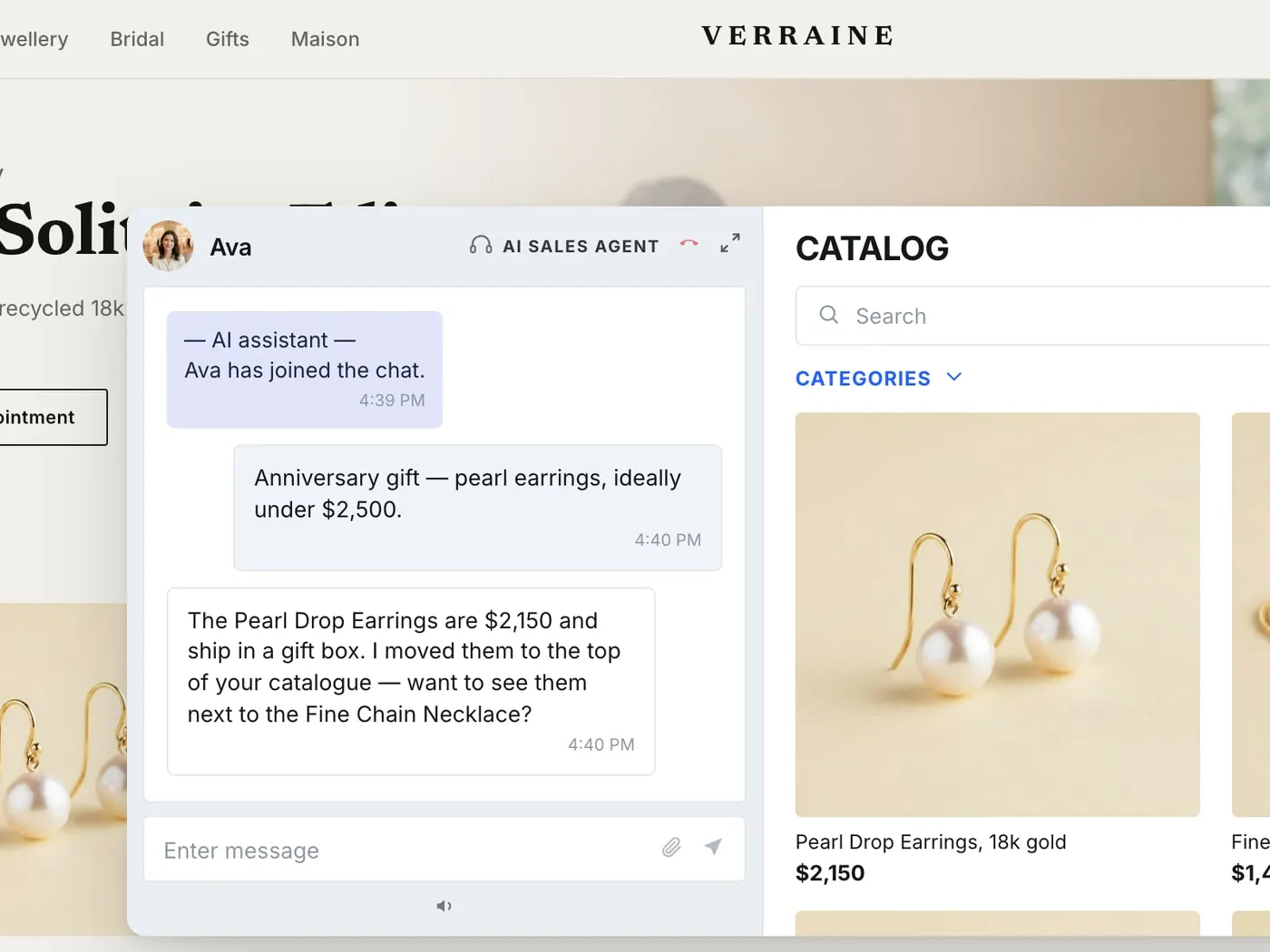
- AI Sales Agent: answers the specific questions (dimensions, materials, delivery) at any hour, and hands the conversation to an advisor, with its context intact, when she wants a person.
- Video Commerce: PDP video and shoppable video let the piece be seen moving, on a wrist and in daylight, before she ever asks.
Where she does reach out, the advisor starts from the piece she is considering. The approach stays human, because it is an advisor who shows the piece; personal, because the conversation begins where her thinking is; and measurable, because the house can finally see which circled pieces were consulted on and which were not.
The same discipline applies when an advisor moves on: the house has to be the place the relationship happens, not a system that watches it.
For a house, the entry point is a conversation and a 60-day pilot, on us.
On the floor, the best advisors notice the client circling a piece and make it effortless for her to take the next step, without ever letting her feel observed.
Online, the house can do the same, provided it remembers that the point was always the approach, never the watching.
Frequently asked questions
It is the strongest signal of intent a house receives. A client who returns to one piece again and again has usually already chosen it in every sense but the final one, and is working through something specific: fit or scale, how to justify the purchase, a comparison she can't make alone, or timing. The repeat visits are not indecision about wanting it.
No. Messages like "we noticed you've been looking at this", visible view counts or emails triggered by browsing frequency turn recognition into surveillance. A luxury client wants to be known, not observed. If the house uses that information at all, it belongs to the advisor as context, never to the client as a message.
Make help easy to reach on the piece she keeps returning to, and let her take it up on her own initiative: an elegant way to ask a question or have the piece shown to her on live video. When she does reach out, the advisor starts from the piece she is considering, so the conversation begins where her thinking is rather than from zero.
Three measures: repeat visits to a single piece before purchase, conversion of clients who circle a piece and then consult against those who circle and don't, and time from first view to purchase on consulted versus unconsulted journeys.