

There is a version of the price conversation that only happens above a certain number, and it is routinely mistaken for the ordinary one.
Below that threshold, a client who hesitates on price is usually weighing affordability or comparing alternatives. The response is information: what the piece is made of, why it costs what it costs, how it compares.
Above it, the client can pay. Affordability left the conversation some time ago. What she is doing instead is quite different, and anyone who has stood on a boutique floor has watched it happen: she is assembling a sentence she can say out loud.
To herself, first. Then, usually, to exactly one other person — a partner, a sister, a friend who will ask what it cost in a tone that is not entirely neutral.
What a justification has to survive
The sentence has to hold up under repetition, which is a harder test than it sounds.
It was expensive does not survive. Neither does I wanted it, which is true and unusable. It’s an investment is a sentence people reach for precisely because they have not been given a better one, and everybody in the conversation knows it.
What survives sounds like: it’s the last one they made in that leather, and the atelier is closing that line. Or: I wore the other one for eleven years and it needed replacing. Or: it’s cut for my shoulder, which nothing off a rail has ever been.
Notice the structure. Each is specific, factual, and connects the object to the client’s own situation. None is a claim about quality in the abstract. And the client did not invent any of them — they were given to her, by someone who knew the piece and knew her.
That is most of what a great advisor does at the high end, and it is almost never described as part of the sale. It gets filed as rapport, or service, or knowing the stock. It is actually the provision of language.
Where the digital channel leaves her
Online, the client arrives at the same piece and is given a photograph, a description and a number.
The description will often be beautifully written. It may mention the house, the maker, the material, the region the leather came from. What it will not do — because it was written for everyone — is connect any of that to her.
So she is left holding a number and no narrative. If she buys anyway, she buys slightly uneasily. More often she does the thing that looks like price sensitivity and isn’t: she waits. She thinks about it. She mentions it to someone, without a sentence, and that person says how much?, and the purchase quietly does not happen.
Nothing in your analytics will record that as a failure of language. It will look like considered browsing that didn’t convert — and the usual response to it, a markdown, answers a question she never asked. We have written separately about what discounting actually costs a luxury house.
Justification is not rationalisation
Worth separating these, because conflating them produces bad copy.
Rationalisation is what a client does alone, afterwards, to feel better about a decision already made. Cost-per-wear arithmetic mostly lives here. It is private and it is fragile.
Justification is public and prospective. It is the reason she gives before and after, to other people, and it has to be true enough that she is comfortable repeating it to someone who knows her well.
Marketing copy tends to supply rationalisation — reasons the purchase is defensible in general. Advisors supply justification — a specific reason this piece, for this client, now. Only the second one travels.
The practical consequence is that a justification cannot be pre-written for a segment. It has to be assembled in a conversation, from what the client has said about her own situation, which is why it disappears the moment the channel stops being conversational.
The raw material you already have
Most houses hold everything a justification is made of and express almost none of it where the client can use it.
- Provenance. Who made it, where, using what. Often present in the copy, rarely connected to why it matters for this piece rather than as house language.
- Scarcity that is real. A closing line, a limited run, a material that will not be repeated. Powerful when true, corrosive when manufactured — and clients at this level detect the difference immediately.
- The client’s own history. The strongest justifications are frequently about continuity: the replacement of something worn out, the completion of a set, the second piece from a maker she already trusts. That material sits in the client book and rarely makes it past the boutique door.
- Fit and suitability. Cut for her shoulder is a justification. Expertly tailored is not.
- Timing. Why now rather than later — a delivery window, a seasonal last call, an occasion she mentioned. Legitimate when specific, merely pressure when generic.
What good looks like online
The advisor is reachable from the product page. A justification is assembled in conversation. A form does not assemble anything, and a queue assembles it with someone who does not know her.
Video, when the piece has to be seen. Much of the raw material — the weight, the finish, the difference between two leathers — cannot be conveyed in writing at all. A live one-to-one consultation with someone holding the object is where most real justifications get built, because the client can ask why this one and not that one and get an answer that references both. Broadcast formats have their place, but they answer the room, not her; the trade-off is set out in livestream versus one-to-one video.
The client’s history is present in the conversation. The strongest sentence available is often about continuity, and it requires knowing what she owns.
Willingness to say not this one. An advisor who recommends the more expensive piece every time supplies no usable language, because the client knows the recommendation was structural. The advisor who occasionally says wait for the spring delivery, this isn’t your cut is the one whose recommendations can be repeated with confidence.
What to measure
Most houses measure digital clienteling on activity — appointments booked, messages sent, coverage. Those are inputs. More useful here:
- Conversion on consulted sessions against unconsulted ones, at comparable price bands. The gap is the value of the conversation.
- Time from first view to purchase on high-value pieces, consulted against unconsulted. A justification shortens deliberation; its absence extends it indefinitely.
- Return rate on consulted orders. A client who was given real reasons has less cause to reverse the decision, because the reasons survive the third telling. If it does not fall, the consultations are not doing this job.
- Share of high-value online orders attributable to a named advisor. If your systems cannot attribute these, advisors will rationally deprioritise the digital channel, and the language gap widens for organisational reasons rather than technical ones.
Report these against your own baseline. Industry averages say little about your house.
Where Immerss fits
Immerss is a live commerce platform that extends the advisor relationship into the digital channel. Three modules work together:
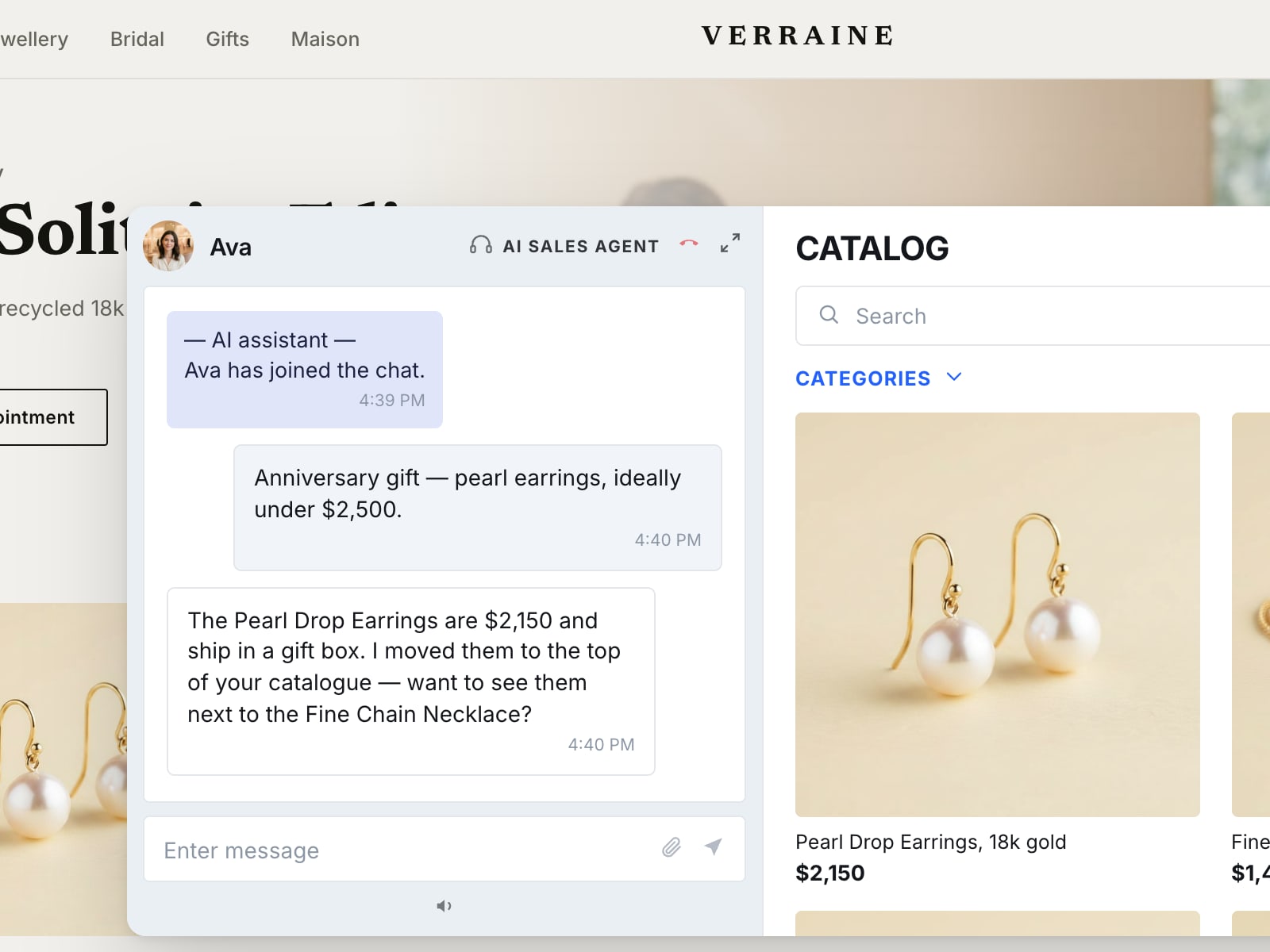
- AI Sales Agent — handles the specific, answerable questions on the site at any hour — availability, materials, sizing, delivery — and, when a question needs a person, hands the same conversation to a named advisor mid-thread: the AI’s replies, what she viewed and what is in her bag are already in front of them. The handover is routed by your rules, so a house running a named-advisor model can send it to the client’s own advisor, and the conversation continues rather than restarting with a stranger.
- Clienteling — Live Co-Shopping puts an advisor and a client in a one-to-one video session with the catalogue and checkout inside it, so she can see the piece handled, hear why this one rather than that one, and buy it in the same conversation; Outbound handles appointments and ongoing client relationships.
- Video Commerce — Live Shopping Events, shoppable video and PDP video, for the moments a house wants to show a collection to many clients at once.
The service stays human, the reasons she leaves with are personal because they start from her situation, and the effect is measurable at the order and advisor level. Lucchese uses live clienteling to put its boot specialists in front of online buyers — the story is in the Lucchese case study.
For a house, the entry point is a conversation and a 60-day pilot, on us, against your own catalogue.
The client did not need to be persuaded that the piece was worth the money.
She needed a way to say so.
Frequently asked questions
First establish whether it is a price objection at all. Above a certain price the client can usually pay, and her hesitation is not about affordability but about justification: she needs a specific, true reason for this piece that she can repeat to herself and to someone close to her. The answer is not a discount or a list of materials but a conversation with an advisor who knows the piece and knows her, and who can connect one to the other.
Rationalisation is private and retrospective: the cost-per-wear arithmetic a client does alone after deciding, to feel better about it. Justification is public and prospective: the reason she gives before and after, to other people, and it has to be true enough to repeat to someone who knows her. Marketing copy tends to supply rationalisation for a segment; an advisor supplies justification for one client, which is why only the second travels.
Because the digital channel gives her a photograph, a description and a number, and the description was written for everyone. In the boutique an advisor connects provenance, scarcity, fit and her own history to this piece. Online nothing does that job, so she is left holding a number without a narrative, and the hesitation that follows looks like price sensitivity in the analytics when it is not.
Compare consulted and unconsulted sessions at comparable price bands: conversion rate, time from first view to purchase, and return rate on the resulting orders. Add the share of high-value online orders attributable to a named advisor. Activity counts such as appointments booked and messages sent are inputs, not evidence.