

Your Clients Search for the Occasion. Your Catalogue Is Indexed by the Object.
On a luxury floor, the opening question is almost never about a product.
What’s the occasion? Or: who is it for? Or, with a client the advisor knows: is this for the wedding in June?
That question is not small talk. It is the mechanism by which an experienced advisor eliminates most of the inventory in under a minute, and everything that follows — which pieces are brought out, in what order, with what framing — descends from the answer.
Now consider what the same client meets on the website.
A search field that accepts the name of a thing.
What the client actually types
Two shapes dominate, and a name-indexed catalogue receives neither.
The occasion. Something for my daughter’s graduation. A gift for a fortieth. Evening, black tie, September. The client is describing a circumstance and asking the house to translate it into a piece — precisely what the advisor does on the floor, and precisely what a keyword index has no mechanism for.
The memory. The one from the September show. The cuff in the campaign with the grey coat. The piece I saw in the Milan window. The client has seen something, formed an intention, and retained everything except the reference name — which is the only key your search accepts.
That second category is particular to this level of retail and rarely discussed. Luxury is marketed through campaigns, shows and windows, all of which create desire attached to an image rather than to a product name. The house spends heavily to generate exactly this kind of intent, and then routes it into a search box that cannot receive it. (The same tension runs through product imagery: the campaign image is part of what the client is buying, which is why it cannot do every job on the page.)
The naming problem is structural, not sloppy
It would be easy to read this as a metadata failure. It isn’t quite.
House nomenclature exists for good reasons. Model names carry heritage, reference numbers carry precision, collection names carry the narrative a client is buying into. Renaming pieces in plain descriptive language to satisfy a search engine would flatten something the house has spent decades building — and would not help, since the client typing something for a graduation is not going to be rescued by a better product name either.
The mismatch isn’t between your words and better words. It’s between a catalogue organised by object and a client arriving with an intention. Filters and better ranking help the client who already knows what she wants; they do little for the one still deciding — the difference between retrieval and selection.
What the log will tell you
Most houses can answer this in an afternoon, and few have looked.
Export a month of site-search queries and read them rather than measuring them. Three things usually emerge.
How many queries name an occasion rather than a product. This is the share of demand your search architecture cannot serve by design.
How many reference a campaign, show or window — the intent your marketing generated and your site couldn’t receive.
Which pieces clients name incorrectly, and how. Where a house name and a client name diverge consistently, that divergence is worth knowing even if you change nothing, because it’s how your pieces are actually discussed.
Two cautions on reading it. The absolute volume will look low — luxury sites have far fewer sessions than mass retail, and a small number of queries can represent a large amount of money. Judge it by value, not count.
And expect the occasion-shaped queries to be undercounted. Clients who type a sentence, get nothing, and rephrase to a single word have been trained by the interface, and the log records the second attempt as though it were the first.
Why this is getting worse, and why it will look like the opposite
Clients now spend their week describing situations to assistants and receiving useful answers. The habit transfers. Sentences arrive in search boxes because people have learned, elsewhere, that sentences work.
Where they don’t work, the behaviour stops — and the log quietly reports that clients search in simple terms. Which becomes true, because the interface made it true.
The same shift is happening off-site. A client asking an assistant for a gift for a fortieth, something classic, under a certain budget is having the occasion conversation somewhere other than with you, and arriving, if she arrives, with the shortlist already formed.
What good looks like
Treat the occasion as the opening question online, as it is on the floor. Not a filter labelled “occasion” with six values — the ability to receive a sentence and respond to it.
Make the campaign findable by description. If a client can only recall the coat in the image, something should be able to resolve that. This is where the house’s own visual assets, properly described, do work they currently don’t.
Never return nothing. At this level a blank result is not a neutral outcome; it is a small failure of service, in a channel the client is already inclined to think of as the lesser one.
Route the sentence to a person where it warrants one. An occasion query from a known client is not a search event. It is the beginning of the conversation an advisor would have had, and it should be able to become one — in text immediately, and on video when the pieces need to be seen. Gifting is where this pays first: the high-value gift buyer arrives with an occasion and almost never with a reference number.
What to measure
Share of search sessions with no result, and their value weighting rather than their count.
Share of queries naming an occasion or a campaign rather than a product. This is the demand your architecture currently declines.
Conversion of sessions that begin with a search against those that don’t. Searchers are almost always the higher-intent group, which is what makes a blank page expensive.
Consultation requests originating from search. If an unresolved query can become a conversation, this is where the recovery shows up.
Report these against your own baseline. Industry averages say little about your house.
Where Immerss fits
Immerss is a live commerce platform that puts the floor’s first question back online. Three modules work together:
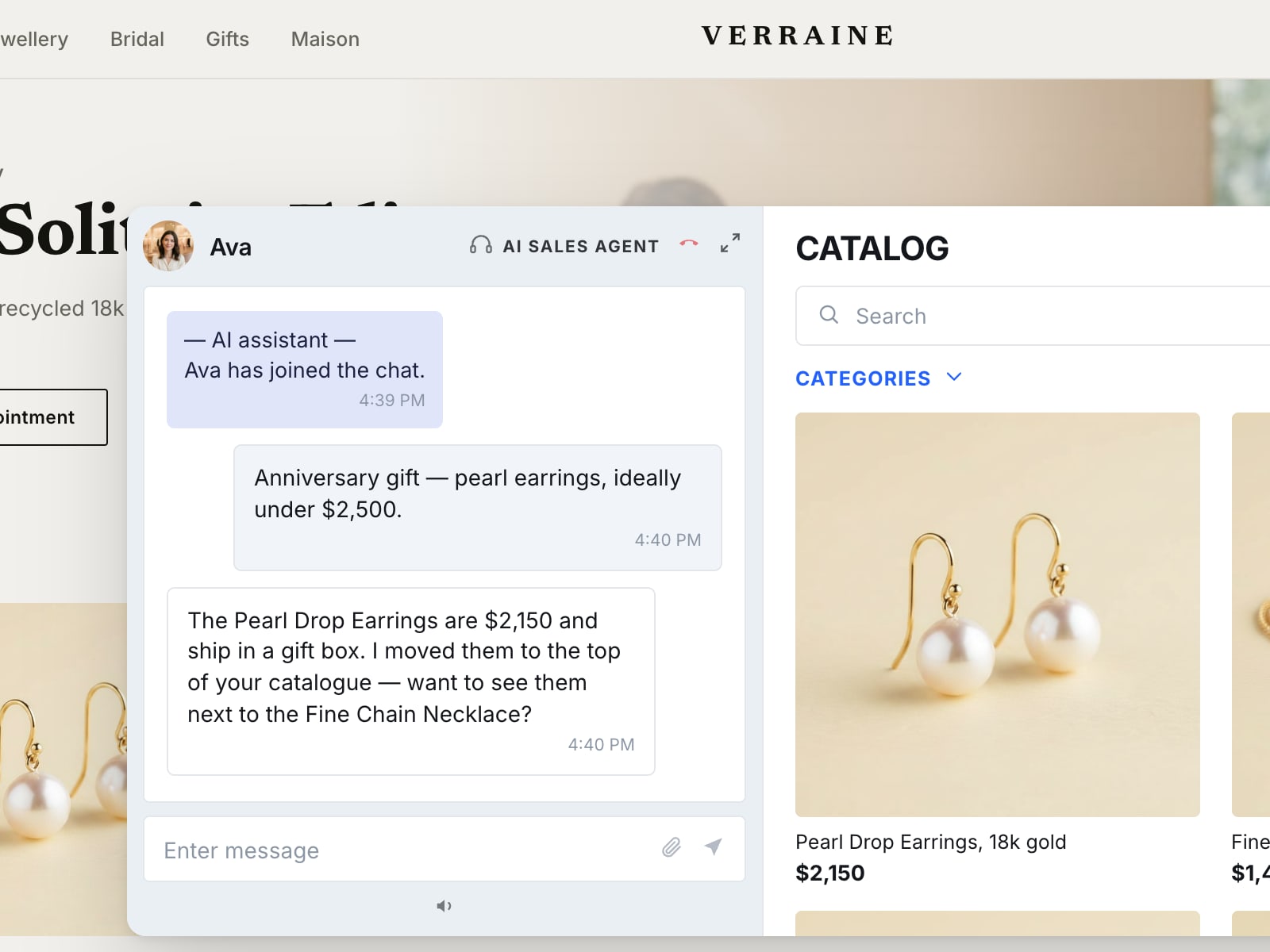
- AI Sales Agent — receives the sentence your search box cannot: the occasion, the recipient, the half-remembered campaign piece. It asks the clarifying question an advisor would ask, and when she needs to see the pieces, one tap hands the same conversation to an advisor on live video, with what she searched for and viewed already in front of them. The handover is routed by your rules, so a house running a named-advisor model can send it to the client’s own advisor.
- Clienteling — Live Co-Shopping puts advisor and client in a one-to-one video session with the catalogue and checkout inside it, so the advisor can show the pieces for the occasion and place one in her basket during the call; Outbound lets the advisor who knows her follow up with the piece itself when the occasion is still weeks away.
- Video Commerce — Live Shopping Events, shoppable video and PDP video, so the campaign a client remembers can be shown and found by what is in it, not only by what it is called.
The conversation stays human, it is personal because it starts from the occasion she named rather than the object you catalogued, and it is measurable from the search query to the order.
For a house, the entry point is a conversation and a 60-day pilot, on us, against your own catalogue.
On the floor, the first question is what it’s for.
Online, the house has built a beautiful index of what things are called, and the client has never needed to know.
Frequently asked questions
It is a search query that describes a circumstance rather than a product: a gift for a fortieth, something for a graduation, evening wear for a black-tie dinner in September. The client is asking the site to translate a situation into a piece, which is what an advisor does on the floor. A catalogue indexed by product name, model and reference number has no mechanism for it, so these queries usually return nothing or return the wrong thing.
Two reasons particular to luxury. Clients often arrive with an occasion rather than an object, and luxury is marketed through campaigns, shows and windows, which create desire attached to an image rather than to a product name. So the client searches for the cuff in the campaign with the grey coat, or the piece in the Milan window, and the only key the search accepts is the reference name she never learned.
No. Model names carry heritage, reference numbers carry precision and collection names carry the narrative the client is buying into. Renaming pieces in plain descriptive language would flatten that, and it would not help the client who types something for a graduation, because no product name answers an occasion. The mismatch is between a catalogue organised by object and a client arriving with an intention.
Never a blank page. At this level an empty result is a small failure of service in a channel clients already think of as the lesser one. Show the closest pieces, let the client describe what she is looking for in a sentence, and where the query warrants it, offer a person: an advisor in text straight away, or on live video when the pieces need to be seen.
Read a month of queries rather than only counting them. Track the share of search sessions with no result, weighted by value rather than count; the share of queries that name an occasion or a campaign rather than a product; conversion of sessions that begin with a search against those that do not; and consultation requests that start from a search. Judge it against your own baseline, since luxury sites have few sessions and a small number of queries can carry a large amount of money.