

Not a Window. A Date.
Many of the most considered purchases a house sells are bought for a day.
An anniversary. A proposal. A fiftieth birthday. A gala the client has known about for months. The piece matters, but so does the date it has to be in her hands, and in the boutique, everyone understands that.
What happens in the boutique
The client mentions the date almost in passing. It’s for our anniversary, the twelfth.
A good advisor hears it as the most important sentence of the conversation. They check the piece is in stock, or which boutique holds it. They confirm the engraving can be done in time. And then they commit, in the client’s terms: It will be with you on Thursday the tenth. If the usual delivery won’t do it, they arrange a courier, or offer to hold the piece for collection.
The client leaves with a date and a name. If anything changes, she knows someone will call her before she has to ask.
That commitment is part of what she’s paying for.
What happens online
The same client, the same piece, on the house’s website.
At checkout she sees Complimentary delivery: 3–5 business days. After ordering, an email with a tracking number. Somewhere in between, she does the arithmetic herself: the time of day she ordered, whether the courier delivers on Saturdays, whether the engraving adds time. She arrives at an answer she can’t be sure of.
For most purchases, a window is fine. For a piece bought for a moment, a window isn’t service. It’s a hope. And at this level, a client who isn’t sure the piece will arrive in time doesn’t gamble. She calls the boutique, or buys it somewhere she can be told.
Why it’s harder online, and why it matters more
Online, the date often goes unsaid. The client doesn’t tell a checkout page that it’s for the twelfth; there’s no one to tell. So the house never learns that the delivery date is the one thing that matters about this order, until it’s late.
And a late anniversary piece isn’t a minor service failure. It’s the moment missed. That memory attaches to the house, not to the courier.
The date is also rarely the only thing that has to be ready. An engraving, a resized ring, a strap fitted to a bag: whatever the piece needs before it can be worn, the subject of the piece that completes it, has to fit inside the same date.
What a date-led experience looks like
Ask the occasion, gently, before checkout. Is this for a particular date? An invitation, never a required field.
Answer in dates, not windows. Where the house can stand behind a date, say it: Arrives Thursday the tenth. Where it can’t, say what can be done: Standard delivery may not reach you in time; we can arrange a courier.
Put a person behind the date. For date-bound orders, an advisor confirms the date and owns it, the way they would in the boutique.
Tell her before she has to ask. If anything threatens the date, she hears it from the house first, with a solution.
Never promise a date the house doesn’t control. A committed date that slips does more damage than an honest window. Commit only where the house can deliver: by courier, by collection, by holding the piece.
What to measure
How many online orders are date-bound: gift messages, occasion notes, express or courier choices, client questions about timing.
How often clients ask about delivery timing before ordering, by phone, email or chat. Each is a client doing arithmetic the house could have done.
On-time delivery for date-bound orders, tracked separately from the rest.
Where Immerss fits
Immerss is a live commerce platform, and two of its modules carry this kind of commitment.
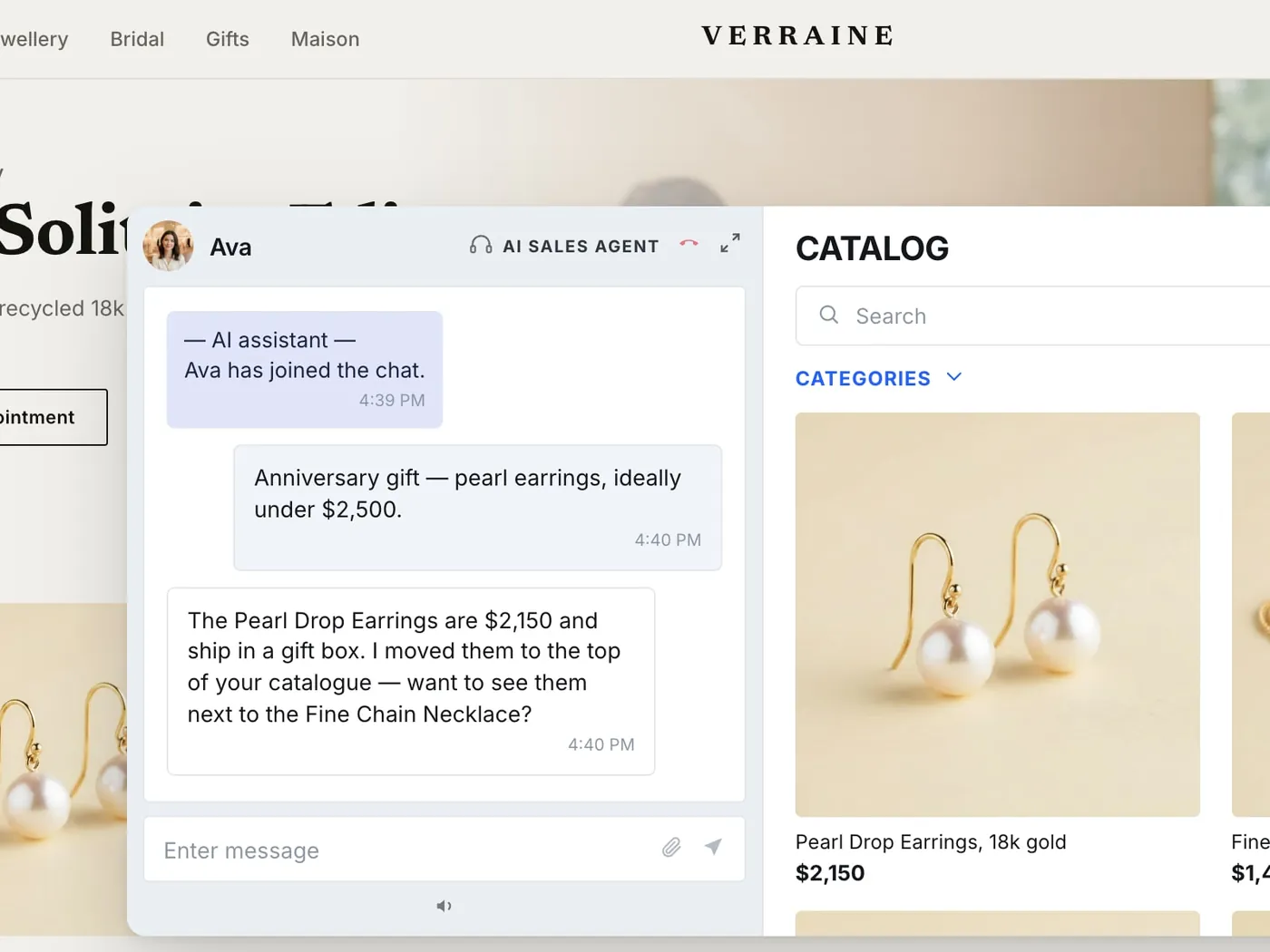
- AI Sales Agent: answers the client’s questions out of the house’s own catalogue and policies, delivery included, at any hour and on the house’s own site. When the question is will it be here by the twelfth?, it answers from what the house has written down rather than sending her to a policy page.
- Clienteling: Live Co-Shopping brings a named advisor onto one-to-one video in one tap, with no download and no appointment. The advisor can show the piece, confirm what the house can commit to, and place it in her bag during the call. Outbound Clienteling lets that advisor reach her afterwards by text, email or phone from the same client record, so that if the date is at risk, she hears it from someone she has already spoken to.
The software does not calculate or guarantee a delivery date. The date stays the house’s promise, made by a person.
The commitment stays human, because a named advisor makes it and keeps it; personal, because it is made in her terms, Thursday the tenth, not in business days; and measurable, because the house can count its date-bound orders, the timing questions asked before ordering and how many of those orders arrive on time.
For a house, the entry point is a conversation and a 60-day pilot, on us.
In the boutique, the client leaves with a date and a name.
Online, she should too.
Frequently asked questions
Because many of them are bought for a day: an anniversary, a proposal, a gala. For a piece bought for a moment, "3–5 business days" leaves the client to do the arithmetic herself, and a client who isn't sure the piece will arrive in time calls the boutique or buys where she can be told.
They treat the date as the most important sentence of the conversation: check stock or which boutique holds the piece, confirm any engraving can be done in time, then commit in the client's terms, "It will be with you on Thursday the tenth", arranging a courier or a hold for collection if the usual delivery won't do it.
Gently, as an invitation and never as a required field. Online, the client has no one to tell that the piece is for the twelfth, so the house often learns the date mattered only once the delivery is late.
Only where it can stand behind them: by courier, by collection, by holding the piece. A committed date that slips does more damage than an honest window.