
Best Videowise Alternative for 1-to-1 Video Selling
If you are comparing Videowise against Tolstoy, Firework or Bambuser, you are choosing inside one category. It is worth checking first whether the category matches the sale you are trying to close.
The short answer
Videowise is a capable video content engine. It describes itself as an AI-powered video commerce platform, and the description is fair: it collects and manages creator content, generates clips automatically, embeds shoppable video across product pages and collections, runs live shopping with shoppable replays, and reports revenue attribution. It syncs with Shopify and Shopify Plus, Magento and Adobe Commerce, and Salesforce Commerce Cloud.
If your constraint is video supply — not enough content, in not enough places, not shoppable — then Videowise is a reasonable pick, and so are its direct peers.
If your constraint is that shoppers arrive at a $600 pair of boots or a $4,000 ring, watch the video, and leave anyway, then you are not short of video. You are short of an answer to one person’s specific question, and no amount of additional content produces one. That is a different category of product, and it is where we sit.
Read the metering, not the feature list
Feature lists across this category converge. Pricing models do not, and they are more honest, because a vendor meters the thing it expects you to consume.
Videowise sells modules rather than one bundle — shoppable video, live shopping, AI clips and content creation are priced separately, with a discount for taking the whole platform and a lower annual rate. Each module meters differently, and the units are the tell:
- Shoppable video is banded by monthly site visitors.
- Live shopping is capped by streamed minutes.
- AI clips is bounded by managed storage.
- Content creation is sold by number of generated videos.
Current figures are on Videowise’s own pricing page, and that is where they should be checked — a monthly number is the fastest-rotting fact in this category. The model is the durable part.
Read those four units together and the product’s centre of gravity is obvious: this is a platform for producing video and serving it to a lot of people. Storage and generated-video counts are supply-side units. Visitor bands are a reach unit. Nothing in that list is priced per conversation, because conversations are not what the platform is for.
The streamed-minute problem nobody flags in the demo
One of those units deserves its own paragraph, because it quietly decides whether a one-to-one selling programme is affordable.
A minute of livestream and a minute of private consultation are the same unit under minute-based metering. They are not the same amount of work.
An hour of broadcast watched by five hundred people spends sixty minutes of your allowance. Sixty one-hour consultations spend sixty times that, and reach sixty people. Broadcast amortises minutes across an audience; one-to-one cannot, by definition. So a minute-metered plan is structurally cheap for broadcast and structurally expensive for consultation.
This is not a criticism of anyone’s integrity — the unit was chosen for the broadcast case, which is the case the product was built for. But if your plan is to sell high-AOV goods through personal sessions, model your expected consultation hours against the allowance before you sign, not in month four. On a considered-purchase catalogue that arithmetic often lands badly, and it lands badly for structural reasons that no discount fixes.
What video does well, and where it stops
Shoppable video earns its place. It shows scale, movement, drape, weight and how a stone reads in daylight — everything a still image flattens out. It does that for every visitor simultaneously, at whatever hour they arrive, which is exactly the economics a catalogue needs. We build this ourselves, and we are not about to argue against it.
What it cannot do is answer a question that exists only in one shopper’s head.
Will this fit my wrist? Does this work with the piece I already own? Is that green closer to olive or lime under a kitchen light? Can it arrive before the anniversary? These are not questions about the product in the abstract. They are questions about the intersection of the product and one person’s situation, and a video recorded before she arrived cannot address the intersection — it can only cover the general case very well.
On a low-consideration purchase this rarely matters; the shopper guesses and moves on. On a considered purchase it is usually the whole blocker. That distinction is the same one that separates livestream broadcast from one-to-one video, and it is the axis this decision actually turns on.
Where Videowise is the right answer
Worth saying plainly, because a comparison that finds the competitor useless is not a comparison.
Choose Videowise or one of its peers if you sell a broad catalogue of low-to-mid-consideration goods, your traffic is large, and your genuine gap is content: you have UGC scattered across social accounts, no efficient way to get it onto product pages, and no one to cut long videos into usable clips. That is a real and common problem, the module structure addresses it directly, and buying a consultation platform instead would be solving a problem you do not have.
Videowise also states that a trial or pilot is available on request, and offers a money-back guarantee — reasonable terms to ask about in any case.
Where the alternative is a different category
Choose differently if your goods are sized, fitted, matched to something already owned, gifted, or simply expensive enough that a wrong guess is painful. Apparel and footwear, fine jewellery and watches, furniture, anything bespoke.
For that catalogue we run three modules, and which one carries the weight depends on the question in front of the shopper:
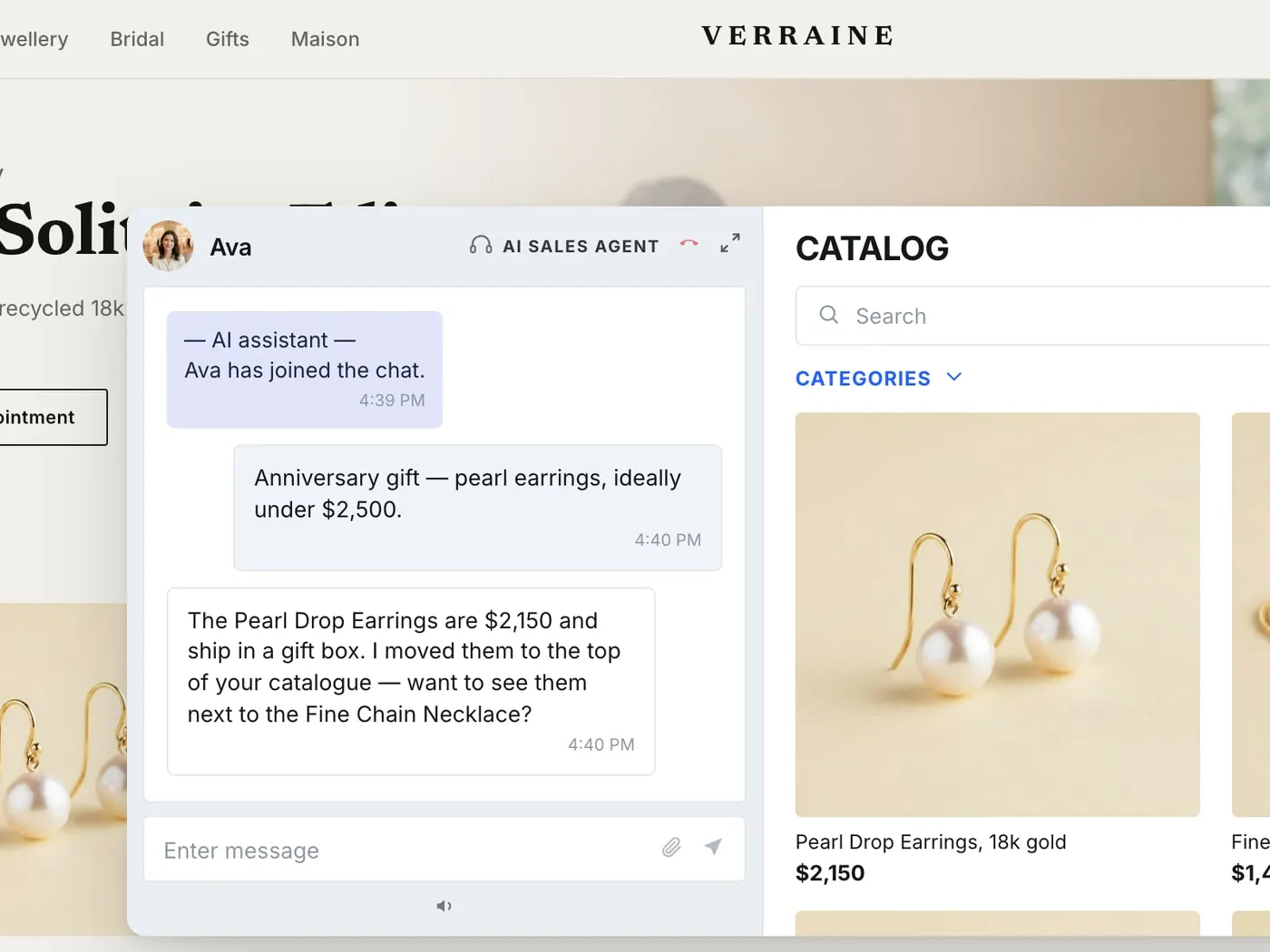
- AI Sales Agent — takes the specific, answerable question on the product page, in the shopper’s own phrasing, at whatever hour she is deciding. Most hesitation is one precise answer away from resolution, and this is the module that handles the volume of it. It is also the layer that qualifies who genuinely needs a person.
- Clienteling — 1:1 Live Co-Shopping and Outbound, for when reassurance is not enough and she needs someone to look at the piece with her. On a $4,000 ring, is this the right piece for her is a conversation, not a lookup.
- Video Commerce — Live Shopping Events, Shoppable Video and video on the PDP, which closes the resolution gap that creates the wrong-guess risk in the first place.
The through-line is Human, Personal, Measurable. Human, because the thing blocking the order is being left alone with a decision. Personal, because the general case is already answered on the page and what she cannot get anywhere else is whether it applies to her. Measurable, because assisted conversations tie to orders, to exchanges-versus-refunds and to the associate who handled them — a programme you cannot attribute is one you cannot defend when someone asks whether it paid for itself.
Note that this is not video instead of content. It is content plus the conversation the content cannot have.
The peer comparison, briefly
Most people arriving at this question are also weighing the neighbours, so:
Videowise vs Tolstoy — close peers. Both embed shoppable video, both manage creator content, both attribute revenue. The decision is operational: which integrations you need, which modules you would genuinely switch on, how each meters what you will consume.
Videowise vs Firework — also close, with Firework adding one-to-one sessions through its Digital Showroom. If you want the longer version, we wrote it up in our Firework alternative comparison.
Videowise vs Bambuser — a real difference of shape rather than degree. Bambuser is built around the scheduled livestream event with shoppable replays; Videowise is built around embedded assets and content supply. We compare our own approach with Bambuser’s in more detail here.
Videowise vs Sprii, Clipara, Recharm — smaller players in the same content-engine category. The category question above applies to all of them identically, which is rather the point: if the category is wrong for your catalogue, comparing within it more carefully will not fix it.
For the wider field, including where the shoppable-video specialists sit relative to each other, see our shoppable video platform comparison and the broader video commerce solutions round-up.
What to check before you sign anything
Five questions that separate the categories faster than a feature matrix:
- What unit does the plan meter, and does it match how I intend to sell? Visitors, streamed minutes, storage and generated videos all price supply and reach. If your plan is consultations, none of them price what you are about to do.
- What happens at the band edge? Ask whether crossing it is a deliberate move to the next band or an overage billed after the fact. The difference is whether a good month is a decision or a surprise.
- Who answers the question the video did not? If the answer is a support inbox on business hours, you have a pre-purchase gap, because evenings and weekends are when consumer shopping peaks.
- Can the platform tell me which conversations produced orders? Engagement and view-through are real metrics, but they are not the ones you will be asked about.
- Does the model penalise the behaviour I want more of? This is the streamed-minute point generalised. Whatever you intend to do more of next year should not be the most expensive line on the plan.
If you want the wider context on where your numbers currently sit before you choose, our ecommerce benchmarks piece is the place to start, and the AI sales agent guide covers the answering layer in depth.
Where to start
If your gap is content supply, buy a content engine — Videowise is a legitimate choice and this comparison should not talk you out of it.
If your gap is that a stranger reached the most expensive page on your site, watched everything you made, and still could not get one question answered, then more content is the expensive way to not solve it.
Our entry point is a conversation rather than a signup, and for a real programme we run a 60-day pilot, on us — against your catalogue and your traffic, not a demo dataset. What it costs depends on your traffic and which modules you run; the current bands are on our pricing page, and each module has a free tier if you want to put it in front of a small audience first.
Frequently asked questions
It depends on which constraint you are actually solving. Videowise is a video content engine — shoppable video, UGC management, AI-generated clips and live shopping, sold as separate modules. If your problem is that you do not have enough video in enough places, it is a credible pick and the alternatives are its direct peers: Tolstoy, Firework, Clipara. If your problem is that shoppers on a considered purchase reach the product page, watch the video, and still leave with an unanswered question about their own situation, then more video is not the fix and the alternative is a different category: a platform built around the conversation. Immerss sits there — an AI Sales Agent answering the specific question, with escalation to a human on live one-to-one video when the purchase needs a person.
They are built around different events. Videowise centres on shoppable video assets embedded across your site — product pages, collections, landing pages — with UGC collection and AI clip generation feeding the supply. Bambuser centres on the livestream event: scheduled broadcasts with shoppable replays, plus a one-to-one add-on. The practical question is whether your catalogue converts on watching or on asking. Broadcast and embedded video both scale one message to many viewers; a considered purchase usually turns on one buyer's specific question, which neither format is structured to take.
These are close peers and the choice is usually operational rather than strategic. Both embed shoppable video across the storefront, both import and manage creator content, both report engagement and attributed revenue. Videowise sells its capabilities as separate modules — shoppable video, live shopping, AI clips and content creation are priced independently — so the shape of your bill depends on how many of them you switch on. Compare them on the modules you would actually run, the platforms they sync with, and how each meters usage, and confirm the current numbers on each vendor's own pricing page.
Less than the marketing suggests. Both are shoppable-video and live-commerce platforms selling video reach: embed clips at scale, import UGC, run live events, attribute revenue. Firework additionally offers one-to-one sessions through its Digital Showroom. Choosing between them is a procurement exercise — integrations, metering, support, contract shape. The more useful question, if you sell high-consideration goods, is whether the category is right at all: both optimise for video getting watched, and neither is structured around a salesperson closing one buyer.
Videowise sells modules rather than one bundled seat: shoppable video, live shopping, AI clips and content creation are each priced separately, with a discounted bundle for the full platform and a lower annual rate. The metering differs per module and that is the part worth reading closely — shoppable video is banded by monthly site visitors, live shopping is capped by streamed minutes, AI clips by managed storage, and content creation by number of generated videos. Check the current figures on the Videowise pricing page; the model matters more than the number, because it tells you which behaviour gets more expensive as you grow.
Because a minute of broadcast and a minute of private consultation cost the same under it, while doing completely different amounts of work. A one-hour livestream watched by five hundred people spends sixty minutes of the allowance. Sixty one-to-one consultations of an hour each spend sixty times that, and reach sixty people. Minute-based metering is therefore structurally cheap for broadcast and structurally expensive for consultation — not because anyone designed it against you, but because the unit was chosen for the broadcast case. If your plan is to sell high-AOV items through personal sessions, price that against the allowance before you commit.
No, and the good ones do not claim to. Shoppable video does the job of a very good catalogue: it shows scale, movement, texture and context far better than a still image, and it does that for every visitor at once. What it cannot do is take a question that exists only in one shopper's head — whether this fits her wrist, works with the room she already owns, or arrives before an anniversary — and answer that specific version of it. That is a different job, and on considered purchases it is usually the one blocking the order.
Yes. Immerss integrates natively with Shopify and Shopify Plus, Salesforce Commerce Cloud, Magento and Adobe Commerce, WooCommerce, and custom storefronts via API — the same integration surface most video commerce platforms cover, so a migration or a parallel pilot does not usually require replatforming.