
Where the Online Consultation Begins: 3 Approaches Compared
In a boutique, an advisor sees which piece a client is holding before a word is spoken. The consultation begins with the piece.
Online, it usually begins with a question, which piece are you interested in?, even when the client has already placed a ring in her bag and saved the earrings that go with it.
Here are three ways an online consultation can begin, compared.
The approaches at a glance
| Approach | How the consultation begins | What the advisor sees | Best for |
|---|---|---|---|
| 1. The advisor asks | ”Which piece are you looking at?” | Nothing | Very small catalogues |
| 2. The house’s client record | A look-up in the house’s own CRM | Past purchases and notes, not today’s interest | Known clients the house already holds records for |
| 3. Today’s interest, in the consultation (Immerss) | With the piece | Her bag, the pieces she has saved, the pieces she has viewed | Every client, including first-time visitors |
1. The advisor asks
Courteous, and quick to set up. But the opening minutes go on identifying the piece rather than on the question that brought her: the size, the clasp, the occasion.
2. The house’s client record
Where a house holds records in its own CRM, an advisor may know a client’s history. That is valuable, but it describes the past. It does not show the piece she is considering right now, and it says nothing about a first-time client.
3. Today’s interest, in the consultation
When the client begins a consultation, the pieces already in her bag are in the consultation’s bag. The advisor’s app shows, from the start:
- Bag: the pieces in her bag;
- Liked: the pieces she has saved, when a supported wishlist is connected;
- Viewed: the pieces she has recently viewed.
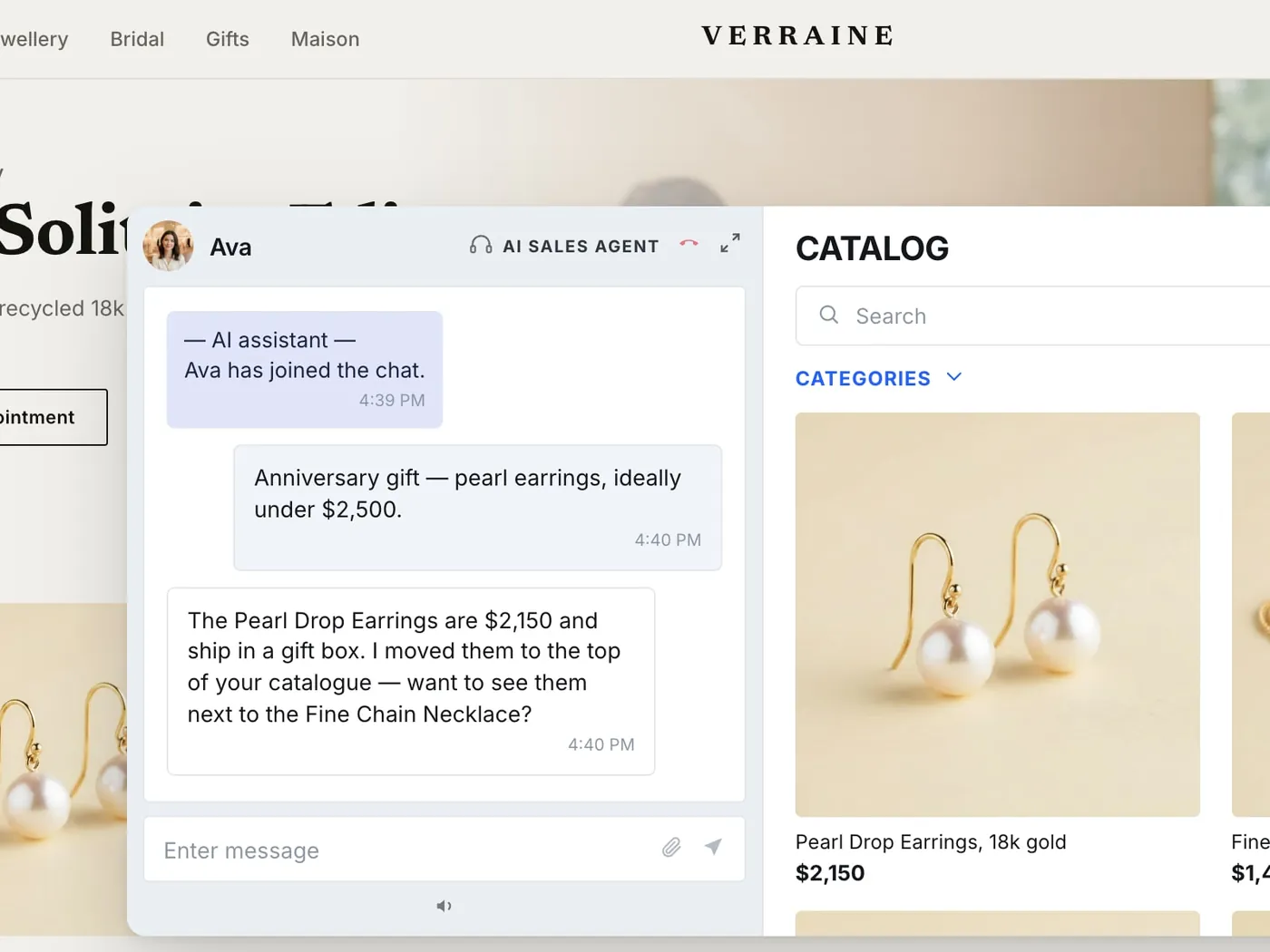
The consultation can begin with the piece: Is it the size of the solitaire you’re considering? The advisor does not announce what they can see; it simply shapes the first sentence. The bag is shared, so the advisor can add a piece, the earrings she saved perhaps, and she completes the purchase at the house’s checkout.
This describes the present visit, not her history: advisors do not see her past orders in the consultation. Nor do they see her screen; they see the pieces she has placed before the house. Her bag is copied once, when the consultation begins, and on Shopify the consultation’s bag replaces the cart on the site.
Which approach fits the house?
- A small catalogue and few online consultations: approach 1.
- Known clients with records in the house’s own systems: approach 2 alongside approach 3.
- Every client who begins a consultation online: approach 3.
Knowing the piece once she has asked is one half. Noticing a client who is still deciding, without watching her, is the other; we’ve written about a client circling a piece.
What a house needs
The bag is recognised on Shopify, WooCommerce, Magento and Salesforce Commerce Cloud. On Shopify, recently viewed pieces need the “Product recently viewed” app embed, and saved pieces need Wishlist Plus. Magento and Salesforce Commerce Cloud wishlists, and on WooCommerce the TI WooCommerce Wishlist plugin, are picked up automatically.
What to measure
How long it takes for the consultation to reach the piece: the first question about size, clasp or occasion, rather than about which piece.
How many consultations begin with a piece already in the bag or saved, and how many of those end in a purchase.
Which pieces advisors add to the bag, and how often the client keeps them.
Where Immerss fits
Immerss is a live commerce platform, and two of its modules carry this decision.
- Clienteling: the advisor’s app shows the client’s bag, saved pieces and recently viewed pieces from the start of the consultation, and the advisor can add a piece to the shared bag and follow up by text, email or phone.
- AI Sales Agent: when the AI answers first, it receives the same context and uses it to shape its answers, without reading it back to her. When every advisor is with a client, the house decides whether the AI answers first or last.
The arrangement stays human, because the advisor leads the consultation and chooses what to add; personal, because the first sentence is about her piece, not a question she has already answered; and measurable, because the house can see how quickly consultations reach the piece and what they lead to.
For a house, the entry point is a conversation.
In the boutique, the advisor sees the piece in her hand. Online, the consultation should begin there too.
Frequently asked questions
With Immerss, the pieces in her bag are carried into the consultation when it begins, and the advisor's app shows them next to the pieces she has saved (with a supported wishlist) and the pieces she has recently viewed. The consultation can begin with the piece rather than with a question.
No. The consultation shows the present visit: her bag, her saved pieces and the pieces she has viewed. Advisors do not see her order history in the consultation, and they never see her screen.
Her cart is copied once, when the consultation begins. After that, changes to the consultation's bag are sent to the cart on the site; on Shopify, the bag's contents replace the cart.
Yes. The AI receives her bag, saved pieces and recently viewed pieces as context. It uses them to shape what it says and does not read them back to her.