

A Client Shouldn't Have to Be Seen to Be Shown
When a client walks onto a floor, being seen is simply part of arriving. She chose to come in, dressed for it, at a time that suited her. The advisor greeting her by sight is natural.
Online, none of that holds. And yet many live consultation experiences quietly ask the client to accept exactly the same condition: to appear on camera, in her own home, in order to be shown a piece.
At this level of retail, that is the wrong default.
What the client actually wants from a consultation
A client asking to see a piece wants to see it properly: how the case sits, how the stone takes the light, how the leather looks in daylight, how two finishes compare side by side. These are the things a campaign image cannot prove, and they are why she asked. She wants an advisor’s expertise and an advisor’s hands.
What she does not need, for any of that, is to be seen herself.
The asymmetry is complete. Everything of value in a showing flows from the advisor’s side of the frame to hers. Asking her to switch on her own camera adds nothing to what she’s shown, and asks a good deal of her.
Why discretion matters more here, not less
There are ordinary reasons any client might prefer not to appear: the hour, the room, the people around her, simply not being dressed to receive a stranger.
At this level there are additional ones.
Some clients are recognisable, and would rather not appear on camera to a retailer at all.
Many simply value privacy as part of the service they expect from a house.
A visible call carries social weight. Once she’s on camera, being looked at, it’s harder to end the consultation gracefully without a purchase. A client who senses that may decline to begin.
None of this reflects any reluctance about the piece or the house. It reflects a reasonable preference about her own visibility, which a house that prides itself on discretion should anticipate and not override.
The advisor’s frame is what matters
If the client’s camera is off by default, the entire experience rests on the advisor’s side of the frame. That side deserves the care a boutique would give its counter.
Light that shows the piece truly. Not flattering studio light that misrepresents colour, but light in which the client can trust what she sees.
A composed setting. Calm, uncluttered, consistent with the house.
The piece at the centre. Held, turned, compared, brought close. The showing is the point.
Attentiveness without pressure. The advisor responds to what she asks to see, at her pace.
Her camera, her choice
Off by default does not mean never.
Sometimes a client will want to switch her camera on: to show her wrist so the advisor can judge how a watch sits, to show a setting so a piece can be considered for a particular room, to hold an existing piece up for comparison. That should be easy, and entirely her decision.
The principle is simply that being seen is something she offers, not something she must give in order to be shown.
A practical detail worth checking
On many video tools, the moment a client begins a consultation, her browser asks for permission to use her camera and microphone. For a client who only wished to watch, that request is jarring, and some will decline the permission, or leave, sooner than grant it.
If her camera is off by default, she should not be asked for camera access at all until she chooses to enable it. It takes a minute to find out: begin a consultation on the house’s own site, as she would, and see what appears first.
What good looks like
Client camera off by default, with no permission request unless she chooses to enable it.
Text or voice, her choice, so she can ask quietly while watching.
The advisor’s frame treated as a boutique counter: true light, composed setting, the piece at the centre.
An easy, graceful way to end the consultation, so beginning one carries no implied obligation.
A named advisor where the client has a relationship, so the person showing the piece knows her.
What to measure
Consultation acceptance: how often clients who are offered a showing begin one.
Drop-off at any camera-permission step, if one exists.
How often clients enable their own camera during a consultation. A house that counts will learn whether two-way was ever what its clients wanted.
Conversion and return rates on consulted purchases compared with unconsulted ones.
Where Immerss fits
Immerss is a live commerce platform, and this is the part of it a client meets face to face, or chooses not to.
- Clienteling: Live Co-Shopping puts a named advisor on one-to-one video from the house’s own site, with no download and no appointment. The client joins with her camera and microphone off, and is not asked for access to either in order to begin. She watches the advisor show the piece and can type throughout; if she wishes to speak, or to show her wrist, she switches her microphone or camera on herself, and only then does her browser ask. The advisor can place the piece in her bag during the call.
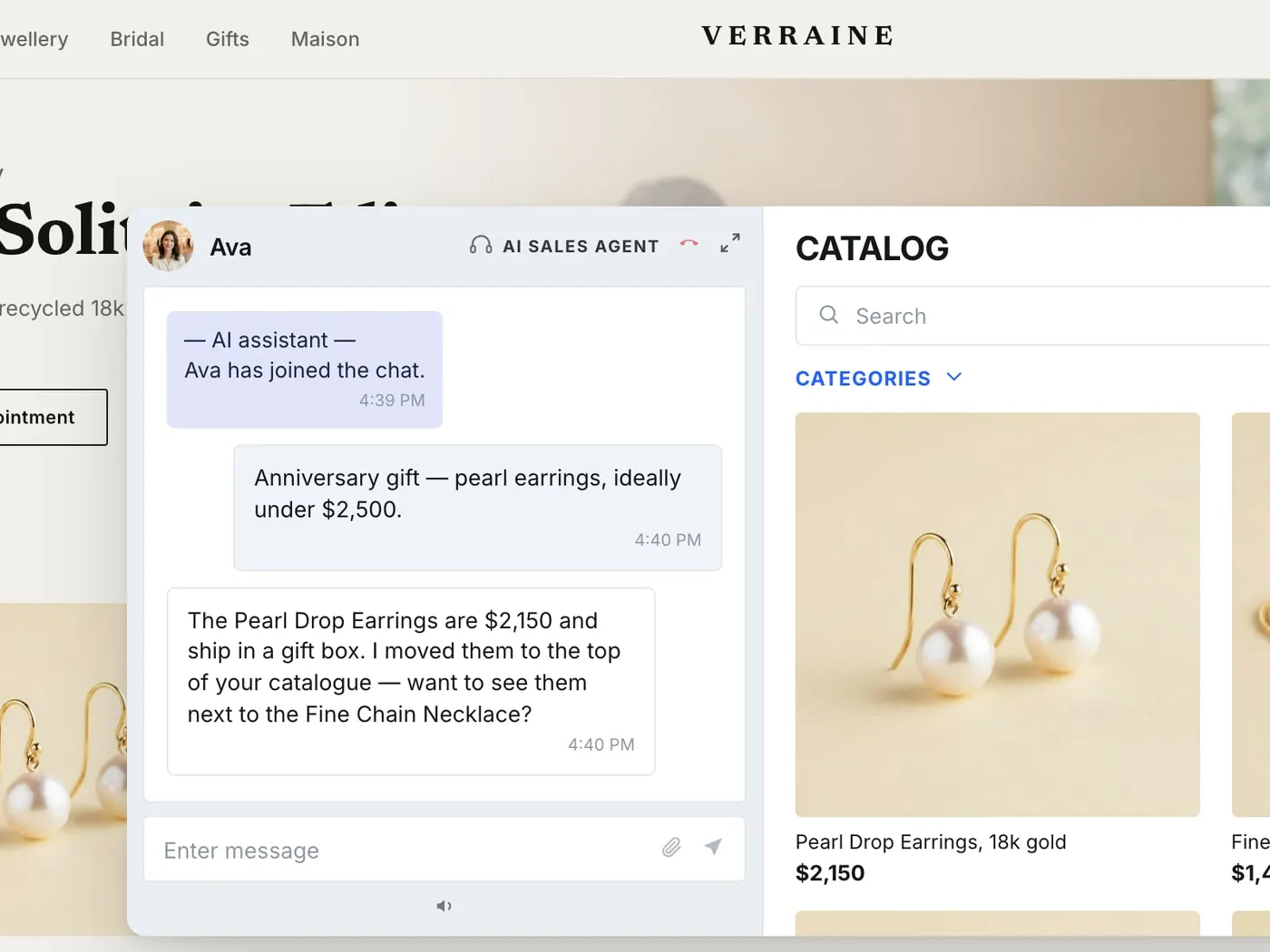
- AI Sales Agent: answers out of the house’s catalogue at any hour, and when the question is one that has to be seen, passes the conversation to an advisor with the thread intact.
What the client sees of the house is the house’s to compose: the light, the setting and the advisor are not something software supplies.
The approach stays human, because the showing is given by an advisor and not a recording; personal, because it follows what she asks to see, at her pace; and measurable, because the house can count how many showings are begun, how many clients choose to be seen, and what came of each.
For a house, the entry point is a conversation and a 60-day pilot, on us.
On the floor, a client is seen because she chose to walk in.
Online, a house should show her everything she wishes to see, and ask nothing of her in return.
Frequently asked questions
No. Everything of value in a showing flows from the advisor's side of the frame to hers: the piece, the light, the advisor's hands and expertise. Her camera adds nothing to what she is shown, so it should be off by default and hers to switch on.
Some clients are recognisable and would rather not appear on camera to a retailer at all. Many treat privacy as part of the service they expect from a house. And once a client is visible, it is harder to end a consultation gracefully without a purchase, so a client who senses that may decline to begin.
To show her wrist so the advisor can judge how a watch sits, to show a room a piece is being considered for, or to hold up a piece she already owns for comparison. That should be easy and entirely her decision: being seen is something she offers, not something she must give in order to be shown.
Begin a consultation as a client would. If her browser asks for camera and microphone access before she has seen anything, that request is where some clients leave. With her camera off by default, she should not be asked for camera access unless she chooses to enable it.