
Shopify Live Selling in 2026: Broadcast, One-to-One, or Shoppable Video?
Search for live selling on Shopify and the results describe one thing: a scheduled broadcast with a host, a chat column and products pinned below the video. That is a real mechanism and it works for some catalogues. It is also one of three, and the other two are easier to staff.
This guide covers what Shopify does and does not provide natively, the three mechanisms that share the name “live selling”, how the apps in this category meter their pricing, and how to tell which one your store actually needs.
Does Shopify have live selling built in?
No. Shopify provides the commerce backend — inventory, payments, orders, and the customer record — and expects the live selling layer to come from an app or a social platform.
This is Shopify’s own position rather than an outside reading of it. Its guidance to merchants splits the field three ways: use social platforms for reach and discovery, dedicated apps for creator-led selling, and your own site for customer data and loyalty. The named examples run from social channels like TikTok, YouTube, Meta and Amazon Live through to storefront apps.
The practical consequence is worth stating before anything else, because it removes a question people spend weeks on. There is no migration decision here. Live selling on Shopify is not a replatform; it is a layer you add, and the only structural choice is where the stream happens and therefore who ends up owning the customer relationship afterwards.
What does “live selling” actually mean on Shopify?
Three distinct mechanisms are sold under the phrase, and they differ on who has to be present, when, and what the effort leaves behind.
Scheduled broadcast. One host, many viewers, a published date. Products are pinned during the show, the audience buys without leaving the stream, and the recording becomes a shoppable replay. This is what the Shopify App Store category is mostly made of.
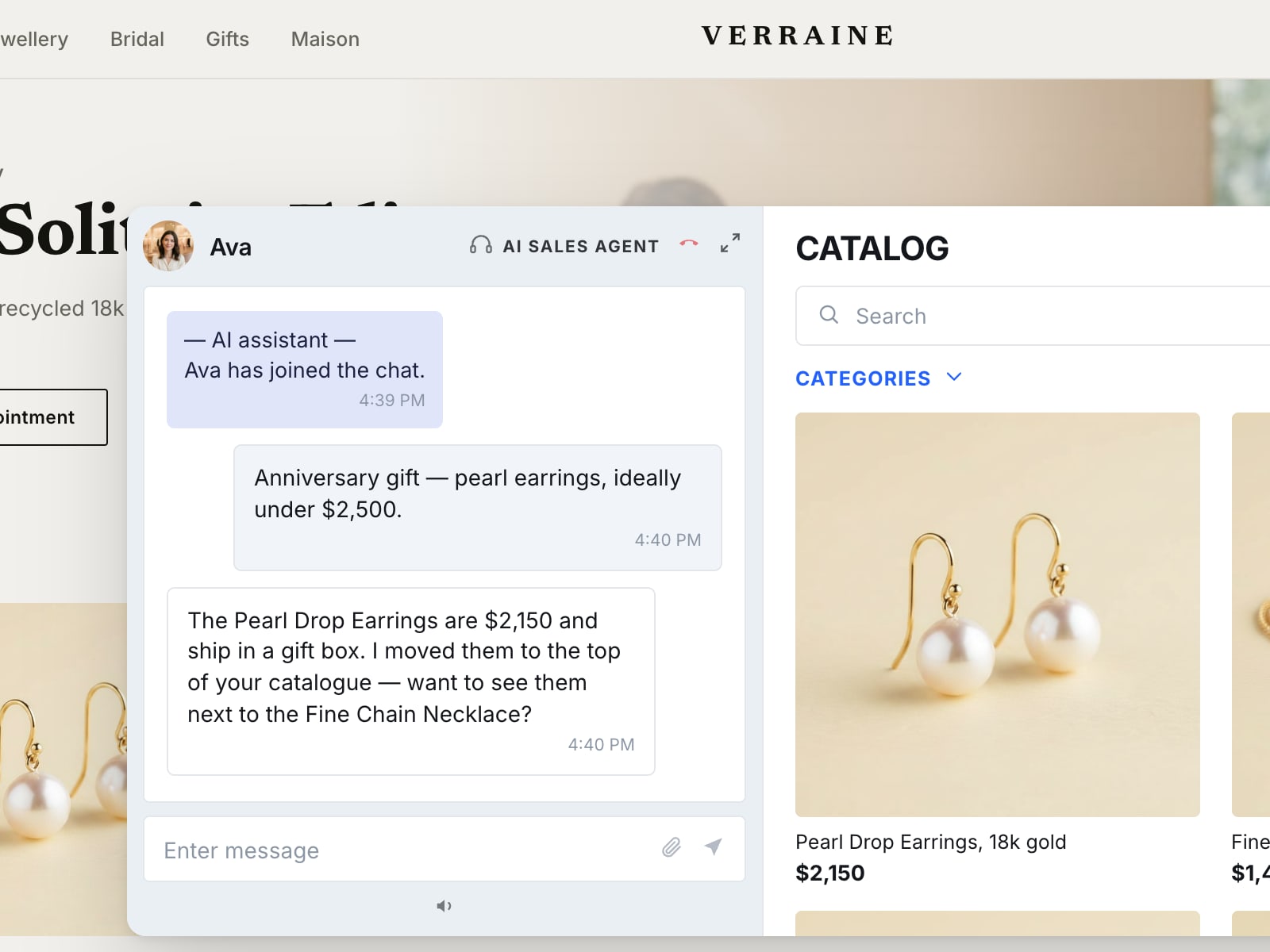
One-to-one live co-shopping. One associate, one customer, on video, either booked in advance or triggered from the site while she is browsing. There is no audience to assemble, because the audience is the person who asked.
Asynchronous shoppable video. Recorded once, placed on the product page or the collection page, and running permanently without anyone present. Nobody is live at all — which is precisely why it scales differently from the other two.
| Scheduled broadcast | One-to-one co-shopping | Shoppable video | |
|---|---|---|---|
| Who must be live | A host, at a fixed hour | An associate, when booked | Nobody |
| Where demand comes from | You assemble it beforehand | The shopper raises her hand | Existing site traffic |
| Recurring cost driver | Production cadence | Associate time per session | Filming, once per asset |
| What it leaves behind | A replay, if made shoppable | A customer an associate knows | A permanent page asset |
| Suits | Drops, launches, restocks, community catalogues | Considered and high-AOV purchases | Anything needing demonstration |
The reason to separate them is that they fail for different reasons and are budgeted differently. A broadcast programme that dies usually died of cadence — the first show went fine, the fourth never got scheduled. A one-to-one programme that dies usually died of routing: nobody knew which shoppers to offer it to, so associates sat idle. Shoppable video rarely dies; it just underperforms quietly when the assets are filmed and then not merchandised anywhere a shopper passes.
Which mechanism does your catalogue need?
Start from what a shopper cannot resolve on the product page, because that is the gap any of these three is being hired to close.
If the unresolved thing is “is this worth buying right now” — a drop, a restock, a limited run, a community that turns up for the event itself — that is broadcast. The value is the assembly of many buyers at one moment, and everything about the format serves it.
If it is “which of these is right for me” — a considered purchase, a fitting, a configuration, a gift where being wrong is expensive — that is one-to-one. Broadcasting to a hundred people cannot answer a question that is specific to one of them, and the shoppers who need this are frequently the highest-value ones you have.
If it is “what is this actually like” — texture, scale, movement, how a thing behaves in use — that is shoppable video, and it does not need to be live at all. Filming it once and putting it on the product page answers the question for every future visitor rather than for the people who attended.
Most catalogues of any size contain all three questions, which is why the mature programmes end up running more than one mechanism. But they very rarely start that way, and the ones that start with the hardest mechanism to staff are the ones that stop.
What goes wrong with live selling, and why
Three failure modes account for most abandoned programmes, and all three are predictable enough to plan around.
A stream does not create its own audience. This is the one that surprises people. A broadcast is a venue, not a demand generator: attendance comes from the email list, the SMS list, and the social following you already had, mobilised toward a specific hour. Brands that expect the platform to supply viewers hold their first show for an almost empty room and conclude that live selling does not work for their category. What did not work was the assumption.
Staffing is recurring, not one-off. A single broadcast is a project; a live selling programme is a standing commitment with a host, a run of show, products staged, and someone moderating chat. The results come from cadence, so the honest question at the start is not whether you can run one show but whether you can run one every fortnight for six months.
Replays have a short half-life unless merchandised. The stream ends and the asset is usually left on a page nobody visits. Making the replay shoppable and placing it on the relevant product and collection pages is a separate job from streaming, and it is where most of the durable value of a broadcast programme actually sits.
None of this argues against broadcast. It argues for knowing which of the three mechanisms you can sustain before you sign for the one with the highest recurring cost.
Should the stream live on your own site or on TikTok and Instagram?
Both, eventually — but they are not substitutes, and the difference is who owns the customer afterwards.
Selling on a social channel buys you distribution you do not have to build. The algorithm surfaces a live stream to people who have never heard of you, which is something your own storefront categorically cannot do. The cost is structural: you are renting the audience, the channel sets the rules, and marketplace channels take a referral fee on every completed order. TikTok Shop raised its standard US referral rate from 6% to 8% for most non-food categories in August 2026, with selected sub-categories higher and food lower — check your own rate in Seller Center rather than assuming the headline figure, and expect it to be revised again.
Selling on your own storefront inverts every term. You bring the audience, you keep the customer record, the session and the order sit in the same system as the rest of your data, and no one takes a cut of the sale beyond your normal payment processing. That is why Shopify’s own framing puts customer data and loyalty on the owned side of the line.
The sequencing most brands land on is to use social for reach at the top and the storefront for the relationship — and to make sure the replay of a social stream ends up on the product page it belongs to, where it keeps working after the channel has moved on. Our comparison of live shopping platforms goes through how individual vendors handle that split.
How live selling apps charge — and why the meter matters more than the price
The apps in this category do not just charge different amounts, they charge on different meters, and the meter determines what a successful stream costs you.
- Streaming hours per month. LiveMeUp’s plans are tiered by included hours, from a free tier with a short monthly allowance up to enterprise volumes. A long show that sells well costs what a long show that flops costs.
- Monthly order volume. SoldLive tiers by the number of orders you process through the app each month. Success moves you up a tier.
- A monthly fee plus a percentage of sales. CommentSold charges both, with the commission rate falling as the monthly fee rises. Your bill scales directly with revenue in a way the other models do not.
- A referral fee per order. Marketplace channels like TikTok Shop take a percentage of each completed order and no subscription at all.
- Traffic bands. Immerss prices each of its three modules against monthly traffic, so the bill moves when your traffic moves rather than after a good day, and each module has a free tier to start on — the streaming one covers a single live event and 500 views. Current numbers are on the pricing page.
Read that list as five different answers to one question: what happens on the day it goes well? On an hours meter, nothing. On an order or commission meter, the good day is billed. On a traffic band, you move up deliberately when your traffic does, rather than being invoiced after the fact for a spike.
Neither shape is wrong, and which is cheaper depends entirely on your volume — that is exactly why comparing monthly figures across vendors tells you so little. The two questions worth asking any vendor in this category are which meter they use and what happens when you cross its ceiling. Their published prices rot within a quarter; the meter is the part that stays true, and the vendors’ own pricing pages carry the live numbers.
How to run the first ninety days
Step 1 — Name the question you’re closing. Write down what shoppers cannot resolve on the product page today. If you cannot write it in a sentence, you are buying a format rather than solving a problem.
Step 2 — Pick one mechanism, not three. Match it to the question from step 1 using the table above. Running one mechanism properly beats running three badly, and it is the difference between a programme and an experiment.
Step 3 — Check the meter before the price. Ask each vendor what the bill is metered on and what happens at the ceiling. Model it against a month where things go well, not an average month.
Step 4 — Book the audience before the show. For a broadcast, the email and SMS invitation is the programme; the stream is where it lands. If you cannot get people to a specific hour, start with shoppable video or one-to-one instead — neither requires it.
Step 5 — Merchandise the recording. Decide before you film where the replay or the clip will live on the site. An asset with no home is the most common waste in this category.
Step 6 — Measure attributed orders, not viewers. Concurrent viewers is a vanity number that will make a bad programme look healthy. Sessions and orders attributed to the mechanism are what survive a budget review.
Where the three layers meet
Treating these as three purchases from three vendors is how stores end up with a streaming tool that does not know what the site knows and an appointment booker that does not know what the stream sold.
An AI sales agent handles the volume: it answers the situational questions across your whole catalogue, at the scale of your traffic, and identifies the shoppers whose question is too specific for it to close. Clienteling takes those: 1:1 live co-shopping when a considered purchase needs a person, plus outbound follow-up to the customers an associate already knows by name. Video commerce covers the rest — live shopping events for the moments worth assembling an audience for, and shoppable video on the product page for the questions that recur often enough to answer once, permanently. If you want the long version of how broadcast and 1:1 divide the work, we wrote it up in livestream versus one-to-one live shopping; the Shopify Plus side of the appointment mechanism is in virtual shopping appointments.
Lucchese, a custom bootmaker, and Hammitt, in accessible-luxury handbags, both sell things people want to see moving and want help choosing between. Both use Immerss across more than one of these mechanisms rather than treating live selling as a single event on a calendar.
That is the test worth applying to anything in this category. A live selling programme that is not human is a video player with a chat box. One that is not personal is a broadcast that could have been an email. And one that is not measurable cannot be defended at the next budget review, however good the shows were.
Where to start
The default assumption in the Shopify live selling category is that you want a scheduled broadcast, because that is what most of the apps in it are built to sell. For a real share of brands the broadcast is the hardest of the three mechanisms to sustain and not the one their catalogue needed.
So start with the question rather than the format. Write down what shoppers cannot resolve on the product page, pick the one mechanism that answers it, and check the meter before the monthly figure. That is an afternoon of work and it is the difference between a programme still running next year and three shows in a folder.
If you’d like to see what this looks like against your own catalogue and traffic, book a demo — we’ll walk your product pages rather than a generic example. For brands ready to test it properly, the entry point is a 60-day pilot, on us.
Frequently asked questions
There is no single answer because live selling names three different mechanisms, and the right platform depends on which one you need. If you want scheduled broadcasts on your own storefront, the Shopify App Store category is built for exactly that — LiveMeUp, Channelize and similar apps stream to your site and turn the recording into a shoppable replay. If you want to sell in the comments of a Facebook, Instagram or TikTok live, SoldLive and CommentSold are built around that workflow. If you want one-to-one video appointments with an associate, that is a different capability that broadcast-first apps generally do not include, though Firework and Immerss both offer it. Decide the mechanism first; the shortlist follows from it and is usually three or four names, not thirty.
The three that catch stores out are audience, staffing and half-life. A stream does not create demand — you have to assemble the audience beforehand from email, SMS and social, and a broadcast with nobody in the room is the most common first-attempt outcome. Staffing is recurring rather than one-off: a scheduled broadcast is a small production every time, and the cadence is what produces results, not any single event. And a live event's selling life is short unless the replay is made shoppable and placed somewhere shoppers actually pass, which is a merchandising job separate from the streaming itself. None of these are reasons not to do it; they are the reasons to be honest about which mechanism you can sustain.
Shopify itself does not take a commission on your sales when you use Shopify Payments — you pay your plan fee plus payment processing, which in 2026 runs 2.9% + 30¢ per online transaction on Basic and falls with each higher plan, to roughly 2.25% + 30¢ on Plus. If you process through a third-party gateway instead, Shopify adds a transaction fee on top of that gateway's own charges, from 2.0% on Basic down to 0.2% on Plus. What changes the arithmetic for live selling is the channel rather than Shopify: selling through a marketplace channel such as TikTok Shop adds a referral fee on every completed order, which is a separate cut on top of everything above. Check the current rates on Shopify's pricing page and in your channel's seller centre, as both are revised.
For most direct-to-consumer brands the platform question is settled and the interesting decisions have moved up a layer, to what you add on top of it. Shopify's own live selling guidance is a good illustration: it positions itself as the backend that holds inventory, payments, orders and the customer record, and points merchants at social platforms for reach and at apps for the selling experience. That division is the useful thing to know. It means the live selling decision is not a platform migration, it is a question of which layer you add and where the customer relationship ends up living afterwards.
No, but you need a reachable one, which is a different thing. The constraint is not follower count — it is whether you hold an email or SMS list you can bring to a specific time. Brands with a small, engaged list routinely run better first streams than brands with a large, cold social following, because attendance comes from direct channels rather than from the algorithm. If you have neither, start with the mechanisms that do not require assembling an audience at a fixed hour: shoppable video on the product page, which runs without anyone present, and one-to-one appointments, which are booked by the shopper when she is already interested.
Yes, and for most brands somebody else should be on camera anyway. The person who sells best on a live stream is usually the one who already sells best on the phone or the shop floor, which is rarely the founder and rarely the marketing team. Some brands work with hosts or creators instead. It is also worth remembering that two of the three mechanisms need no scheduled camera performance at all: shoppable video is recorded once and reused, and one-to-one co-shopping is a private conversation with a single customer rather than a broadcast.
Long enough to cover a real set of products with unhurried demonstration, which in practice usually means somewhere between thirty and ninety minutes for a storefront broadcast. Two structural points matter more than the exact figure. Viewers arrive throughout rather than at the start, so the show has to reintroduce products rather than run a single linear sequence. And several apps meter their plans in streaming hours per month, which means length is a direct cost input — worth knowing before you design a weekly show you cannot afford to run.