
The House FAQ Is About the House
Most luxury houses publish a frequently-asked-questions page, and it tends to cover the same ground.
How is authenticity guaranteed? Where are the boutiques? Is delivery insured? What aftercare and servicing does the house offer? How are returns handled for made-to-order pieces?
All of it is accurate, considered and worth having. And all of it is about the house.
The questions clients actually ask
Spend a day beside a good advisor and you hear a very different list.
How does this compare to the 36mm on my wrist? Is this the same yellow gold as the ring I bought in 2019? Does the clasp work one-handed? Will this leather darken, and how quickly? Is this the piece from the September campaign, or a variation?
Not one of those is about the house. Every one is about a particular piece and a particular client: her wrist, her other jewellery, her habits, her memory of a campaign image.
On the floor, these questions are answered without anyone noticing that an answer is being given. The advisor simply knows, or checks, or shows. They are the substance of a consultation.
Online, they have nowhere to go.
Why the FAQ can’t hold them
A house FAQ is written once, centrally, about matters that apply to every client: authenticity, delivery, servicing. That makes sense for those matters.
A client’s question about a piece doesn’t apply to every client. Will this gold match my ring is only meaningful for her ring. No central page could anticipate it, and no house would want to fill its product pages with every possible comparison.
So the questions that matter most to a purchase fall between two places: too specific for the FAQ, too personal for the product description.
What the questions are worth to the house
There is a second reason to care about these questions, beyond answering them.
Taken together, they are a precise record of what clients could not tell from the house’s own presentation of a piece. A recurring question about how a case sits on a smaller wrist says the imagery doesn’t convey scale. A recurring question about whether a colour matches an earlier collection says the naming isn’t doing its job. A recurring question about a campaign piece says clients are arriving from the campaign and can’t find what they saw, which is one more way a campaign image cannot be the proof.
That is unusually direct feedback. It is not a survey and not an inference, but the exact words clients used when the page left them uncertain. Most houses capture very little of it, because online the questions are either never asked or never recorded.
What good looks like
Give clients somewhere to ask about the piece itself. Not a general enquiry form routed to customer service, but a way to ask from the page she is on and reach someone who knows the piece: immediately, by text, or on live video when it needs to be seen.
Let the advisor show rather than describe. Many of these questions, such as scale on a wrist, one gold compared to another, or how a clasp works, are answered far better by a short live showing than by any written reply. She can be shown without appearing herself: a client shouldn’t have to be seen to be shown.
Collect the recurring questions, discreetly. Where the same question arises about the same piece, it is a sign the page could answer it, or that the imagery should show it. The questions inform the page and the advisor team. They are never published with a client’s name, her circumstances or anything that identifies her.
Keep the house FAQ for what it does well: authenticity, delivery, servicing, policy. It remains essential. It simply isn’t where purchases are decided.
What to measure
Questions per piece: which pieces generate the most uncertainty, and what kind.
Consultation requests arising from a product page, and what came of each.
Recurring questions that change after the page is updated, a sign the presentation now answers what it didn’t before.
Where Immerss fits
Immerss is a live commerce platform, and this is the part of it that gives a client’s question about a piece somewhere to go.
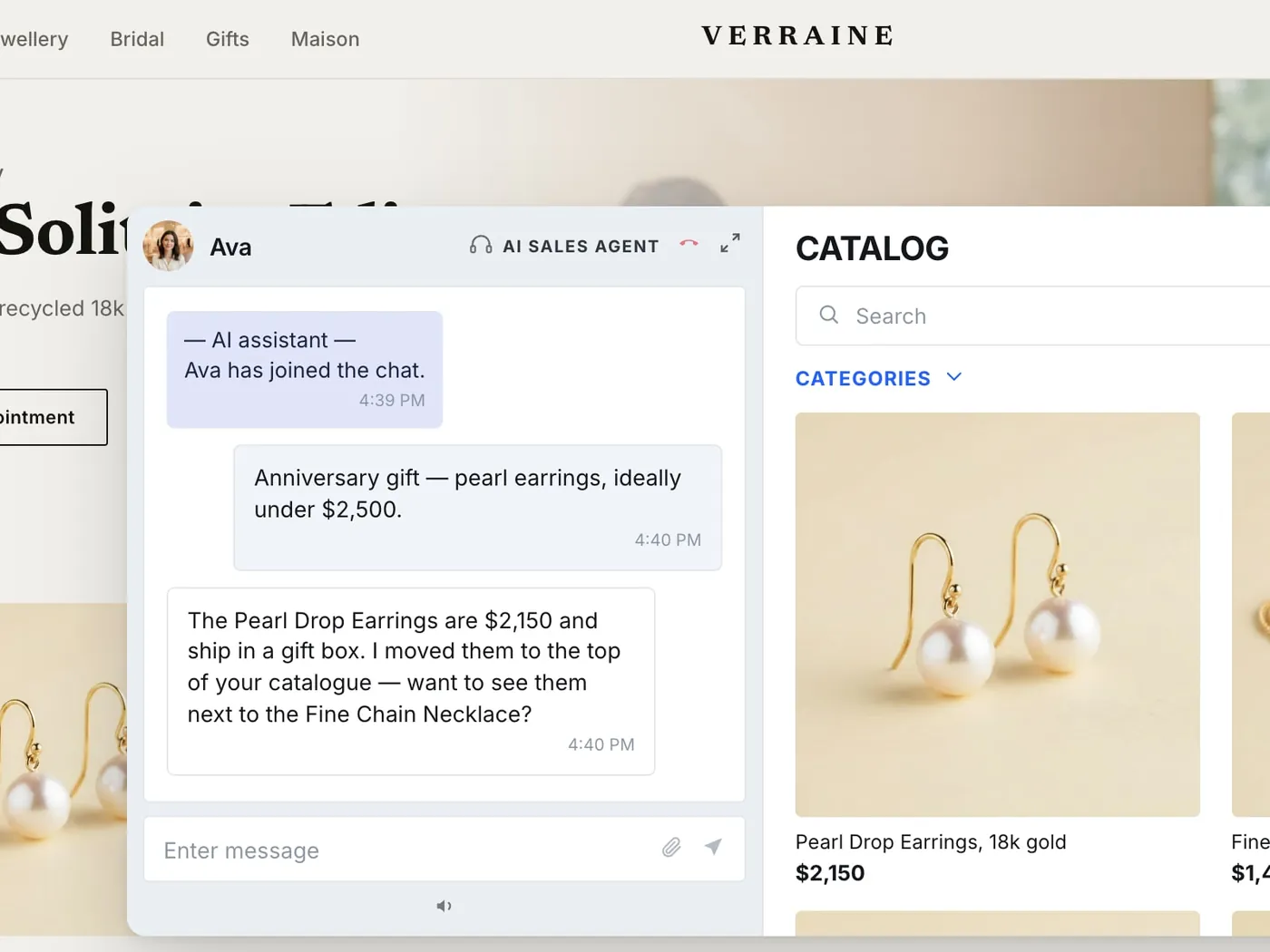
- AI Sales Agent: answers out of the house’s catalogue at any hour, from the house’s own site. Where a question falls outside that, the conversation goes to a person and not to a guess.
- Clienteling: Live Co-Shopping puts a named advisor on one-to-one video, with no download and no appointment. She picks up the same conversation, the AI’s replies included, with what the client viewed beside it, so the question does not have to be asked twice. The advisor can show the piece and place it in the client’s bag during the call.
Because the question is asked in a conversation and not lost when a page is closed, it exists in the client’s own words. Reading those conversations piece by piece, and deciding what the page or the imagery should now answer, remains the house’s work; software does not do the editing.
The approach stays human, because the answer to a question about her wrist or her ring comes from an advisor who can show it; personal, because it starts from what she asked and not from what the house chose to publish; and measurable, because the house can count which pieces draw questions, what kind, and what came of each consultation.
For a house, the entry point is a conversation and a 60-day pilot, on us.
The house FAQ tells a client about the house.
The questions she actually asks are about the piece, and on the floor they were always the heart of the consultation.
Frequently asked questions
Authenticity, boutique locations, insured delivery, aftercare and servicing, and returns on made-to-order pieces. All of it is accurate and worth having, and all of it is about the house: matters that apply to every client equally.
Because those questions do not apply to every client. Whether a gold matches a ring she already owns is only meaningful for her ring. No central page could anticipate it, and no house would fill its product pages with every possible comparison. The questions fall between two places: too specific for the FAQ, too personal for the product description.
Taken together they are a precise record of what clients could not tell from the house's own presentation of a piece. A recurring question about how a case sits on a smaller wrist says the imagery does not convey scale; a recurring question about a campaign piece says clients arrive from the campaign and cannot find what they saw.
Not as they were asked. Recurring questions inform the product page, the imagery and the advisor team. A question is never published with a client's name, circumstances or anything that could identify her.